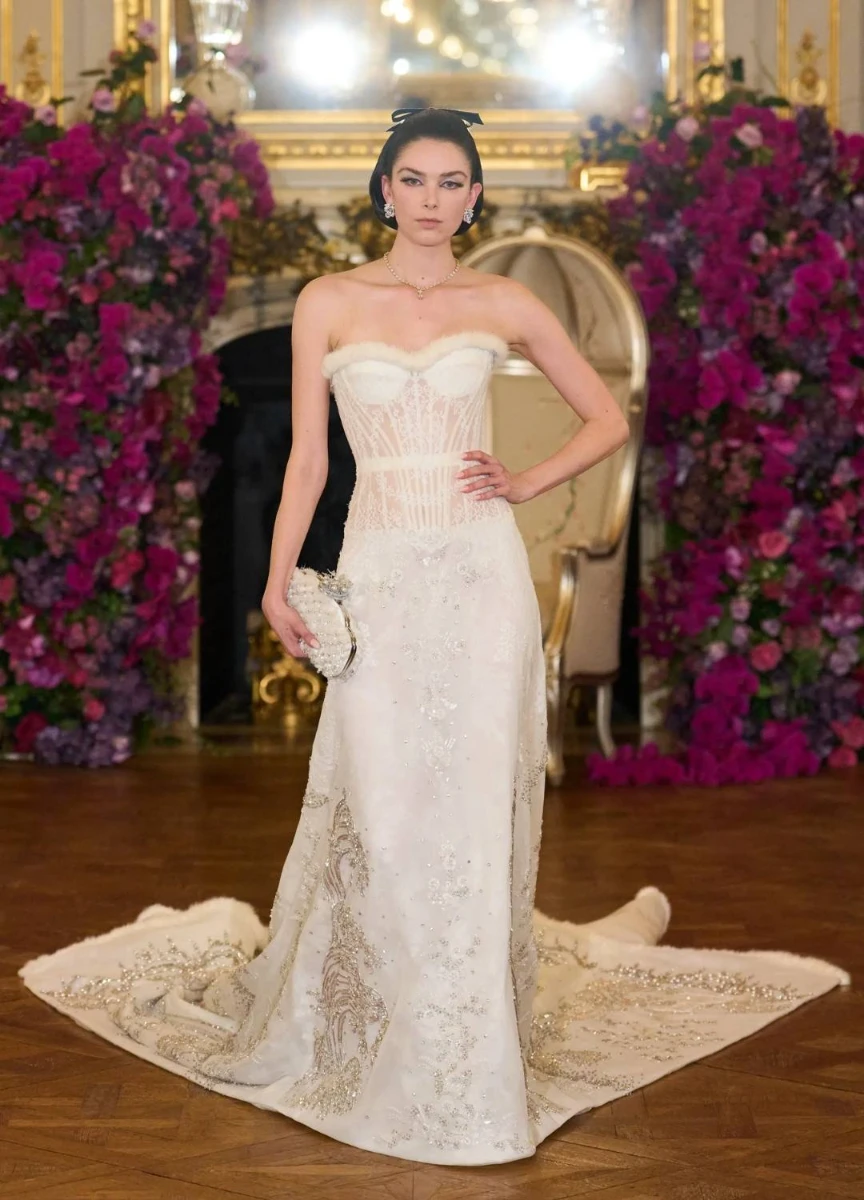
Windows, gardens, and the body — how Miss Sohee redefines the emotional architecture of couture
Couture has been getting louder. Shows scale up, silhouettes expand, narratives push toward the explicit. Against that backdrop, Miss Sohee’s Spring 2026 Couture arrives at a different pace, and with a different density.
The collection does not propose a radically new silhouette. Instead, it asks a quieter, harder question: can couture still hold emotion without depending on spectacle? The answer here is structural rather than declarative.
The Designer’s Logic — Framing Rather Than Display
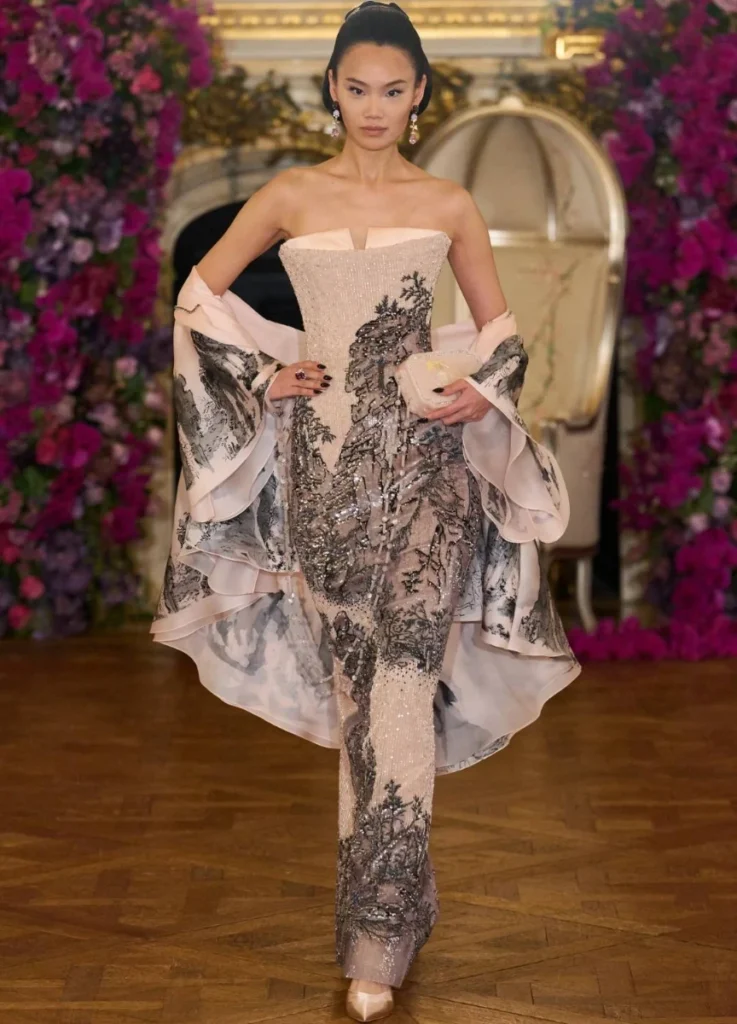
Sohee Park is often described as a bridge between Eastern sensibility and Western couture tradition. The framing isn’t wrong, but it flattens the work. Her real focus is closer to the architecture of looking — what is shown, what is held back, where on the body emotion begins.
Spring 2026 Couture is built around a single structural idea: the window.
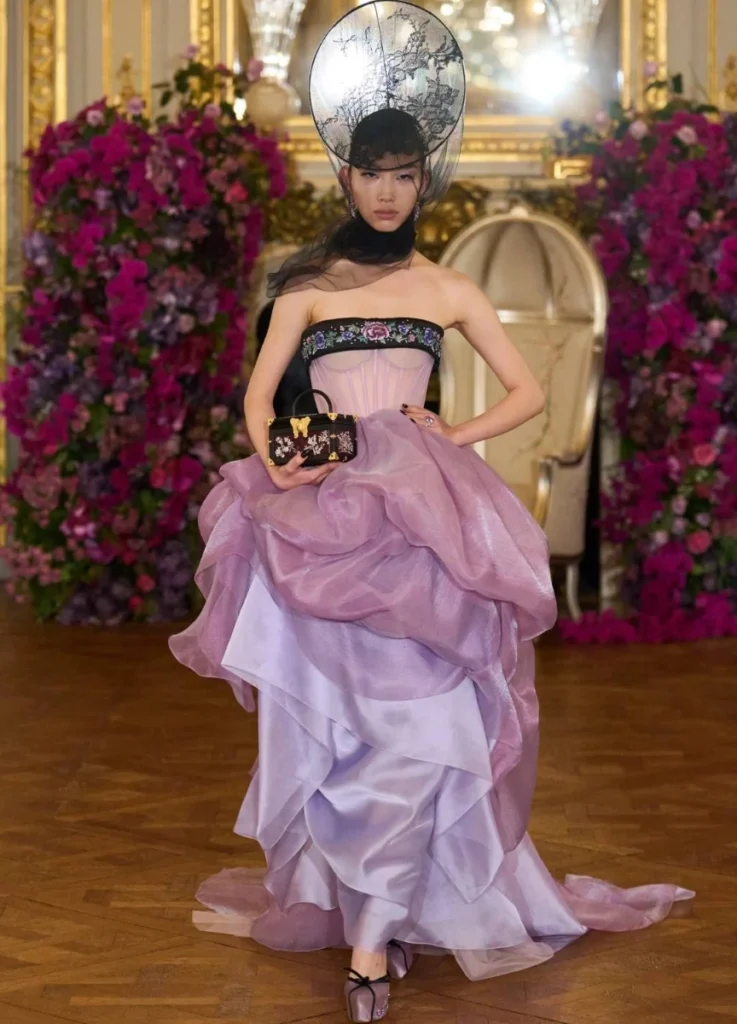
The starting point, as Park noted to Vogue, wasn’t a salon or a historic palace. It was a window in a summer house overlooking the southern coast of Korea — wisteria in bloom outside, bamboo moving in the wind, the slow shifting of seasons. Her mother had been photographing those views over time, and that quiet act of recording became the emotional ground for the collection.
The collection doesn’t try to reproduce the landscape. It translates the act of looking at landscape into garment structure.
Silhouettes as Frames for Landscape
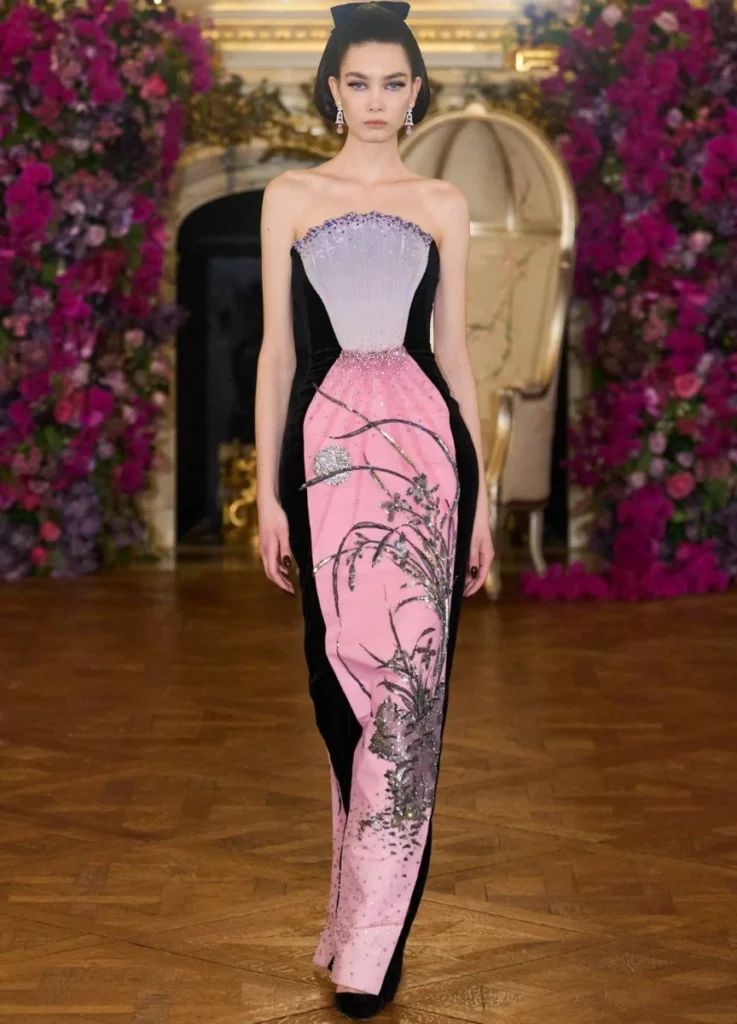
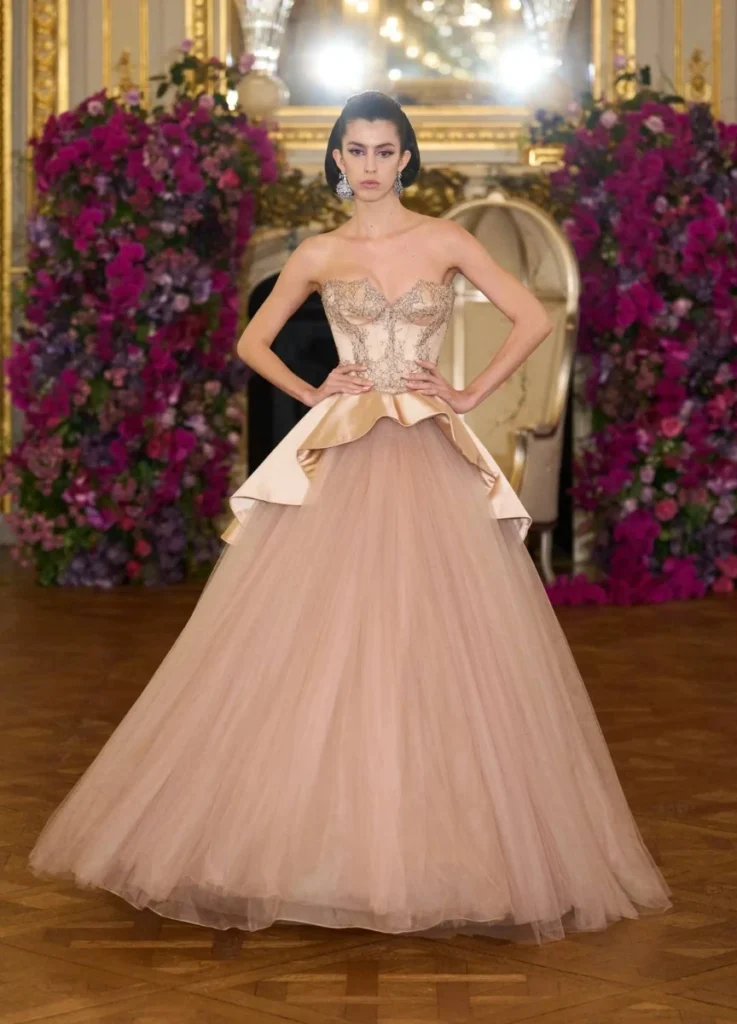
Park’s signature corsetry is still here, but its function has shifted.
The corset no longer sculpts to control the body. It frames. Mountain ridgelines, the curve of orchids, a gradation of dusk sky — these references appear less as motifs than as spatial coordinates arranged across the body. The embroidery isn’t decoration. It directs the gaze, the way a window’s mullion divides what you see.
The dresses behave less like worn objects and more like constructed viewpoints. The body becomes the architecture; the landscape moves through it.
Restraint at the Edge of Excess
Spring 2026 contains elements that could collapse into kitsch if handled differently.
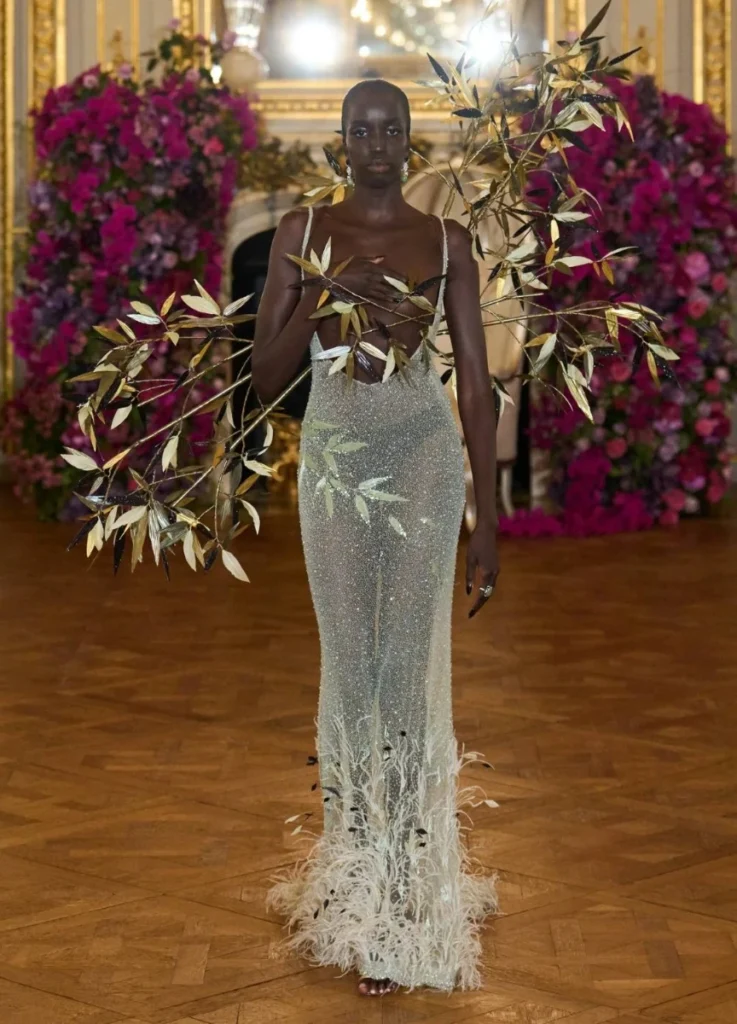
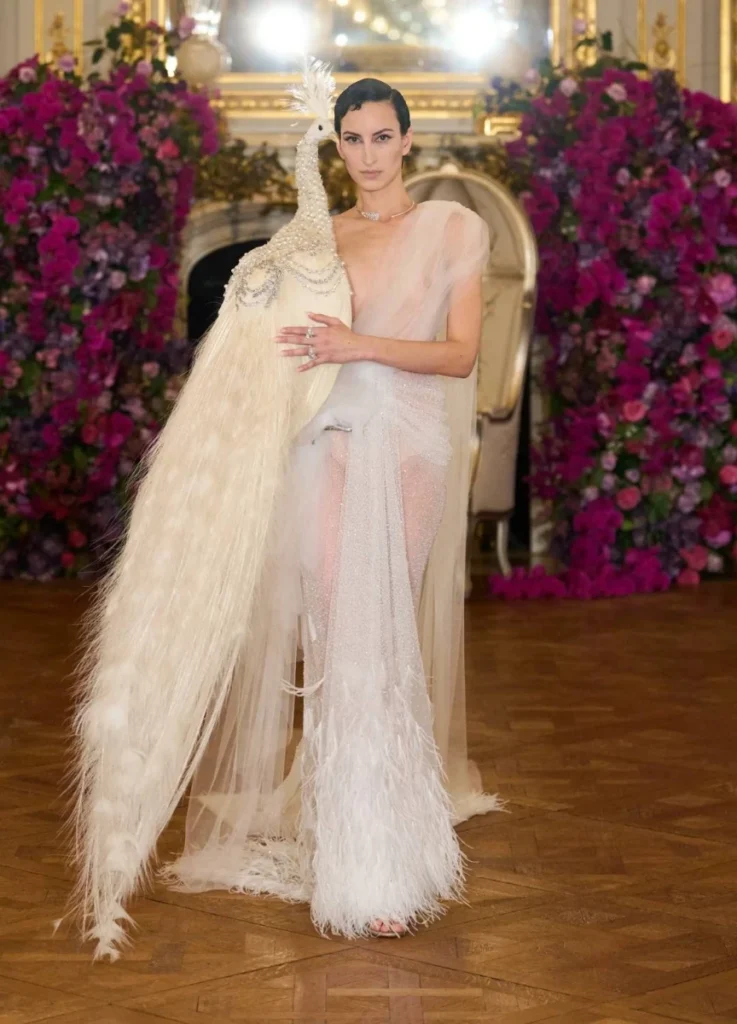
Brass structures evoking bamboo. Cherry blossoms erupting in three dimensions across a bodice. A model carrying a taxidermied albino peacock. On paper, the inventory reads maximalist.
It doesn’t read that way in motion. The discipline holds because every embellishment is following the silhouette’s internal logic. Nothing operates on its own — the ornament aligns with the body’s center line, with the waist axis, with the rhythm of the walk. Movement governs placement. Spectacle does not.
This separates Park’s couture from the season’s louder propositions. She isn’t building a story for the dress to tell. She’s building a structure that produces emotion through design alone.
The Bridal Segment — Designing for Feeling, Not Ceremony
The bridal section drew the most attention from the room, and the reason is worth naming.
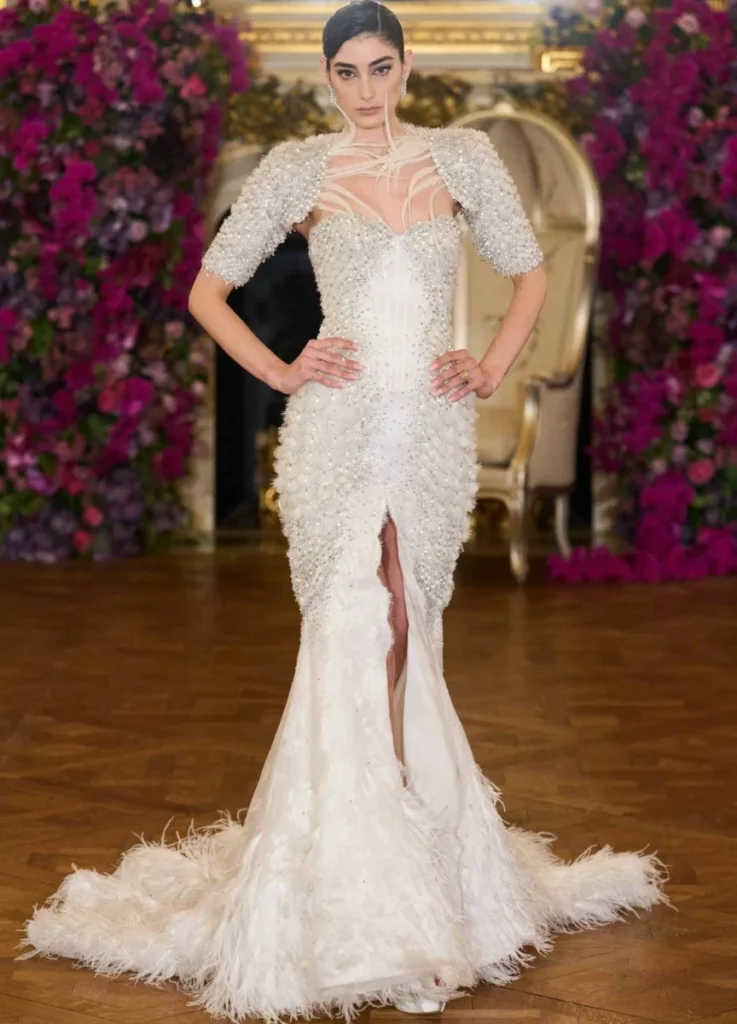
Most couture shows this season closed on the same note: a bride as a sacred figure, the dress as a relic. Park went the other direction. Her bridal looks aren’t relics. They are garments designed to be felt by the woman wearing them.
A hooded veil drawn from traditional Korean head coverings. Embroidery patterned like ocean waves. Sheer silk densely set with Swarovski crystal. The references aren’t presented as nostalgia. They aren’t there to honor the past. They’re there because they belong to a specific emotional register the bride is supposed to inhabit.
Park, in the same Vogue conversation, said today’s brides aren’t interested in wearing their mother’s dress. The line registers as more than generational. It signals a structural shift in how marriage is being emotionally framed at the high end. Park doesn’t reenact tradition; she translates it into present-tense feeling.
“Designed for Women” as a Structural Practice, Not a Tagline
Many designers say they design for women. In Park’s case, the phrase carries something specific.
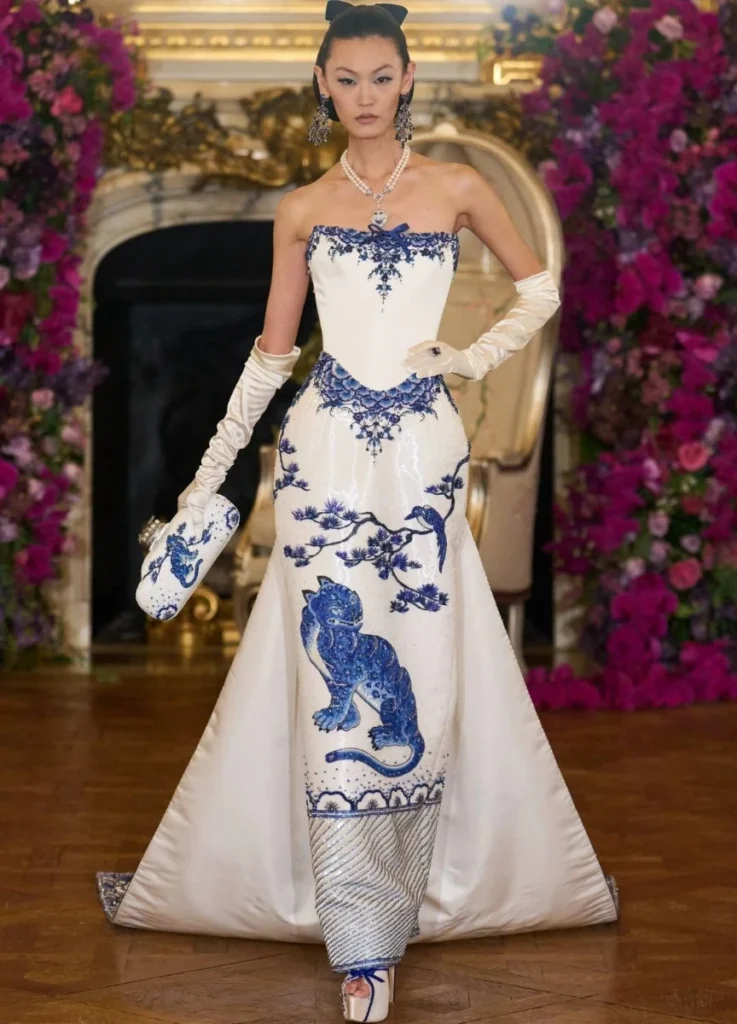
Her work shows precise understanding of where emphasis produces ease, where concealment produces confidence, and how a structurally rigorous garment can still read as light. The dresses don’t idealize the female body. They respect how women actually inhabit their own bodies — the way fabric falls when you move, the way a waistline locks a posture without restricting it.
The result is a fragile equilibrium between dream and wearability, sculpture and feeling. It holds.
Why Miss Sohee Is Resonating With the Middle Eastern and Global High-End Market
Park’s traction with Middle Eastern and global high-end couture clientele isn’t surface-driven. It’s structural, and worth breaking down.
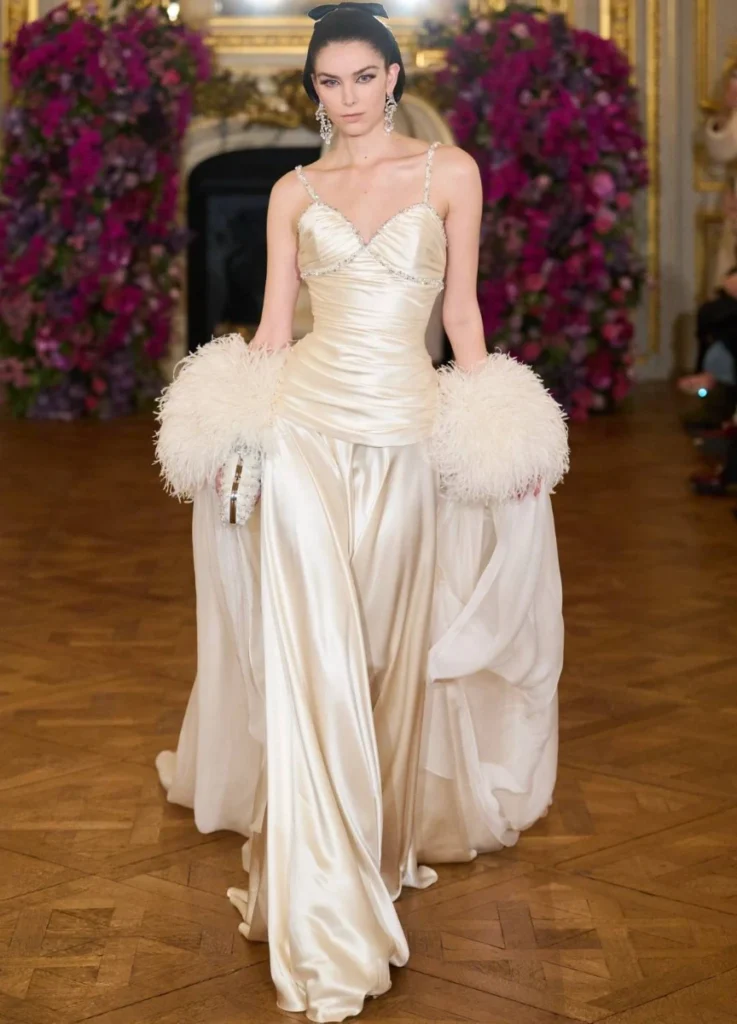
First, ornament and meaning are aligned. Middle Eastern high-end clients value embellishment but don’t respond to randomness. Park’s embroidery, crystal work, and metallic elements are built into silhouette construction rather than applied on top. For audiences fluent in high jewelry — where value depends on structural intelligence as much as on stones — that distinction registers immediately.
Second, her femininity is built on presence rather than exposure. The dresses command attention through tension at the shoulder, the waist, and the neckline rather than through skin. That controlled authority maps cleanly onto the aesthetic preferences of elite Middle Eastern women, where restraint and unmistakable scale tend to coexist.
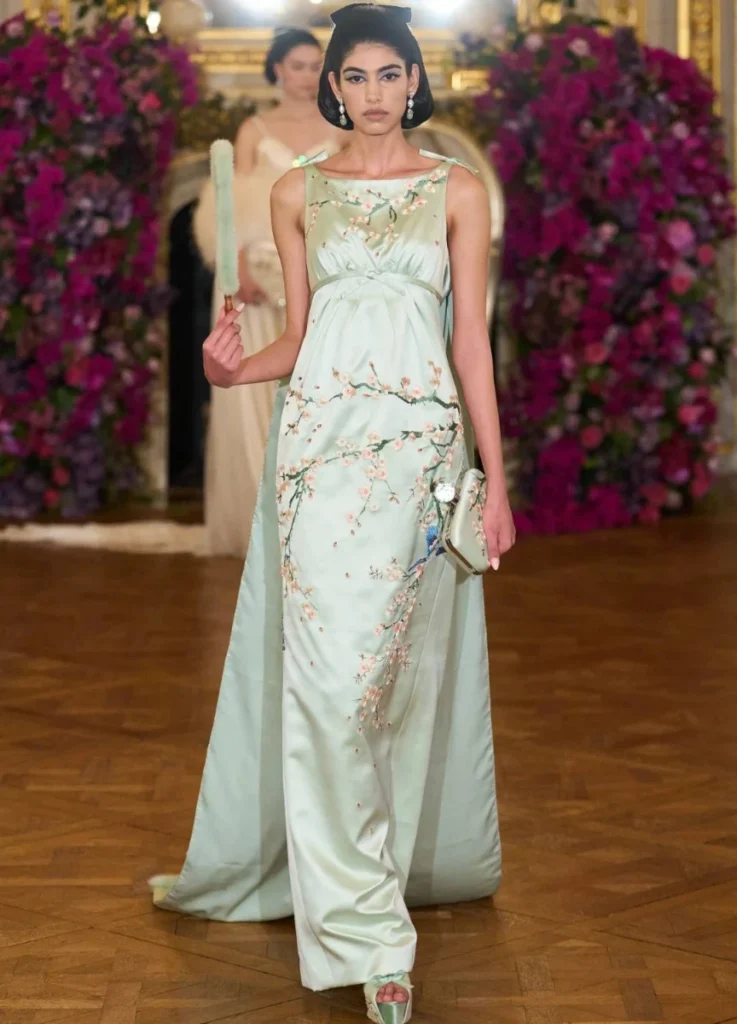
Third, she handles cultural reference obliquely. Park doesn’t put motifs on the surface. She works with universal concepts — time, ritual, landscape — translated through texture and form. That leaves interpretive space for clients across cultural contexts, which is what makes a couture house resonate globally rather than regionally.
Fourth, bridal and eveningwear are clearly differentiated. Park doesn’t treat bridal as an extension of evening. The wedding dress has its own emotional architecture, designed separately. For made-to-order clients — where bridal commissions are a distinct category from gala dressing — that separation matters.
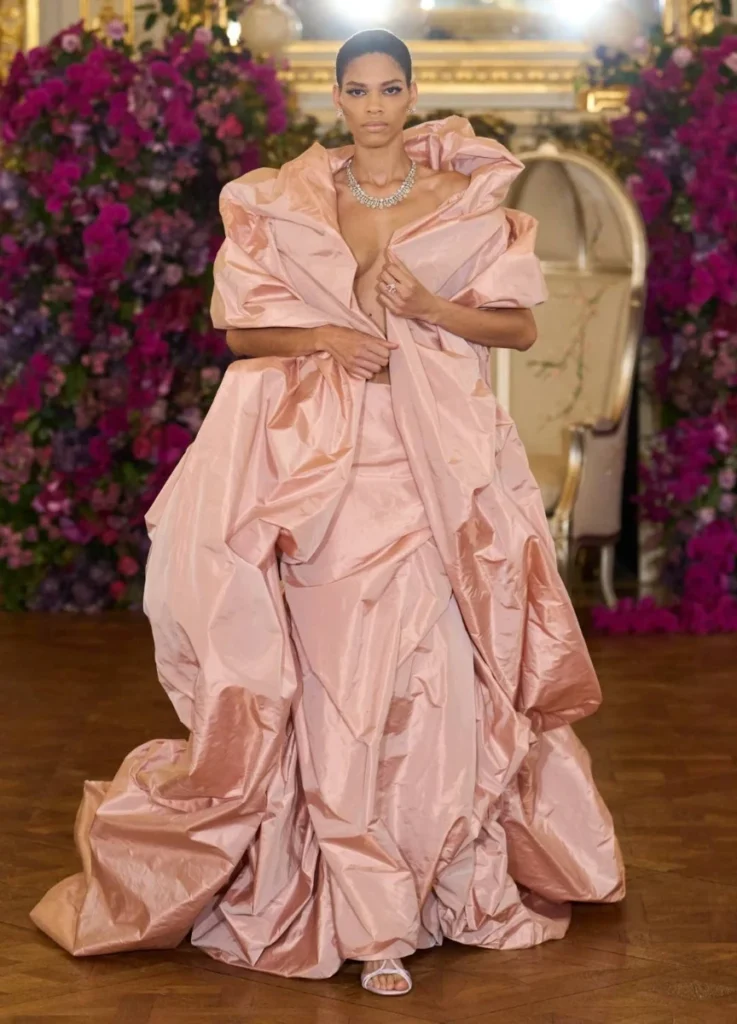
Finally, the work is built for longevity, not for the season. These are dresses made to retain meaning over years, not to peak on the day they’re delivered. That aligns with the way her client base treats couture: as legacy, archive, and inheritance rather than as trend.
Park doesn’t sell spectacle. She designs understood structure and respected emotion. That distinction, more than glamour, is why her name is being repeated in rooms where couture is taken seriously.
What Spring 2026 Couture Leaves Behind
The collection condenses to a single idea: couture can still function as a frame through which we see the world.
There is no escapism here. No exaggerated fantasy. There is a window, placed carefully between body and landscape, and what appears through it is quiet rather than loud — the kind of view that holds attention without demanding it.
Park, with this collection, returns couture to one of its older functions: a structure capable of holding emotion. The result moves more slowly than the season’s louder shows. It will stay in memory longer.
All images referenced in this post are drawn from Vogue Runway.
[ Related Editorials ]