Reading Matthieu Blazy’s first Chanel couture
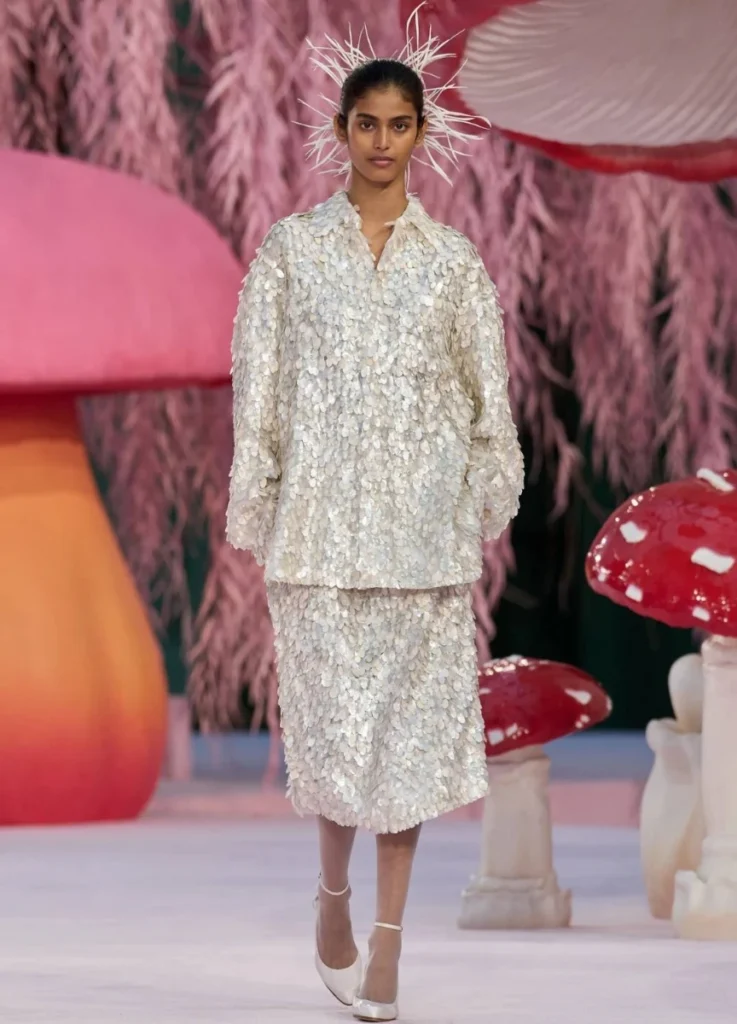
Chanel Haute Couture Spring 2026 unfolded within a landscape that appeared suspended outside of time. Oversized mushrooms emerged from the floor of the Grand Palais. Pink willow branches cascaded overhead. Proportions were deliberately scaled beyond reality. The setting suggested softness, fantasy, and emotional immersion.
The collection itself moved in another direction entirely.
This was Matthieu Blazy’s first haute couture collection — only the fourth creative director in Chanel’s 116-year history, and his first time working in the genre at all. The expectation was substantial. What Blazy delivered was a collection that resisted spectacle in favor of essence. As he put it backstage to AnOther’s Alexander Fury, the work was made directly on the body, with no sketches and no reference images. Zero. The reduction was the point.
This was a couture collection built to demonstrate continuity, precision, and preservation — not seduction or narrative escalation. Beautiful, and beautifully made. Emotionally restrained, almost by design.
The Set Was Not Floral — and That Distinction Matters
What’s most telling about this season lies in what the set deliberately avoided.
There were no flowers. Instead, Chanel chose mushrooms and pink willow — two natural forms that carry meanings far removed from the romantic symbolism traditionally associated with haute couture. The reference, Blazy revealed in preview interviews, came from an anonymous Japanese haiku about a bird perching briefly on a mushroom before flying away. He wondered whether that three-line poem could be expanded into enough material for an entire collection.
Mushroom — Nature Without Romance
Mushrooms don’t bloom. They don’t climax, seduce, or visually dominate. They exist quietly, structurally, and repeatedly.
In nature, mushrooms represent systems rather than spectacle — growth without narrative, continuity without emotional climax. They appear, disappear, and return to the same place, largely unchanged. Placing mushrooms at the center of the set didn’t reference nature as romance. It referenced nature as infrastructure.
This wasn’t an invitation into fantasy. It was a statement about stability.
Pink Willow — Movement Without Voice
Pink willow reinforced the idea with a different rhythm. Willow branches bend, sway, and follow air currents, yet never become the focal point. They frame space rather than define it. In folklore and visual language, willow trees often signal suspended time — places where stories pause rather than begin.
Mushroom and willow together created a world that felt preserved rather than alive. A landscape where time doesn’t progress, but holds.
Clothes That Refused Emotional Escalation
Against the dreamlike environment, the clothes made a clear and deliberate choice. They didn’t echo the fantasy of the set. They didn’t amplify emotion. They remained controlled, precise, and technically grounded.
This was couture driven by execution rather than narrative.
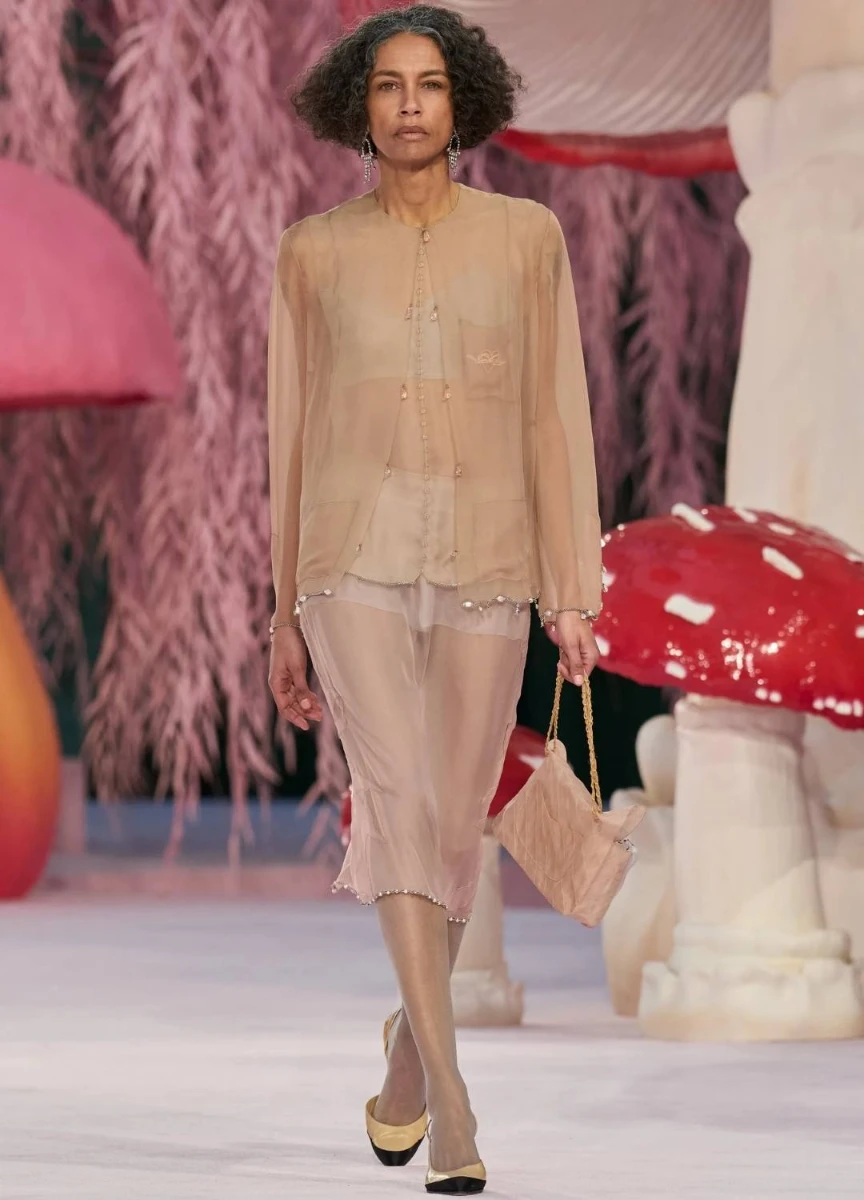
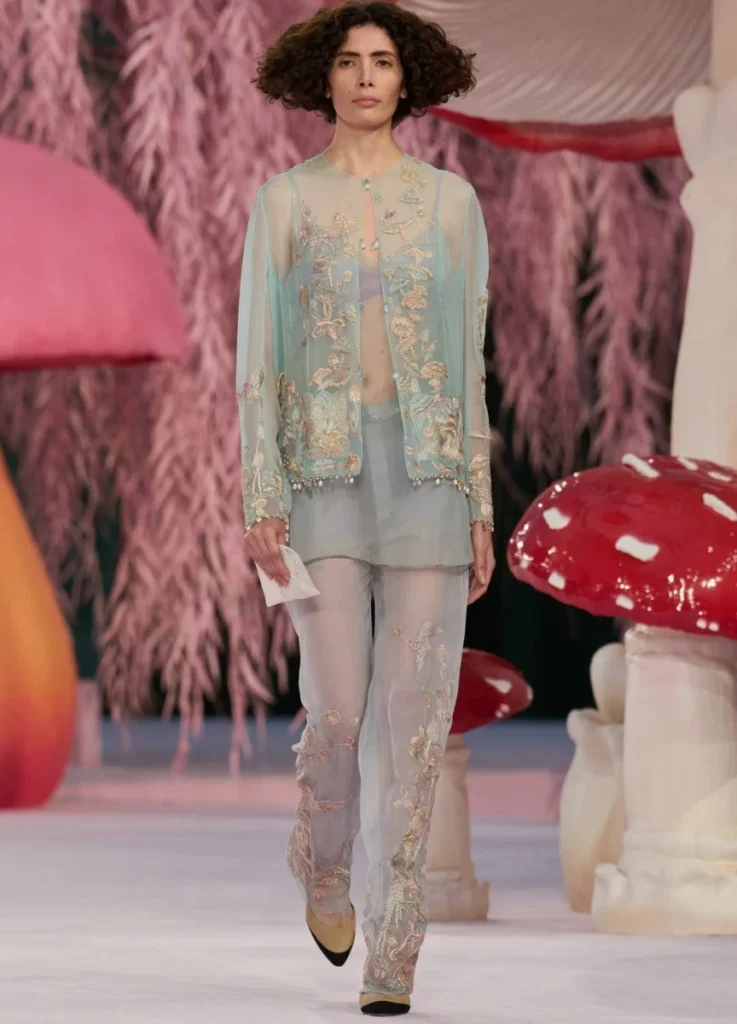
The opening look established the tone immediately. The classic Chanel suit appeared rendered in nude silk mousseline — translucent layers held together by fine chains and pearls sewn into the hems. Stephanie Cavalli, a fortysomething Italian model, opened the show with what AnOther described as something flowing like lingerie around the body, executed in French-seamed silk mousseline so fine that even through multiple layers the body remained visible.
Blazy’s archival research had surfaced a detail: Gabrielle Chanel was the first couturier to use mousseline as a stand-alone fabric rather than backing for embroidery. The opening was a quiet reference to a historical first that few outside the house’s archive would recognize.
Sheer Layering — Transparency as Engineering
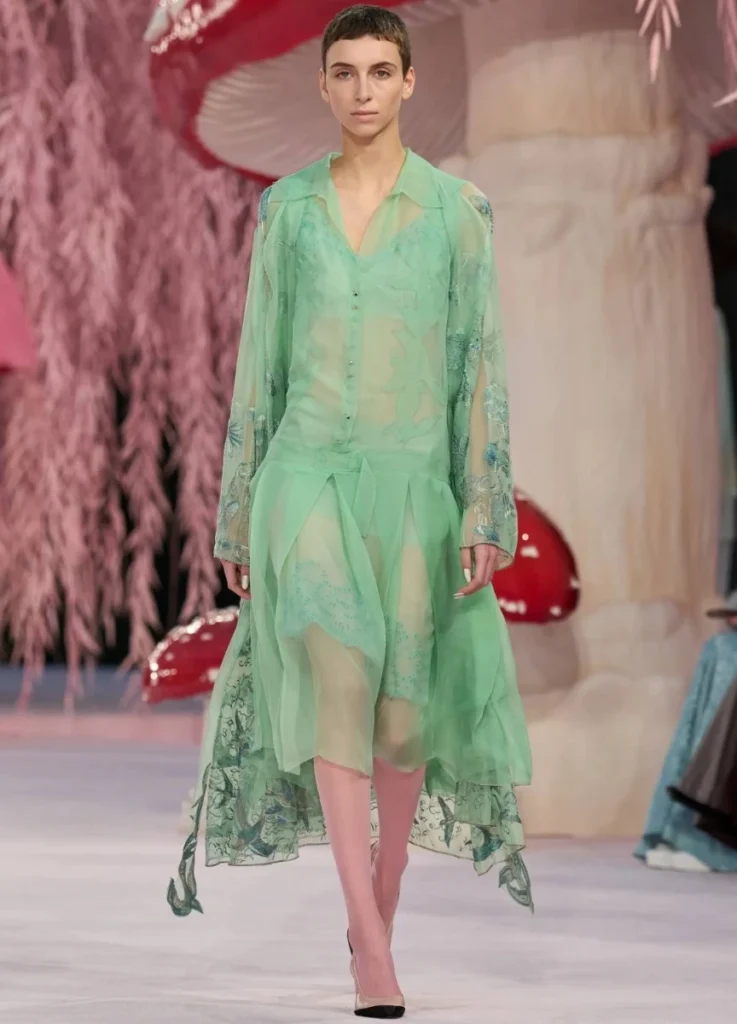
Tulle, organza, and ultra-light silk appeared repeatedly, layered with extraordinary restraint. Transparency in couture is notoriously difficult. Layers cloud easily, tension shifts, and structure collapses.
Here, the fabrics slid rather than floated. Clarity was maintained even through repetition.
The effect wasn’t poetic. It was technical. Vogue Scandinavia and others observed that the elaborate embroideries throughout the collection maintained an almost impossible lightness even at close range — labor that registered most clearly when held in the hand. Hours of invisible craft, in The Pull’s phrasing, made visible only through restraint.
Tweed Reconsidered — Surface Over Shape
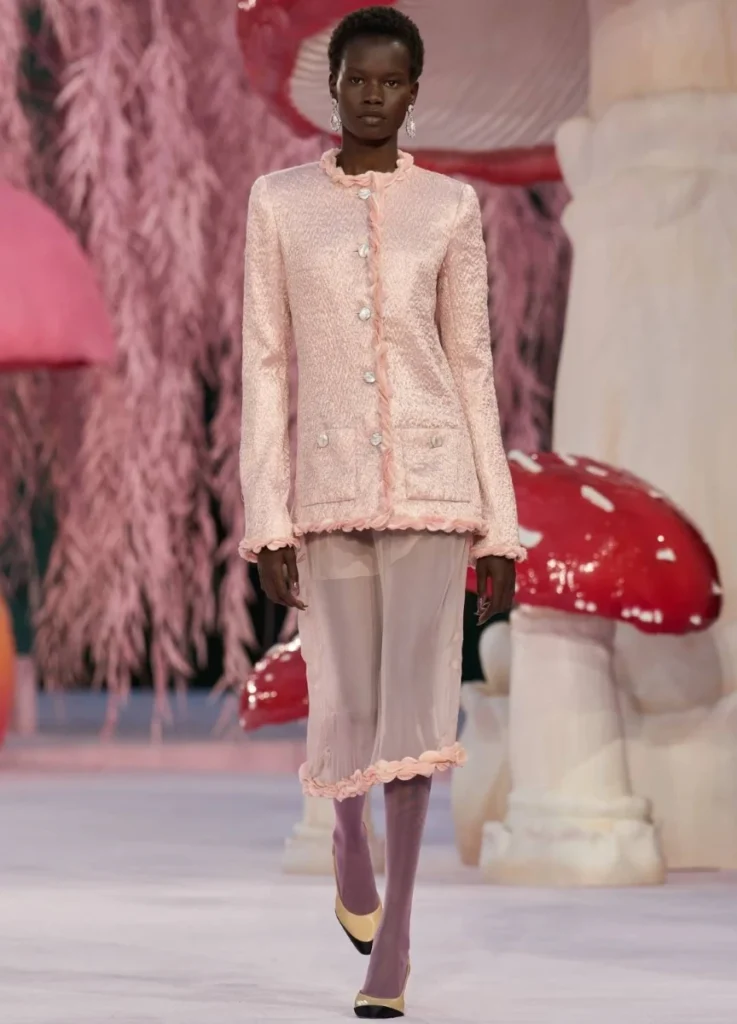
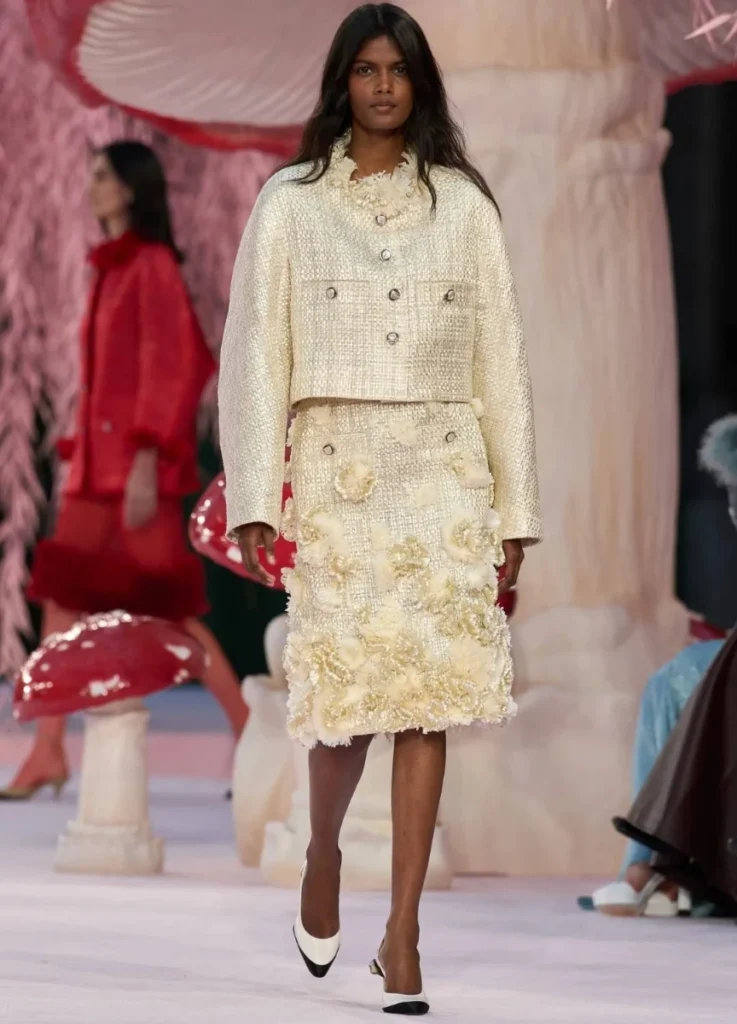
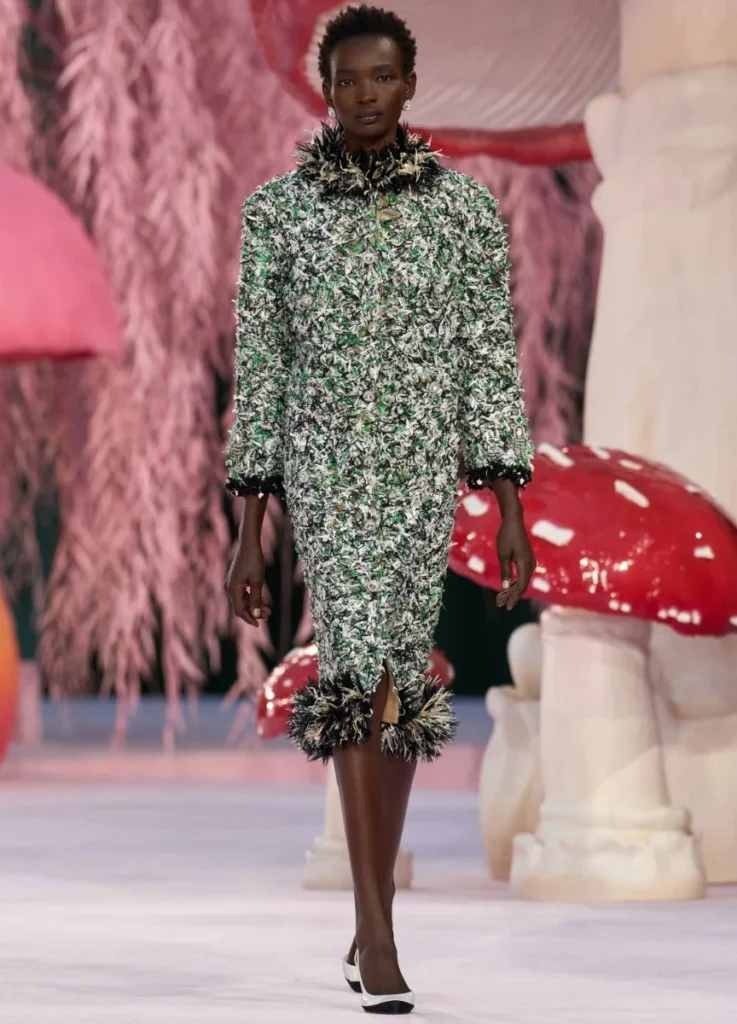
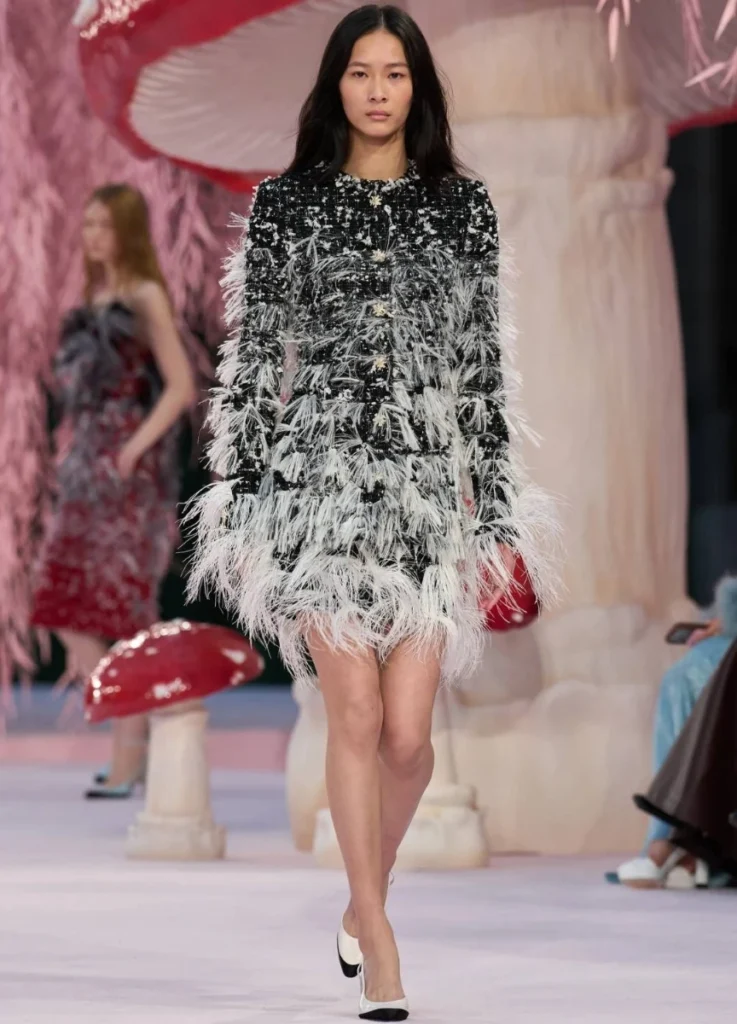
The tweed in this collection avoided architectural silhouette and focused instead on surface complexity. Threads of varying thickness and finish created depth without volume. Fringe and feather elements appeared irregular yet were placed with surgical precision.
What looked natural was, in fact, meticulously controlled. That paradox — apparent looseness underpinned by absolute discipline — defines couture craftsmanship at its highest register.
Embellishment Without Emotion
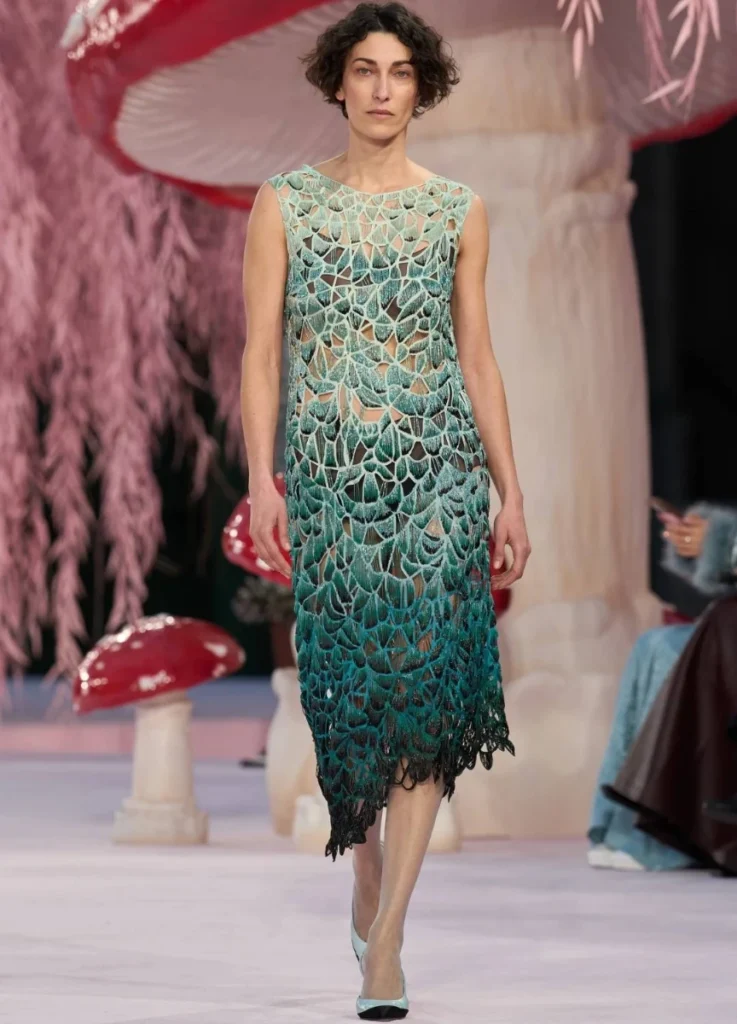
Embroidery, sequins, and beadwork didn’t perform theatrically. They lay flat, lifted slightly, then receded again. From a distance, garments read as unified surfaces. Up close, they revealed immense informational density.
This is couture’s most traditional argument: persuasion through labor rather than emotion. Cathy Horyn, writing for The Cut, noted that Blazy’s radicalism in this debut wasn’t really about fabric — it was about his refusal to deliver a new silhouette in his first couture collection at all. The choice to reinterpret without reinvention is, in couture terms, a quietly substantial position.
The Details Critics Returned To
Several elements emerged in international coverage as standout moments worth flagging directly.
The trompe l’œil organza tank top and jeans — a quiet nod to Blazy’s own work at Bottega Veneta, translated into Chanel’s vocabulary. WWD called it one of the season’s most clever transitions of personal designer history into a new house language.
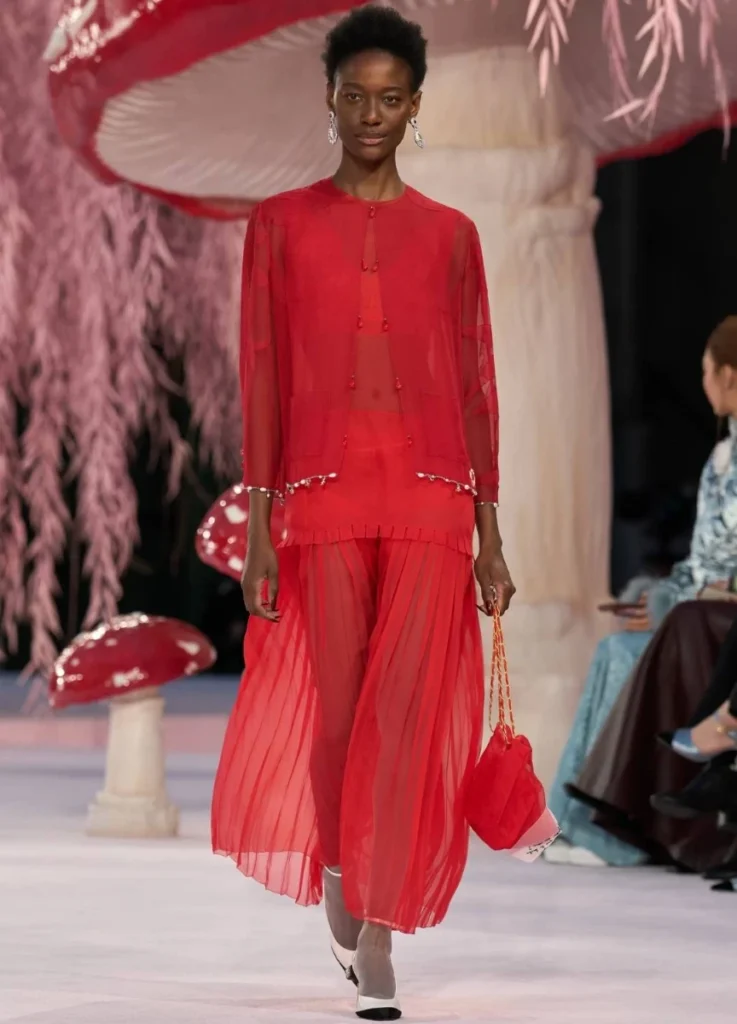
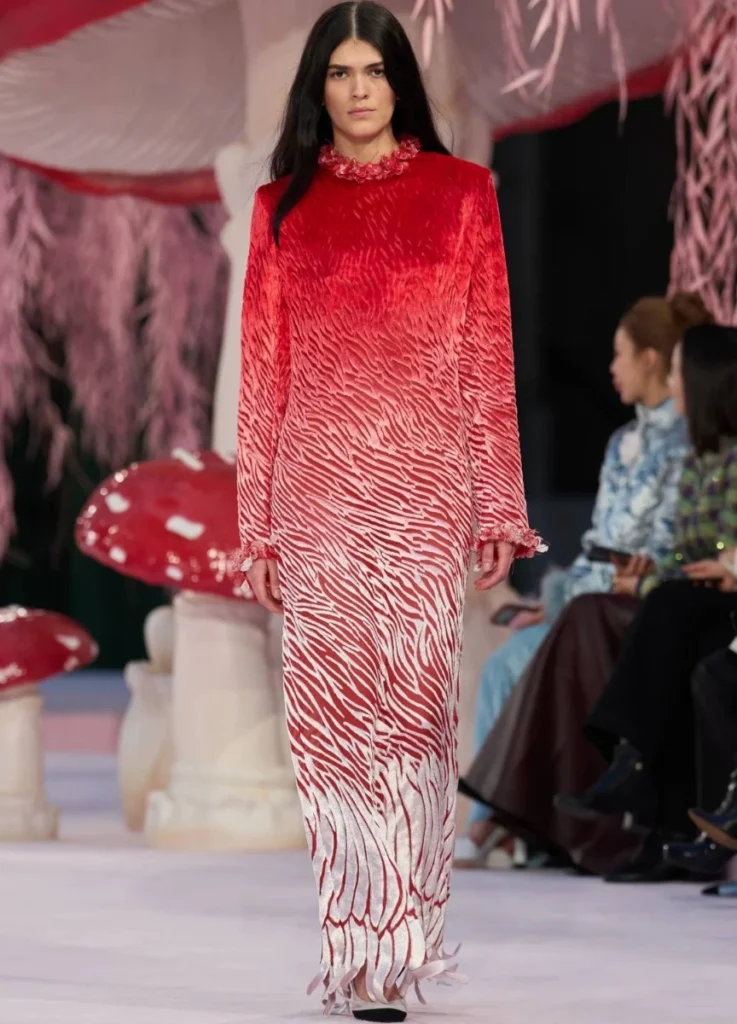
The red evening gown topped with a fuzzy cocoon, widely described by WWD and AnOther as the chicest take yet on mushroom couture — a single look that became the visual headline of the show.
The wedding gown of mother-of-pearl shaved to paper-thin petals, like feathers. The two-piece feathered paillette shirt and skirt set on Blazy’s first Chanel bride, which Grazia called modern magic one can’t quite believe was crafted by hand.
The hood made of black-tipped quills atop a slender red silk stem. AnOther described the model wearing it as an avian-mycelium hybrid — the loudest, boldest piece in the Grand Palais, which faded into restraint when seen alongside the rest of the collection.
The mushroom-shaped heels on two-tone pumps. The pleated tops referencing the gills underneath mushroom caps. The pearl buttons carved into tiny parrot shapes. Birds perched on shoe heels. Critics returned repeatedly to these touches, reading them as evidence of a designer thinking through every register of the collection rather than only the runway-visible surface.
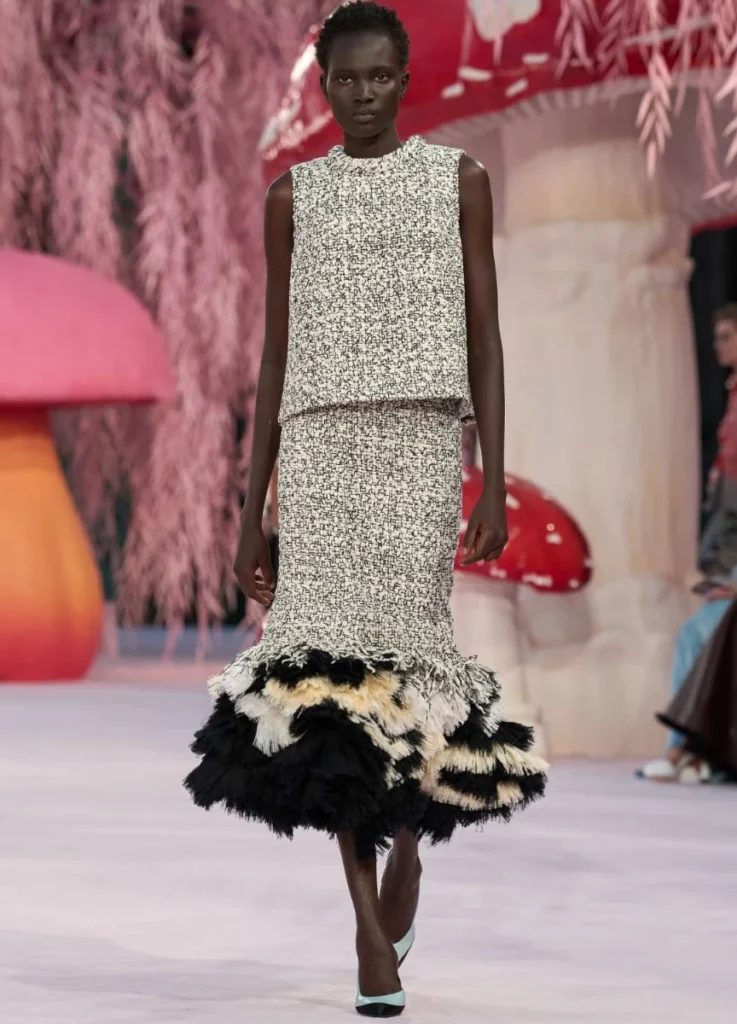
Why the Collection Felt Emotionally Distant — A Personal Read
The issue, for me, was never quality. Every look was resolved, exact, complete — almost immaculately so. Perhaps too complete.
Nothing here appeared unfinished, searching, or becoming. The garments had already arrived.
As a viewer, the eye was satisfied quickly. The mind respected the work. But emotional projection became limited. The collection felt less like a conversation and more like an archive in perfect condition.
The set proposed emotion in excess — the fairy-tale forest, the willows weeping, the Disney-inflected animation Chanel released ahead of the show. The clothes refused to absorb that emotion. The result was a productive dissonance for some viewers — and a kind of muted register for others. AnOther’s Alexander Fury framed the same observation with an open question rather than a verdict: Can you do a lot with a little?
That’s the question this collection invites without resolving.
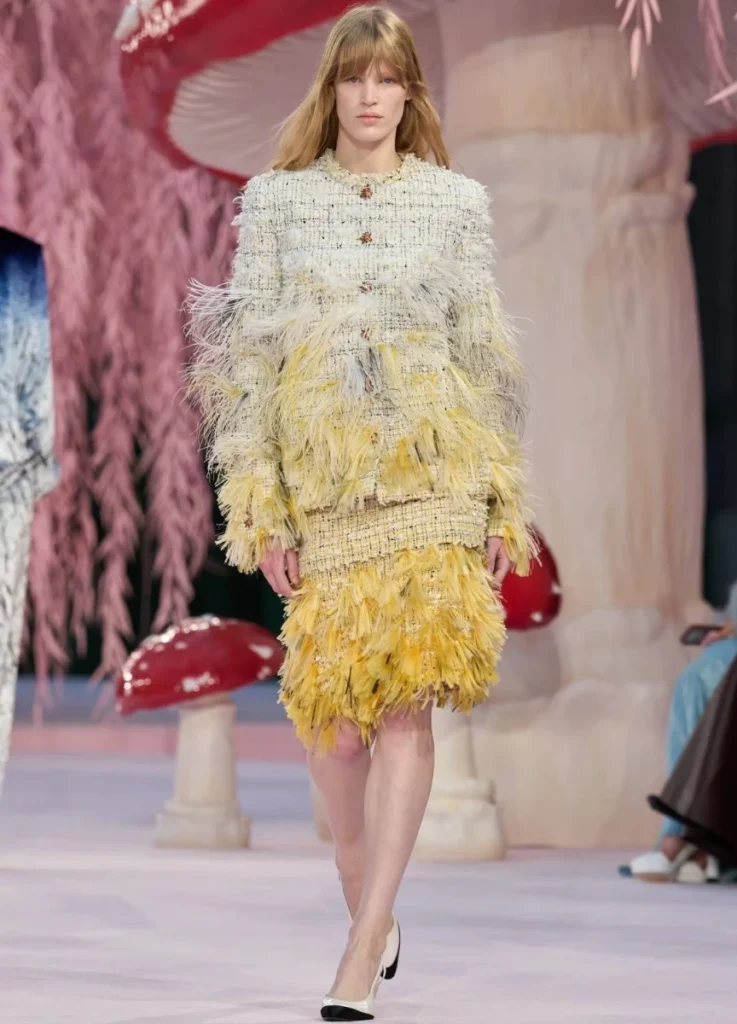
The Woman as a Bird
The emotional restraint of the collection wasn’t incidental. The set, the materials, and the execution all pointed toward a single proposition — a woman imagined not as a protagonist in motion, but as a form in balance.
That’s where the avian image quietly enters the collection. Not as symbol, but as posture.
A Bird That Has Already Landed
Birds in fashion are most often associated with movement: wings spread, feathers trembling, the promise of departure. Chanel deliberately resisted that symbolism.
Feathers appeared throughout the collection, but they didn’t perform. They didn’t flutter dramatically or animate the silhouette. They stabilized it. The figure presented wasn’t one preparing to take flight, but one that had already landed.
Blazy framed it differently in show notes — birds as freedom and movement, women in motion, clothes that don’t constrain. Both readings can hold at once. The collection presents the option of flight without insisting on it. The wearer chooses the register.
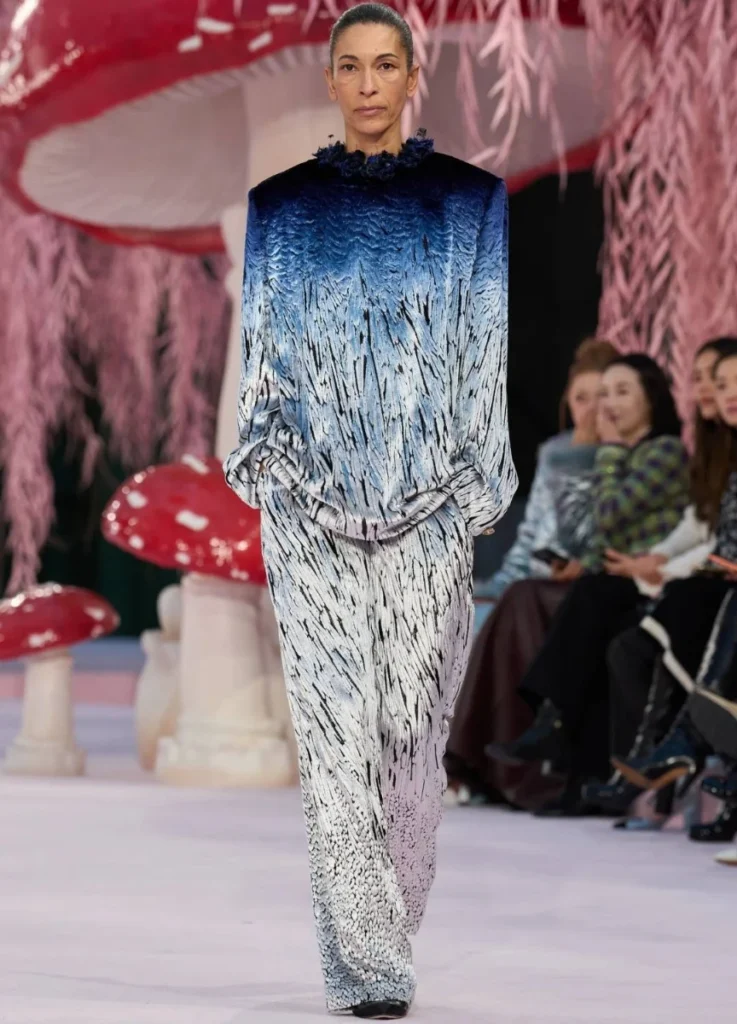
From Freedom to Balance
In fashion, the bird traditionally symbolizes liberation. Chanel reverses that logic here. The avian image becomes a symbol of equilibrium rather than escape. The woman isn’t striving toward transcendence. She doesn’t require narrative momentum.
Her authority lies in stillness.
The shift in how femininity is framed is subtle but significant — not as action or transformation, but as presence.
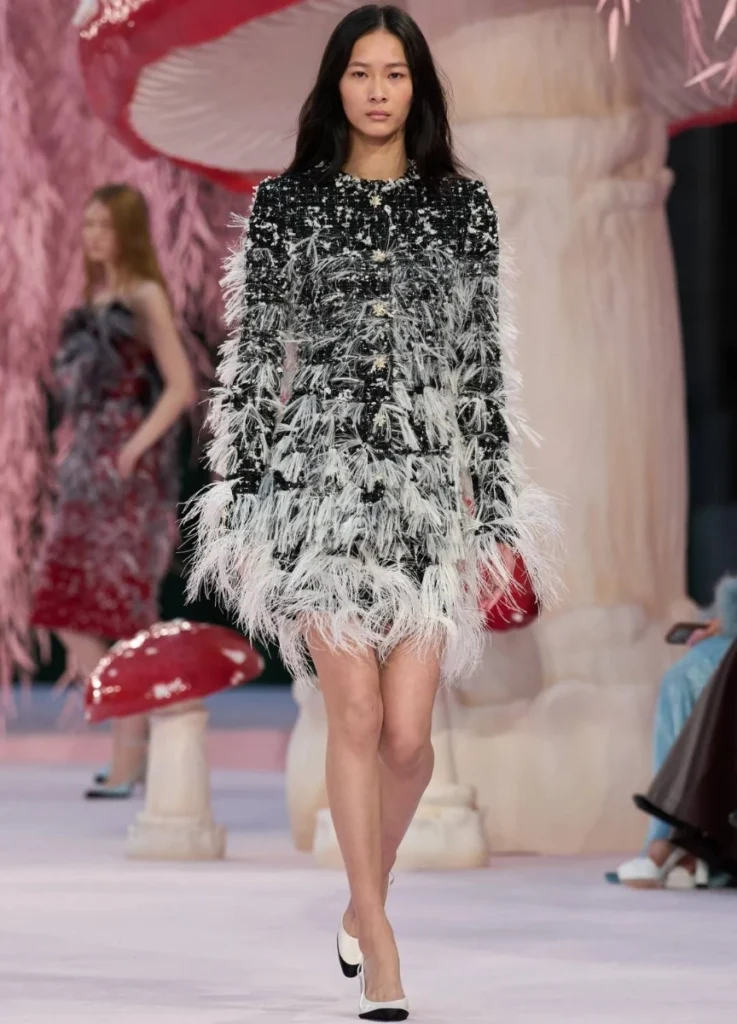
Feathers as Structure, Not Emotion
Feathers in this collection weren’t romanticized. They functioned architecturally — softening edges, regulating surface density, reinforcing balance. The emotional associations typically attached to plumage — fragility, sensuality, theatricality — were deliberately muted.
What remained was technique. Pigeon-gray petals on a barely-there skirt suit. Raw threads creating the illusion of peacock feathers on a flapper-style dress. Pea-hen rather than peacock, in AnOther’s framing — the females of the species. Could anything be more Chanel?
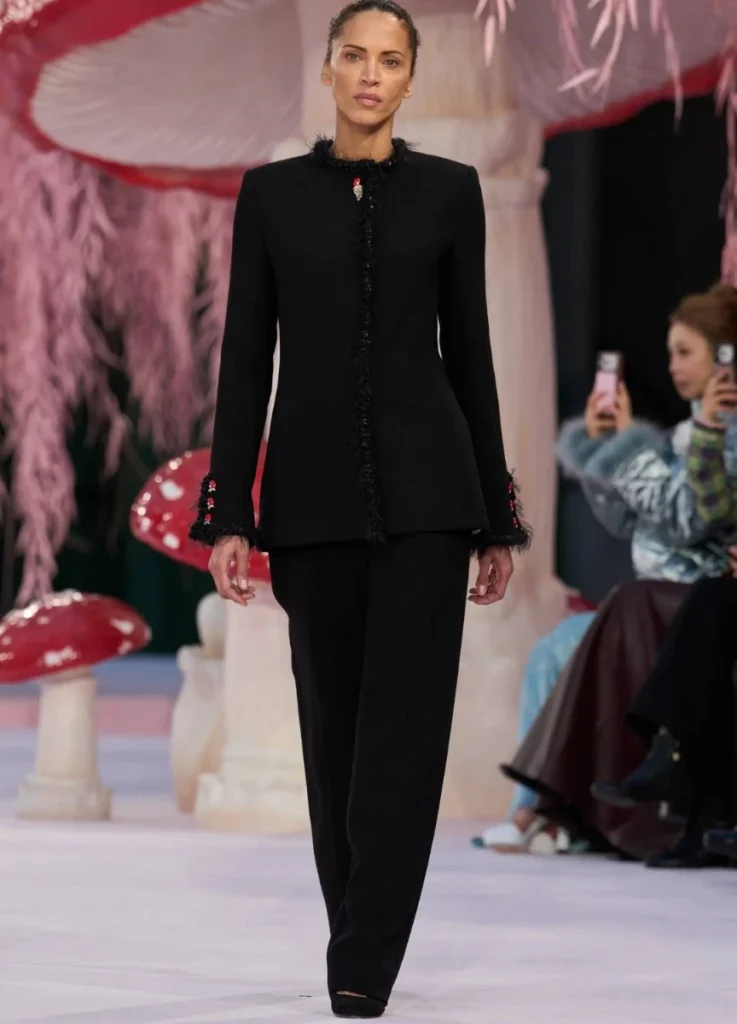
Five Looks That Defined the Season
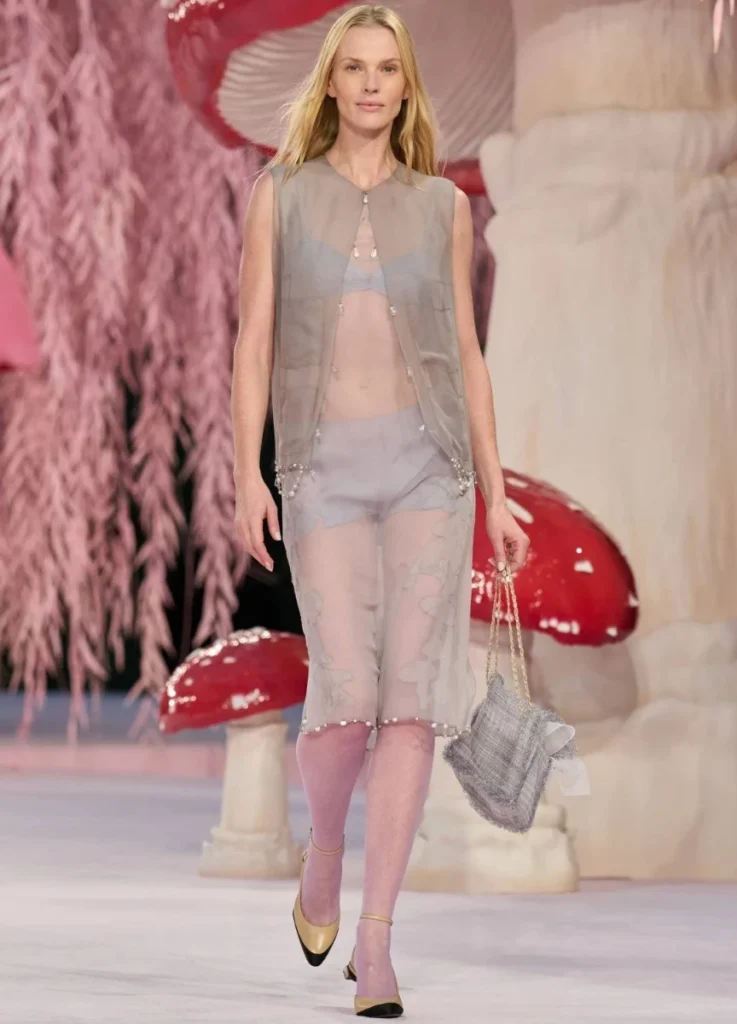
- Look 2 — Powder Sheer Dress. A masterclass in layered transparency and weight control.
2. Look 20 — Green Tweed Ensemble. Surface texture articulated with minimal silhouette intervention.
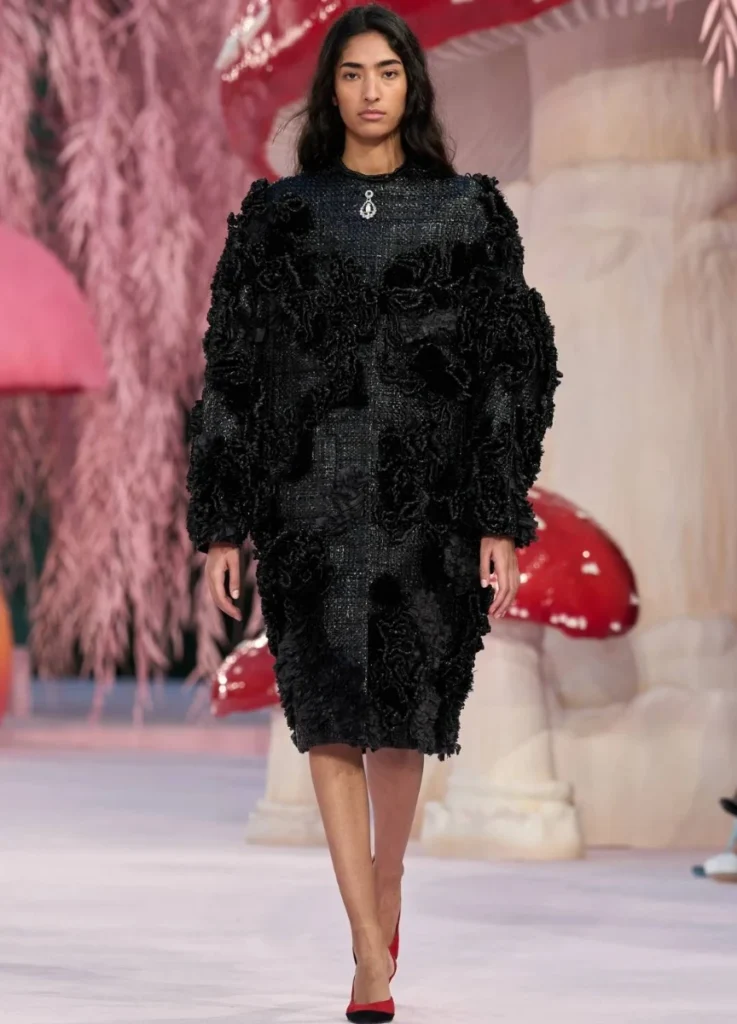
3. Look 29 — Black Feathered Tweed Dress. Decoration reinforcing structure rather than interrupting it.
4. Look 37 — Red Gradient Gown. Color diffusion executed with exceptional technical clarity.
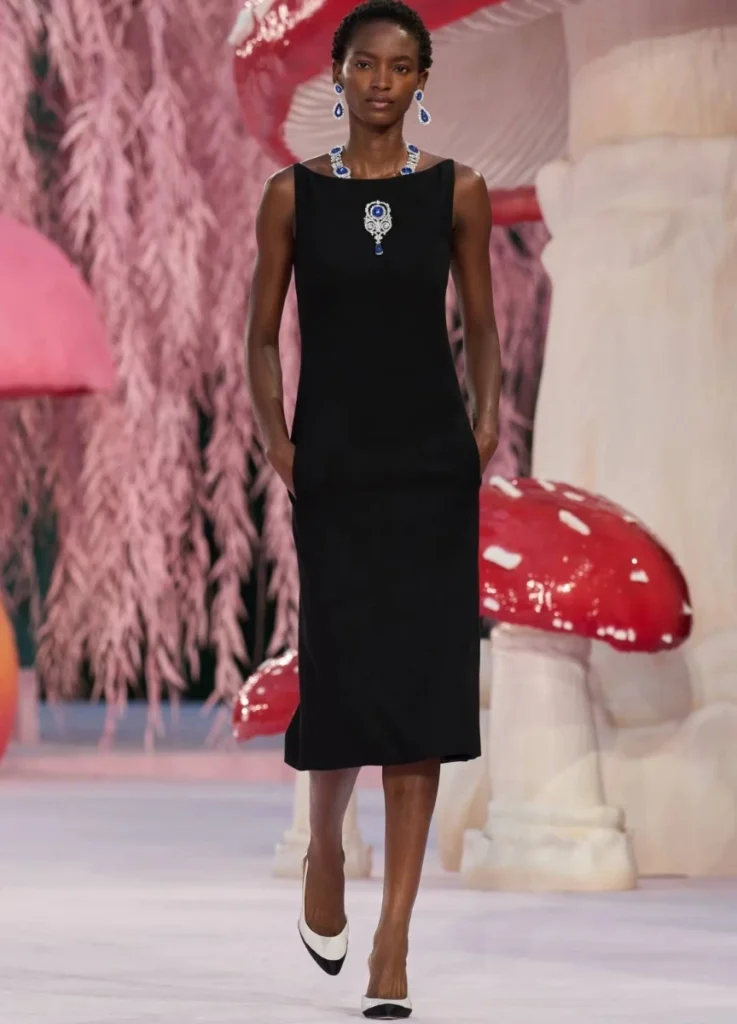
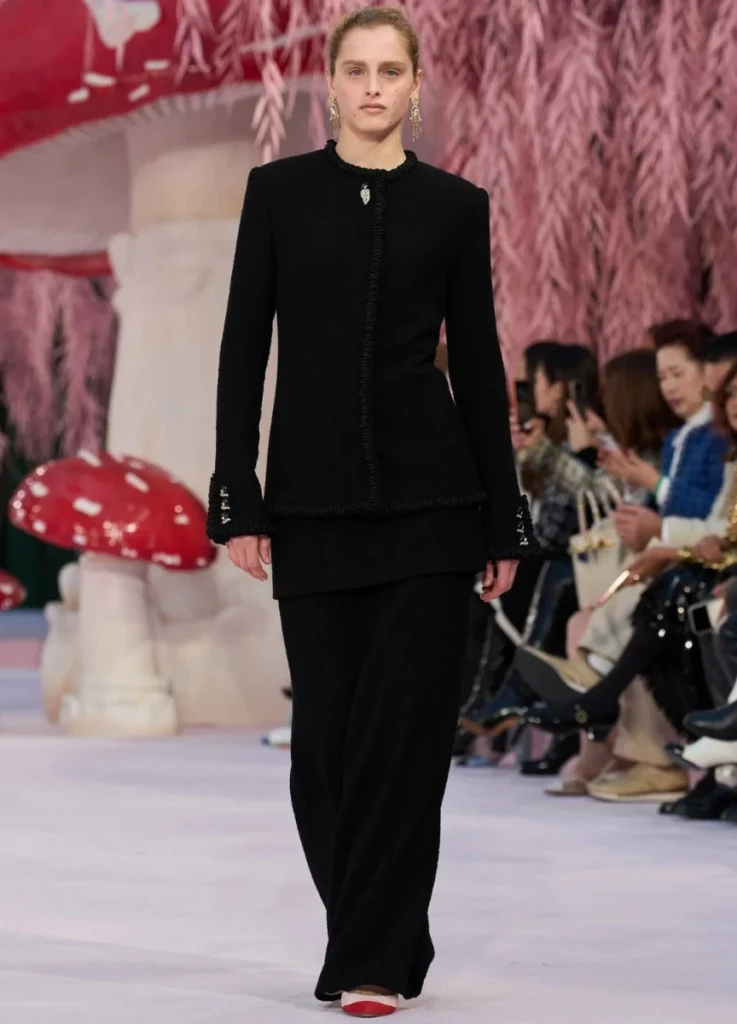
5. Look 51 — Black Tailored Suit. The skeletal form of Chanel couture, reduced to essentials.
The Sheer Bag — A Single Object That Carried the Thesis
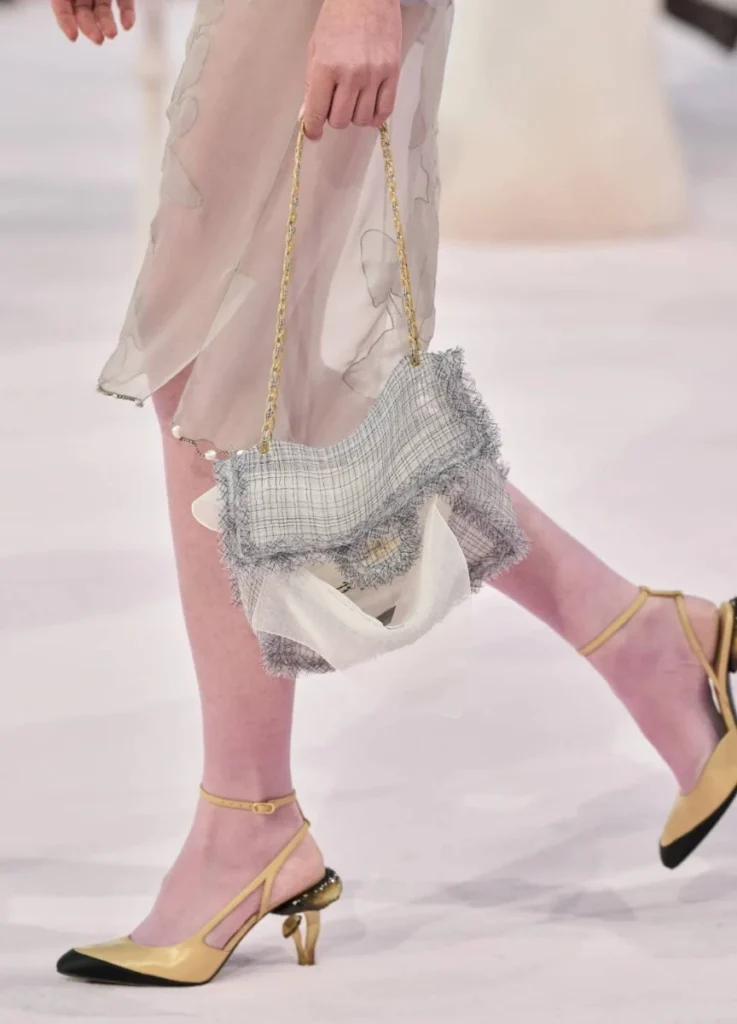
Among the accessories, one piece concentrated the collection’s logic into portable form. The sheer organza and tulle handbag — fragile in appearance, structurally disciplined — appeared throughout the show as quietly the most photographed object in close-up coverage.
The bag carries the collection’s most explicit statement on what couture means now. (For the deeper read on the sheer bag specifically, see the dedicated piece.)
The Sheer Bag
The Critical Polarity
The collection drew sharp polarities in critical response.
In the praise column: AnOther called it quietly radical and praised its return to essence absolue. WWD’s Joelle Diderich described it as a breath of fresh air. Vogue Scandinavia read birds and freedom as Blazy’s own moment of pause before the next chapter takes flight.
The Pull identified the larger seasonal current — that couture’s future may lie in practical exactitude rather than spectacle, and that Blazy at Chanel is one of the most exciting things happening in fashion right now. Cathy Horyn’s reading of the absent new silhouette as the radical move added a structural register to the conversation.
In the more reserved column: viewers (myself included) who found the collection technically immaculate but emotionally distant. Beauty that was understood, but didn’t migrate into attachment.
The polarity itself is revealing. The collection wasn’t designed to persuade universally. It was designed to clarify Chanel’s current position — and to ask, openly, whether craft alone is enough.
A Bird Without a Story
Chanel Spring 2026 Haute Couture doesn’t offer a bird in flight. It presents a bird without a story — balanced, contained, and deliberately unmoved.
This isn’t a collection designed to linger emotionally. It’s designed to endure structurally.
Perhaps that’s the most Chanel gesture of all — to imagine femininity not as transformation, but as a condition that requires no ascent, no narrative, and no applause. Only balance.
The result is couture that commands respect rather than affection, admiration rather than intimacy. And while the heart may not follow, the hand — the discipline, the craft, the preserved knowledge — remains unmistakably present.
A personal note. I respond more these days to clothes whose making is still breathing on them than to refined finished results. To sentences with white space, more than perfectly closed ones. This season’s Chanel was an object of respect. It didn’t enter the territory of taste. The beauty was sufficient, but the beauty didn’t call me back.
A couture that stays in the hand more than in the heart. Perhaps the maison still believes that’s enough.
The question of whether it’s enough for the audience — that’s the one Blazy seems to be asking, not answering. Was it enough? Can you do a lot with a little? The first Chanel couture under his direction sets the question. The next collection will start to answer it.
All images referenced in this post are drawn from Vogue Runway.
[ Related Editorials ]