The Manner of Growth
Jonathan Anderson’s first couture for Christian Dior, shown in January, was an act of generosity. He filled a single collection with ceramics and craft, gardens and botany, art and history — the full inventory of a new director introducing himself to a house and, in the process, to himself. It had the density that only a first encounter allows.
His second couture moves the other way. Where the debut widened, this one narrows; it says less and holds the note longer. Across sixty-five looks, the thread that runs from the first exit to the last is not a colour, a silhouette, or a borrowed period. It is a single method — the pleat, and everything Anderson can make cloth do by folding, twisting, gathering, and letting it fall.
Very little of it functions as decoration. Pleating is usually understood as a way to enrich a surface or animate movement. Here it does structural work: it builds a waist, raises a volume, turns a silhouette, and changes the character of a fabric mid-garment. The pleat is the skeleton the whole show hangs on.
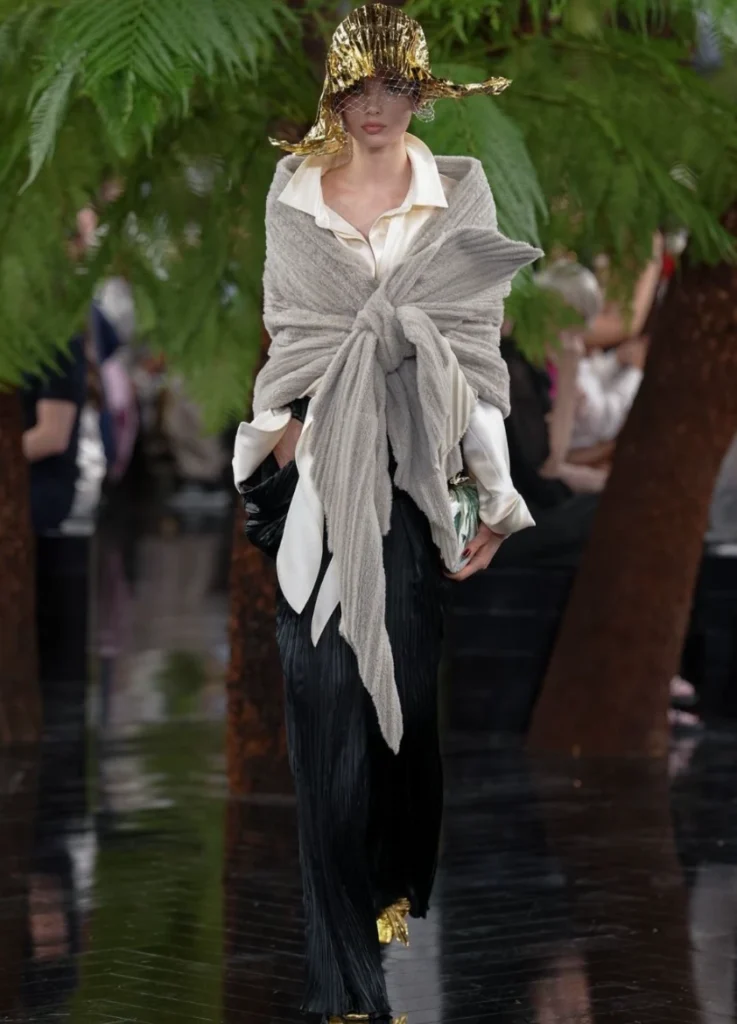
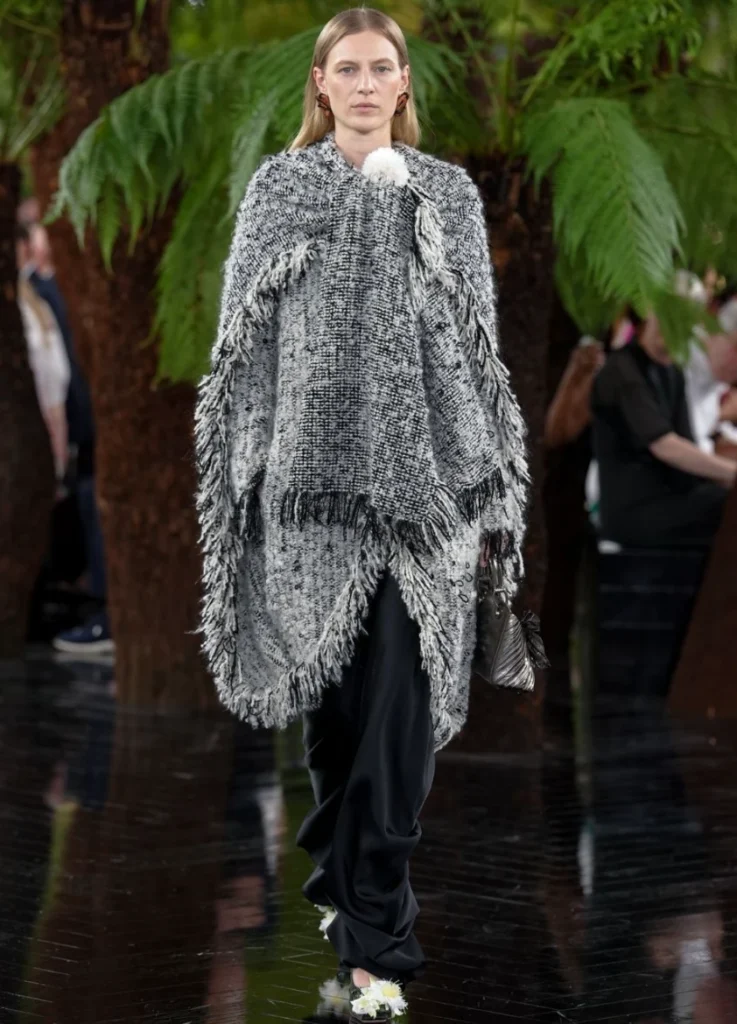
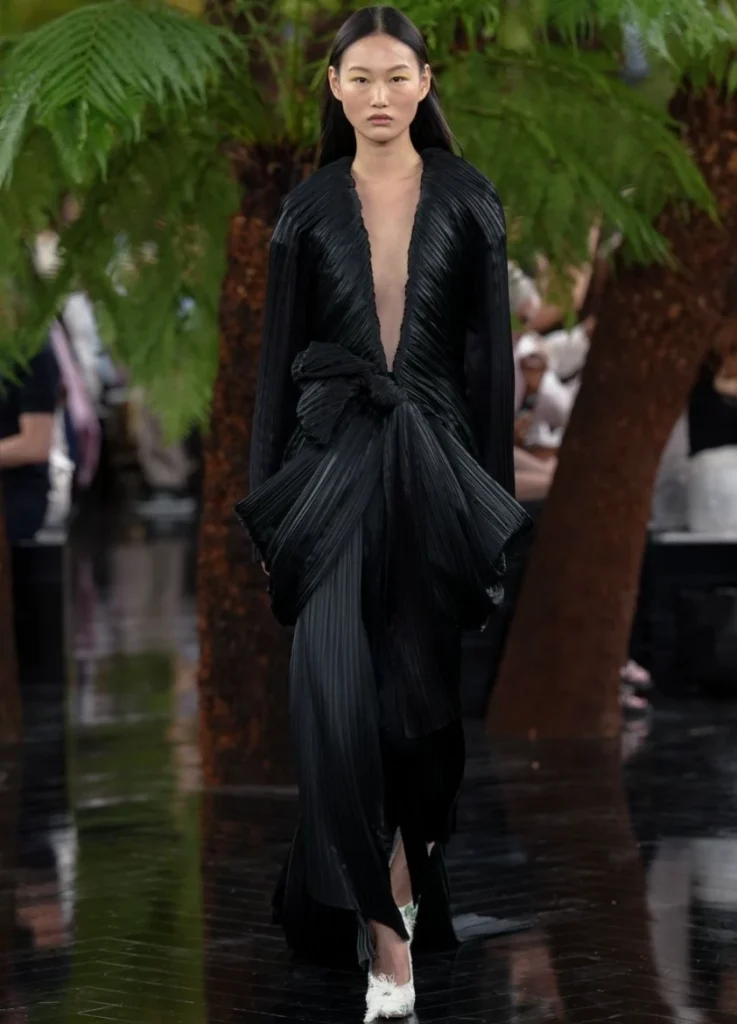
That much is clear from the opening look. A rectangle of grey knit, wrung hard at the waist and knotted over black pleated trousers — no familiar drape, no Bar jacket. The knit is folded and fixed until it becomes a shape, closer to sculpture than to tailoring: cloth carved on the body rather than cut to fit it. The grey coat that follows repeats the idea in another material, its surface dissolving into long loosened threads. A third look, in black, twists once at the waist and drops in a taut vertical fall. Move through the first ten exits and you notice that each look repeats one sentence in a different fabric rather than proposing a new one. The materials keep changing; the logic never does. The collection gains an unusual unity from it.
A structure that begins in the undergrowth
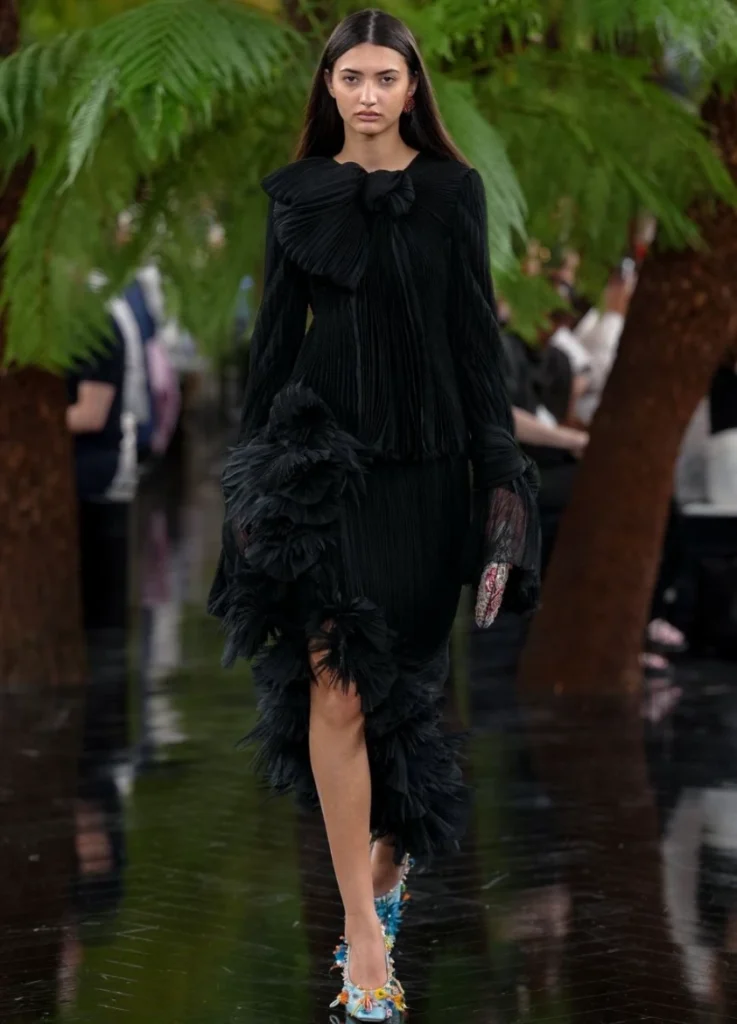
The staging laid out the method before a single garment appeared. The room was built like a vast greenhouse, dense with ferns and tree ferns; the runway, lacquered black, threw back the light like a forest floor after rain. Between the wet green and the dark water of the floor, each look surfaced as part of a landscape.
The fern is the season’s key motif. A young frond unrolls from a tight spiral and opens by degrees into a run of even, repeating ridges — one of the oldest structures nature makes. Anderson takes that motion and lays it into fabric, so that the pleating stops looking like ornament and starts looking like the way a plant grows.
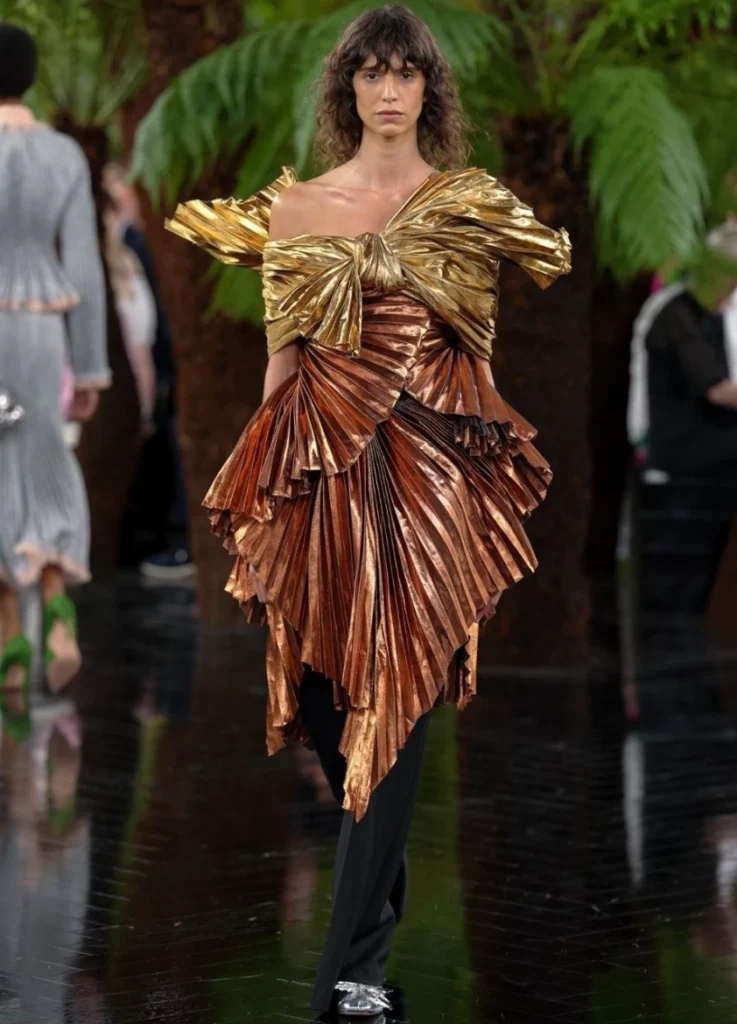
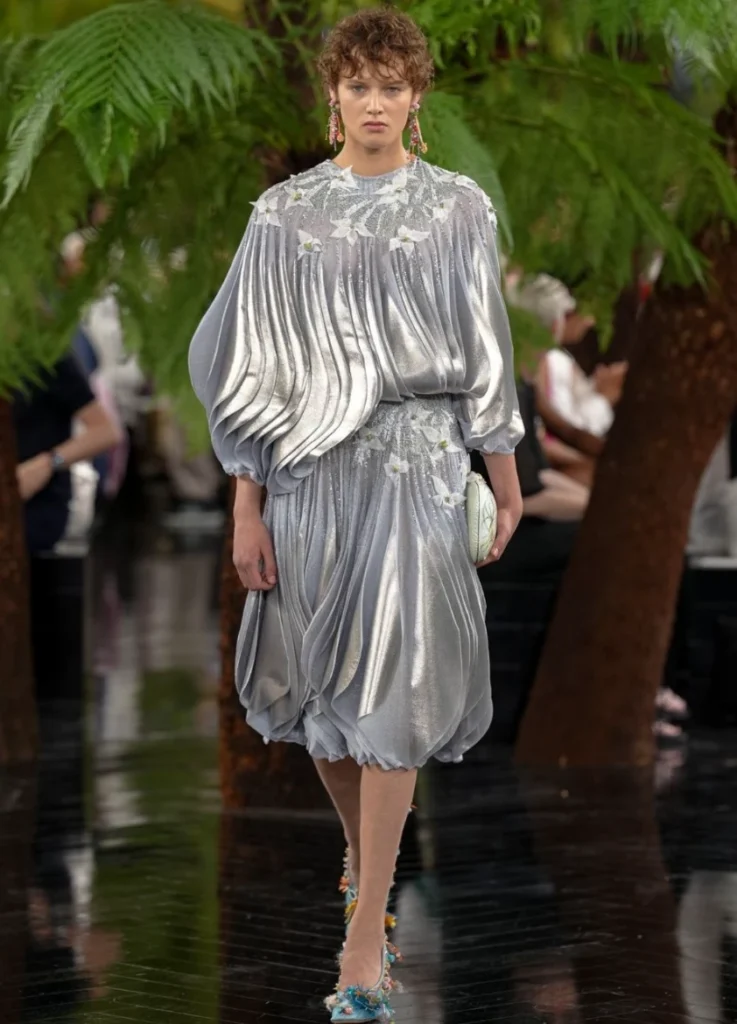
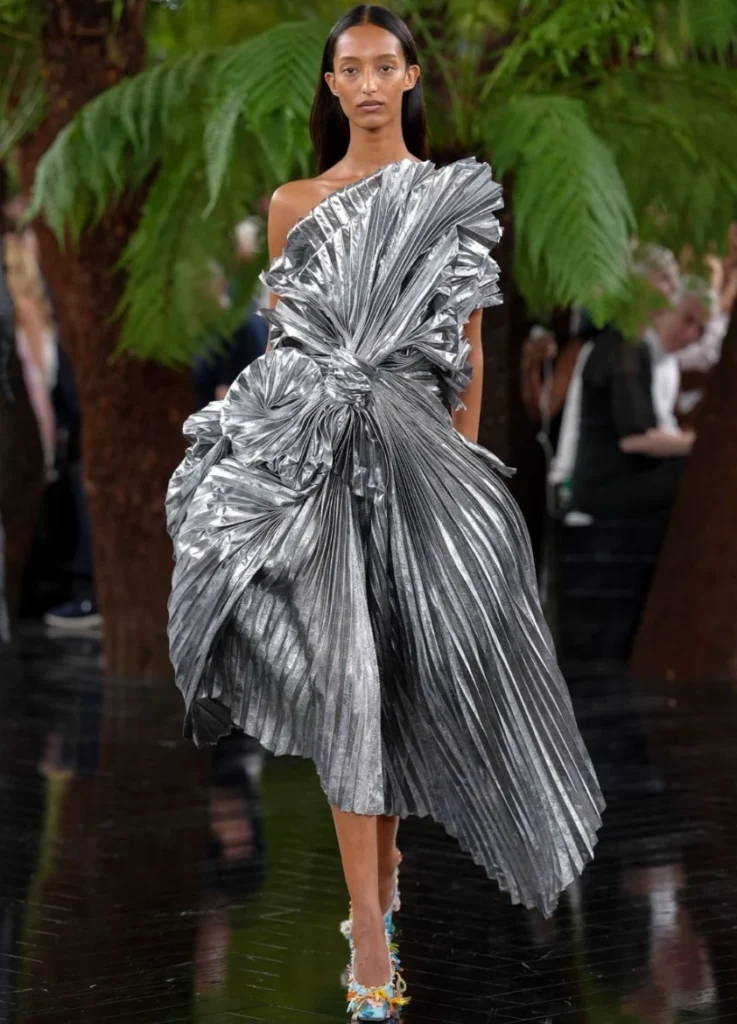
A second reference settles over the first. The American sculptor Lynda Benglis, whom Anderson singled out himself in the days before the show, is known for pouring latex and molten metal and letting them harden in the act of flowing — objects that hold the liquid and the solid in a single gesture. The crushed metallic lamé carries that DNA plainly. A silver gown looks like aluminium poured over the body and set; a copper off-shoulder dress catches metal in the moment it runs and stops. The light never sits flat on either. It fractures along hundreds of small ridges and shifts with every step, so the surface seems to move on its own.
Nature’s fold and metal’s fold: Anderson binds the two into one structure, and the collection holds the organic and the industrial at once. On a runway staged as a forest, metal blooms and cloth folds like leaves. The result doesn’t set out to reproduce nature so much as to translate the way it grows into the language of couture.
Into couture’s longer history
Anderson’s most pointed decision is a refusal to show off the house’s icons. The Bar jacket appears; the nipped waist and softly flared line still carry the memory of the New Look. But those elements work as punctuation rather than argument. The eye is sent further back, into couture’s deeper past.
The name that comes first is Madame Grès. Her art was to fold rather than cut — to let cloth fall in endless fine pleats that traced the body, still regarded as one of couture’s highest skills. The deep pleated columns here, and the folds that spill from the waist, belong to that lineage; the black plissé gown and the ivory column strip away ornament until the pleat alone carries the structure.
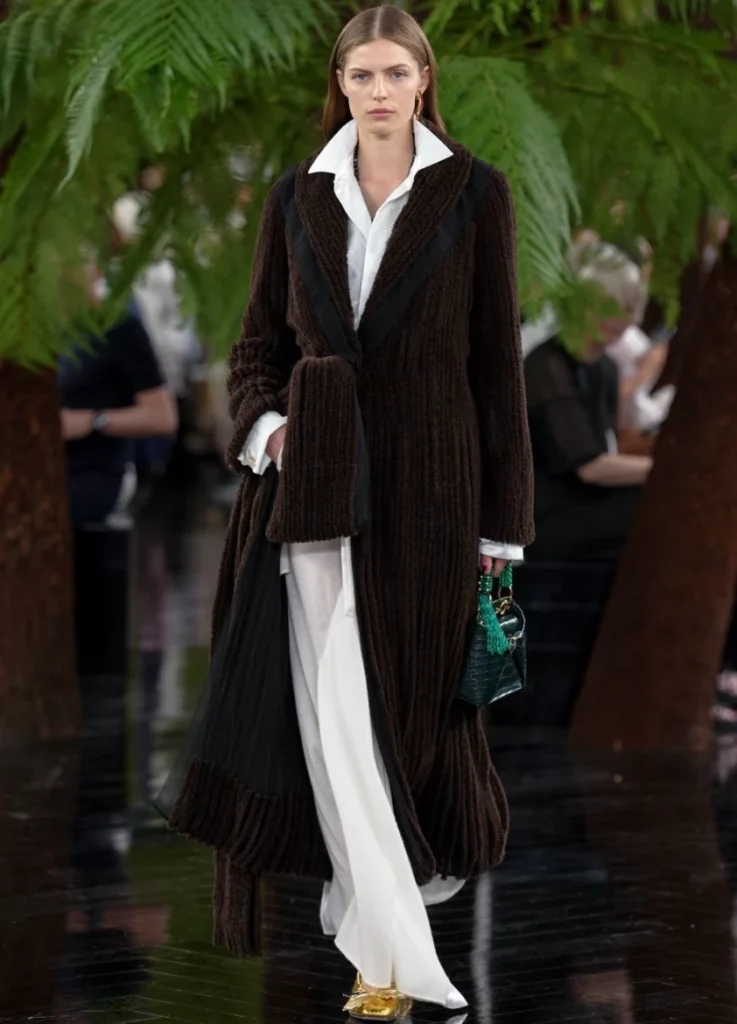
Fortuny is present too. His Delphos gown used minute pleating to make silk pour down the figure, and the vertical plissé that recurs all season shares the principle. Anderson refuses to leave it at homage, though. He twists the pleat at the waist, folds it at the shoulder, and lets it detonate into volume, turning a fluid surface into a piece of engineering.
A shift comes into focus here. His first couture introduced his vocabulary inside the house; his second steps briefly past the house to talk with couture as a whole. He seems less interested in restating Dior’s history than in locating himself within couture’s — and he does it without discarding what makes Dior Dior. Instead of repeating the New Look, he reaches back past it to an older grammar and pulls it into the present. By the end, you’re thinking about couture at least as much as Dior. Anderson has chosen to set the house down on a longer history rather than copy its emblems.
Pulled in, let go
Reduce the season’s silhouette to a sentence and it sounds simple: draw in above, release below. Watch it to the end and the formula turns out to be something else. Anderson doesn’t cinch to flatter a waist; he runs a single force through the body, compressing it at one point and letting it burst at another.
The opening look states the principle. The grey knit doesn’t wrap the body like a cardigan — a broad rectangle of cloth, twisted hard at the centre of the waist, pushes the volume out to either side. The fabric knots at the waist; the black plissé beneath it falls straight and long. The eye catches the knot first, then follows the pleats down. Even the emphasis on the waist is solved by the flow of cloth rather than by cutting.
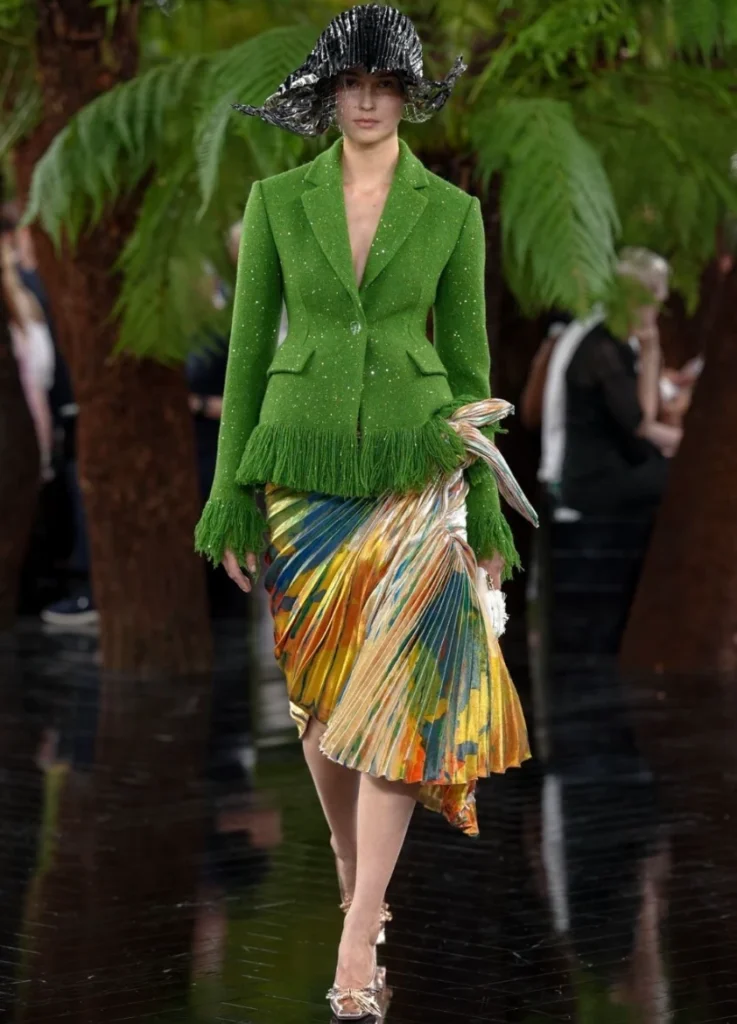
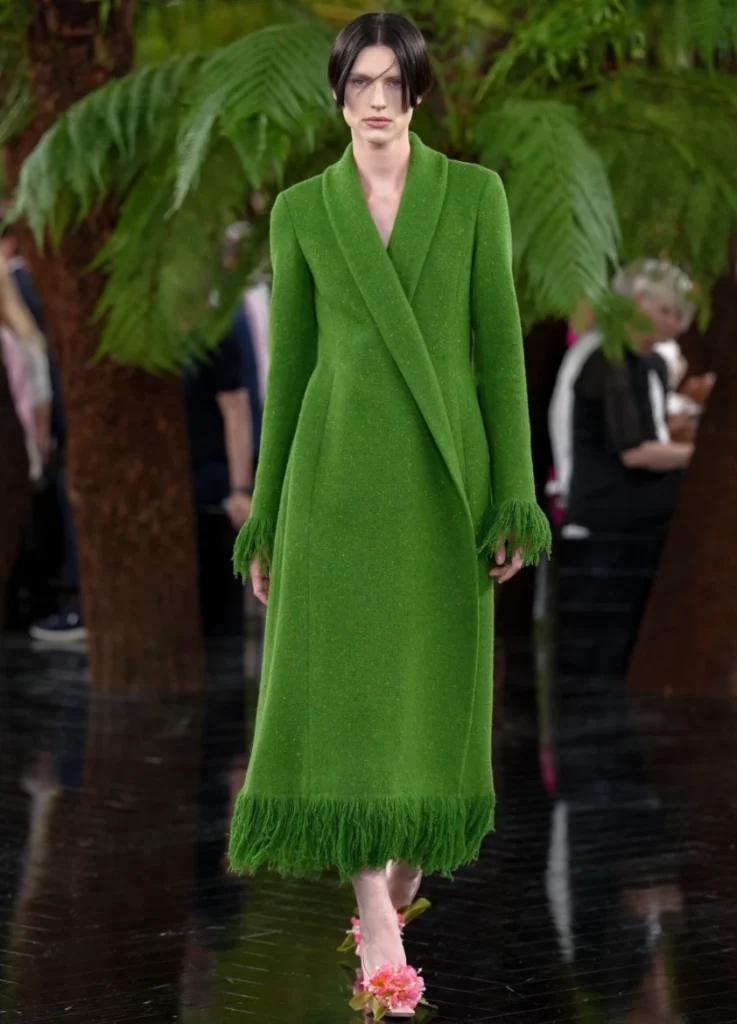
The green Bar jacket works the same way. It nips the waist like the Dior archetype, but up close it is the pleating, not the seam, that pulls the body inward, and below it a white pleated skirt swells like a calyx before falling away. The jacket is control; the skirt is its release. Where the New Look built a waist through structured tailoring, this season the pleat builds it.
The black looks carry the logic further, twisting at the waist and dropping into long, narrow pleated columns. The body barely moves and the cloth keeps trembling; as the model walks, the dress shivers on its own rather than following her. The metal dresses invert the same structure. The copper off-shoulder gathers hundreds of sharp folds to a single point and explodes them outward. In most couture that volume would come from a pannier or an inner cage; here the pleat is the skeleton, so the volume stays light, its space held by the tension of folded lines instead of stacked weight. From the front the silver dress looks like liquid metal poured and set, until the model turns, the folds throw the light in a new direction, and the shape becomes another thing entirely.
If one verb defines the season, it is to fold. By the sixty-fifth look you have stopped watching individual dresses and started watching a single structure declare itself in material after material.
Dior, with the sweetness set aside
Anderson changed more than the silhouette. The colour changed too, and that may be the bigger move. Say the name Dior and most people picture pink — the roses and gardens Monsieur Dior loved, the romantic pastels Maria Grazia Chiuri extended in her own register for the better part of a decade. Flowers were always in bloom; the dresses were light as air; the palette opened toward softness and romance.
This collection steps to one side of that feeling. The palette is severe — ivory and cream, grey and greige, black and silvered metal — and most of the show unfolds across those low tones. Strong colour exists, but as a moment of relief in a long neutral line, never as its subject.
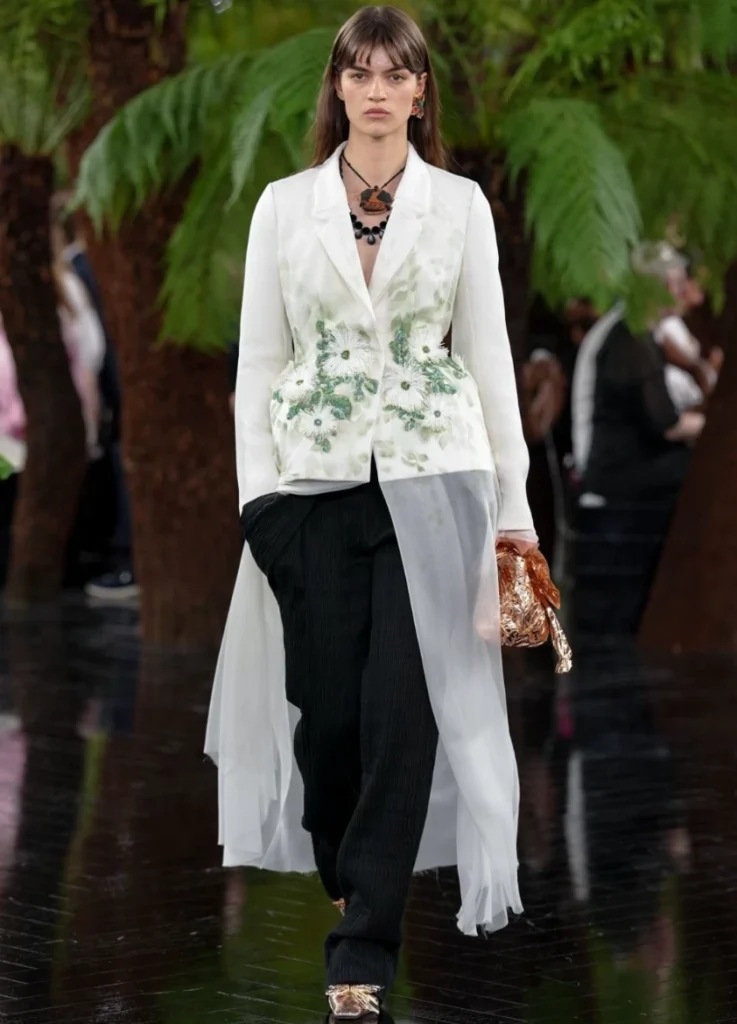
Green reads first, and it is the specific green of a leaf just unfurled rather than the green of a flower. A vivid green Bar jacket, an acid-green dress scattered with daisies, olive knits with the grain of foliage — all of it ties back to the set. It is the colour of how a plant is built.
Metal follows the same logic. Couture tends to treat the metallic as glamour, as the drama of evening; here it refuses to sparkle, creased and folded until it scatters the light, cold as a set liquid and heavy as sculpture. The copper lamé is the clearest instance — a great volume that looks wrung from a single sheet of metal, glowing under the lights like bronze, an installation set walking more than a gown sent down a runway.
Black earns its place, too. This season it is the colour that shows a pleat’s depth most dramatically: light-absorbing, it sharpens every fold, while long fringe and feathers layer across it like cast shadow. It lets you see structure before you see colour.
By the close, a quiet fact surfaces. Flowers still appear — daisy embroidery, small floral motifs — but they have stopped being the protagonist. They sit on top of the structure. What holds Anderson’s attention is the stem and the leaf beneath the petal, and the manner of growth, and the colour moves with him: the sweet pastels recede, and the tones of earth and metal, moss and leaf take their place. Dior’s flower survives, but as a structural element more than an object to admire.
The change in colour changes the temperature of the whole show. The first couture overwhelmed with reference and craft; this one is calmer, and it doesn’t push its feeling at you. Form and texture draw the eye slowly instead — silver plissé swaying, ivory fringe trembling in the air, feathers loosening at the end of a fold. The beauty lives in how the material moves. It is a cooler, more disciplined, more sculptural beauty than Dior usually offers. Anderson hasn’t drained the romance so much as moved the eye from the flower to the structure that holds it up.
The bride: one last fern
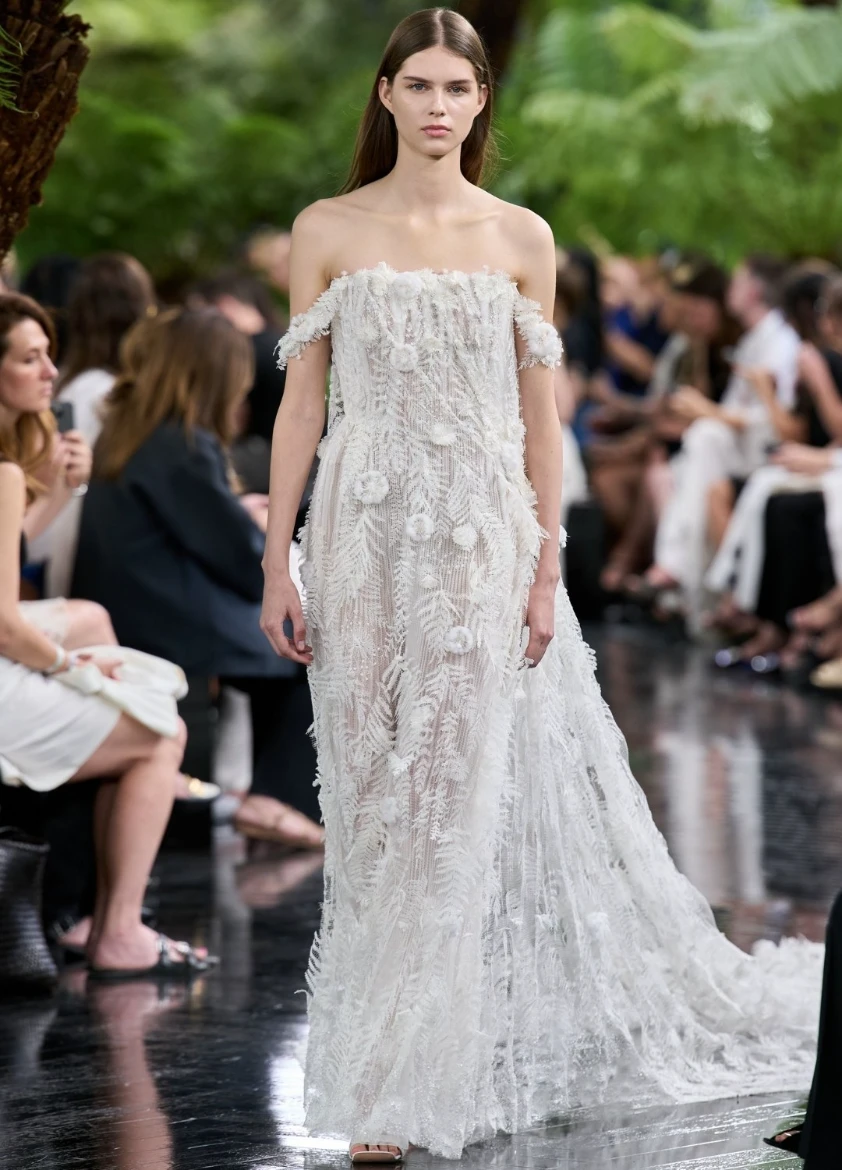
A finale is where a designer compresses the whole collection into one statement, and this bride is no exception. It works as the purest distillation of the language the previous sixty-four looks kept speaking.
The first impression is remarkably quiet. An off-shoulder neckline clears the collarbone and shoulders; the waist is barely drawn in. There is none of the exaggerated crinoline a traditional Dior bride might promise — instead a column that falls the length of the body and holds the tension by itself.
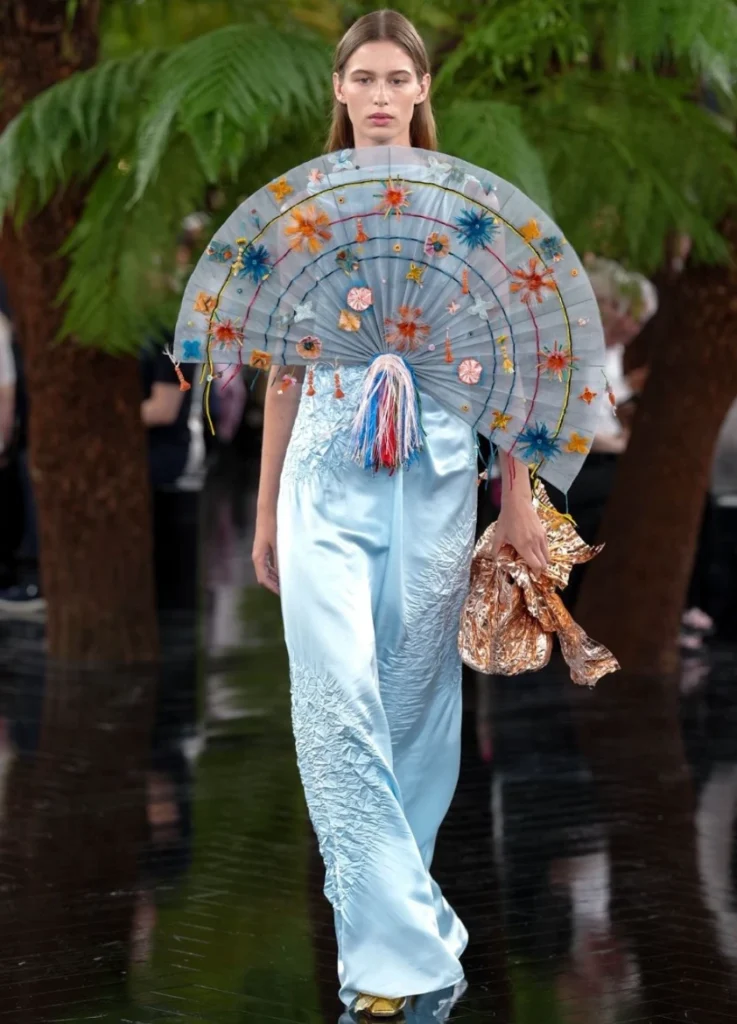
From a distance it looks like restraint. Up close, another world opens. The surface isn’t lace. It’s fern — fine frond embroidery layered over itself into a kind of undergrowth, threads running along the veins at different rhythms, multiplying the way a plant does rather than repeating on a grid. Small raised florals scatter through it, settled in like life that has grown up through a forest floor.
The pleat that ran through everything returns here in altered form. Where the earlier looks built structure from folds of cloth, the bride builds it from the direction of the stitch: the run of the thread becomes the structure, and the density of the embroidery gives the body its dimension. The fold moves out of cloth and into thread — from pleating into growth.
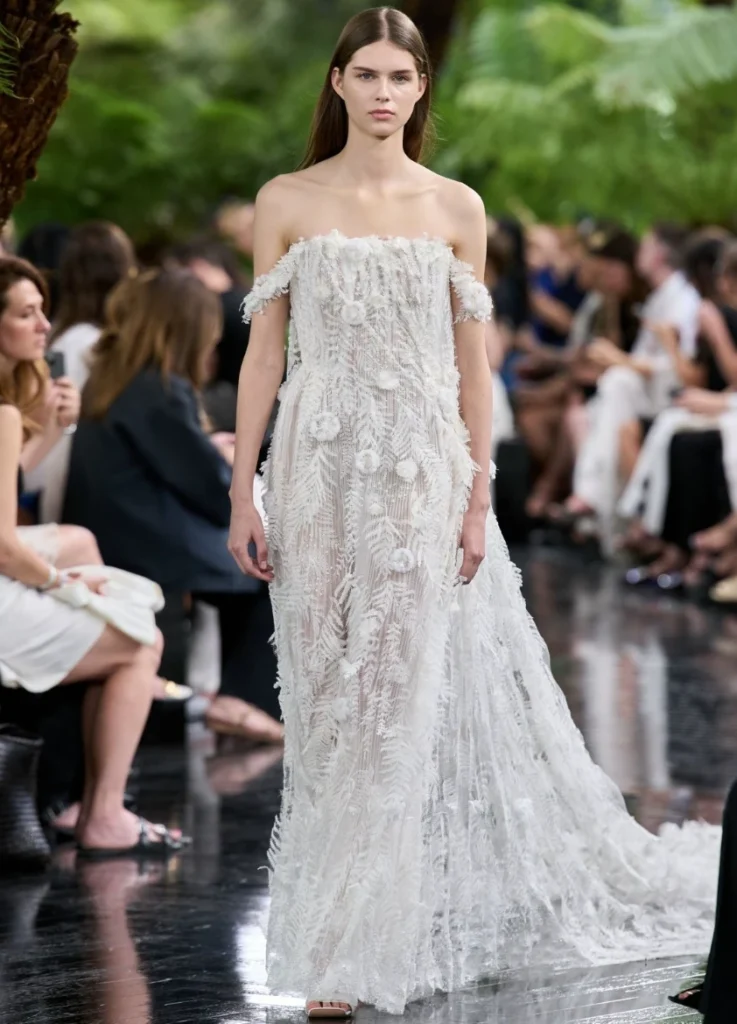
The train stays with you longest. A conventional bridal train works through length and volume; this one chooses texture over weight. Thousands of fine threads brush the floor and trail behind like fronds caught in a breeze, and against the black lacquered runway the long white train looks like a ribbon of mist settling into a primeval wood.
So it is a dress of the forest rather than the flower, and the decision to stage the entire show inside a fern-filled jungle makes complete sense only here, at the last look. Nature has been borrowed as a method of construction, the growth of a plant translated into the structure of a garment. The bride draws every thread together.
That makes the finale different in kind from Dior’s usual wedding spectacle. Rather than closing on display, it closes on the single idea the collection has pursued from the start, rendered as plainly as it can be. The first couture introduced a world through many references; the second leaves a single question through its last look — where cloth ends and a living thing begins.
Anderson’s answer is plain. Here the pleat was never ornament; it was a way of growing, and the bride is that growth carried to its conclusion.
When the show ends, what stays is not the metal or the theatrics but the last white dress moving slowly across the black-water runway, and the countless veins growing over it — as if the forest could disappear and the fold it made would remain. Flowers fade; structure remains. In his second haute couture for Dior, Jonathan Anderson kept the manner of growth.
All images referenced in this post are drawn from Vogue Runway.
[ Related Editorials ]