Why Anderson showed clothes for becoming someone, not clothes for going somewhere.
Inside Dior Cruise 2027
Jonathan Anderson’s first Dior cruise didn’t unfold as a resort collection. It barely tried to.
When cruise enters the calendar, the genre usually arrives with its own vocabulary — sunlight, departure, holiday destinations, easy dresses, travel-ready accessories. The clothes Anderson showed at LACMA on May 13 shared almost none of that vocabulary. These were not the clothes of someone leaving for somewhere. They were the clothes of someone who has already arrived, and is trying to become a different version of themselves.
The Setting │ Why LA, Why LACMA
The venue made the argument before any model walked. The show took place on the grounds of the Los Angeles County Museum of Art, against the backdrop of the newly opened David Geffen Galleries — Peter Zumthor’s first American building, which had been open to the public for only nine days. Layered on top: the Rodeo Drive flagship expansion, the new Monsieur Dior restaurant by Dominique Crenn, a guest list that mixed Hollywood with K-pop figures and younger cultural names. Taken together, this reads less like a destination show than a strategic claim on LA as cultural capital.
But the venue is a smaller question than the framing. Anderson did not treat LA as a beach city. He treated it as a city of reinvention — the place people come to change their names, change their faces, audition for a different role. Norma Jeane became Marilyn here. So did countless others whose names never made it onto the marquee. Cruise 2027 arrived in that lineage rather than in the lineage of holiday wear.
The Author │ Anderson the Aspiring Actor
That framing tracks with Anderson’s biography. Before fashion, he had wanted to be an actor — moved to the US as a teenager to pursue it, and only later turned toward design. There is, in other words, an autobiographical layer in a former would-be actor staging his first cruise show in Hollywood, dressing the house that has historically dressed leading ladies on and off the screen.
The collection notes made that layer explicit. They were written as a fantasy film script, with Anderson appearing inside the text as a kind of narrator. The conceit closed the loop. Dior has long dressed screen characters. Anderson has long wanted to be one. Cruise 2027 sits at the seam where those two histories overlap.
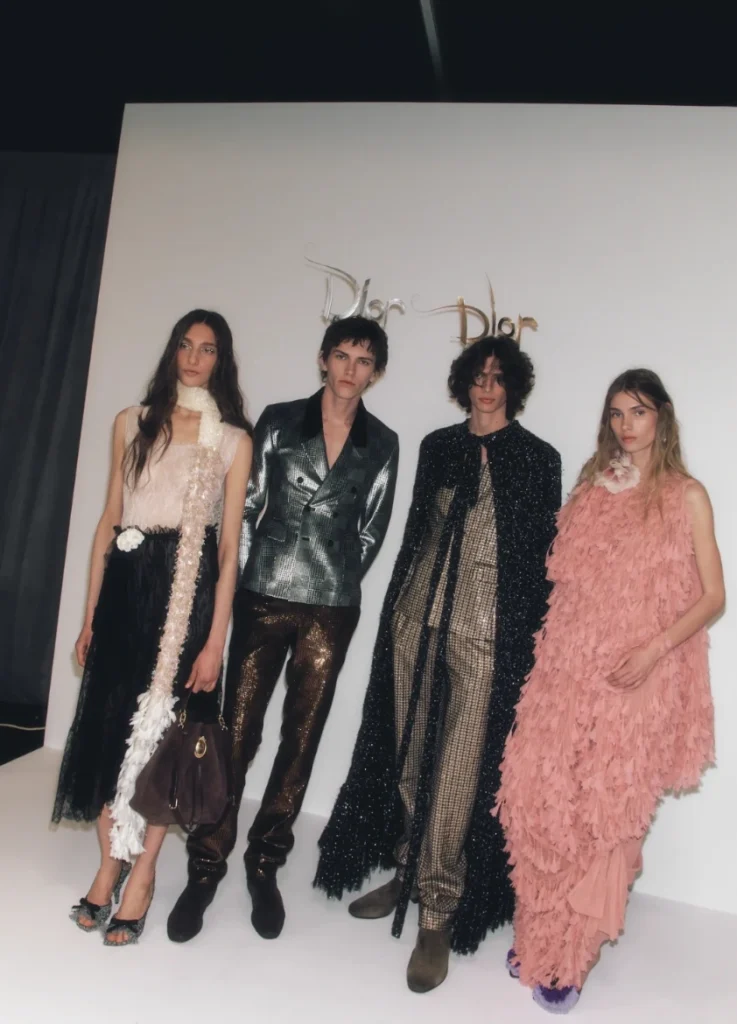
The clothes follow from that decision. They do not propose looks for a holiday wardrobe. They propose costumes for specific characters — the young actor who has just landed a role, the older actress who carries the glamour of an earlier era as afterglow rather than performance, the noir director, the studio assistant walking out a back lot, the figure who has already failed once and is trying again. Each look carries a casting hint rather than a styling suggestion. The effect is to move Dior’s historical femininity away from completed elegance and toward elegance built through role — femininity still in motion, rather than femininity displayed.
Design Vocabulary │ Three Operations
The visible design language of Cruise 2027 organizes into three approaches: reworking house memory rather than restoring it, treating surface as theatre rather than finish, and styling clothes as characters rather than customer profiles.
Reworking the heritage
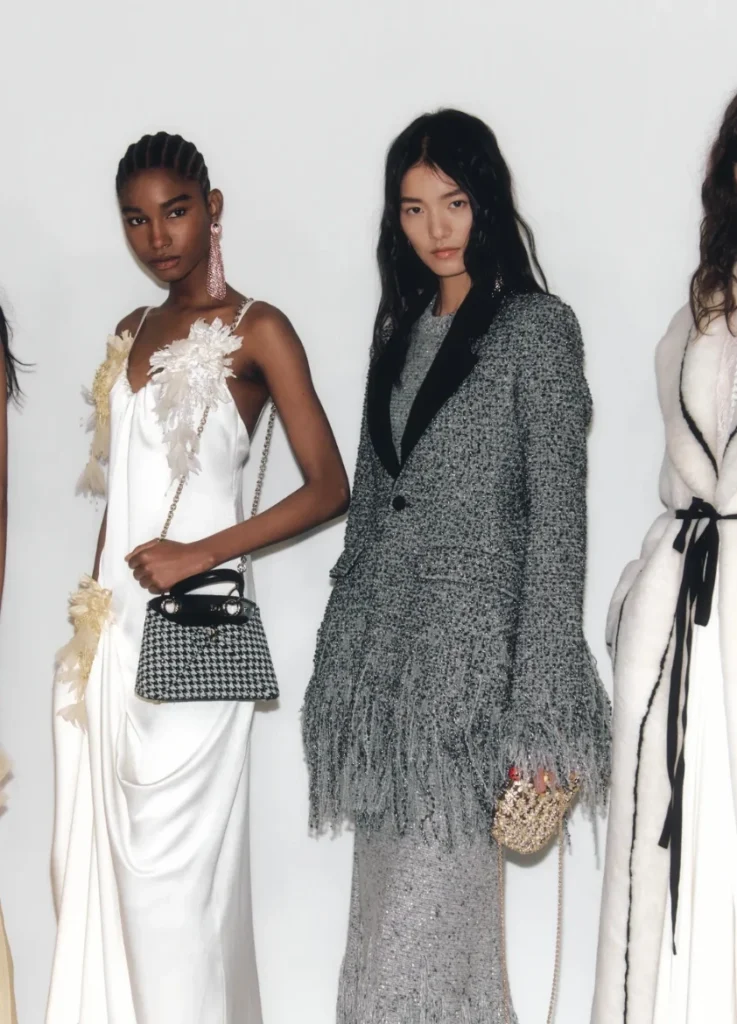
The most legible case is the Bar jacket. The collection clearly invoked Dior’s most structural symbol, but not in the canonical way. The traditional New Look discipline — sharp waist suppression, sculptural hip emphasis, body-as-architecture — has been softened. Proportions flow rather than insist.
Some edges are finished slightly less than perfectly. A blue beading detail glows like a worn surface rather than a new one. Across the collection, Dior history was not preserved under glass; it was treated as memory that has been used. The Galliano newsprint print returning on the bow bag belongs to the same gesture. The past is cited rather than restored, brought forward as something already once-handled.
Surface as stage
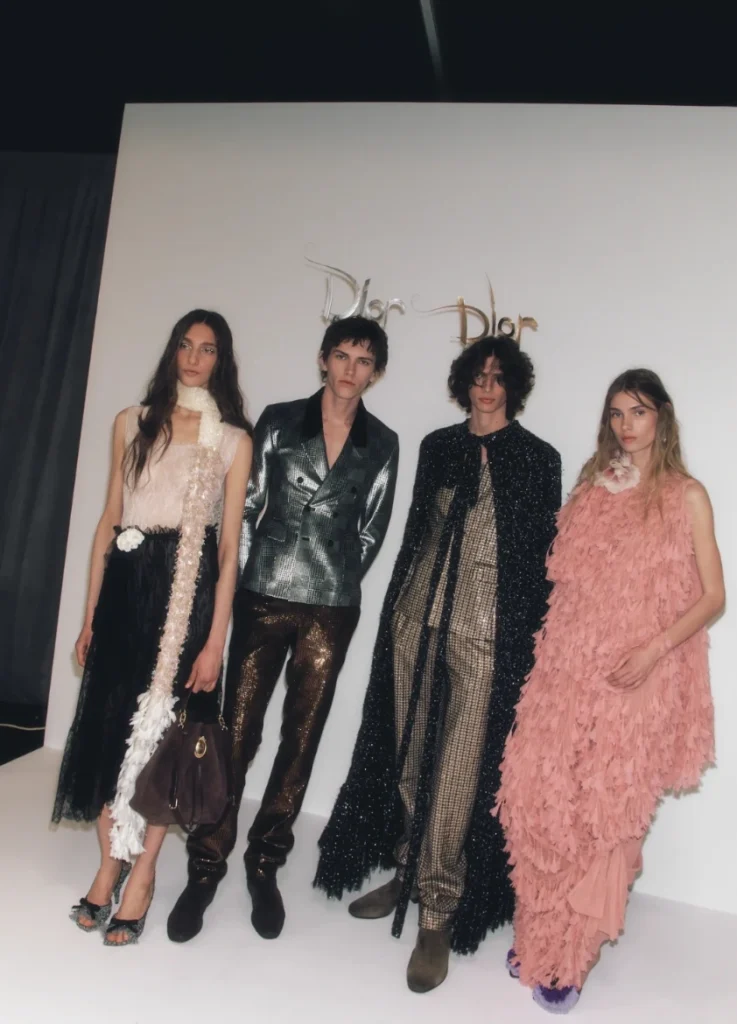
A second pattern: nearly every surface in the collection is doing something with light. Beading on the dresses, shimmer in the makeup, lacquered sunglasses, decorative density on the accessories — surface here functions less as finish than as emotional device. The headpieces twist feathers into recognizable words — “Dior,” “Flow,” “Buzz” — letting the clothing wear something close to language. Decoration is not ornamental; it places the wearer inside a frame, as if entering a scene rather than a photograph. The surrealist accessory grammar Anderson has worked with for years arrives here on top of Dior house codes rather than next to them. The point is the collision: Dior’s traditional refinement and Anderson’s stranger sensibility on the same surface at the same time.
Character before customer
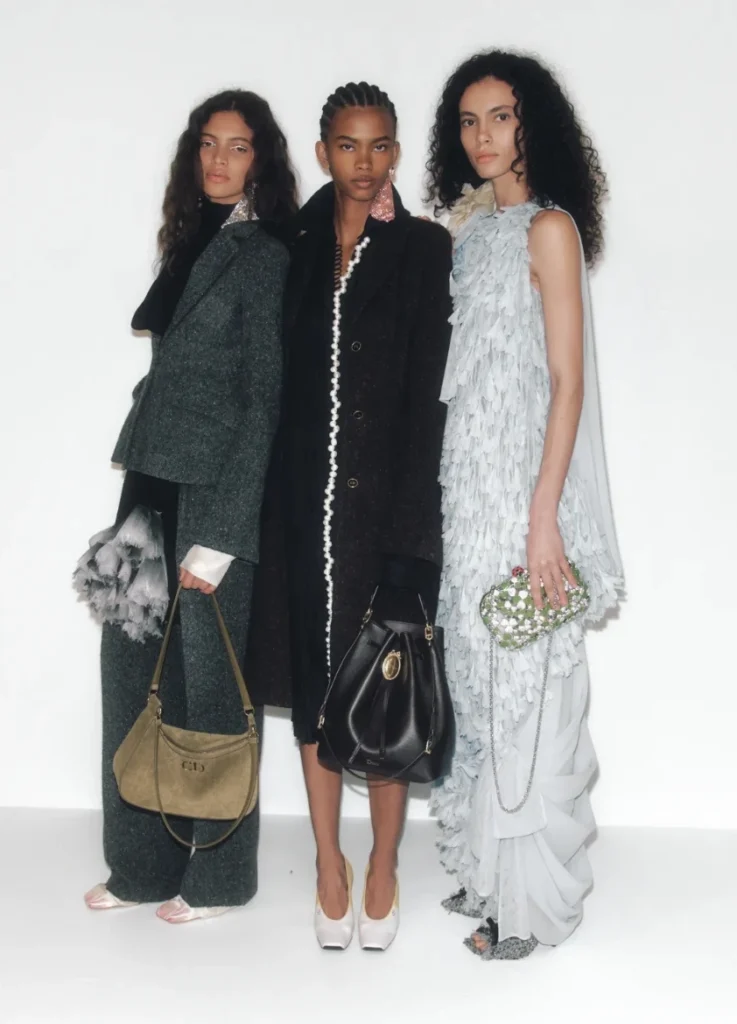
The third operation is the styling itself. The runway behaved more like a casting session than a presentation. Each model carried a specific character cue, and the menswear-leaning looks were a particularly important device. Sharp-shadowed tailoring, gray wool flannel familiar from noir, long and lean double-breasted coats — these were not styling choices so much as backstory worn outward. The clothes established the character before a word was spoken.
The collection’s first task, in other words, is identity. Product comes later.
What the Cruise Used to Sell
The deeper shift here is not in the clothes themselves but in what kind of fantasy the cruise genre has been engineered to sell. Cruise collections historically traded in travel — the wardrobe of someone arriving somewhere warm and elegant. Anderson’s first cruise rewrites the genre’s underlying fantasy. The wardrobe is no longer “for going somewhere.” It is “for being someone.”
The collection notes pushed the move further. Written as a fantasy film script, with Anderson stepping in as narrator, they do not describe products. They describe scenes. The runway, by extension, did not present a wardrobe; it staged a sequence of people who could be cast.
The references back this up. The starting point was the 1949 Dior haute couture jacket that Marlene Dietrich wore in Hitchcock’s Stage Fright. To that, Anderson layered California poppies, the American visual idiom of Ed Ruscha, the residue of old Hollywood leading ladies, and the word Christian Dior himself used for an entire career — dream.
The references are layered rather than simply collaged. The dream Dior has historically sold, the fantasy Hollywood has historically sold, and Anderson’s own cinematic imagination converge in a single structure. When the Galliano newsprint reappears on the bow bag, it does so as a citation of the house’s most theatrical chapter, treating Dior’s past as an editable archive rather than a fixed image.
Looks │ The Bar Jacket, Loosened
The most consequential silhouette change in the collection is in the Bar jacket. At Dior the Bar jacket is the structural symbol — the 1947 New Look compressed into a single piece, a way of seeing the female body that has organized the house for nearly eight decades. Cinched waist, sculpted hip, redrawn proportion. Beautiful, but architecturally demanding.
Anderson does not restore that structure. He keeps its memory.
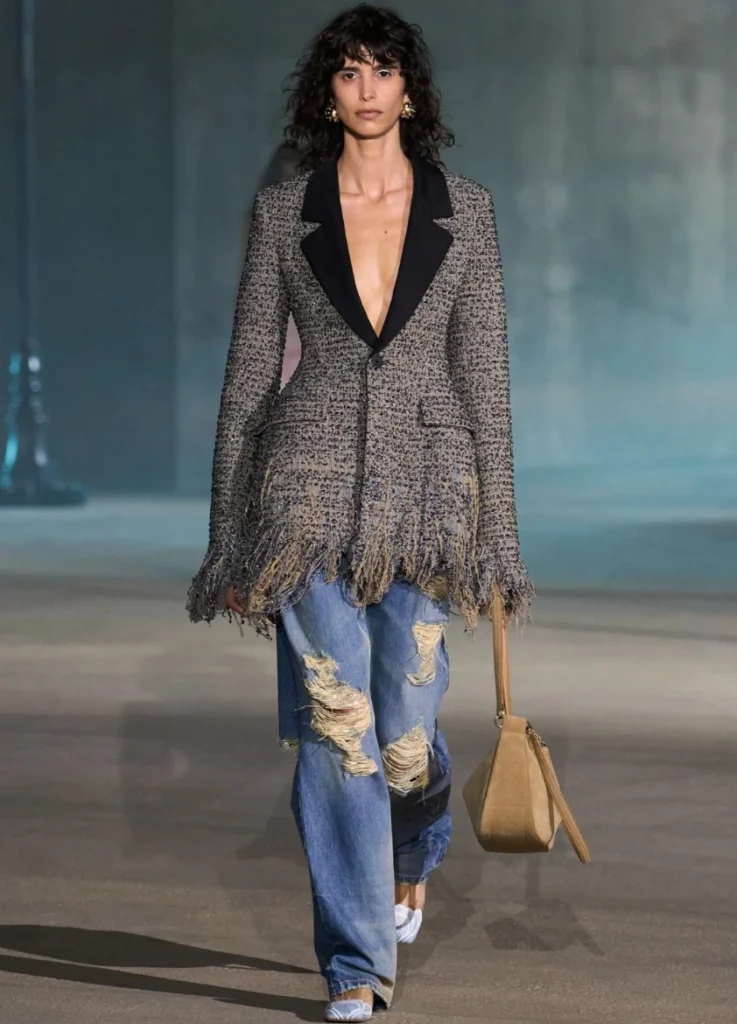
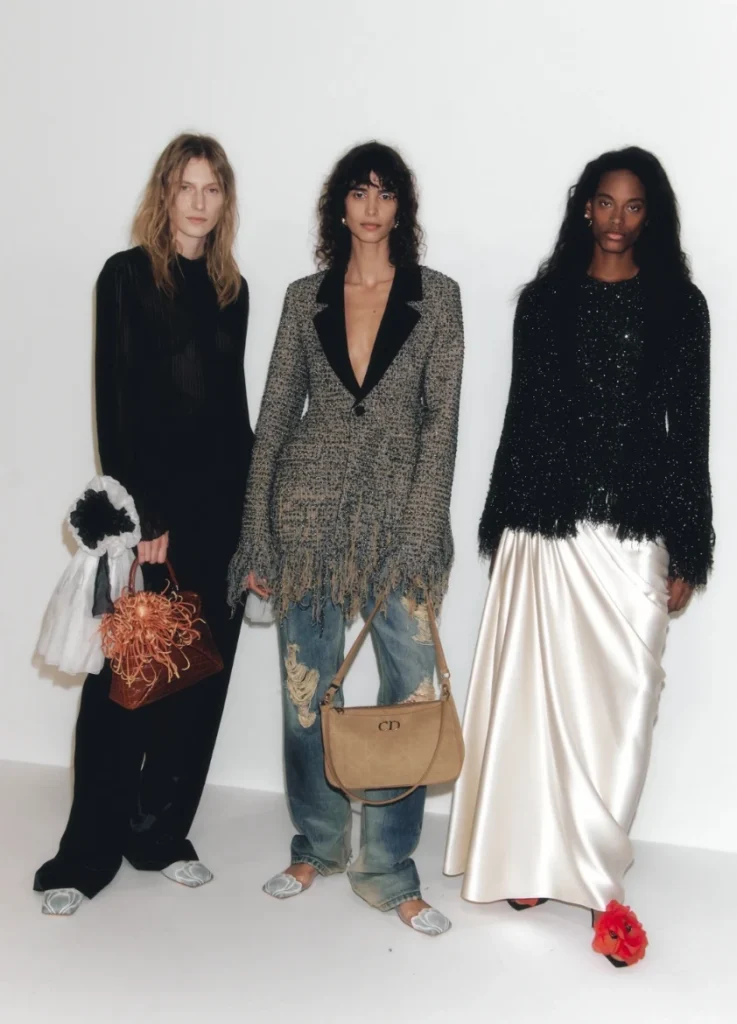
A gray tailored look made the shift visible. Shoulders unexaggerated. Lapels cut deep, drawing the torso longer. A waist that exists but does not bite. The traditional Bar would have pulled the side seams inward sharply, then broken into volume at the hip. The Cruise version lets the jacket front and the skirt below meet in a softer continuity, suggesting the waist without enforcing it. The symbol is preserved. The bodily discipline that came with it is not.
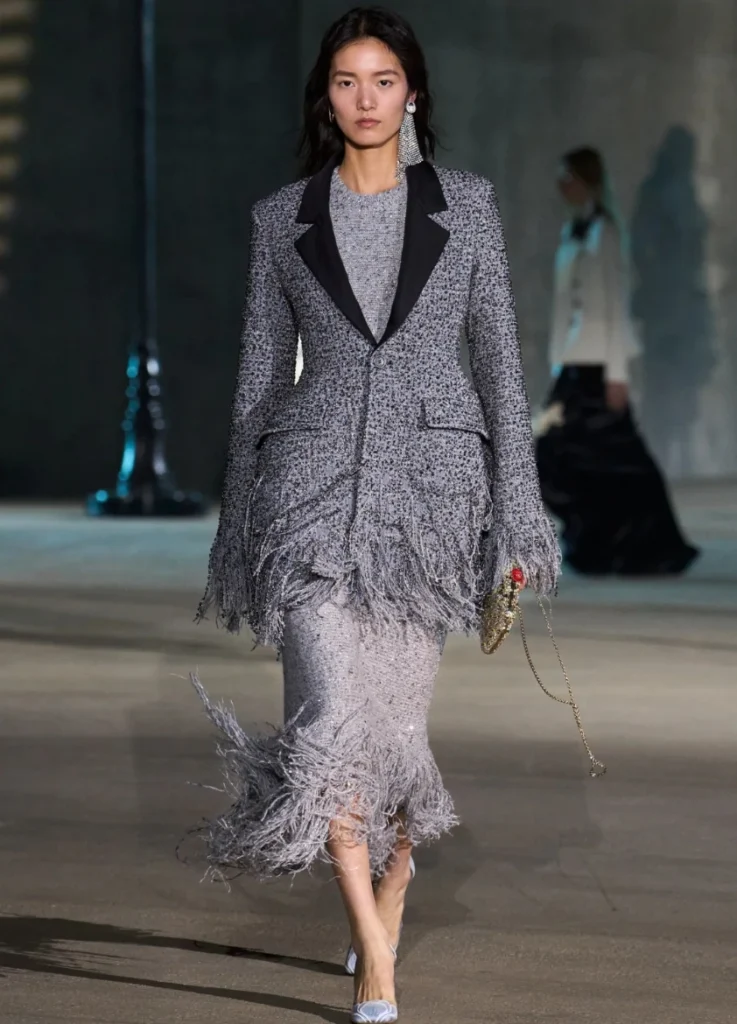
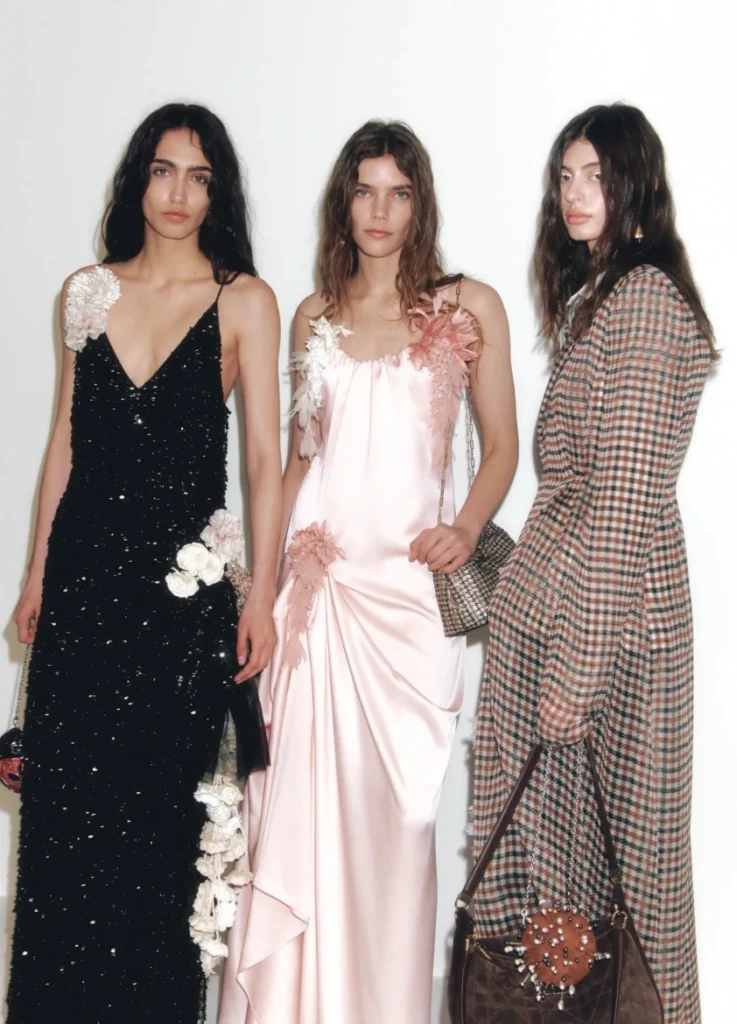
A houndstooth jacket over a chiffon slip offered the same logic. The outer coat speaks Dior’s public language — neat check, double-breasted structure, full length, house decorum. Inside is a more private garment — thin chiffon, an almost unfinished feeling at the hem, movement that refuses to settle into the coat’s discipline. The exterior holds the house. The interior loosens it. The contrast is the point.
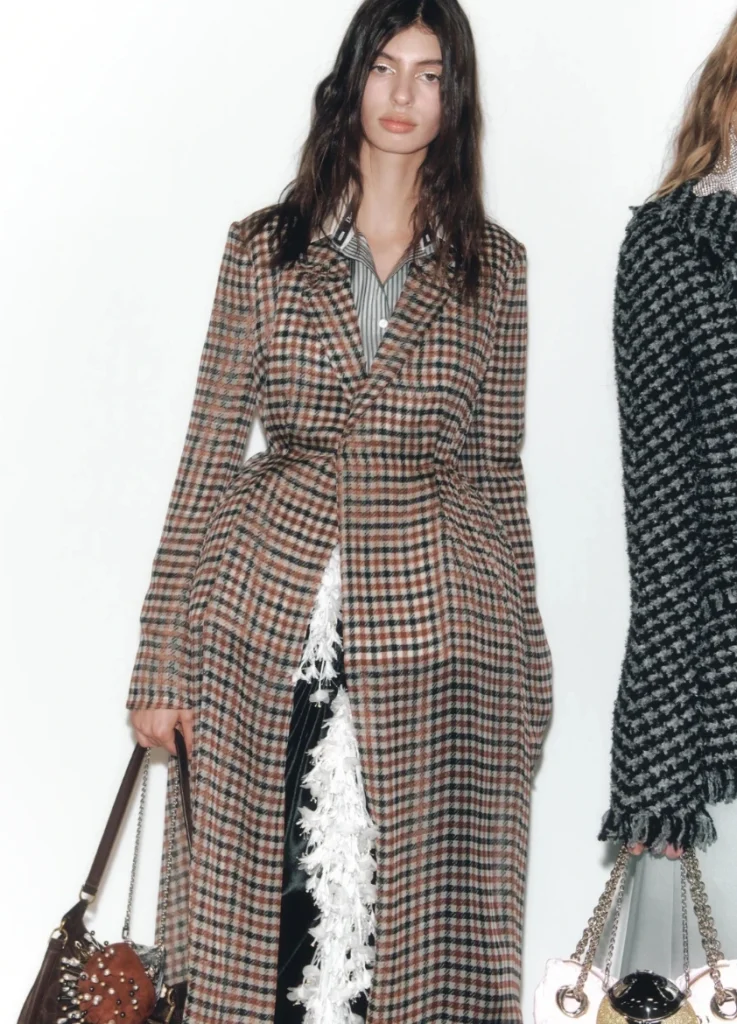
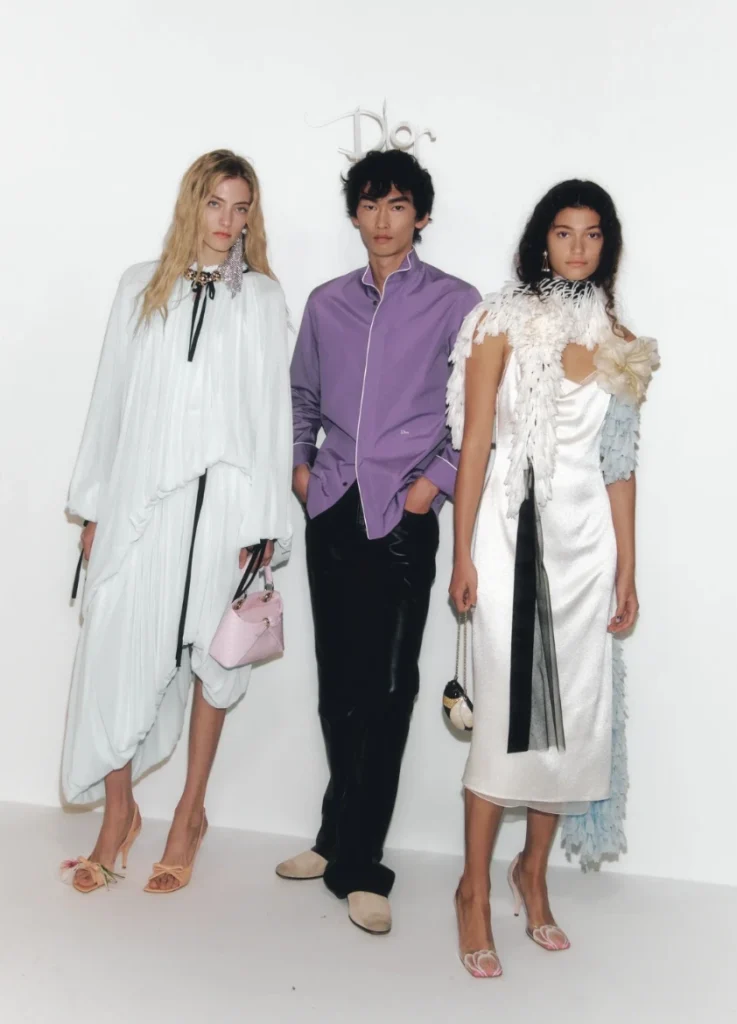
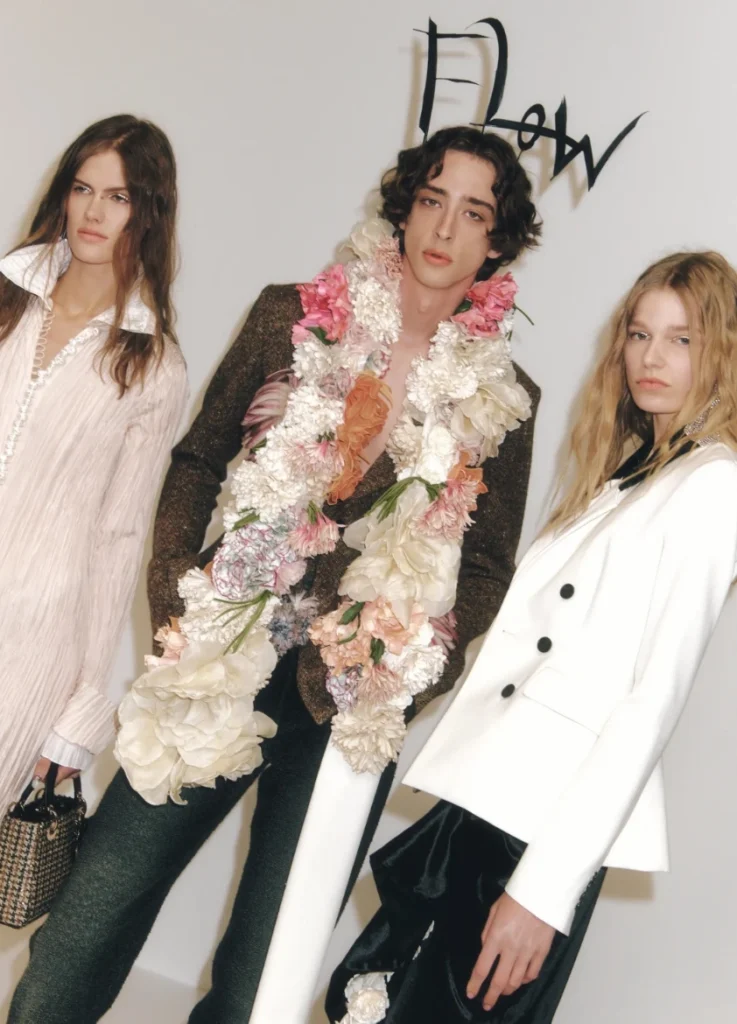
A white tailored look reads, at first, as direct descent from the Bar. Closer in, the discipline relaxes. The closure is neat, the line tidy, but the waist suppression is gentle. A long black skirt below stretches the verticals and softens the bodice further. The decision is house-aware and commercially aware at once. The symbol survives. The wearer is no longer asked to perform it.
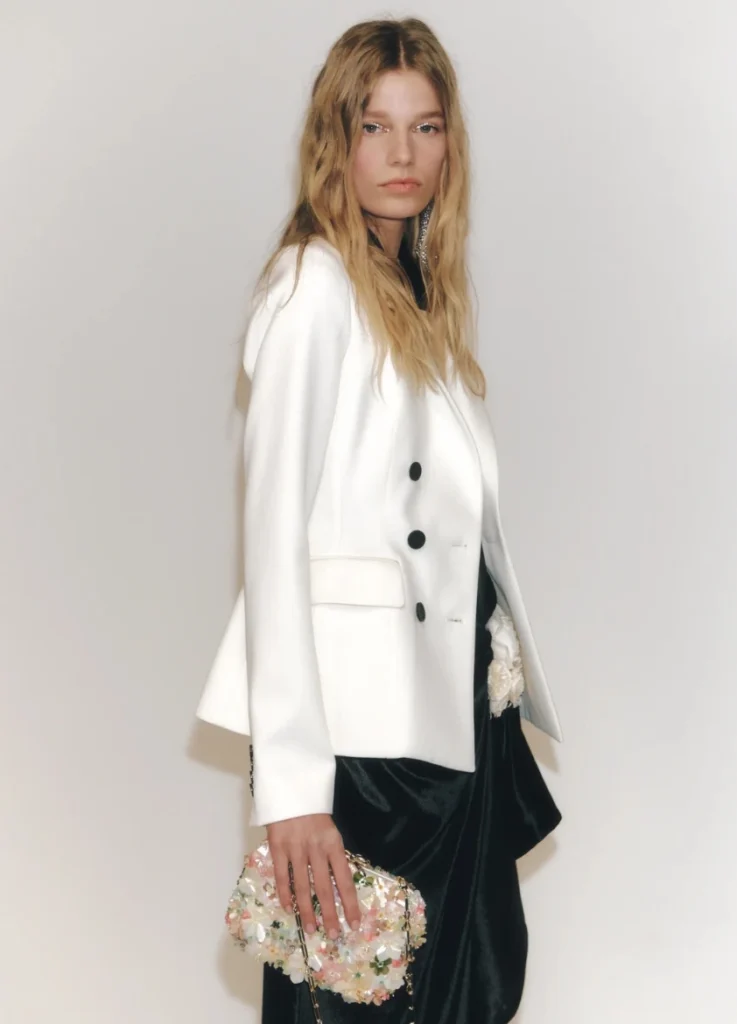
Looks │ The Drape, Emotionalized
If the tailoring carried Dior’s structure, the drape carried the season’s feeling.
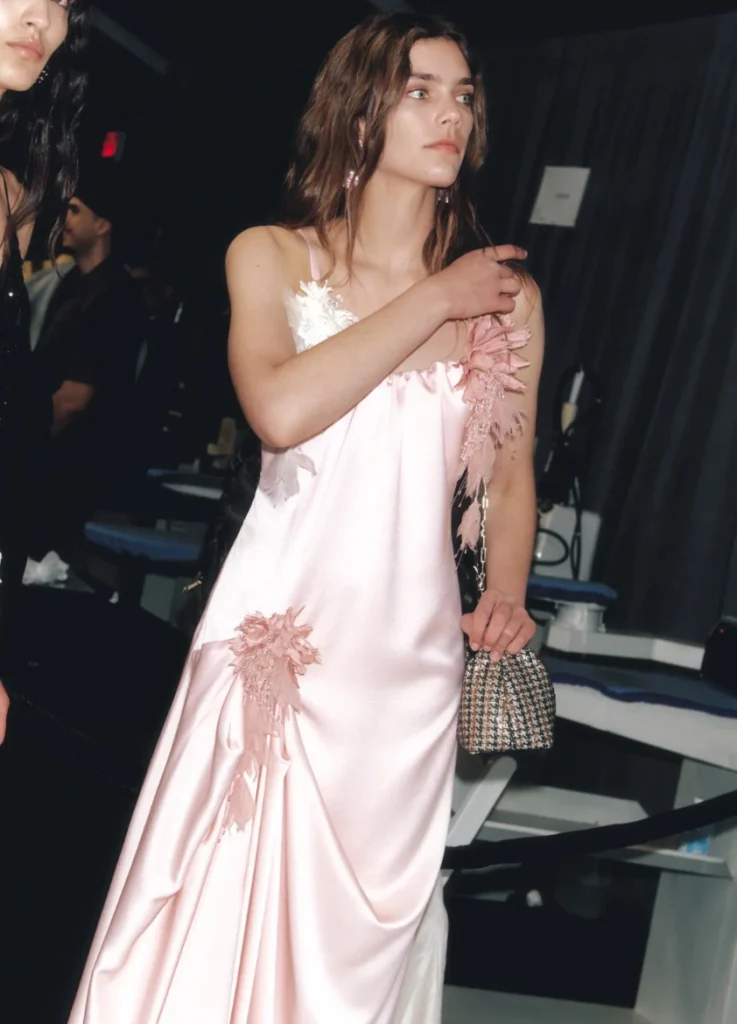
A pink draped dress made the emotional case most clearly. A flower-like construction sits at one shoulder; the fabric collects through the waist and falls. The dress does not finish at the camera. It looks like the dress of an actress who has just left her makeup chair after a long shoot — composed, but not entirely composed; glamorous, but with a layer of tiredness in the expression. The staging supports it. The shoulder ornament pulls the eye up; the drape carries the eye down the body. The upper half is theatrical. The lower half is private. That contrast organizes most of the collection.
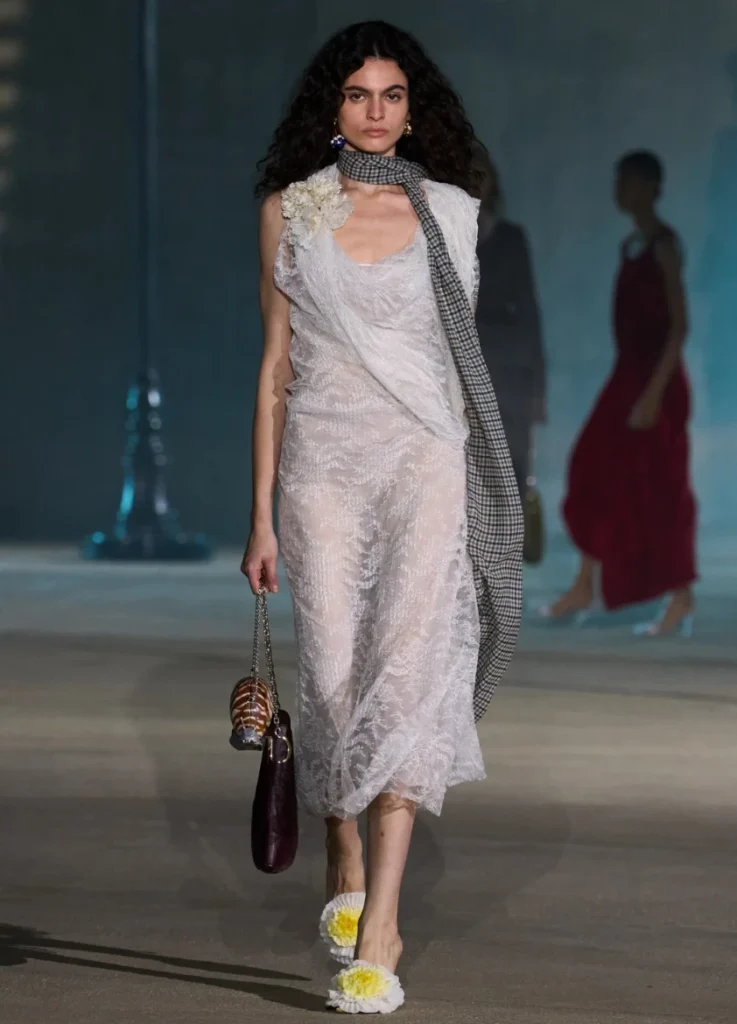
A white satin slip with pale blue feather trim does something more delicate. The decoration on the shoulder and hem is not embroidery; it moves. The dress does not complete itself in stillness, only when the wearer walks. Dior’s floral code arrives here without flowers. It arrives as a small tremor. The decorative impulse Anderson developed at Loewe — objects rather than ornaments — lands inside the house, but quieted by Dior’s grammar rather than amplified through it.
A red bias gown is the most cinematic. The color is strong; the construction is unexpectedly restrained. No competing ruffles, no decorative overload — the fabric and the saturation carry the dress alone. It is not a resort dress. It is a memory of a film frame. The matching floral clutch the model carried operated less as accessory than as character object.
Looks │ Menswear as Disruption
Menswear language plays a more important role here than the usual “androgynous tailoring” reading would suggest. Anderson did not bring menswear in to dilute Dior’s femininity. He brought it in to interrupt completion. Dior’s traditional image of completed femininity — sealed, perfected, ready — gets resisted by the looser body of menswear.
A patchworked denim and oversized shirt look made the case. The faded denim carries vintage-looking embroidery and visible wear, though not the actual collapse of a long-worn garment. The shirt looks like a basic men’s shirt, but its shoulders, length, and collar are scaled with intent. The piece looks as though it already belongs to someone’s wardrobe. In practice, the proportions are tuned.
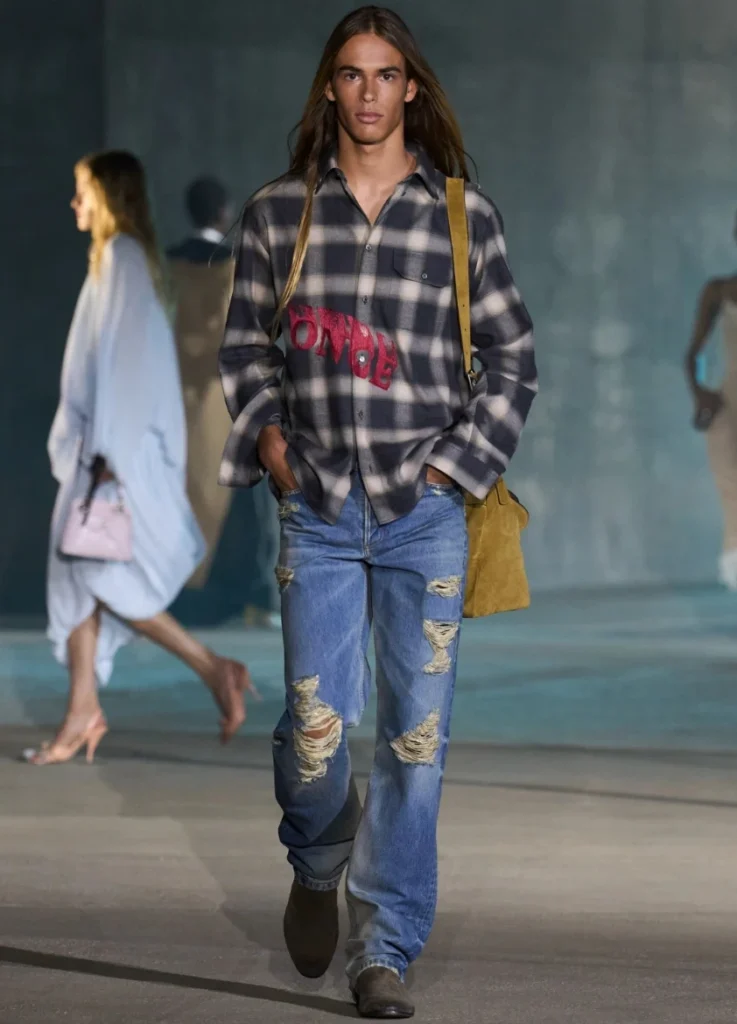
The expansion that matters is not the garment — it is the range of people Dior is willing to dress. Dior has long built around an idealized femininity, or around women who already occupy a social position. The denim look brings a different cast: the aspiring writer, the indie director, the studio assistant, the figure who has not yet been cast at all. Hollywood was not built on its leading women alone. It was built on the people circling them. Cruise 2027 lets that secondary layer onto the runway.
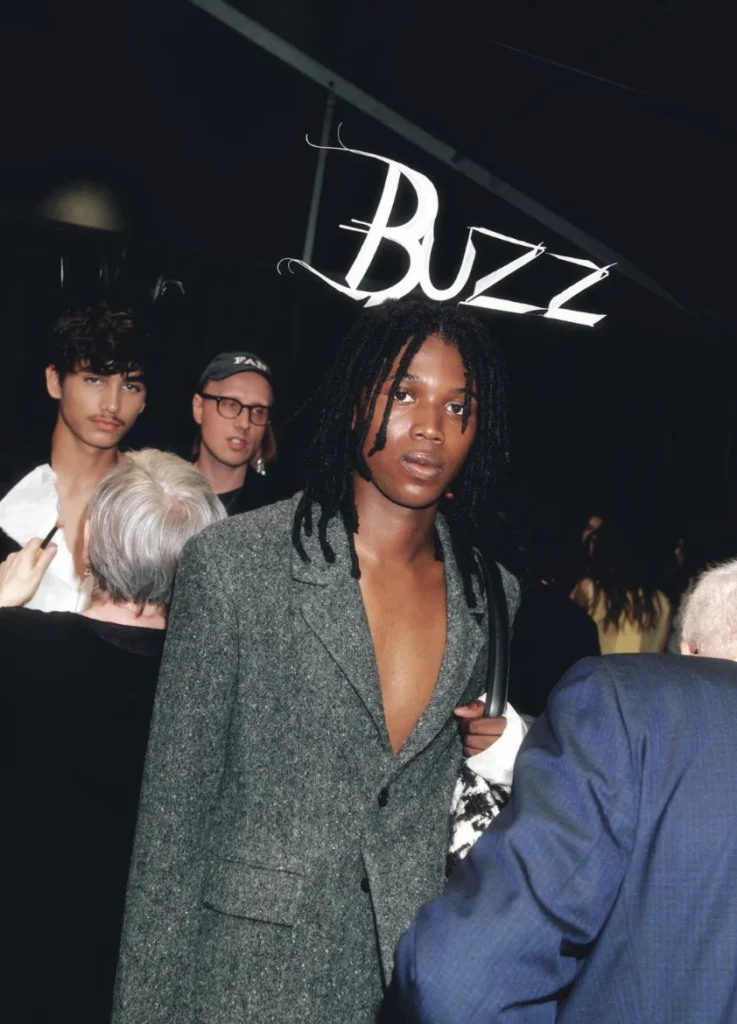
The “Buzz” headpiece look stands at the peak of this thread. A gray herringbone double-breasted suit and wide trousers carry the noir mood; a houndstooth bag pushes the look further toward menswear vocabulary. Then the headpiece arrives — feathers twisted into the word Buzz — and the suit stops behaving like clean tailoring. The wearer is no longer wearing a suit. She is walking with a word on her head. Decoration moves from finish to concept. The look becomes one of the collection’s clearest emblems: menswear structure plus Dior’s check plus Hollywood’s industry noise, condensed into a single image.
Excess │ What Lands, What Doesn’t
The collection has weakness, and it is worth saying directly. The weakness is not that there is too much. It is that some of the excess does not connect to the body underneath it.
The opening look — pearl beading with feather elements — sits among the successful examples of excess. Light glances off the surface when the wearer is still; the decoration trembles when she moves. California sun meets Hollywood surface, and the ornament behaves architecturally rather than additively. The decoration shapes how the body is seen.
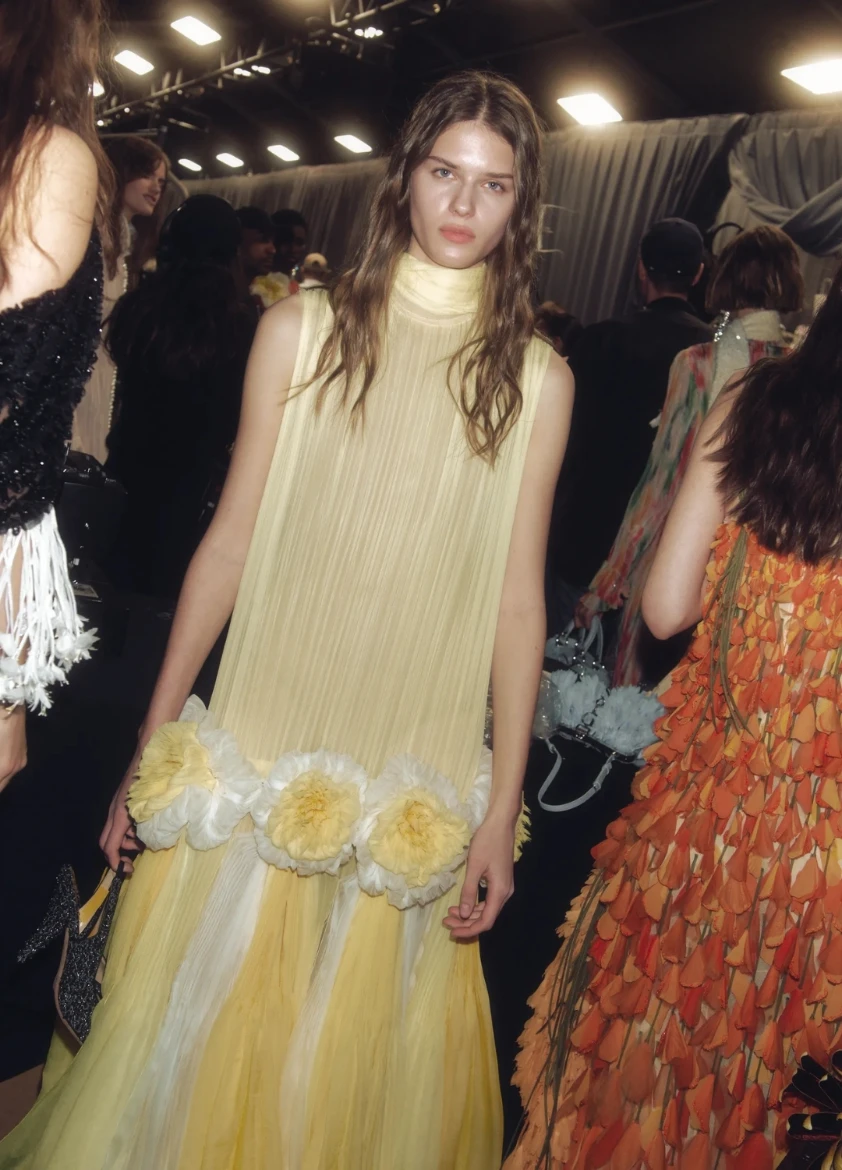
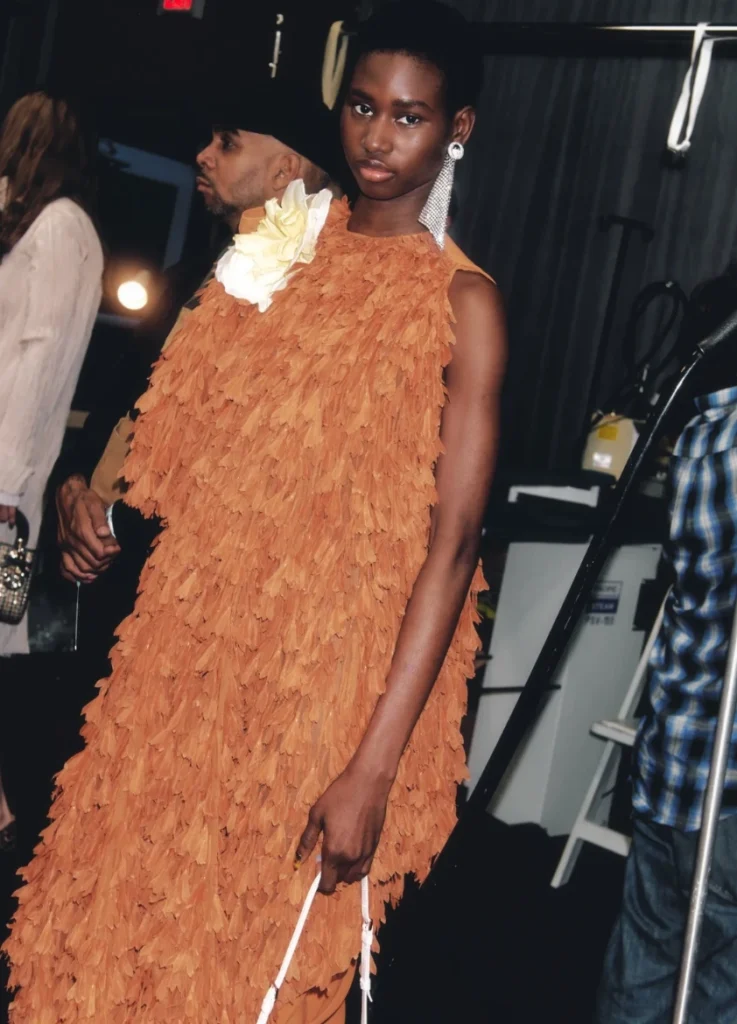
The orange petal-textured dress is a harder call. From a distance, it is dramatic. Up close, the surface ornament arrives before the silhouette does. Strong excess re-proportions the body. Weaker excess covers it. A few looks in the collection sit on the wrong side of that line — the image holds, but the garment loses coherence.
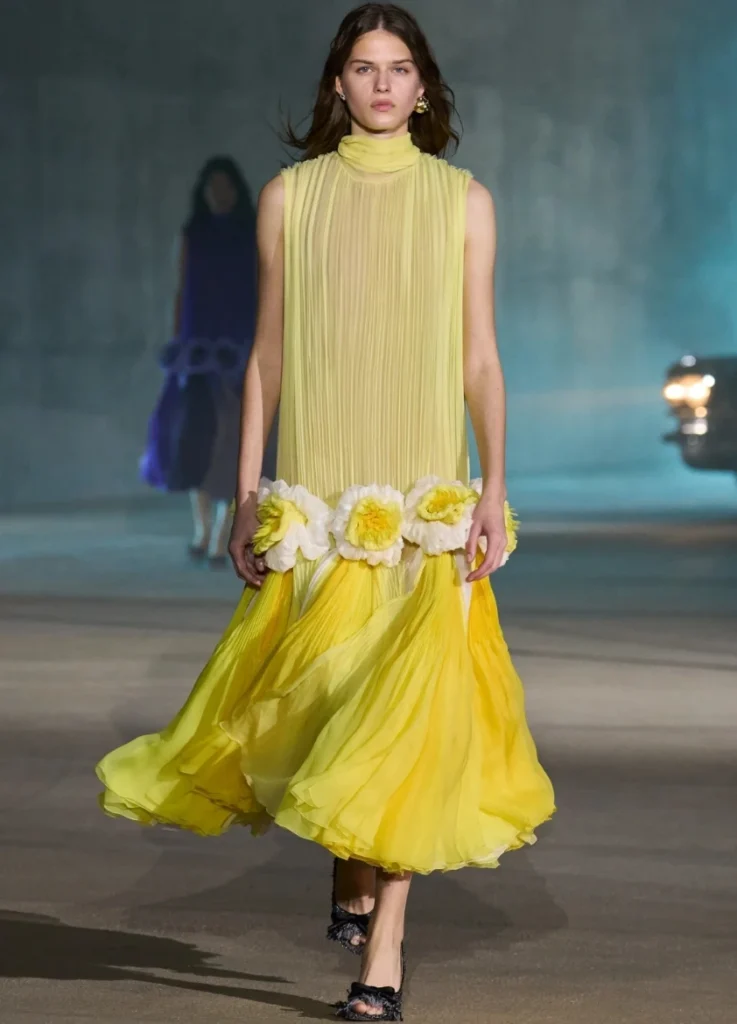
A handful of looks with yellow floral decoration around the waist sit at a similar edge. The California-poppy mood is present, and the seasonal reference lands. But the placement adds visual weight to the body’s middle rather than re-explaining it. Dior’s waistline has always been the house’s central architectural axis. When decoration does not reinforce that axis precisely, the proportion blurs rather than sharpens.
The collection’s decorative logic divides cleanly. Decoration that introduces movement carries the look. Decoration that only adds surface area does not.
Accessories │ Closer to Commerce
Where the clothes are theatrical, the accessories are commercial. The runway is character-driven; the bags are not.
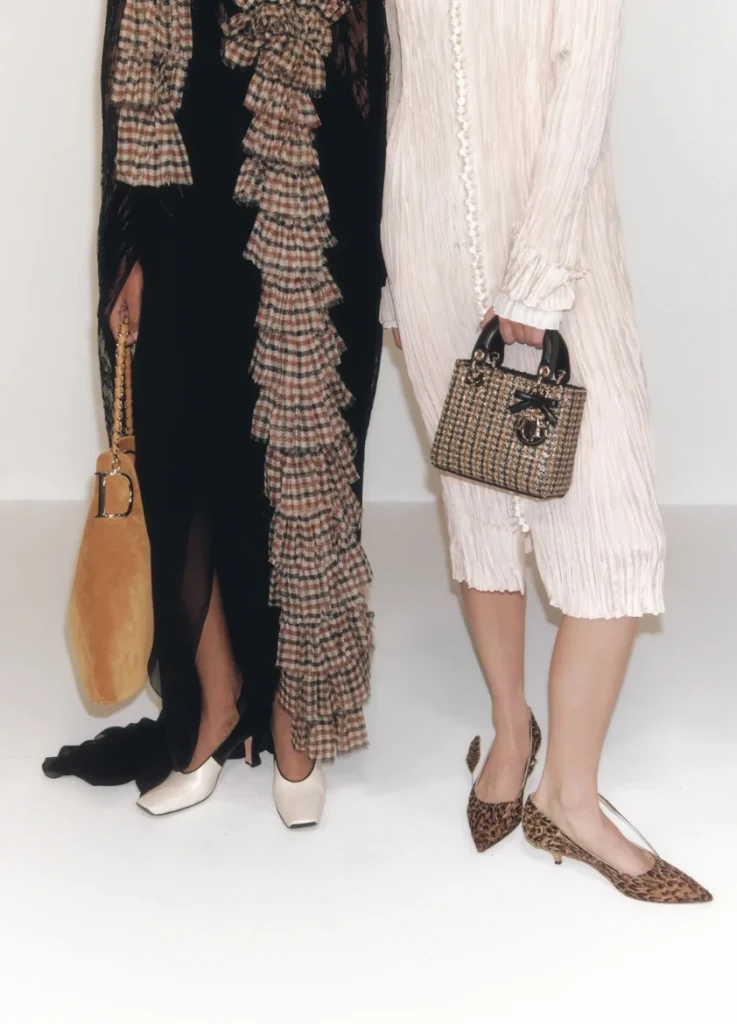
The Lady Dior arrives in houndstooth. The Saddle takes on a padded surface. The bow bag carries the Galliano-era newsprint — less as homage than as the house’s archive being reopened and reworked for current product. Anderson does not treat Dior’s past as an exhibit. He treats it as inventory.
The miniature object bags — snail, ladybug, hedgehog — sit elsewhere on the spectrum. These are not volume bags. They are symbolic devices, the kind of object that makes the brand memorable rather than the kind of object that drives revenue. The commercial fact of a Dior season is that revenue tends to come from the stable bag families and the tailored product. Brand memory tends to come from the unexpected objects. Anderson appears comfortable letting those two functions run on different tracks.
The commercial layer of Cruise 2027 is, in that sense, clear-eyed. The runway proposes characters. The store proposes products. The two do not have to overlap completely. But they cannot fully separate either, and Anderson appears to know it.
Where Anderson’s Dior Goes From Here
The collection is closer to a direction than a finished destination. After roughly a year inside the house, Anderson has visibly absorbed Dior’s vocabulary — the Bar jacket, the Hollywood reference, the Galliano theatricality, the floral and houndstooth codes, the Lady Dior and Saddle bag — and he has chosen to rearrange rather than reconstruct it.
Dior’s femininity no longer fixes into one ideal silhouette. It flows in places, collides with menswear in others, takes on the look of vintage film costume in others again, and occasionally pushes its own ornament past the point where it is supported by the garment underneath. Those variations are themselves part of what Anderson is testing. Cruise 2027 reads as an exploration of how much range the house will allow.
The weaknesses are present. Some looks promised a density the construction did not fully support; certain decorative choices sat closer to image production than to garment design; the menswear voice was not always fully absorbed into Dior’s femininity. But the larger risk for a first cruise is not excess but neutrality. A safe Dior would have been graceful and unmemorable. This is not that.
What this collection most clearly changes is the way the house operates narratively. Maria Grazia Chiuri’s Dior worked through message and symbol — femininity argued for. Anderson’s Dior works through character and scene — femininity put on. The method is uneven so far. The direction is not.
Cruise 2027 did not show a holiday wardrobe. It used LA as a stage for the desire to become someone else, and it dressed the desire rather than the destination.
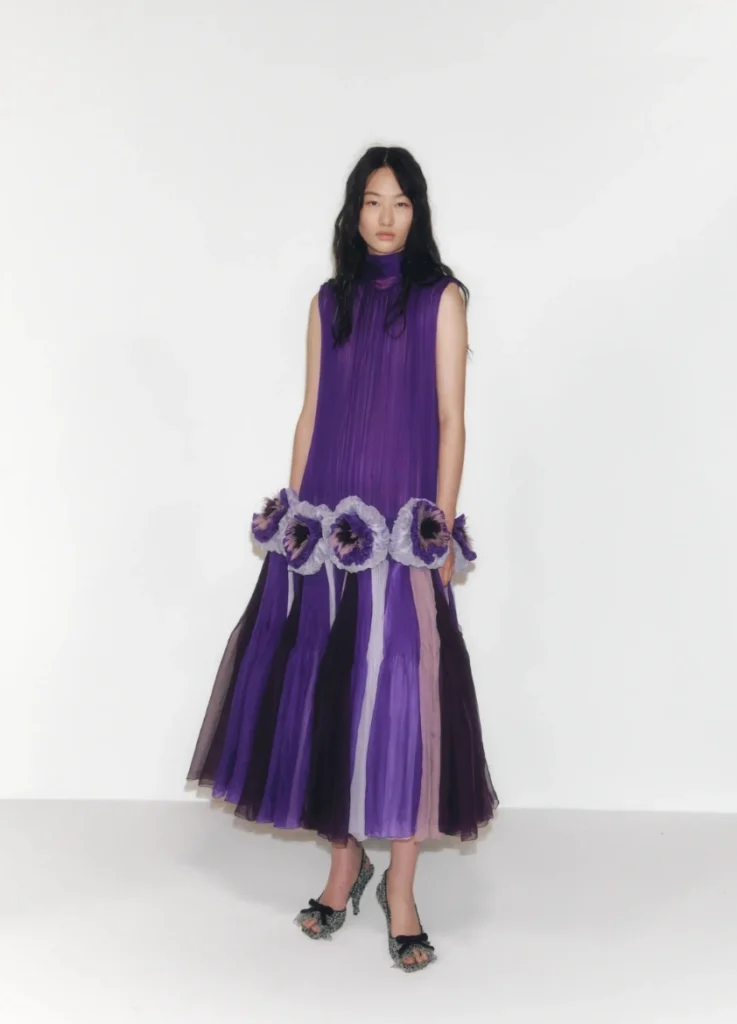
All images referenced in this post are drawn from Vogue Runway.
[ Related Editorials ]
- The Newspaper Bag at Dior │ Reading Anderson’s First Cruise 2027
- Dior Fall 2026 In-Person Review │ Anderson’s Reading of Bar, Bow, Lace, and Cannage in Real Wear
- Dior 2026SS Bags | Jonathan Anderson’s First Bag Line-Up — Structure as Strategy
- Dior Fall/Winter 2026 RTW Review – Light Over Water and the Return of Structure