On Proportion, Craft, and the Watches That Age Better Than We Do
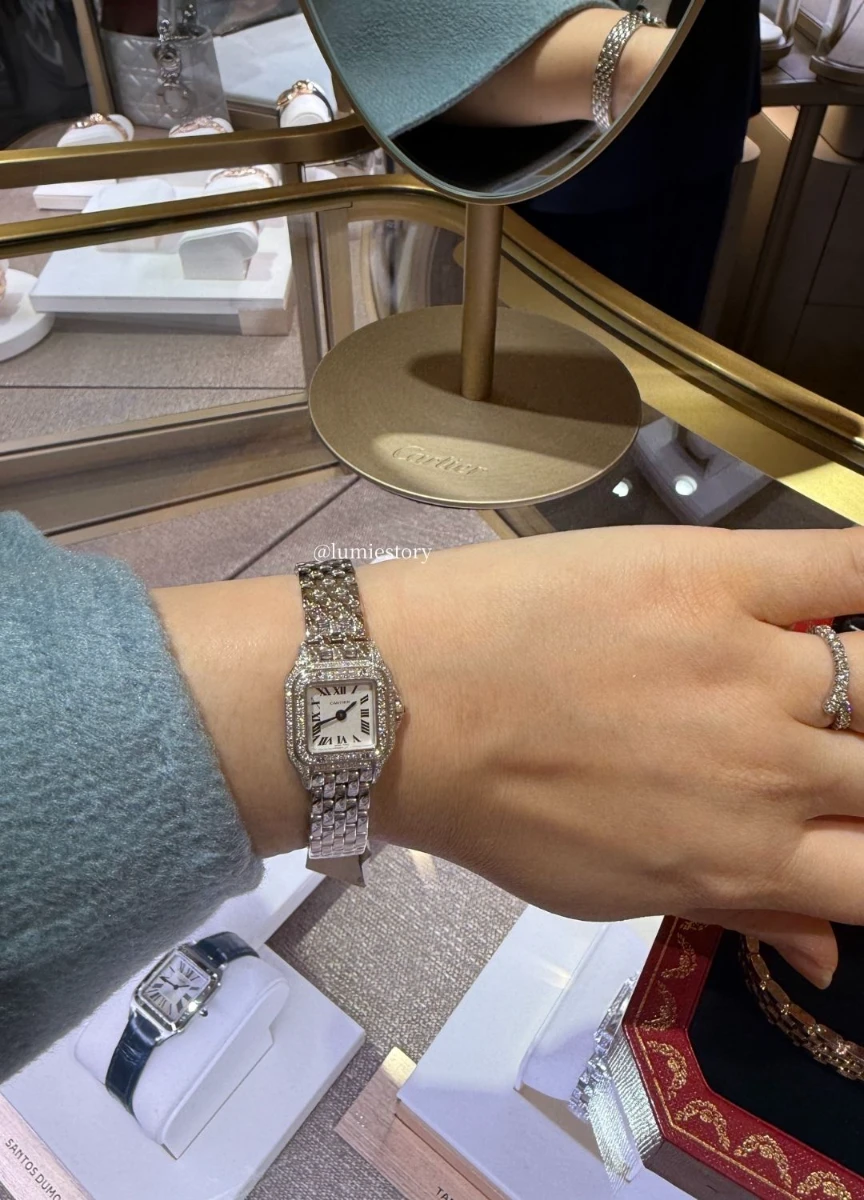
The Panthère sits in a rare zone within Cartier’s catalogue — one of the few lines where the boundary between watch and bracelet jewelry actually dissolves on the wrist.
That’s why choosing a Panthère starts somewhere different from most watch decisions. The first questions aren’t about dial size or movement. They concern how the links curve around your wrist, where the case settles, and whether the proportions hold up when your hand changes shape over the years.
Cartier has been expanding the Mini lineup recently. The Panthère Mini Semi-Pavé — released in white gold and rose gold — gives a clean comparison point against the Small Panthère. They share a name, but wear very differently.
Here’s how I’d think about the choice — proportion conditions, the semi-pavé question, what changes as hands age, and who I’d genuinely not recommend this watch to.
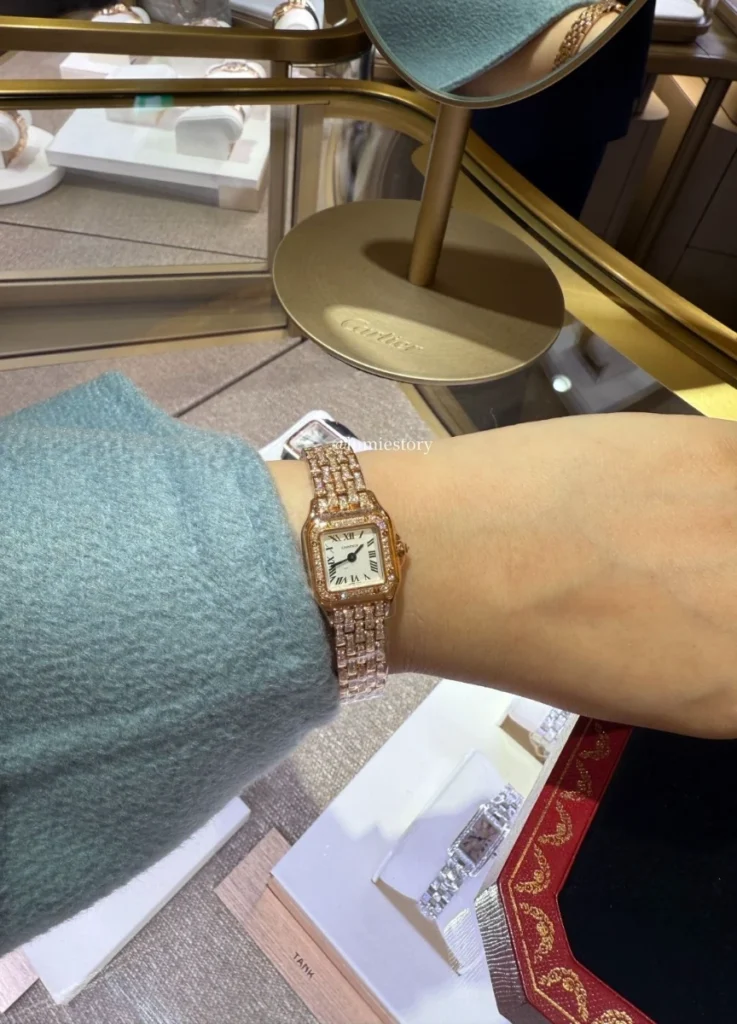
$38,600
18K rose gold (750/1000) case set with 32 brilliant-cut diamonds totaling 0.15 carats.
Dimensions: 25 mm x 20 mm, thickness: 6 mm.
18K rose gold (750/1000) octagonal crown set with a brilliant-cut diamond totaling 0.02 carats.
Silvered dial, blued-steel sword-shaped hands.
18K rose gold (750/1000) bracelet semi-set with 142 brilliant-cut diamonds totaling 0.90 carats.
Water-resistant up to 3 bar (approx. 30 meters/100 feet).
photograph by Lumie
Why the Panthère Is Decided by the Bracelet, Not the Case
The Panthère’s defining feature isn’t the dial. It’s the bracelet structure.
Each link is built to move independently, which lets the bracelet follow the wrist’s natural curvature rather than imposing a geometry on it.
That structural logic matters more on smaller wrists. The difference between Mini and Small on a 14cm wrist isn’t really millimeter-level. It comes down to how much wrist surface the watch occupies.
The Panthère’s perceived size is set by the band’s wrist-coverage, with dial size as a secondary variable. What you’re really choosing between is how much wrist real estate the watch claims.
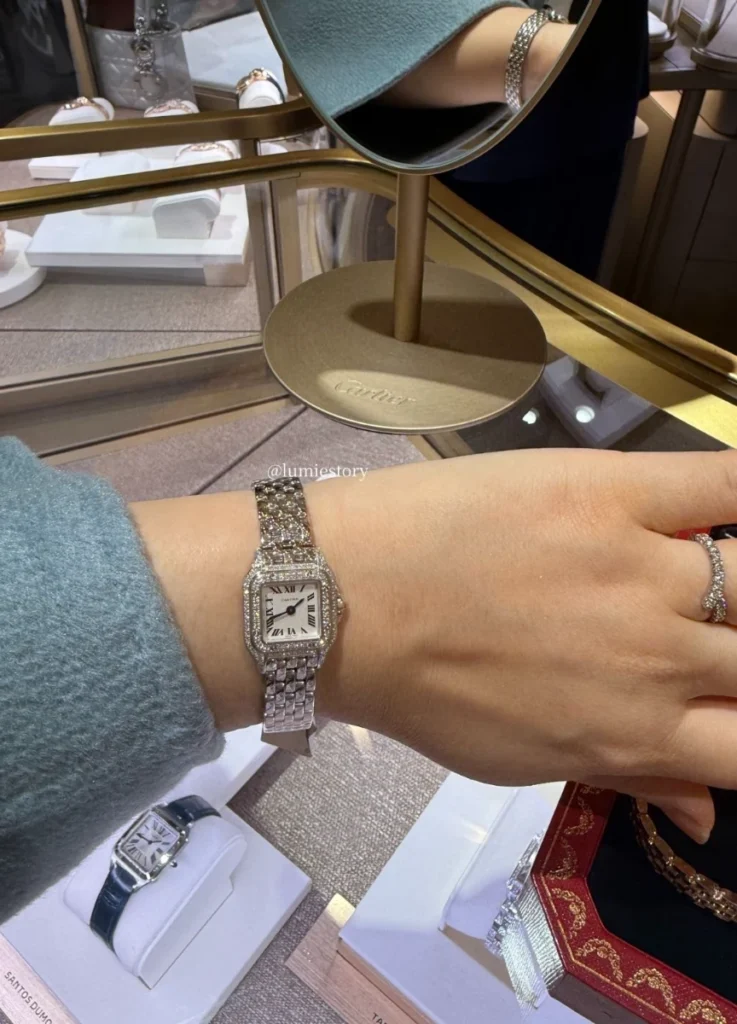
photograph by Lumie
Body Conditions Where the Mini Sits Best
The Mini works most cleanly on three body conditions, and they tend to compound on each other.
Wrist around 14cm, soft contour
A thin wrist tends to run into one of two issues with a watch this proportional. Either the case sits high and looks like it’s floating off the wrist, or the band covers too much wrist surface and starts feeling like a cuff.
The Mini’s narrower link width and smaller case keep negative space between the wrist bone and the back of the hand. That empty space is what lets the watch read as jewelry on the wrist, instead of as a band stretched across it.
When that space disappears, the watch shifts from accompanying the wrist to dominating it.
Short forearm, short wrist-to-knuckle distance
Shorter arms often come with a shorter distance between wrist and back of hand. In that proportion, a larger case and link width can block the visual transition between wrist and hand — the watch becomes a horizontal line cutting across the top of the arm rather than sitting cleanly on the wrist.
The Mini sits at the narrowest part of the wrist without intruding into the hand area. That preserves the visual line from wrist to fingertips, which keeps the hand from looking shorter than it is.
Small or rounded hand
Round, shorter hands react to watch size in a particular way. A bigger case and bracelet on a rounded hand often amplifies the roundness — the watch and the hand read as parts of the same compact silhouette.
The Mini works against that. The Panthère’s signature Roman dial and square case become smaller graphic units in the Mini, which keeps them at detail-level rather than icon-level.
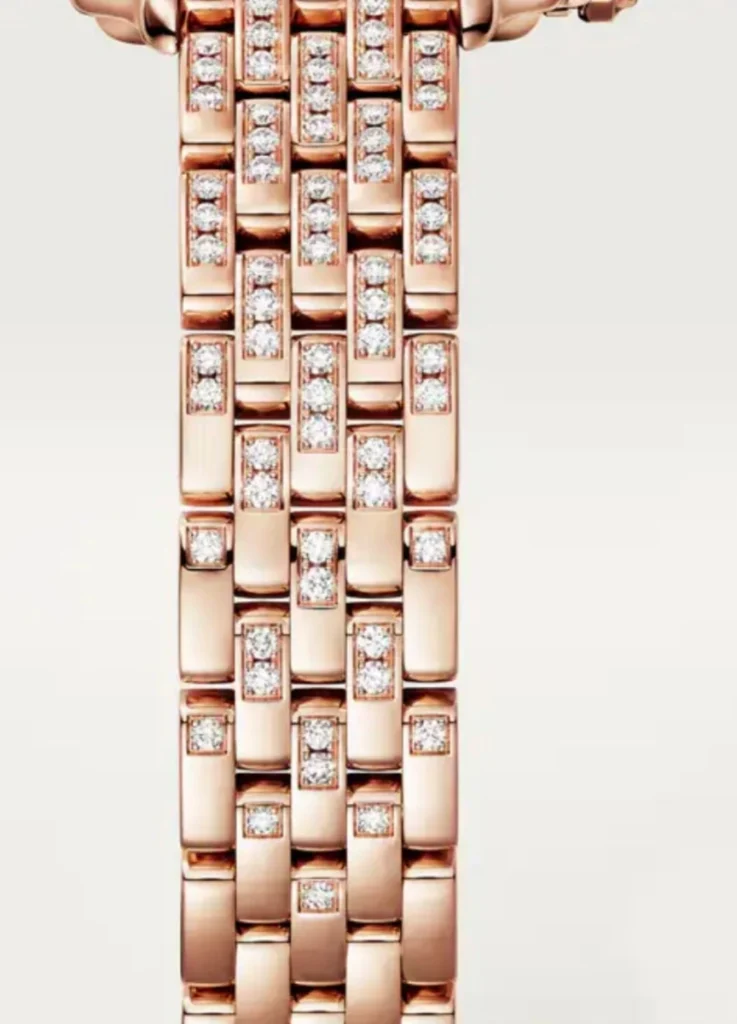
source: Cartier official website
Where the Small Yellow Gold Wins Instead
The Small Panthère in yellow gold is a powerful watch, and it deserves its reputation.
It doesn’t need diamonds. The yellow gold itself carries the jewelry-volume role on the wrist — once it’s on, the styling is essentially complete around it.
The Small Yellow Gold sits best on three different conditions:
- thin wrists with structured, linear bone shapes (the strong wristbone gives the watch an anchor point)
- longer hands or longer fingers (which carry the bigger bracelet line cleanly)
- styling that already runs bold metal hardware — chains, buckles, gold accents
For someone with a thin wrist, short arms, and overall smaller proportions, the Small Yellow Gold can flip into a different problem: the watch ends up at the center of the visual hierarchy, with everything else stepping into a supporting role.
The issue isn’t really about size. It’s about hierarchy — the watch lands at the center of the visual reading, and rings, bracelets, and outfit detailing all have to step back to support it.
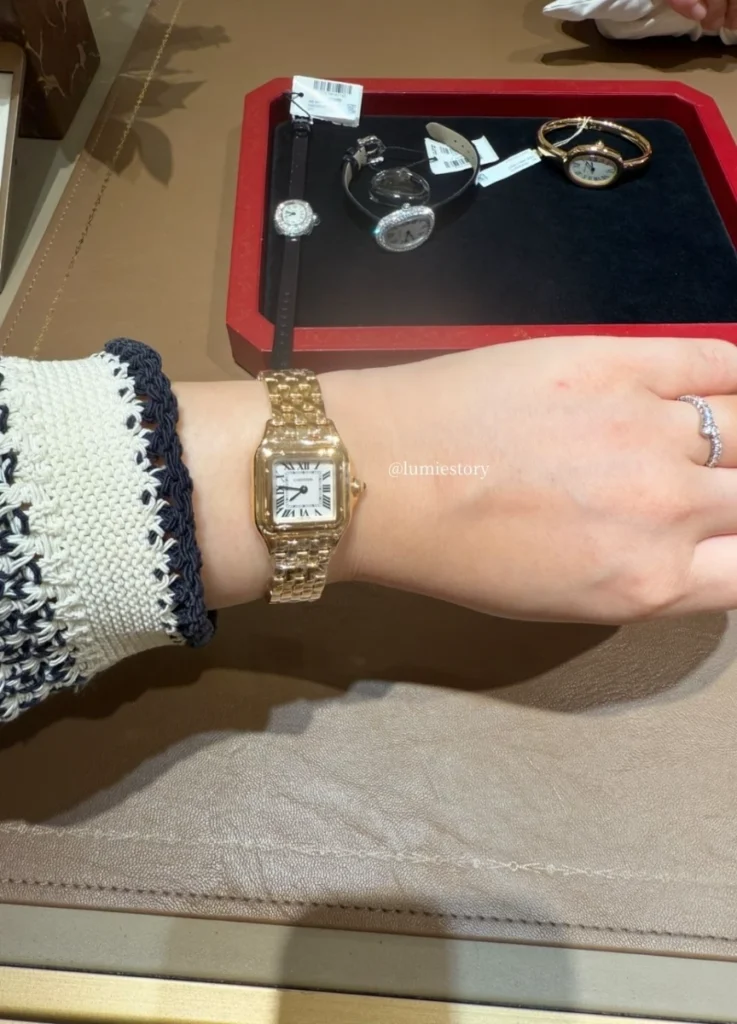
$27,000
Case in 18K yellow gold (750/1000),
dimensions: 23 mm x 30 mm, thickness: 6 mm,
crown set with a blue sapphire, silvered dial, blued-steel sword-shaped hands,
18K yellow gold (750/1000) bracelet.
Water-resistant to 3 bar (approx. 30 meters).
photograph by Lumie
How These Watches Age │ Where the Mini Quietly Wins
Watches negotiate with three changes as time passes.
1. Hand surface changes (volume loss, vein visibility)
As we age, hands tend to lose volume, the veins and tendons get more visible, and the skin gets thinner — the way it reflects light shifts.
A larger watch increases the contrast between metal and skin, which can amplify those changes. The Small Yellow Gold reflects light strongly, and that reflection draws attention to the hand’s surface texture.
The Mini Semi-Pavé works differently. The smaller case reduces the metal-skin contrast, and the diamond point-light scatters across the surface, with the soft-light effect playing well against changing skin texture.
The contrast between flat-metal light (Small YG) and diamond point-light (Mini Semi-Pavé) becomes more relevant the longer you wear the watch.
2. Wrist circumference changes / swelling variations
Wrist circumference often decreases over time, and day-to-day swelling patterns can vary more.
The Panthère’s articulated bracelet handles swelling reasonably well — the links flex with the wrist. But the Small’s wider band starts to feel more like a band than jewelry on swollen days. The Mini’s narrower link width keeps that risk lower.
3. Taste shifts: visible luxury → enduring detail
As taste matures, many people gravitate from “presence-first” pieces to choices where detail sits in the background.
The Small Yellow Gold tends to anchor the look. The Mini Semi-Pavé tends to elevate it without claiming the role of centerpiece.
So the Mini ends up being the choice that ages with the wearer — assuming the proportions match in the first place.
The Semi-Pavé Question │ Why the Mini Isn’t Cheaper
When you first see the price, an obvious question comes up.
The Mini is smaller. So why isn’t it significantly cheaper than the Small? Wouldn’t it just be more rational to buy the Small?
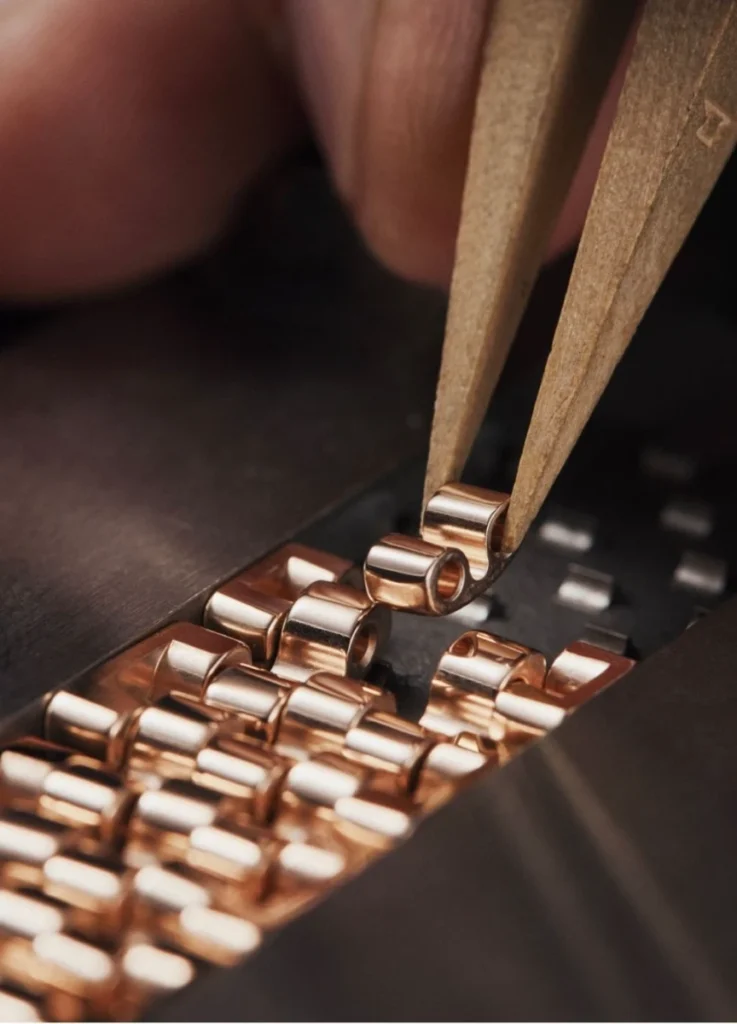
That question comes from valuing watches on weight of gold and number of diamonds. From a craftsmanship standpoint, the Mini Semi-Pavé sits on the higher-difficulty end of Panthère production.
In jewelry watches, going smaller often means going harder
As scale drops, the working tolerances tighten and any misalignment between stones becomes more visible than it would be on a larger piece.
The Mini Panthère Semi-Pavé has a smaller case, narrower links, and less surface area available for setting. Each diamond’s placement becomes more visible at this scale than it would on the Small.
In the Small, slight irregularities in stone spacing get absorbed by the larger overall volume. In the Mini, irregularities show up more easily — a stone that sits a fraction off can be noticed against the bezel line or the curve of the bracelet.
This is what makes the Mini Semi-Pavé harder to produce cleanly than its size would suggest.
Why semi-pavé sits at a different difficulty level
Full pavé is conceptually a fill — every available surface gets stones. That’s labor-intensive but the design question is mostly settled.
Semi-pavé asks a different question: where do we leave space, and where do we set stones? That distinction has to be made before any setting work begins, and the visual logic has to hold up at multiple viewing angles.
The Panthère Mini Semi-Pavé places diamonds along sections of the bezel and across specific links of the bracelet. The placement isn’t decorative filler — it’s been chosen to keep visual rhythm across the moving links.
The principle: the more empty space you leave, the more carefully the filled space has to be considered.
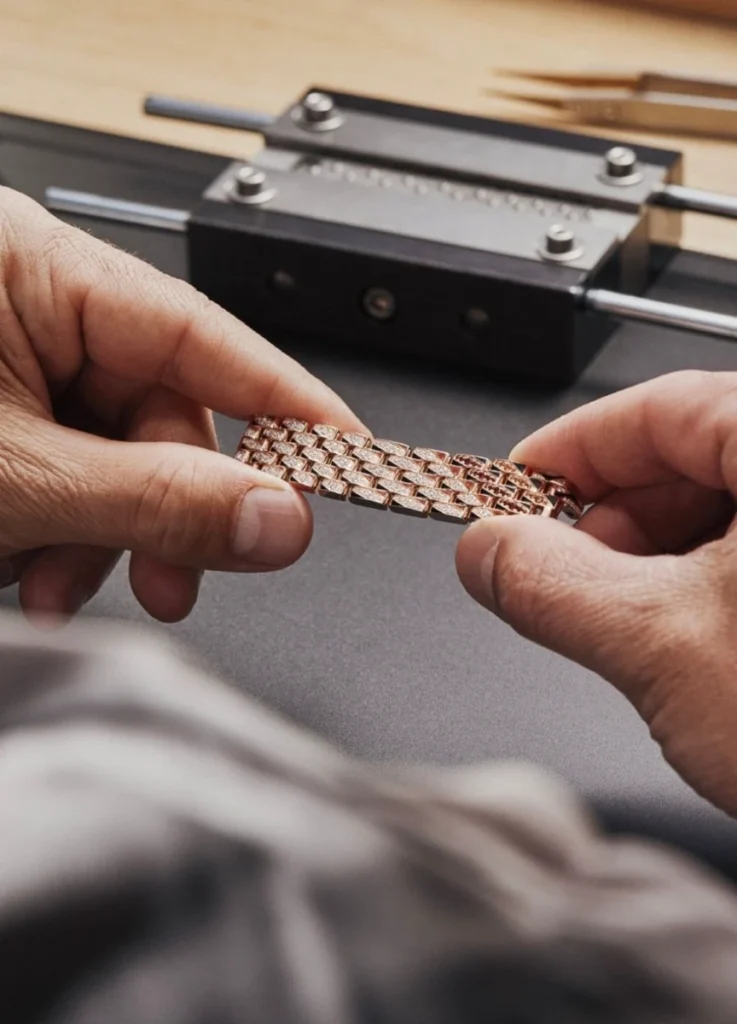
Articulated link + semi-pavé = high-difficulty combo
Most watch bracelets are rigid. Each link sits in a fixed relationship to its neighbors.
The Panthère’s bracelet doesn’t work that way. Each link moves independently, flexing with the wrist’s curvature. Setting semi-pavé into that structure adds another variable — every stone has to hold its setting cleanly through movement.
In the Mini, this gets harder because the links themselves are smaller. The setting depth, prong thickness, and hardware finish all need to be more precise — there’s less material to hide behind.
The Mini Semi-Pavé isn’t really a small watch. It’s a moving piece of jewelry rendered on a smaller canvas.
If you compare strictly on gold weight and diamond count, the Mini Semi-Pavé reads as poor value next to the Small.
If you compare on production difficulty — tolerances, setting precision, design complexity — the Mini sits noticeably higher than the Small. The price tracks production difficulty, with size as a secondary factor.
White Gold vs Steel │ The Quiet Density Question
White gold and steel can look similar in photographs. On the wrist, the difference becomes obvious.
Steel reflects light in a more direct, slightly cooler way — the reflection is sharper, almost edge-like. That makes it work well in casual contexts.
White gold absorbs light differently. The reflection is heavier, more muted, and the metal itself holds a soft greyish-white tone that reads as quietly luxurious. That difference compounds when semi-pavé is added — the diamond point-light interacts with white gold’s denser surface in a way that shifts the watch’s whole register.
White gold isn’t really a steel substitute. The metal does a different job — quiet density, where steel offers bright reflection.
Who I’d Honestly Not Recommend This Watch To
The Panthère Mini Semi-Pavé is a high-precision watch, but it isn’t a universally good choice. There are five conditions where I’d genuinely steer someone toward something else.
1. People who feel “watches need to be visible to count”
The Panthère Mini Semi-Pavé doesn’t announce itself on the wrist. It’s a watch that rewards close looks.
If you want people asking where the watch is from, or you want the watch to be the centerpiece of your look, this is going to feel too quiet.
For that profile, the Panthère Small Yellow Gold or one of the full-pavé Panthères delivers what you’re actually looking for.
2. Wider wrists, or wrists with linear/flat shape
The Mini sits best on thin wrists with soft, rounded curvature.
If your wrist is wider, or sits flat and linear in shape, the Mini risks reading as small in the wrong way — not as “delicate jewelry” but as “watch that disappeared.”
For wider or flatter wrists, the Small sits more structurally stable.
3. People looking for a daily, knockabout watch
Semi-pavé is jewelry-watch territory. White gold or rose gold case, diamond setting, fine surface work — the construction isn’t built for high-impact daily wear.
You can wear it daily. But “needs to be worn carefully” comes with the territory. If you want a daily watch you don’t have to think about, a steel Panthère or a sport watch makes more sense.
4. First-time jewelry watch buyers
This one matters.
The Panthère Mini Semi-Pavé fits the “next step” role better than the starter role. If this is your first luxury watch or your first diamond watch, the satisfaction-per-dollar can feel underwhelming. The “wow” effect at first wear runs subtler than people expect.
For a first jewelry watch, a Panthère Small Yellow Gold or a more clearly-defined character watch tends to deliver more.
5. Buyers who prioritize value-per-dollar
If you’re optimizing for diamond count per dollar or gold weight per dollar, the Mini Semi-Pavé doesn’t win on those metrics.
This watch is priced for precision craftsmanship, balance, and on-wrist refinement. If those aren’t the variables you prioritize most, there are better options for the budget.
So Who Does This Watch Actually Suit?
Putting it together, the Panthère Mini Semi-Pavé suits someone who:
- has experienced jewelry watches before
- doesn’t need the watch to be the protagonist of the look
- thinks about wrist proportion and how their hands will change with time
It also makes sense as a “second jewelry watch” for collectors who already own a full-pavé piece and want a daily-wearable jewelry watch that doesn’t compete with the showpiece.
If you’re after immediate presence, statement-piece energy, or instant-gratification satisfaction, this isn’t the watch.
The Panthère Mini Semi-Pavé works as the watch a collector adds when they specifically want to not add more.
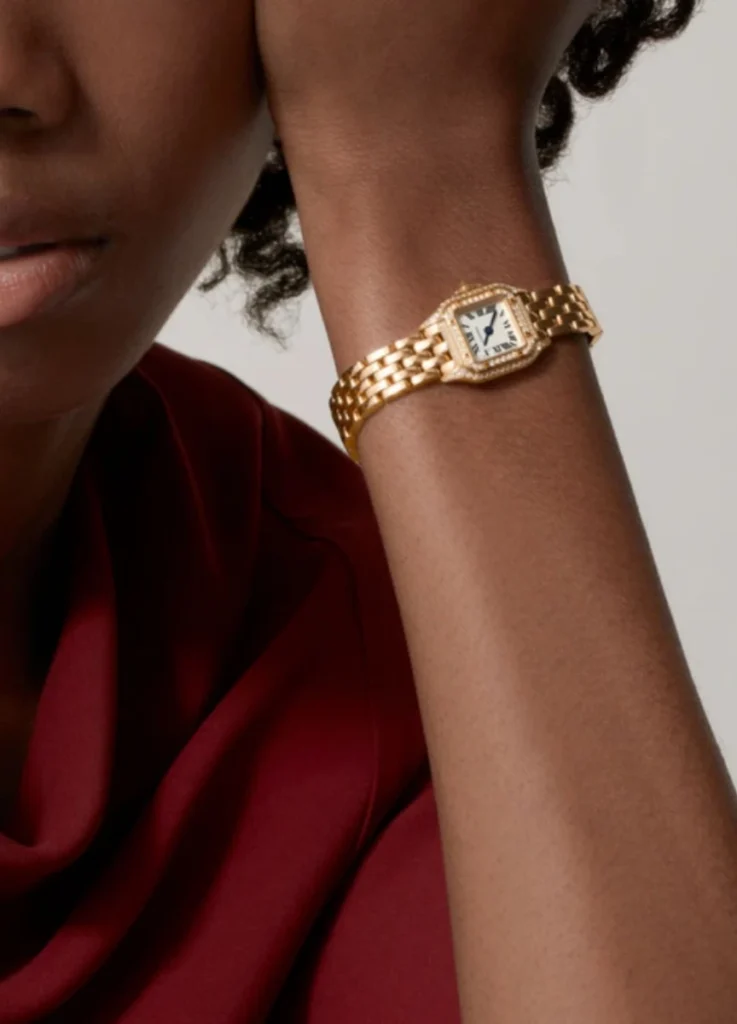
source: Cartier official website
Closing │ The Watch That Gets More Accurate With Time
Watches show time. But how they show time varies.
Some watches try to prove time. Others sit alongside it.
The Panthère Mini Semi-Pavé doesn’t push for attention on the wrist. It doesn’t make its case through size, and it doesn’t argue through brilliance. It quietly adjusts position as the hand moves and as time passes.
It can read as small when worn young. Once time has done some of its work, the same watch starts reading as precise.
A watch that doesn’t dramatize hand changes. A watch that gets sharper as taste refines.
The acquisition moment isn’t the peak. The peak comes a few years in, when you put it on absent-mindedly and it just sits where it belongs.
When the wearer’s relationship to watches matures — the question stops being “does this watch suit me” and becomes “do I still want to wear this watch tomorrow” — the Panthère Mini Semi-Pavé tends to be the choice that stays in the rotation longest.
That’s a quietly Cartier kind of virtue.
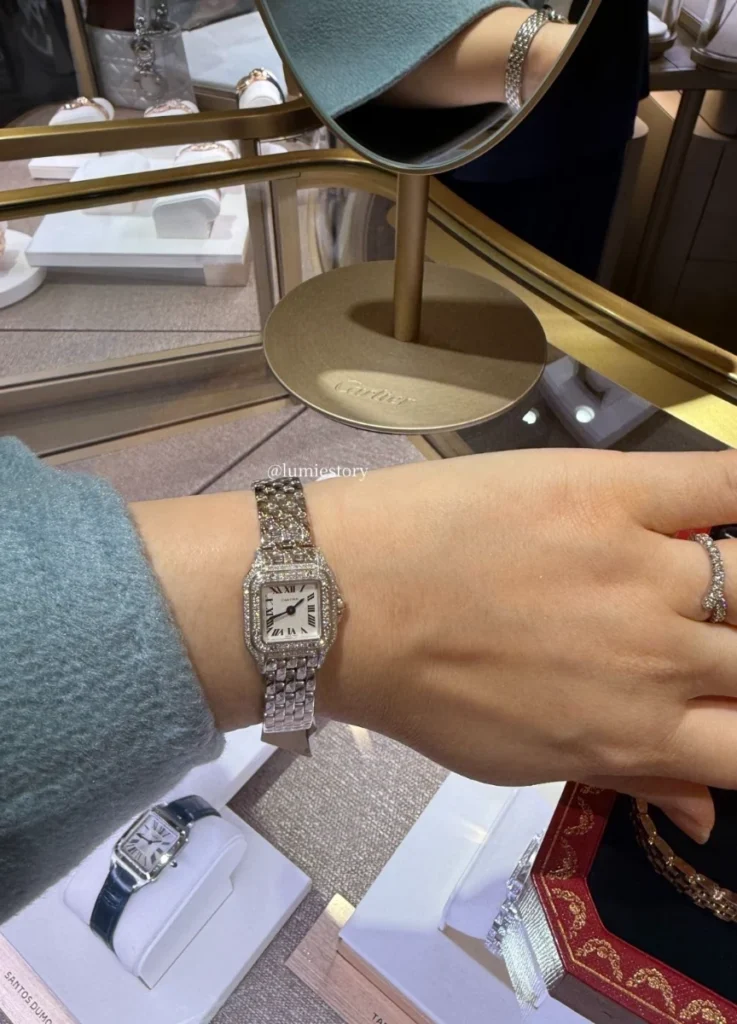
photograph by Lumie
[ Related Editorials ]