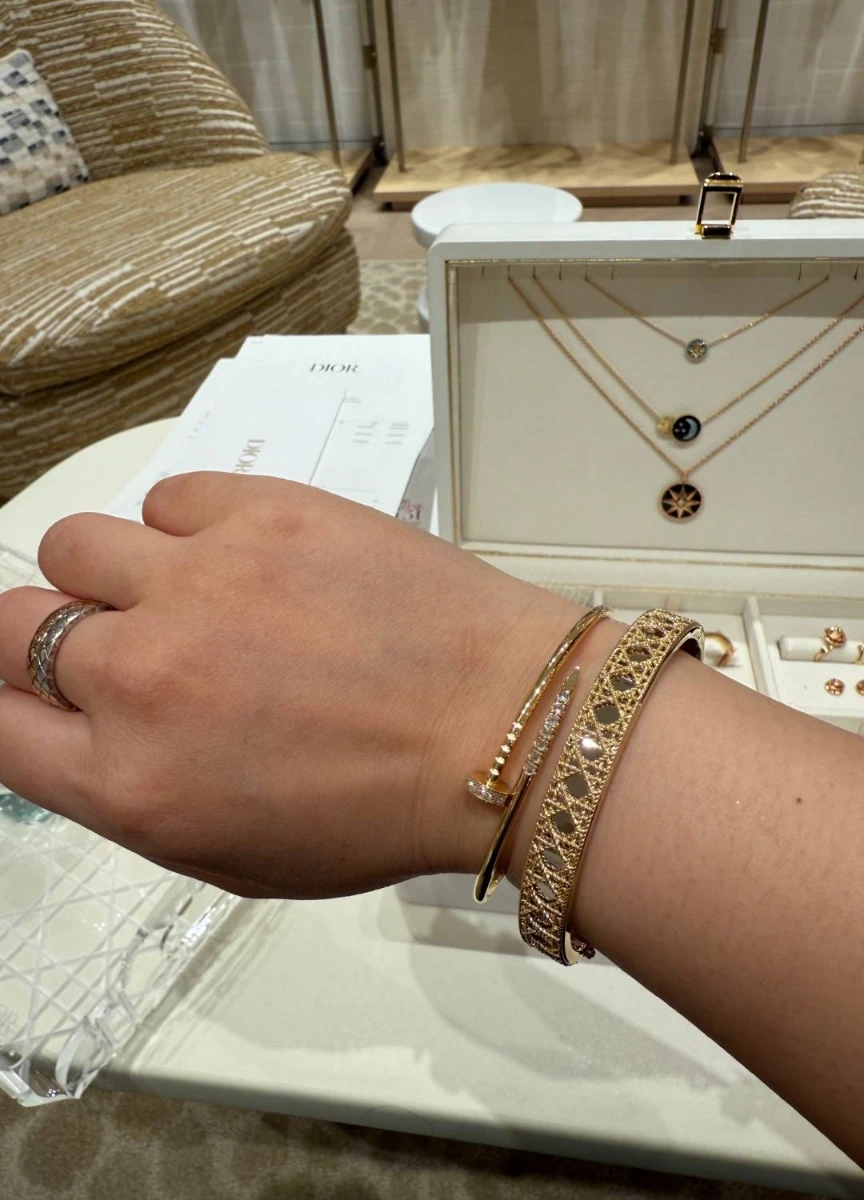
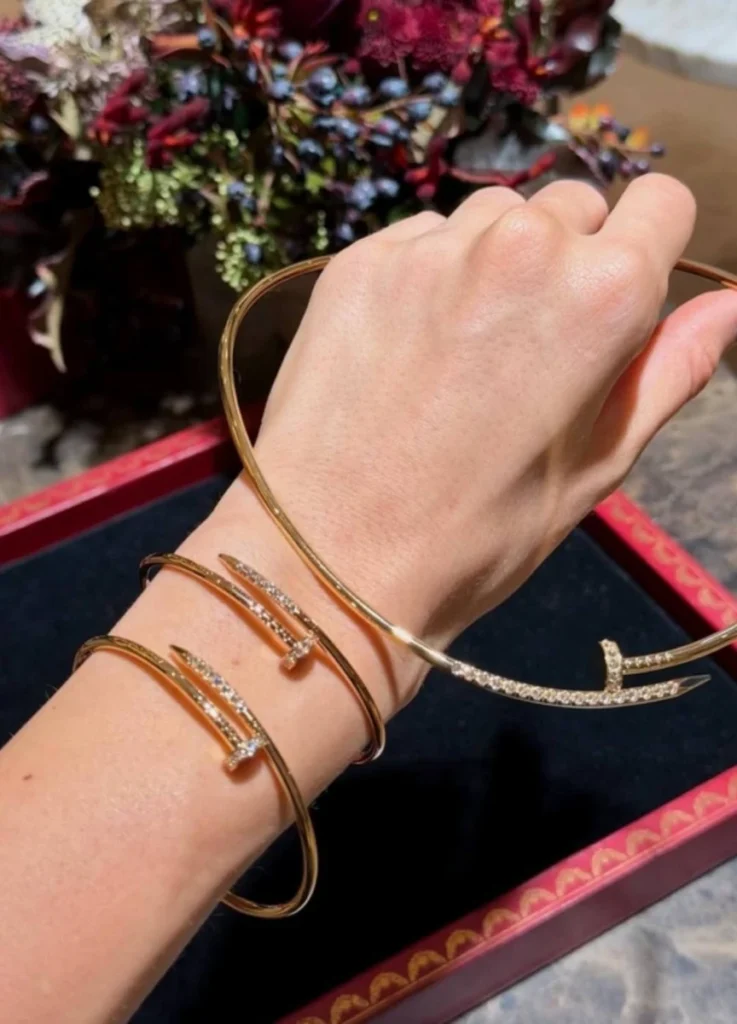
@diamondsindubaii / Instagram
Reading Cartier’s 2025 reverse-set diamond Juste un Clou Small through wrist anatomy, the structural rebalancing of the original design
In late 2025, Cartier quietly re-engineered one of its most uncompromising icons.
The new Juste un Clou bracelet, small model, reverse-set diamonds — to use Cartier’s official designation — represents a structural recalibration rather than a cosmetic update. The change reads as small on paper: the maison redistributed where the diamonds sit on the bracelet’s nail-shaped body. On the wrist, the modification rewrites the entire geometry of the piece.
Cartier rarely rewrites its icons. The Juste un Clou, designed by Aldo Cipullo for Cartier New York in 1971, has remained largely consistent for over five decades — the nail-as-jewelry concept that emerged alongside the Love bracelet and helped define the maison’s late-20th-century aesthetic. When Cartier modifies an icon at this scale, the modification carries weight beyond its literal scope.
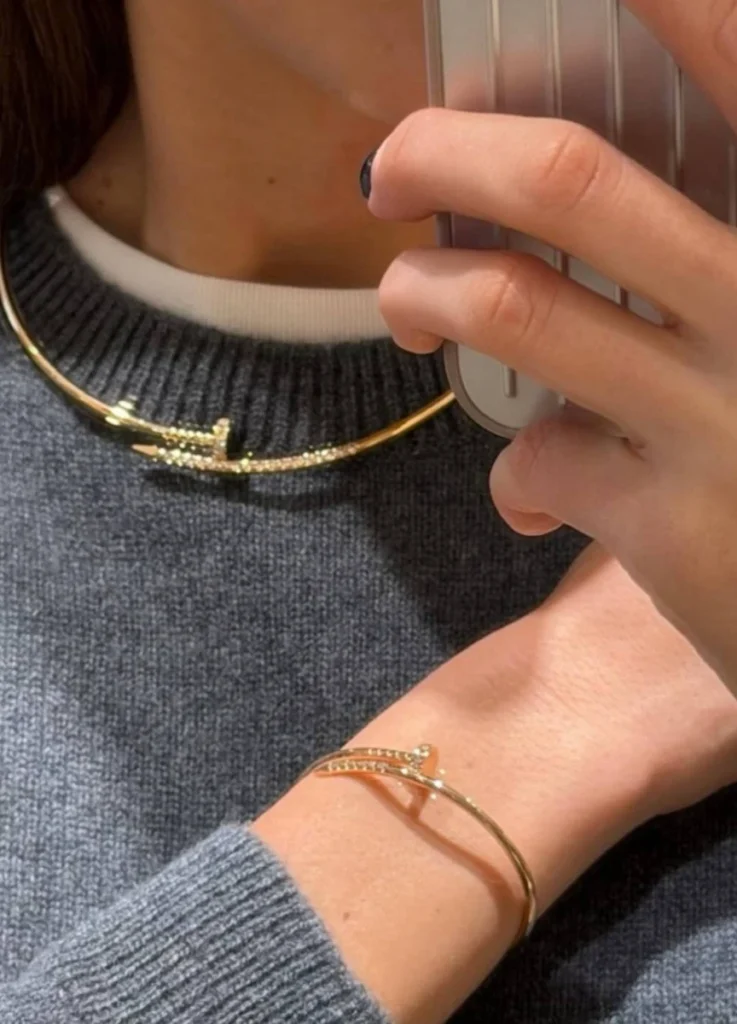
@diamondsindubaii / Instagram
What actually changed
Visually, the bracelet still reads as Juste un Clou — sharp, industrial, unapologetically modern. The nail-head silhouette remains. The screw detailing remains. The 2.5 mm Small width remains.
The actual shift is in the diamond distribution.
The classic pavé Small carried 20 brilliant-cut diamonds totaling 0.18 carats, concentrated around the nail head. Visual weight pulled toward the top of the wrist, where the head sits when worn. The 2025 reverse-set version is officially set with 20 diamonds totaling 0.29 carats — Cartier’s stated specification at size 17. What’s changed isn’t the stone count alone but the way the pavé surface has been redistributed across the bracelet body, with new pavé extending into the nail tip where the original had only metal.
The result isn’t more sparkle. The result is two points of light instead of one — and that distribution changes how the bracelet behaves on the wrist.
Where the original felt like a single visual anchor, the reverse version creates a continuous arc of reflection. The light wraps the wrist rather than sitting on it. The diamond setting at the point — reverse-set, in Cartier’s terminology — produces a quieter sparkle than the head, which keeps the visual hierarchy intact while activating the previously empty inner-wrist surface.
For the size 17 reference: 0.29 carats, 18K gold (yellow, rose, or white), 2.5 mm width. The Yellow Gold and Rose Gold versions retail at $7,350. The White Gold version retails at $7,850.
How This Changes the Bracelet on the Wrist
On a small wrist — mine measures 14 cm, with a shorter arm length — the difference between the two versions reads immediately the moment the bracelet sits on the skin.
With the classic model, the diamond head sits heavily on the top of the wrist. The underside of the bracelet remains visually empty. The piece reads as slightly tilted forward, with visual weight pulling toward the hand rather than distributing around the wrist. On larger wrists, this concentration works — the longer wrist surface absorbs the visual weight without imbalance. On smaller wrists, the bracelet can register as visually displaced from the rest of the hand.
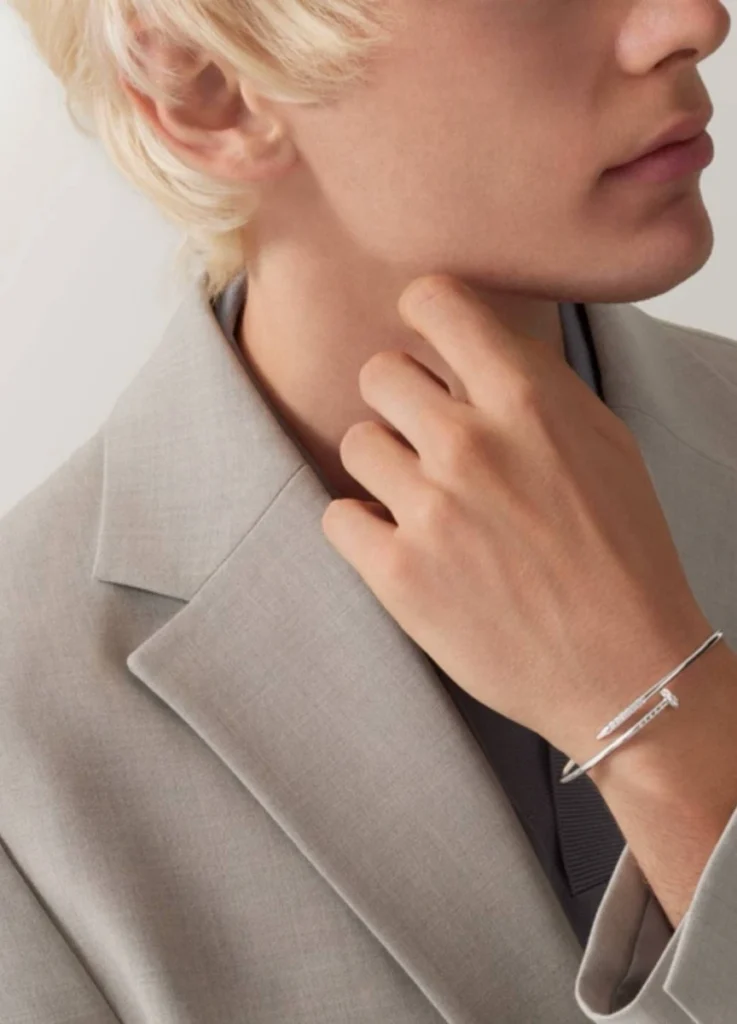
The reverse version solves the geometry differently. The new pavé surface activates the inner wrist where the original had nothing. Light now travels from below upward rather than concentrating at the top. The wrist appears encircled rather than topped. The bracelet sits without competing with the hand.
This reads less as decoration than as optical engineering. The redistributed pavé isn’t adding sparkle for its own sake — it’s redistributing visual weight in a way that allows the bracelet to function on a wider range of wrist anatomies than the original supported. The classic Small worked best on medium-to-large wrists with longer arm proportions. The reverse Small works on those proportions and on smaller, shorter wrists where the original struggled to find balance.
source: Cartier Official Website
Living With It — A Six-Month Owner’s Reading
I’ve been wearing the reverse-set Small daily since acquiring it, and the practical experience confirms what the structural reading suggests.
Weight is the first thing the bracelet does well. The Small profile at 2.5 mm width keeps the piece exceptionally light — the kind of weight you stop registering after the first hour, which makes it well-suited to all-day wear. Heavier bracelets like the Love or the Clash de Cartier Medium carry presence that becomes noticeable across long days. The Juste un Clou Reverse Small disappears into the wrist’s natural register. The piece stays present visually without making itself felt physically.
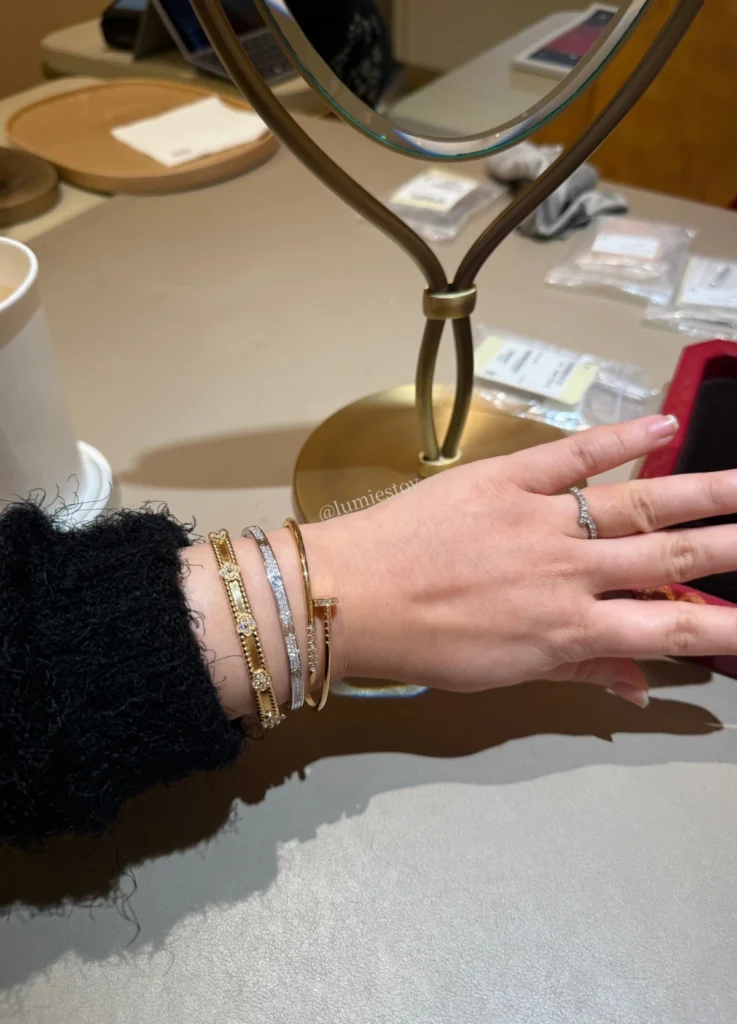
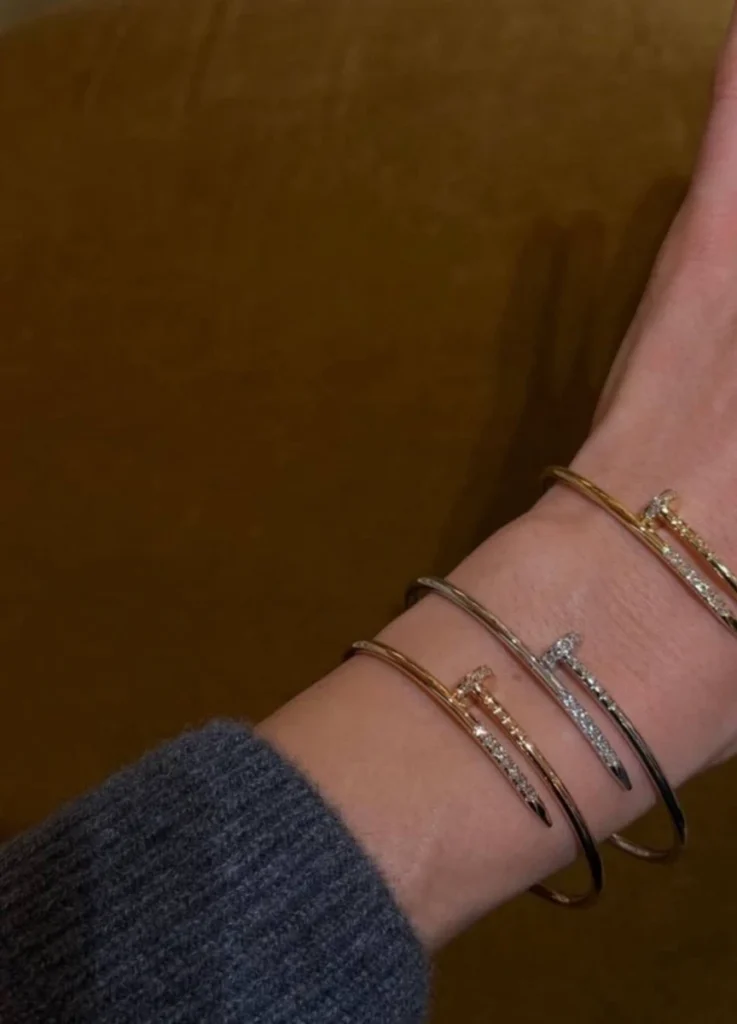
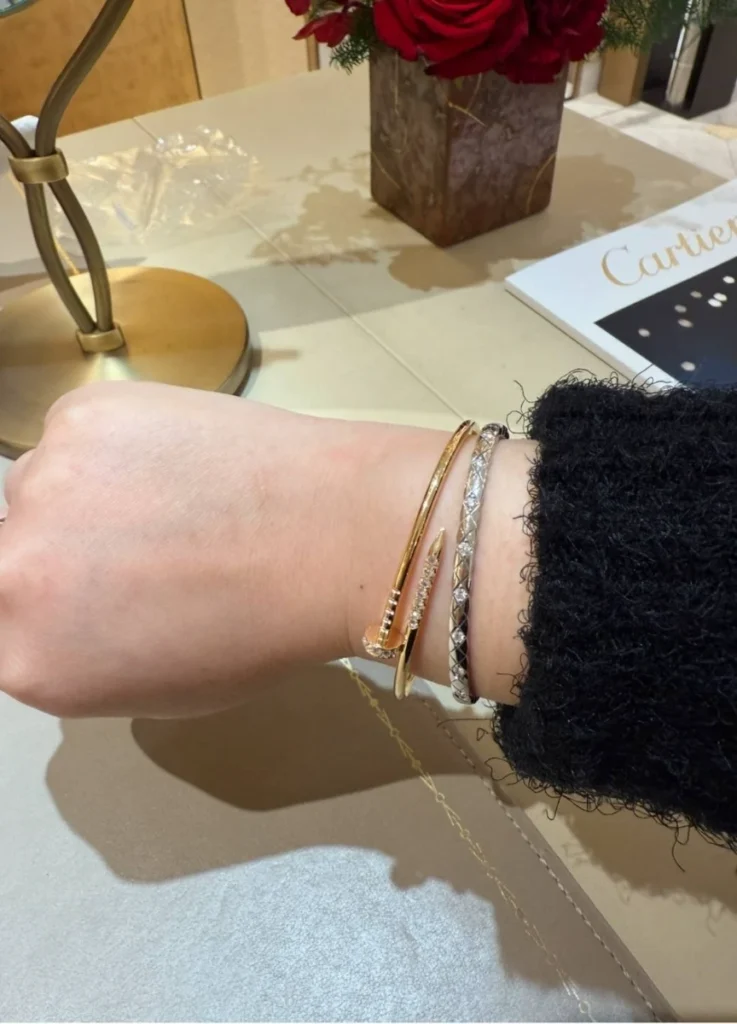
Layering compatibility is where the reverse version genuinely separates itself from the classic. The thin profile means the bracelet doesn’t compete for wrist real estate with adjacent pieces. Stacked next to a Cartier Tank or a Chanel Première, the Juste un Clou sits beside the watch case without crowding the strap area. Layered with a Love bracelet or a Clash de Cartier Small, the nail’s linear geometry plays cleanly against the rounded screw heads or studded surfaces of the adjacent pieces.
The diamonds themselves contribute to layering coherence in a way the classic version couldn’t. When stacked alongside white gold pieces — a diamond tennis bracelet, a white gold watch case, a pavé Love bracelet — the reverse-set diamonds at the tail create visual continuity across the stack. The eye reads diamond-to-diamond rather than reading metal-shift between yellow gold and white gold pieces. For collectors building mixed-metal stacks, this small detail matters in practice — it maintains visual unity across pieces from different gold tones.
The classic version, with its diamonds concentrated only at the head, didn’t bridge the metal shift the same way. The reverse version’s tail pavé sits closer to where the next bracelet in a stack typically begins, creating a sparkle continuity that the original lacked. The effect is subtle but consistent across different layering configurations.
Who the Reverse Version Is Actually For
The classic Juste un Clou pavé suits collectors who want a strong, graphic statement piece. The reverse version answers a different question.
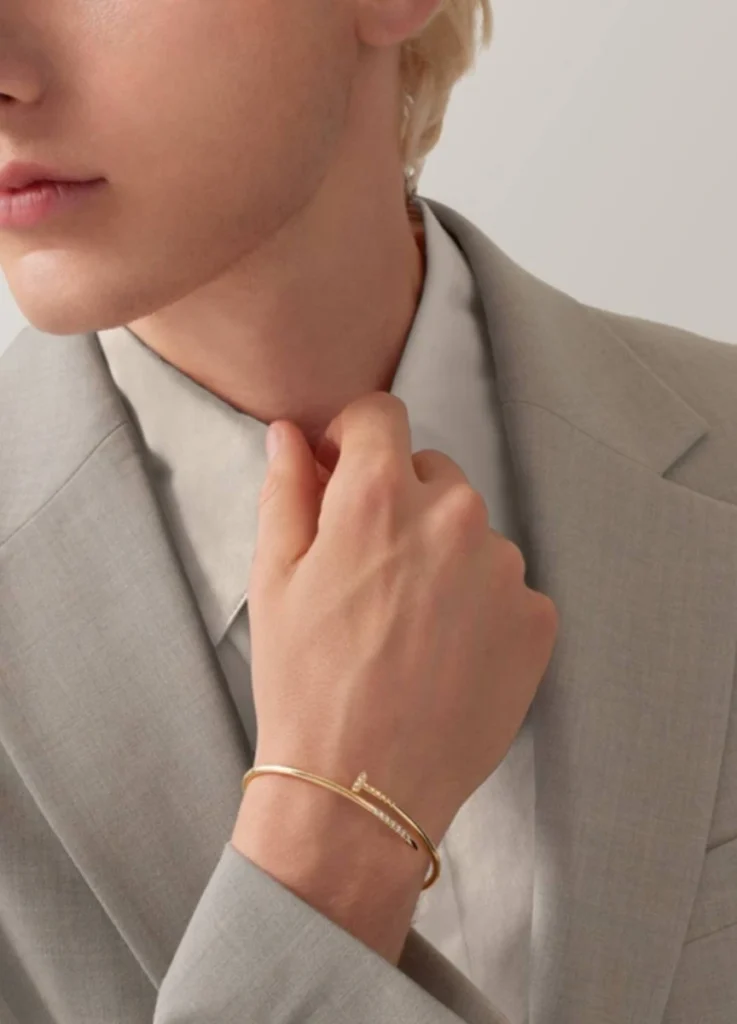
The reverse Small works particularly well for slim wrists and shorter arm proportions, where the redistributed diamond setting prevents the bracelet from visually floating above the hand. The tail pavé anchors the line. On wearers whose wrist circumference sits in the 14-15 cm range, the reverse version reads as completed where the classic version sometimes read as unfinished.
The reverse Small also serves collectors whose wearing pattern leans toward layering rather than statement-piece styling. The visual rhythm of two diamond points — head and tail — pairs cleanly with adjacent bracelets in ways that single-point sparkle doesn’t quite manage. Wearers who already own a Love bracelet, a Clash de Cartier, a watch, or other Cartier pieces may find the reverse version integrates more cleanly than the classic when the goal is structural addition rather than focal anchor.
The classic pavé still works for wrists that can carry the concentrated diamond head without imbalance, and for styling that positions the Juste un Clou as the centerpiece of a single-bracelet wrist composition. The choice between the two versions isn’t really about which is more beautiful. It’s about which structural logic matches the wearer’s existing wrist anatomy and styling pattern.
| Aspect | Classic Pavé | Reverse Pavé |
|---|---|---|
| Wrist size | Medium–large | Especially good for slim wrists |
| Arm length | Balanced to long | Stable even on shorter arms |
| Visual preference | Strong, graphic | Rhythmic, fluid |
| Styling | Bold statement | Works equally solo or layered |
| Focus | Impact | Balance & continuity |
source: Cartier Official Website
Why This Matters in Layering
The Juste un Clou is rarely worn alone. The piece functions as a framework bracelet in most collectors’ rotations — paired with Love bracelets, Cartier bangle watches like the Tank or Baignoire, slim chain bracelets, or watches with thin straps.
In layering, what matters most is the empty space at the front of the wrist where adjacent pieces don’t quite reach. The classic pavé left this space empty visually. The redistributed tail pavé quietly fills that gap.
Three effects emerge as a result. The yellow gold version no longer reads as too warm against adjacent silver or white gold pieces — the diamond reflection at the tail neutralizes the metal warmth where the visual transition happens. The pavé no longer feels heavy concentrated at one point — distributing the diamonds across two locations lightens the perceptual weight even at higher total carat. And the bracelet stops drifting upward visually — the tail anchor counterbalances the head pull, holding the bracelet’s visual center on the wrist.
This isn’t about sparkle. It’s about visual gravity. The reverse version solves a layering problem the classic version didn’t fully address — and for collectors building serious Cartier stacks, that solution justifies the price differential between the two models.
@diamondsindubaii / Instagram
Metal Choices — and Why Yellow Gold Becomes Easier to Wear
The reverse setting changes how each metal reads on the wrist. Cartier offers the reverse Small in yellow gold, rose gold, and white gold. Each carries a different relationship to the new diamond distribution.
White Gold ($7,850) provides the strongest skin-tone correction, working cleanly across cool and neutral complexions. The metal-to-diamond visual unity reads almost continuous — the white gold and the brilliant-cut stones share the same tonal register, producing a quieter overall sparkle that integrates seamlessly into all-white-metal stacks. Wearers whose existing jewelry box leans toward platinum, white gold, or silver-tone watches will find the white gold reverse Small the most natural addition.
Yellow Gold ($7,350) shifts the calculation. On the classic pavé, yellow gold could feel risky on slim wrists — the concentrated diamond head against warm metal sometimes read as visually heavy at one point. The reverse setting stabilizes this. The redistributed pavé prevents the warmth from tipping into heaviness; the diamonds redistribute the visual weight across the bracelet rather than concentrating it. Yellow gold becomes materially easier to wear in the reverse Small version than it was in the classic. Wearers who passed on the yellow gold classic for proportional reasons may find the reverse version solves the issue.
Rose Gold ($7,350) sits more sensitively. The pinkish warmth of rose gold is more skin-tone-dependent than yellow or white, and the reverse diamond distribution helps but doesn’t fully neutralize the metal’s variability. On warmer complexions and skin tones with naturally flushed undertones, rose gold reads beautifully. On cooler or more neutral complexions, the metal can register as visually disconnected from the wrist — a separate object placed on top rather than integrated into the body.
The reverse pavé functions like a visual keel across all three metals — particularly in yellow gold — preventing the metal warmth or temperature from tipping the bracelet’s visual register.
On the Price Difference — A Fair Reading
The reverse version costs roughly $1,500-1,800 more than the classic Small pavé at current retail. That’s a meaningful premium for what reads on paper as a redistribution of pavé surface.
Two factors account for the price gap. First, the total carat weight increased from 0.18 carats on the classic to 0.29 carats on the reverse — meaningful additional diamond weight that justifies a portion of the price increase at material-cost level. Second, the reverse setting required reworking how the diamonds integrate into the nail-tip geometry, which is a more complex setting challenge than the head pavé. The premium represents Cartier’s pricing of the design recalibration alongside the material increase.
The recent softening of diamond prices in the global market means the material-cost differential alone doesn’t account for the full price gap. The remainder reflects the structural redesign — what could be called a sensorial premium and visual density reinforcement rather than a pure material upgrade.
For wearers who already own the classic pavé Small, whether the reverse version justifies the upgrade depends on how much the structural rebalancing matters in their specific wrist context. For wearers approaching the Juste un Clou Small for the first time, the reverse version produces a more universally wearable result and — for the additional $1,500 — represents a defensible investment given that the bracelet will likely sit in daily rotation for years rather than being worn occasionally as a statement piece.
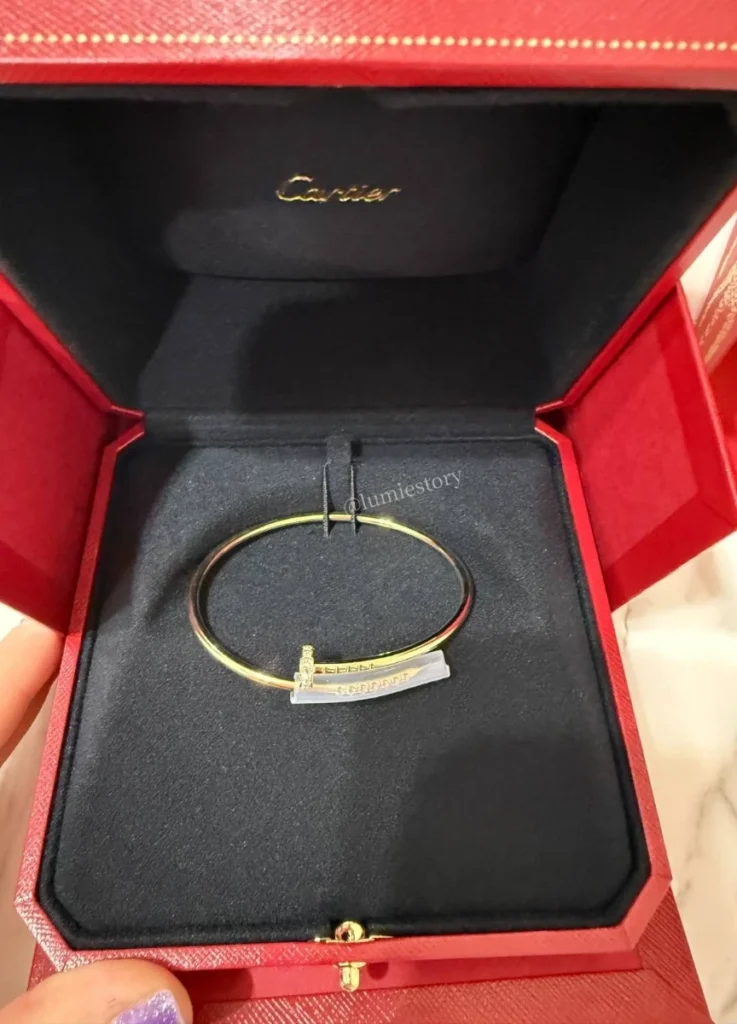
Why This Version Reads as More “Cartier”
Cartier’s strongest pieces operate at the intersection of structure and emotion — the nail-and-screw hardware vocabulary balanced against the way light and skin soften the structural elements into wearable jewelry.
The original Juste un Clou leaned heavily structural. Cipullo’s nail concept was deliberately graphic, deliberately industrial — the maison’s response to the soft, romantic jewelry languages dominating fine jewelry in the early 1970s.
The reverse edition restores emotional symmetry without softening the structural commitment. The nail remains a nail. The hardware vocabulary remains intact. What’s added is a continuous arc of light that moves the eye around the wrist rather than parking it at one point. The bracelet’s visual register shifts from pure declaration to declaration with breath — a structural object that now also carries rhythm.
The piece doesn’t feel softer. It feels completed.
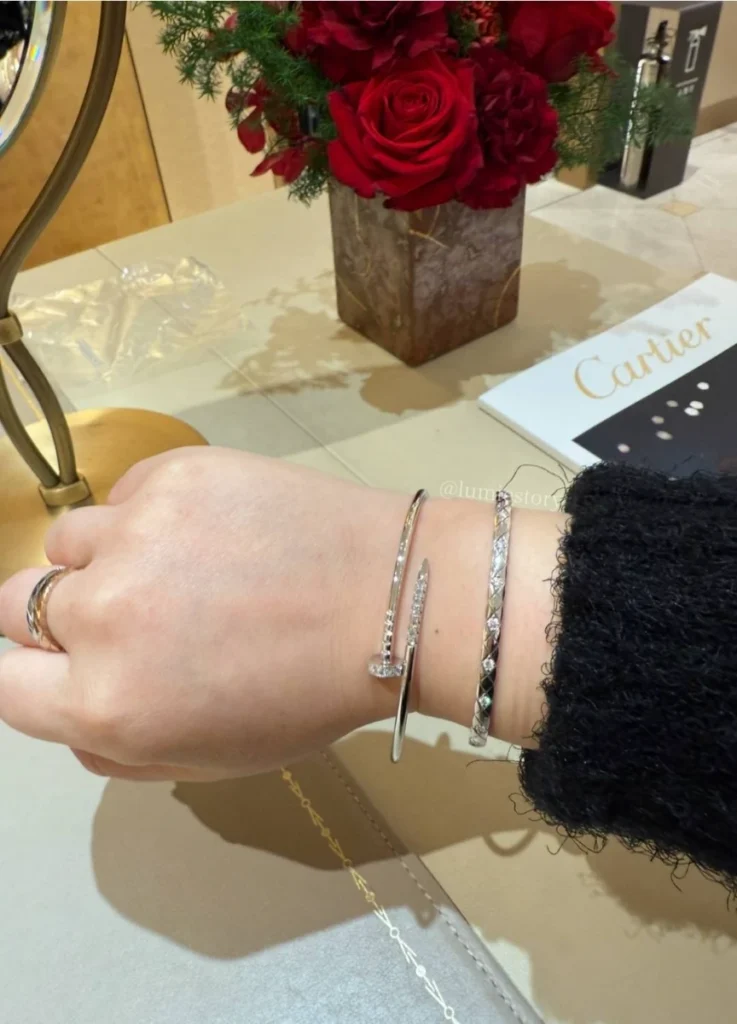
Final Reading — Why Seven Diamonds Matter
Cartier rarely rewrites its icons. The maison adjusts them — adding pauses where statements used to end without one.
In this bracelet, the pause comes from the redistributed pavé at the tail.
The diamonds don’t shout. They pause the eye, then allow it to continue. That pause — on the inner curve of the wrist, where the original left empty visual space — is what makes the reverse version feel not newer but more finished than the classic.
The classic Juste un Clou Small pavé will continue serving wearers who want the original Cipullo statement intact. The reverse version answers the question collectors with smaller wrists, layering-driven styling, or mixed-metal jewelry boxes have been asking for years — the version where the diamond continuity at the tail does meaningful work in maintaining stack coherence.
For anyone deciding between the two: the reverse version solves problems the classic didn’t. The classic version asserts. The reverse version completes. Both are valid Cartier propositions. The wrist, ultimately, decides which question is being asked.
If you find yourself drawn to this piece, the reason probably isn’t that it sparkles more. It’s that Cartier finally listened to the shape of your wrist.
[ Related Editorials ]