On Proportion, Craft, and the Watches That Age Better Than We Do
There is a common misunderstanding surrounding small watches.
They are often dismissed as decorative, secondary, or—at worst—compromised versions of their larger counterparts.
The Panthère Mini Semi-Pavé resists that narrative entirely.
This is not a reduced Panthère.
It is a watch engineered around proportion rather than presence,
and around longevity rather than immediacy.
To understand it properly, one must step away from case dimensions and price tags,
and instead observe how the watch behaves—
on the wrist, over time, and across changing bodies.
Proportion Before Size
The Panthère is not defined by its dial.
It is defined by its bracelet.
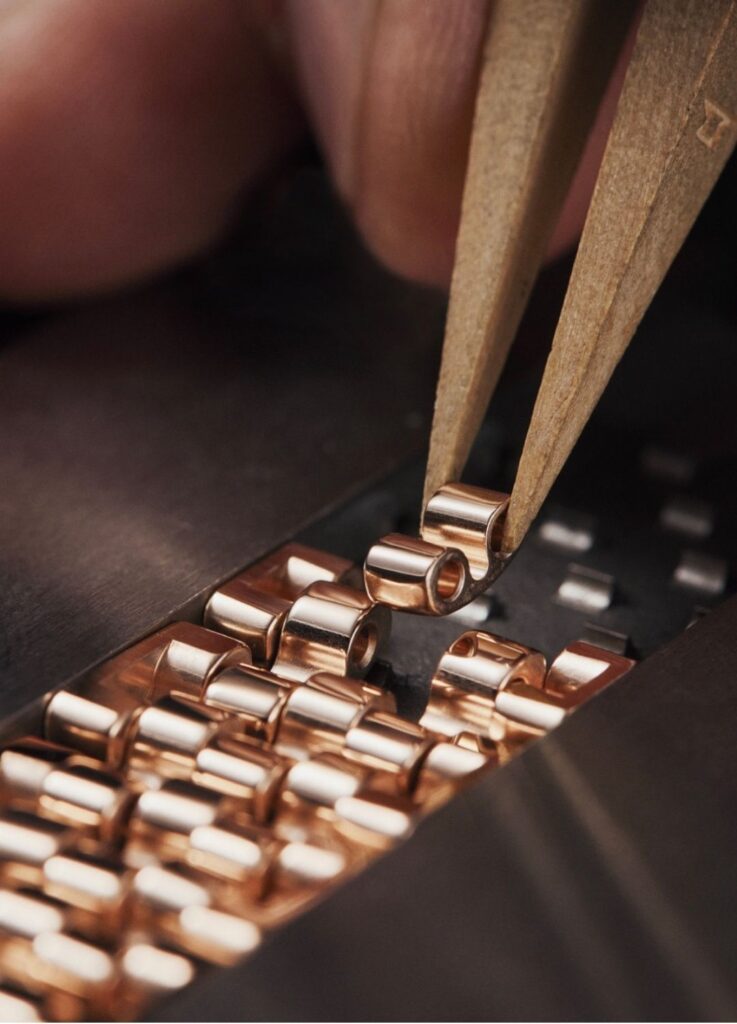
Unlike traditional watch bracelets, the Panthère’s construction prioritizes articulation.
Each link is designed to move independently, allowing the bracelet to follow the wrist’s natural curvature rather than imposing its own geometry.
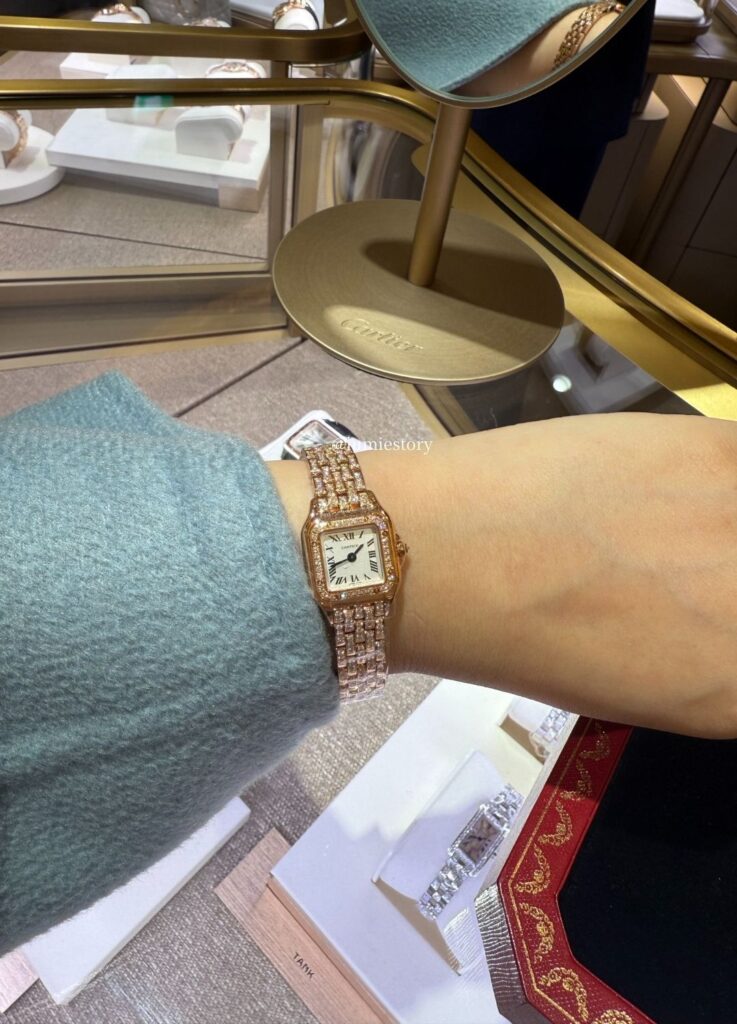
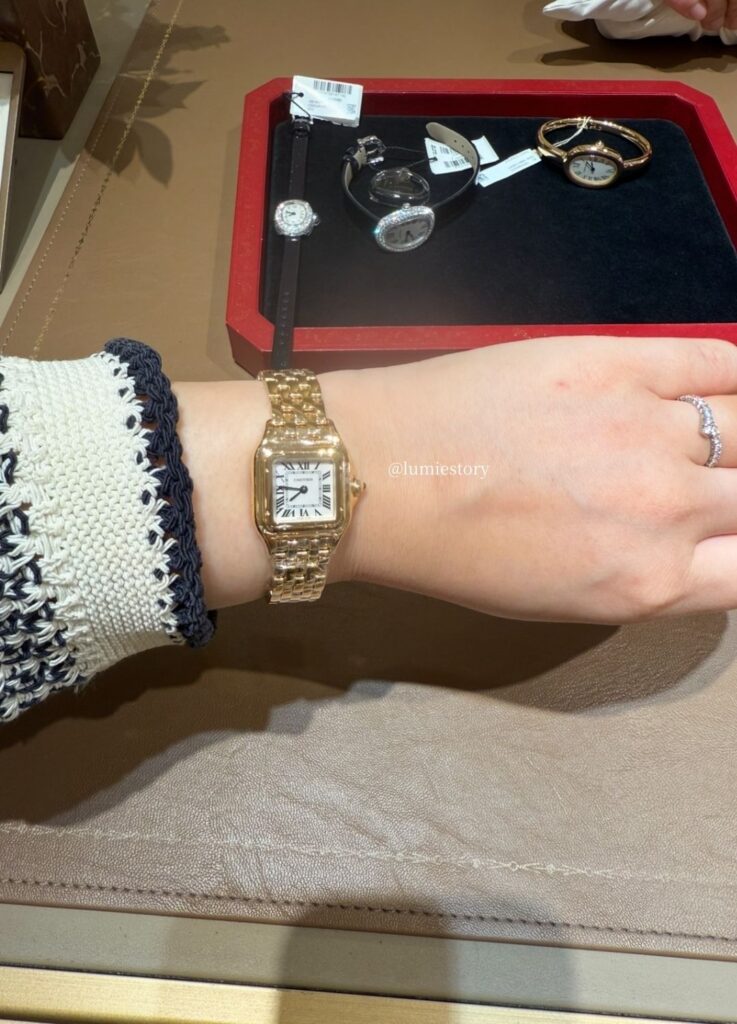
On slimmer wrists—particularly those around 14 cm—the difference between the Mini and the Small is not numerical.
It is spatial.
The Small Panthère occupies the wrist.
The Mini settles into it.
Where the Small establishes itself as a visual anchor,
the Mini preserves negative space—between wrist bone and hand, between jewelry and skin.
That space is not empty; it is what allows the watch to read as intentional rather than imposed.
This distinction becomes especially important for shorter forearms, smaller hands, or wrists with softer contours.
In these cases, the Mini does not diminish presence.
It refines it.
The Semi-Pavé Question
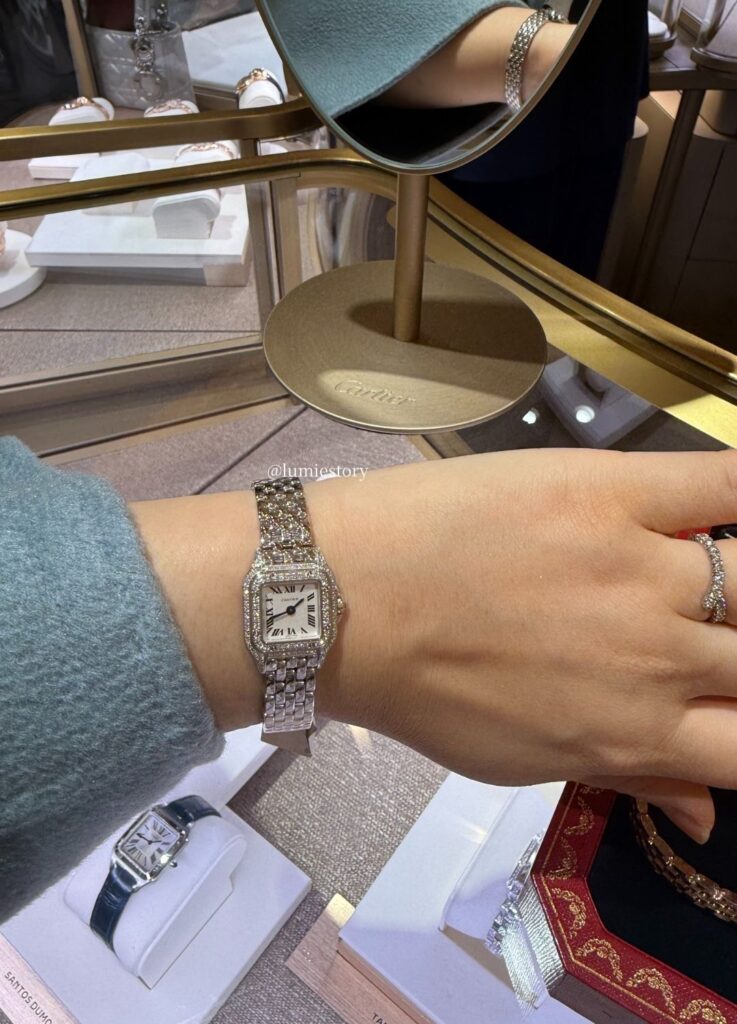
The semi-pavé setting is often misunderstood as restraint for restraint’s sake.
In reality, it is one of the most demanding decorative choices Cartier makes.
Unlike full pavé—where surface brilliance can absorb minor irregularities—the semi-pavé exposes every decision.
Where to place light.
Where to stop.
Where metal must speak on its own.
On the Mini, this challenge intensifies.
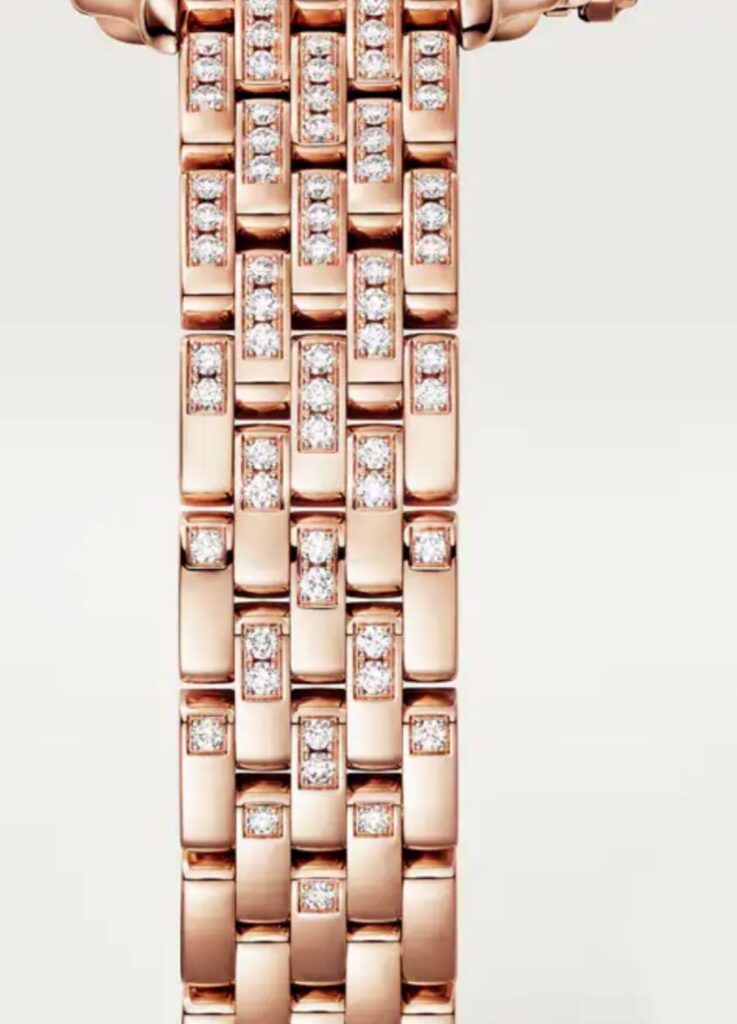
With less surface area, tolerances narrow.
Stone alignment becomes unforgiving.
Any imbalance is immediately visible, particularly along the bezel and articulated links.
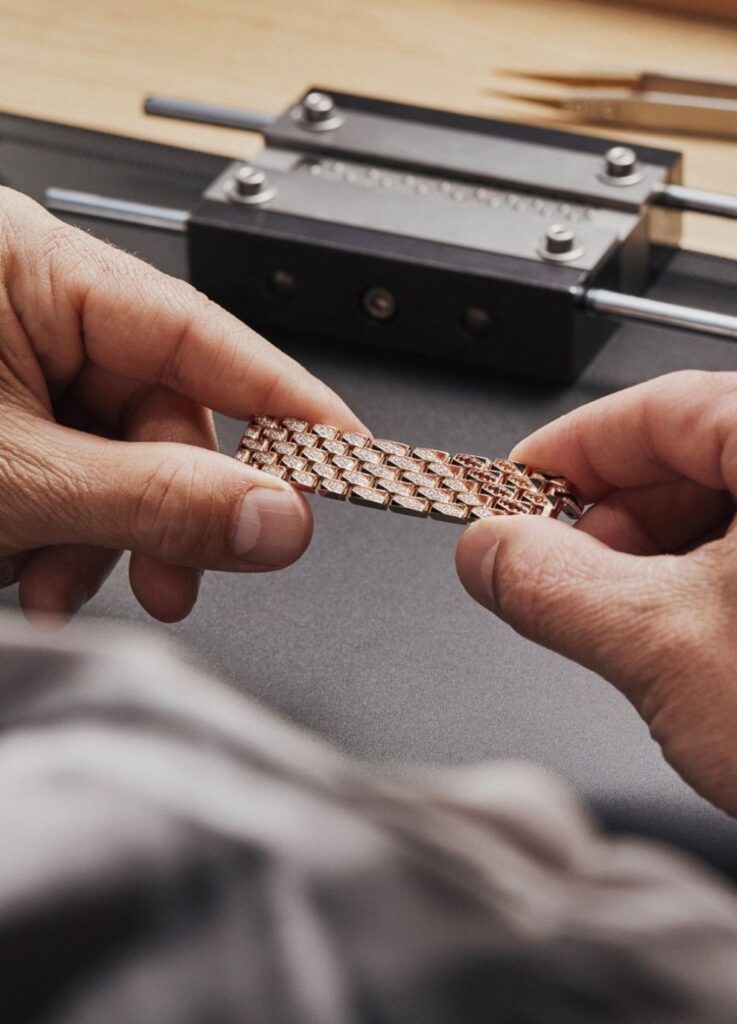
This is why the Mini Semi-Pavé does not sit dramatically lower in price than the Small.
Its value is not driven by volume of material, but by precision of execution.
In white gold, this precision is even more apparent.
The muted, slightly greyed tone of the metal absorbs light rather than reflecting it aggressively.
Paired with diamond point-lighting, the result is not brilliance—but depth.
It rewards proximity.
Not attention.
Mini vs. Small: A Matter of Time
When comparing the Mini Semi-Pavé to the Small Panthère—particularly in yellow gold—the difference is not merely aesthetic.
It is temporal.
The Small Panthère, especially in yellow gold, performs beautifully in moments of assertion.
It completes an outfit.
It announces a choice.
The Mini performs differently.
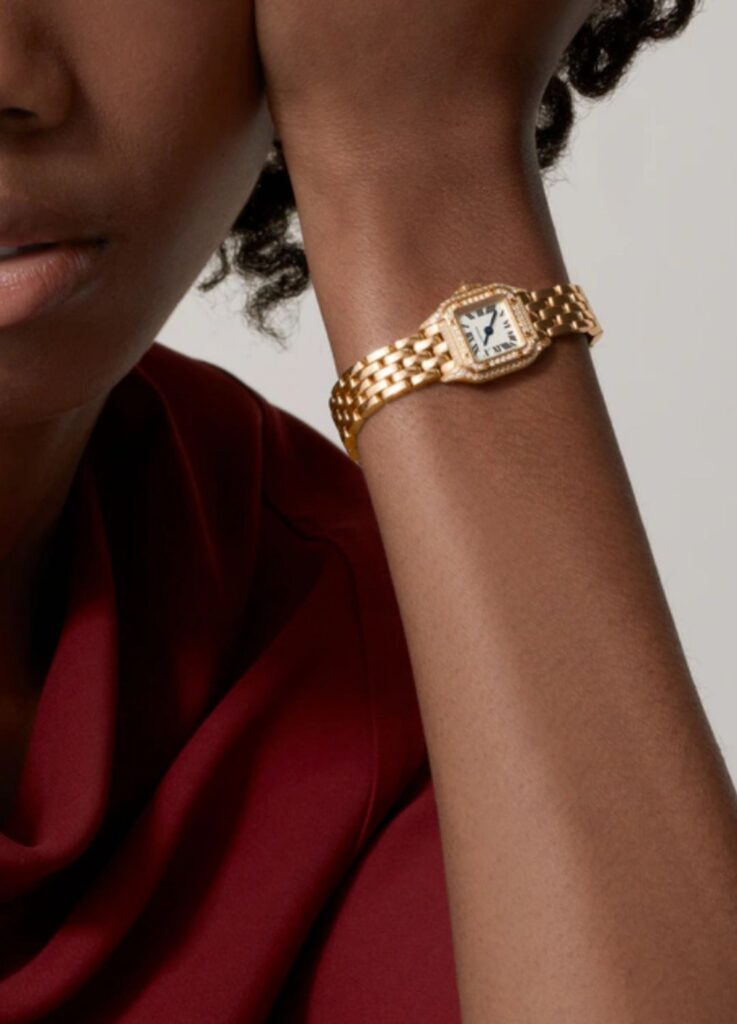
As hands age—losing volume, revealing veins, softening texture—the Mini adapts.
Its reduced contrast against the skin, its lighter visual footprint, and its articulated movement prevent it from amplifying these changes.
Where larger, more reflective watches can harden with age,
the Mini remains proportionate.
This is not a watch that peaks at acquisition.
It improves with familiarity.
Why This Is Not for Everyone
The Panthère Mini Semi-Pavé is not designed for immediate gratification.
Those seeking visible presence, overt luxury, or a singular statement piece may find it underwhelming.
As a first fine watch, it can feel too subtle.
As a daily tool watch, too precious.
But for collectors who already understand weight, light, and restraint—
for those whose wardrobes no longer require punctuation—
the Mini offers something rarer.
Continuity.
A Closing Observation
There comes a point when taste no longer expands.
It narrows.
At that stage, objects are no longer asked to perform.
They are asked to endure.
The Panthère Mini Semi-Pavé does not define an arrival.
It accompanies a passage.
And in that quiet alignment between wrist, craft, and time,
it becomes less a watch—
and more a constant.
[ Related Editorials ]