Louis Vuitton Bought a Museum | Cruise 2027, and the Category the Maison Just Declared
Louis Vuitton did not rent a museum this season. It signed a three-year agreement with one.
On May 20, 2026, the Cruise 2027 collection was unveiled at The Frick Collection in Upper Manhattan. The newly renovated Frick had never opened its galleries to a runway before. A Gilded Age mansion-museum hung with Fragonards, Vermeers, and Van Dycks became the floor a model walked across — for the first time in its history.
The first context this collection asks to be read inside is the three-year cultural sponsorship between Louis Vuitton and the Frick, rather than the venue itself. The arrangement binds a maison to a cultural institution over time, rather than producing a single-season runway rental.
Cruise 2027 isn’t only a collection of looks for a season. More accurately, it’s a declaration of how Louis Vuitton intends to position itself going forward.
The Ignition Point Was a Single Suitcase from 1980
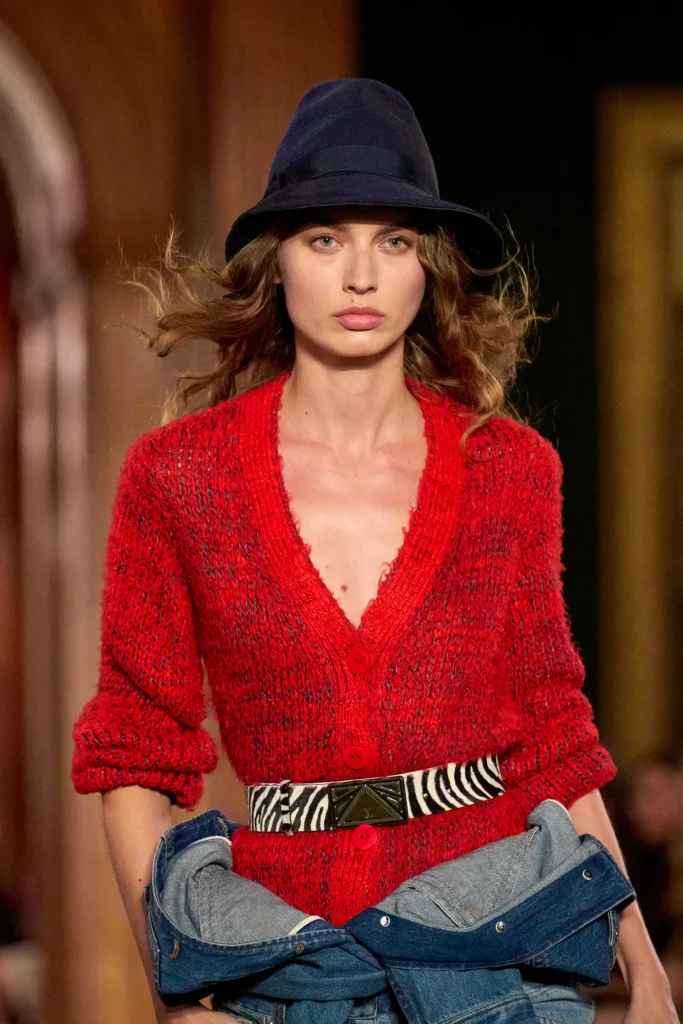
The opening look was a red knit cardigan with washed denim, carried alongside a leather suitcase.
At first glance, it reads as straightforward American casual. The weight of the look, though, is considerably greater than that.
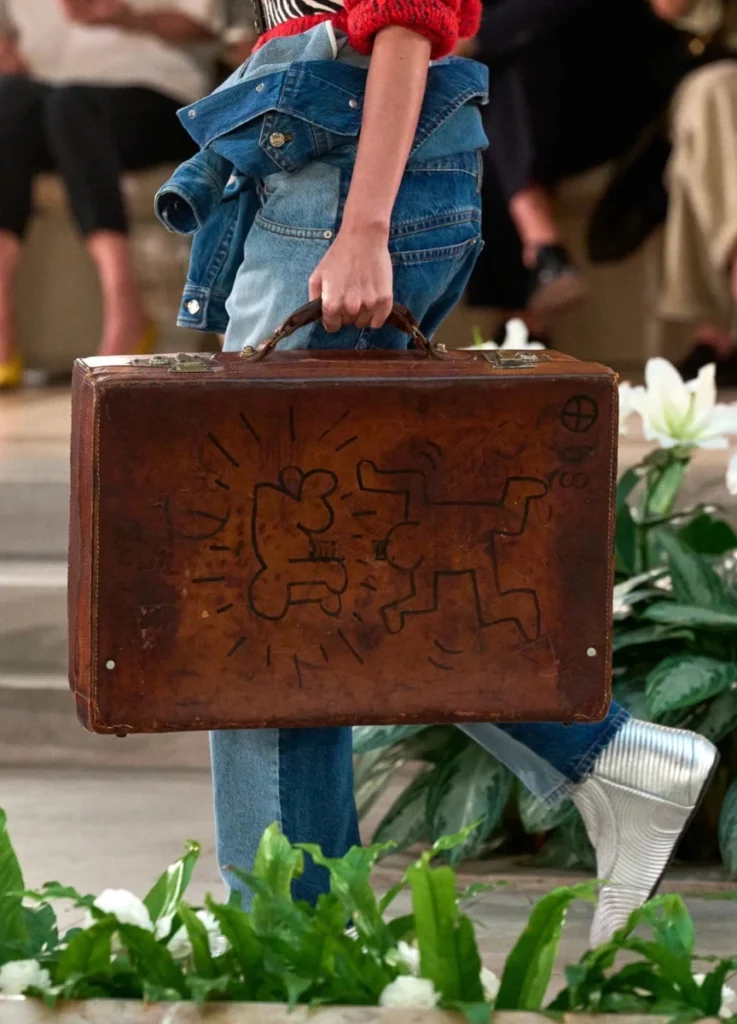
The suitcase is a 1930s Louis Vuitton leather case. On its surface, in black Sharpie, are drawings Keith Haring made in 1980 before gifting the case to a roommate. Nicolas Ghesquière excavated this archival object and used it as the ignition point for the entire collection.
The Haring collaboration separates itself from the usual artist-collaboration formula in one specific way. Most artist licensing works by transposing an artwork’s image onto a product surface. This one operates differently — a trace of Haring that already existed inside the maison’s own history was retrieved and elevated into the starting point of an entire season.
Excavation describes this collaboration more accurately than reproduction.
In his preview interview, Ghesquière described the opening look as American casual. The phrase is simple, but its simplicity is precisely the point. A red knit, denim, an old leather suitcase. The combination looks casual on the surface, while three timelines sit stacked inside it.
1930s Louis Vuitton. 1980s New York. And Cruise 2027.
The opening look compresses three eras into a single figure. The suitcase isn’t an accessory — it’s the object that introduces the collection’s core argument first.
Ghesquière’s Venue Lineage, and Why This Time the Museum Itself Became Part of the Collection
Nicolas Ghesquière’s pattern of choosing Cruise venues has been clear for years.
The Niterói Contemporary Art Museum in Rio (2017). The Miho Museum outside Kyoto (2018). Park Güell in Barcelona (2019). The TWA Flight Center at JFK (2020). The Salk Institute in La Jolla (2023). The Palais des Papes in Avignon (2026).
He consistently chooses spaces where the architecture is already doing half the speaking.
The Frick is different from any of these. Where Niterói or Salk were primarily architectural backdrops, the Frick is a far more layered space. The building doesn’t exist alone — the paintings hanging inside it, the accumulated art history, the social memory of the Gilded Age all exist together. The collection didn’t enter an empty space. It entered a cultural frame that already arrived with its own interpretations.
This season, Ghesquière’s clothes weren’t simply placed inside a beautiful room. They entered the same visual frame as the rococo grace of Fragonard, the light of Vermeer, the portraiture of Goya. Visual authority on the walls, garments on the floor, sharing the same line of sight.
Three years adds another dimension. The maison hasn’t just borrowed a stage — it has secured a stage from which it will continue to speak. Previous Cruise venues were used once and left behind, while the Frick still has two more seasons in front of it.
This appears to be Louis Vuitton’s clearest move toward treating a venue as a long-term asset rather than a temporary location.
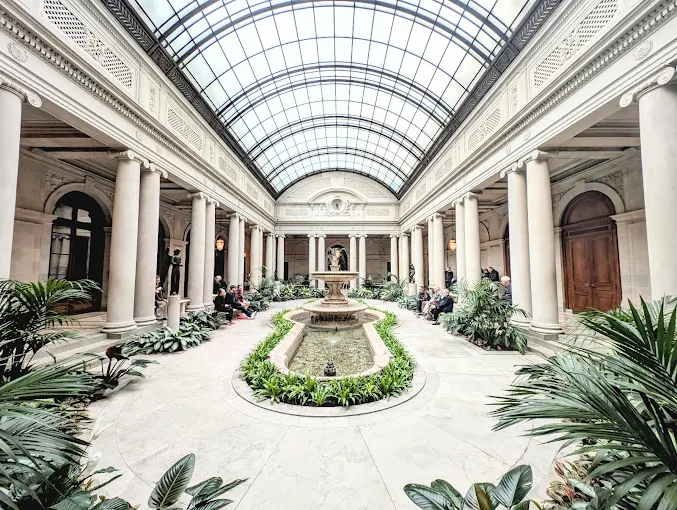
@ K Velasquez via Google
Five Looks Worth Reading — The Spine of the Collection’s Argument
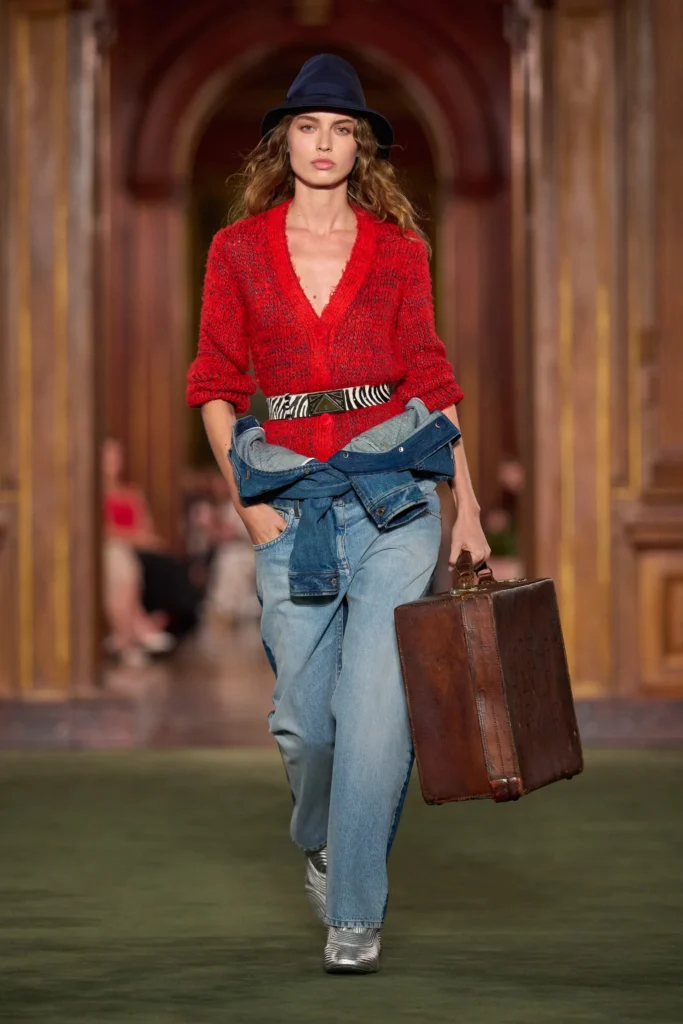
Look 1 — Opening: Red Knit, Denim, and the Haring Suitcase
The simplest-looking look in the collection carries the most weight.
A red knit cardigan, washed denim, and an old leather suitcase still bearing Keith Haring’s drawings. There is no complicated styling here. The look has been deliberately stripped down, closer to a confident American casual than to anything constructed. But this look matters not because it’s casual — it matters because it compresses a long accumulated cultural collision inside a single figure.
A European leather object made by Louis Vuitton in the 1930s. The handwriting of one of the 1980s’ most iconic New York street artists drawn across its surface. And, cutting across both, the denim of 2027.
The suitcase functions less as an accessory and more as the object that introduces the collection’s core proposition first. Louis Vuitton isn’t simply citing the past. The maison reaches into time that already lived inside its own archive and translates it into current product language, and the collection’s entire method becomes visible inside this single look.
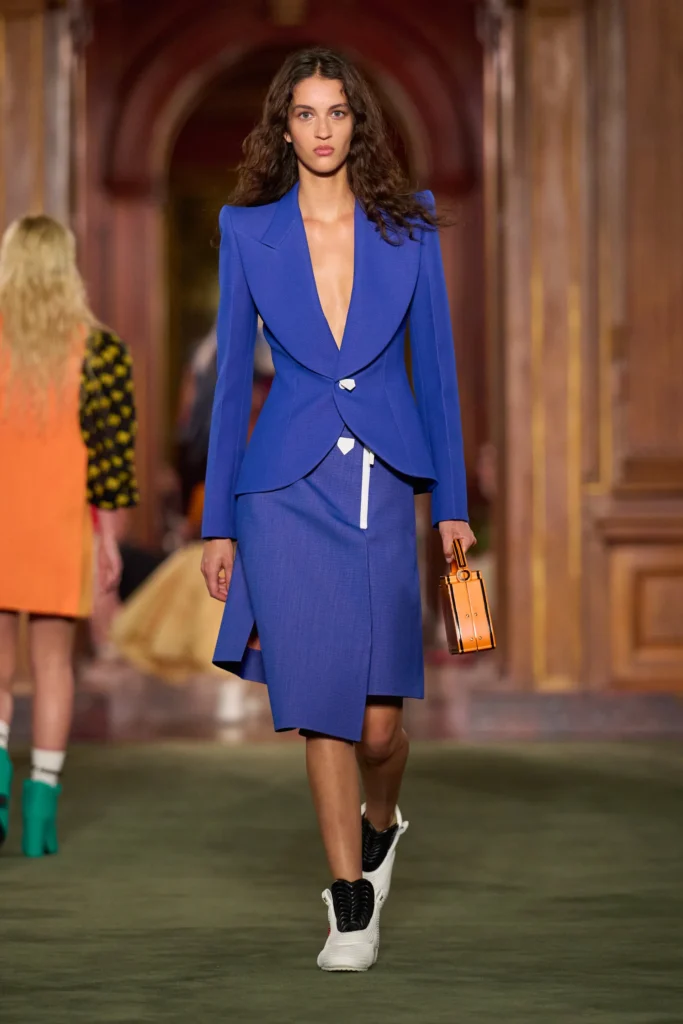
Look 2 — Cobalt Blue Power Suit + Boxing Shoes
Look 2 makes the strongest image in the collection.
A deep cobalt blue V-neck blazer paired with a midi skirt — the moment it appears, it reads as 1980s New York power dressing. The shoulders carry Nicolas Ghesquière’s signature structural force. The waistline holds tension without over-cinching. The look is less about being wearable in the conventional sense than about being remembered in a photograph.
Underneath the structural rigor of the power suit appears a shoe drawn from the lineage of boxing footwear. Repeated piped texture, an athletic build. The shoe’s reference is unmistakable.
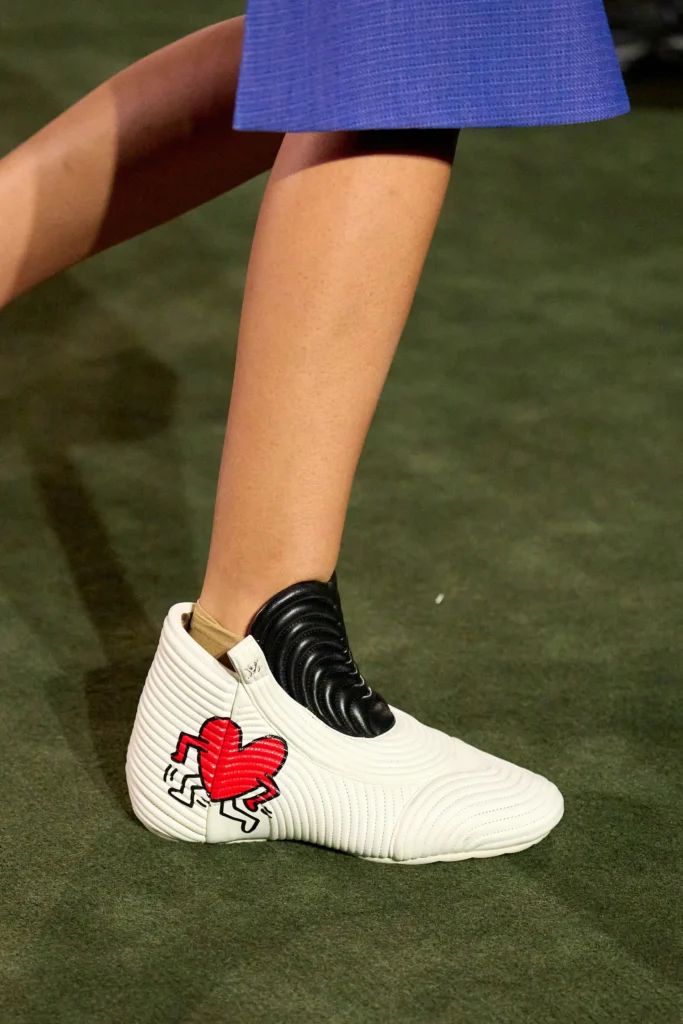
What makes the combination matter is friction. Above, the tailoring of urban authority. Below, the language of movement. Formality and physicality, structure and motion, authority and energy — two opposing registers locking into the same look.
This kind of tension is exactly where Ghesquière is strongest. He builds looks that hold a slight resistance better than he builds looks of complete harmony, and Look 2 is the clearest case of that instinct this season.
Look 3 — Patchwork Leather Jacket
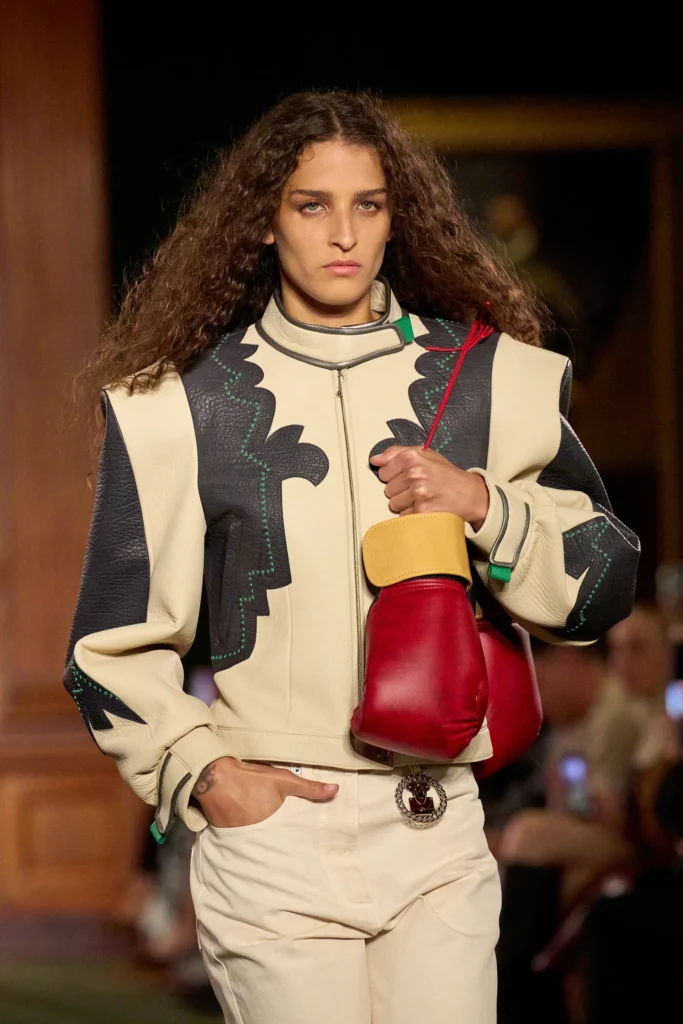
The most craft-dense look in the collection.
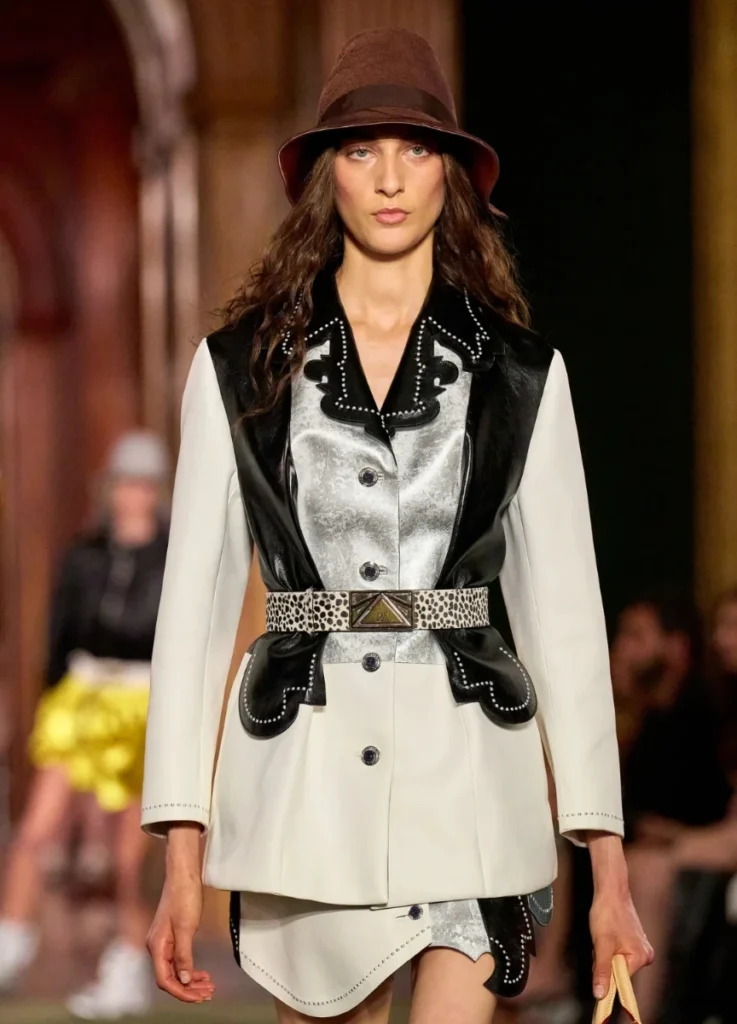
From a distance, it reads as an ornate patchwork leather jacket. Up close, it carries a structure that goes well beyond textile decoration. Panels of leather in different colors divide along straight lines and angles, forming a single surface. The colors haven’t been blended — each panel functions as an independent visual zone, as if the surface were organized through the framing logic of a painting.
The jacket feels less like a garment and more like an object that could hang on a wall. Considering that the collection was shown inside an art-historical space, this look reads not as a beautiful leather jacket but as a deliberate scene — fashion meant to be viewed more like painting than a garment.
There’s also a direct connection to Keith Haring’s visual vocabulary. Haring’s work was fundamentally about strong divisions of color and rhythm of line, and this jacket carries that structural sensibility into leather craftsmanship without ever printing one of Haring’s drawings directly onto the surface.
The look stands as the strongest evidence this season that Cruise has expanded beyond ready-to-wear and into territory closer to collectible.
Look 4 — Keith Haring NEW YORK Top
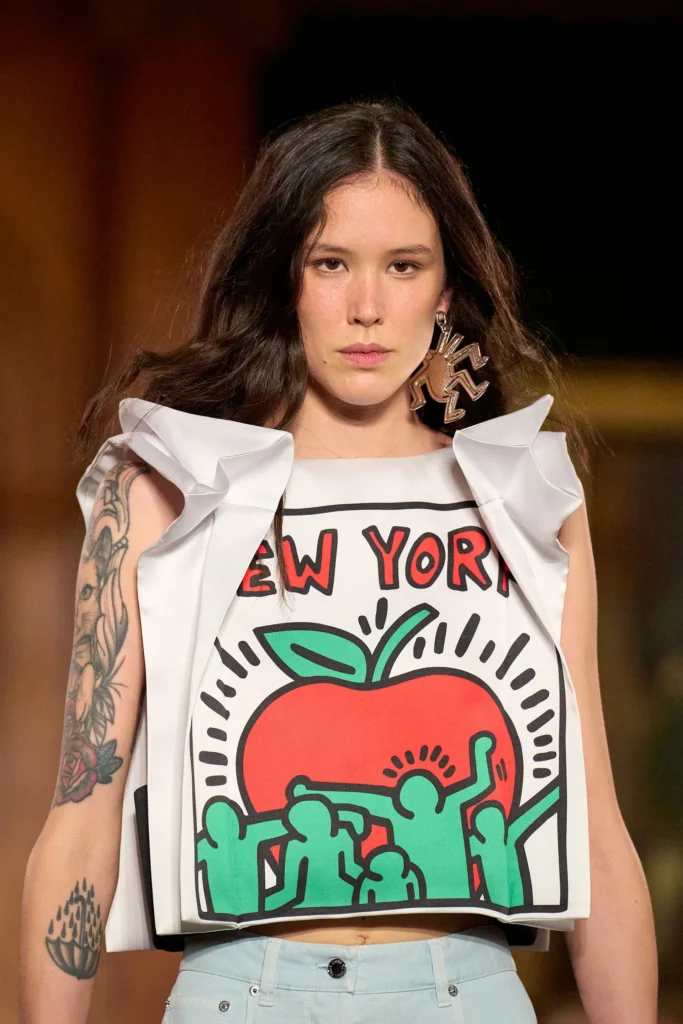
The most direct visualization of the Haring collaboration this season.
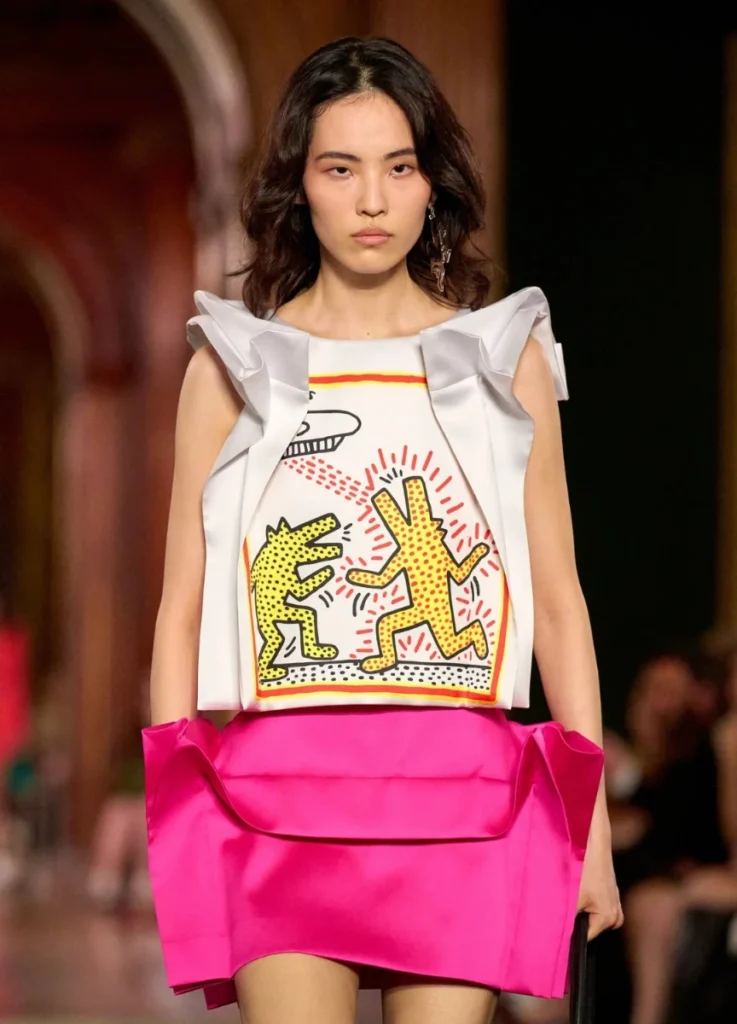
A white cropped top printed with NEW YORK, Haring’s dancing figures, and his apple motif.
If the earlier Haring readings were more indirect and structural, this look is overt. It pulls the energy of Pop Art forward without translation, and that directness gives the look a dual function.
On one side, it’s the most immediately legible look of the season. Most customers would read it instantly as a Keith Haring collaboration. On the other side, it serves as the commercial entry point into the broader Haring product line — T-shirts, smaller bags, prints.
The split between collector objects and broader commercial product line becomes clearest here, and Louis Vuitton has long designed these two layers in parallel.
Look 5 — Closing: Gilded Age Ruffled Top + Capris
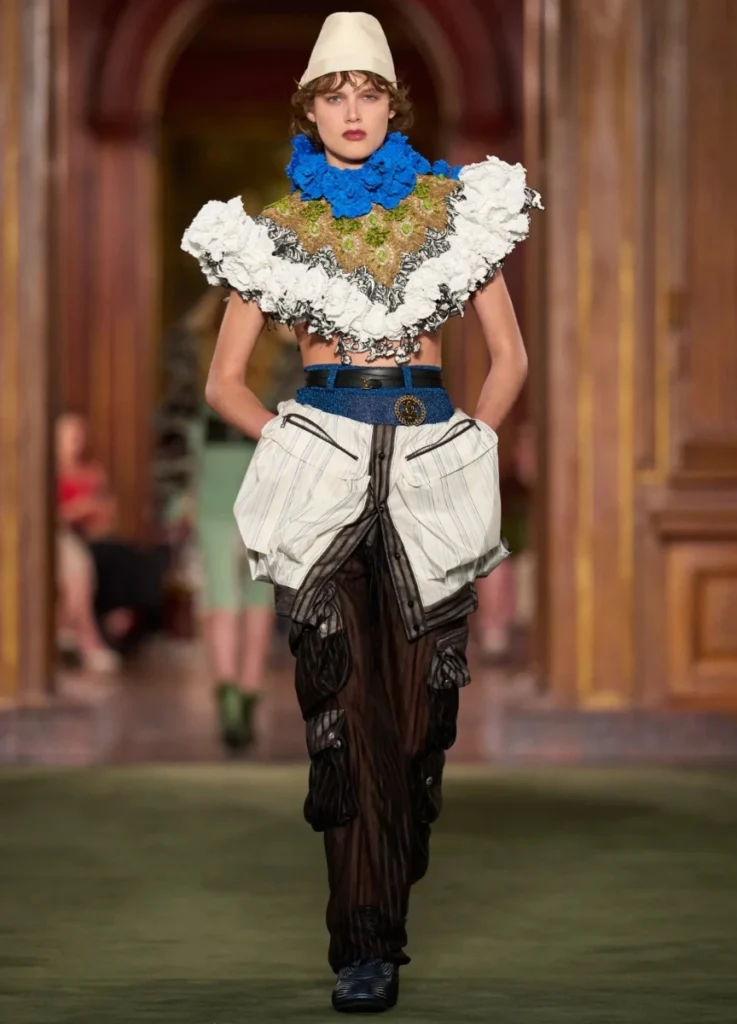
The end of the show stages the collision of time more explicitly than the opening did.
A top with an oversized ruff collar and puffed sleeves looks as though a 17th-century portrait subject from the walls of the Frick had stepped down and joined the runway. The structure carries an Elizabethan ceremonial quality. The neckline almost reads as sculpture, and the upper body adopts a painterly exaggeration.
The lower half pulls in the opposite direction. Capris and practical urban bottoms — closer to the everyday of New York than to any historical reference.
The combination summarizes everything the collection has been arguing.
Past and present. European history and New York urbanity. Ceremony and daily life.
If the opening look held three eras inside a single suitcase, the closing look stages the same collision on a single body — the same argument appears at both the opening and the close, only the second time more dramatically.
The Recurring Shoe — A New Louis Vuitton Signature Arrives
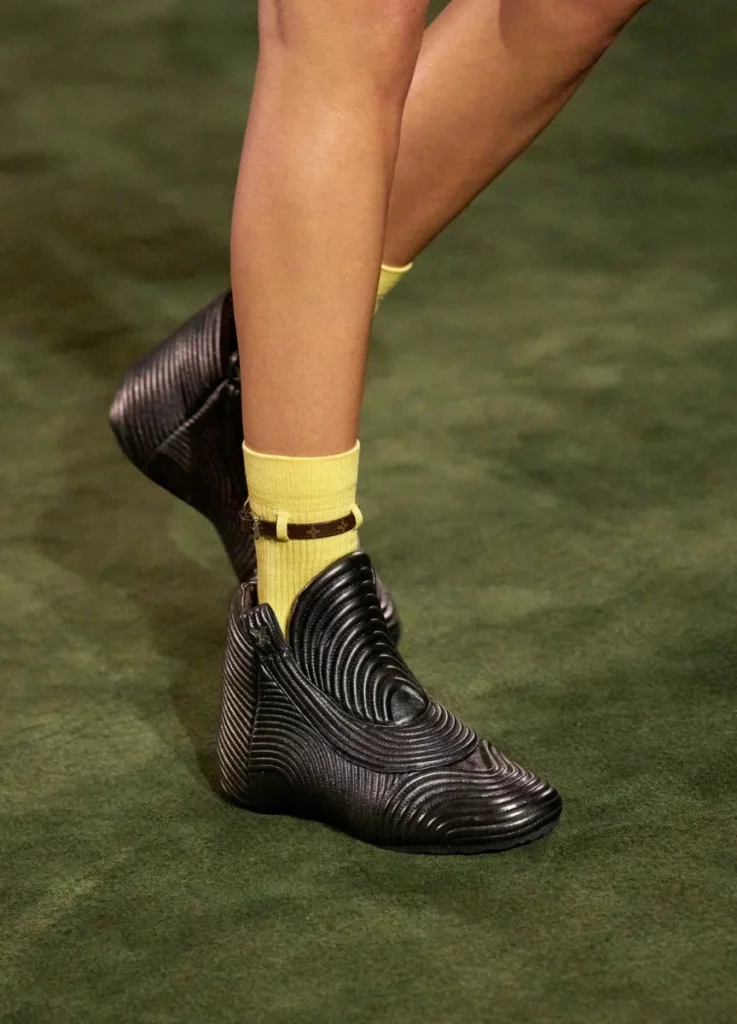
Footwear was the most insistently repeated element of the collection.
Roughly eighty percent of the looks carried the same family of shoes. Not a styling choice on a couple of looks — a visual anchor running through the entire season.
The surface isn’t smooth leather. Vertical piping creates a rhythm across the upper. A ribbed, corrugated texture repeats. The toe carries a metallic gold cap, fixed and substantial. Some versions add a ruffle-like detail at the edges. WWD’s description of the shoe as a meeting point between boxing footwear and Star Wars costuming is, in fact, accurate.
Both references are visible. The ankle structure and the proportions suggest athletic footwear. The surface treatment and metallic details belong to a retro-futurist vocabulary.
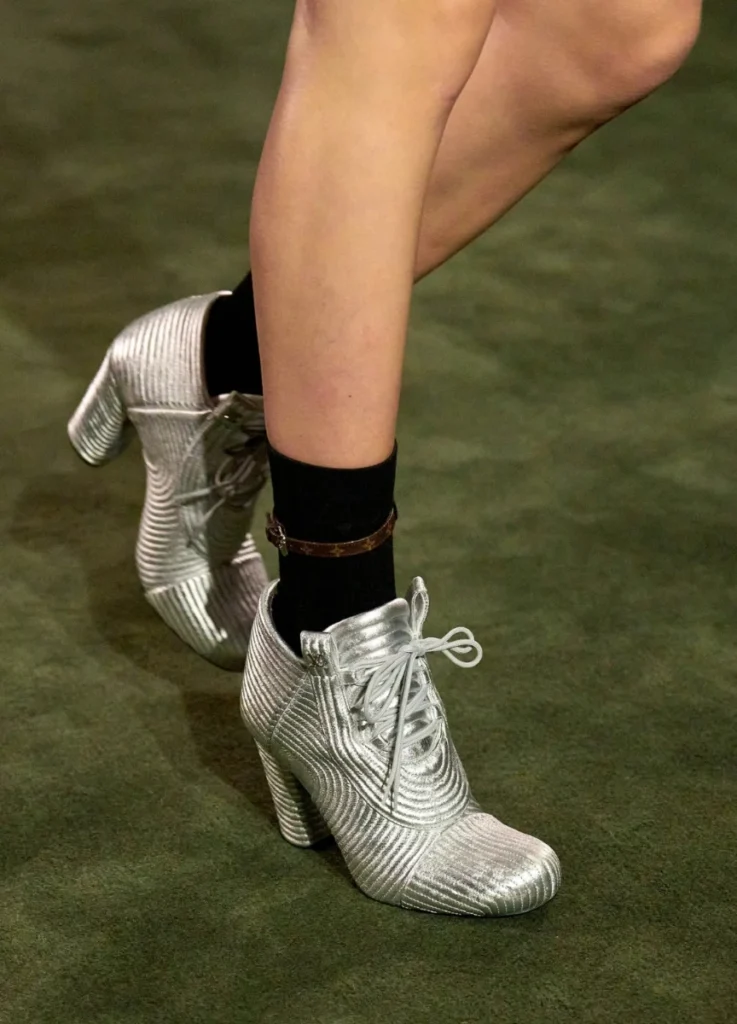
When a single shoe appears across this much of a runway, it signals that the maison intends to push the category into a new signature. The price barrier is lower than for the bags, and the shoe is still capable of compressing brand identity into a single accessory.
If the Haring-treated Speedy and Alma function as the season’s collector-driven objects, this shoe functions as the broader entry point. It also follows the established pattern by which a maison builds a new signature accessory — repetition on the runway, followed by commercial expansion in the next mainline season through color variations and material variations.
If Louis Vuitton follows its usual accessory-development pattern, this category could expand further in SS27 — additional colorways, a heeled variation, more openly commercial executions.
The shoe reads less as a styling choice and more as a preview of a future sales category.
The Recurring Hat — A Unified Frame That Constructs Character
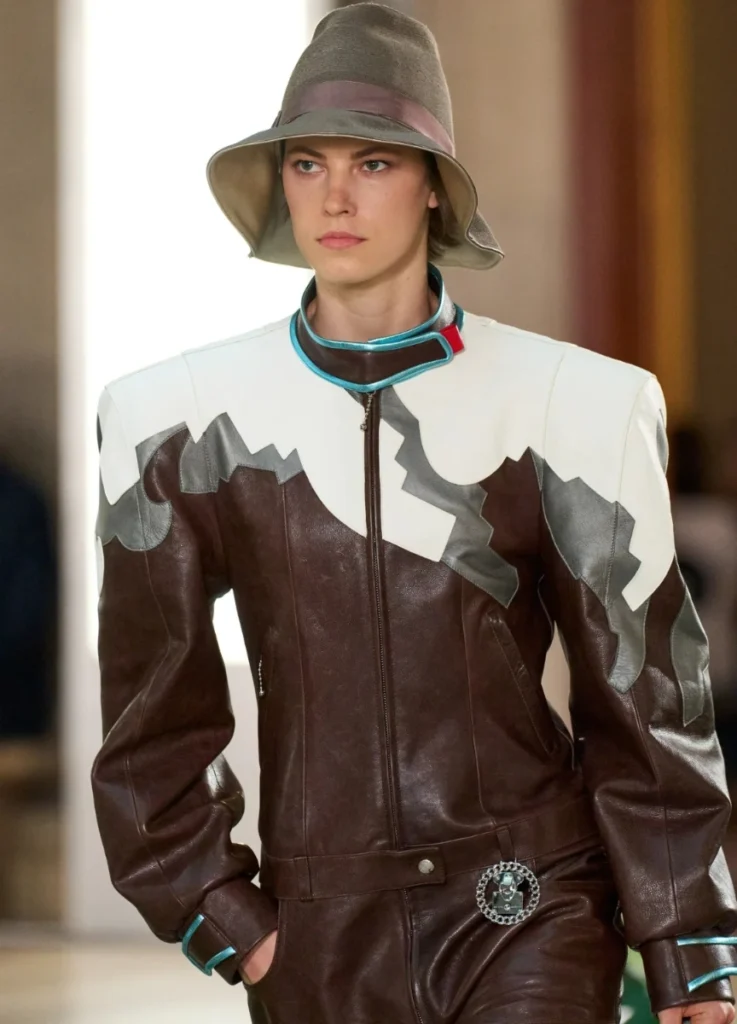
What appeared on the runway with comparable insistence to the shoe was the hat.
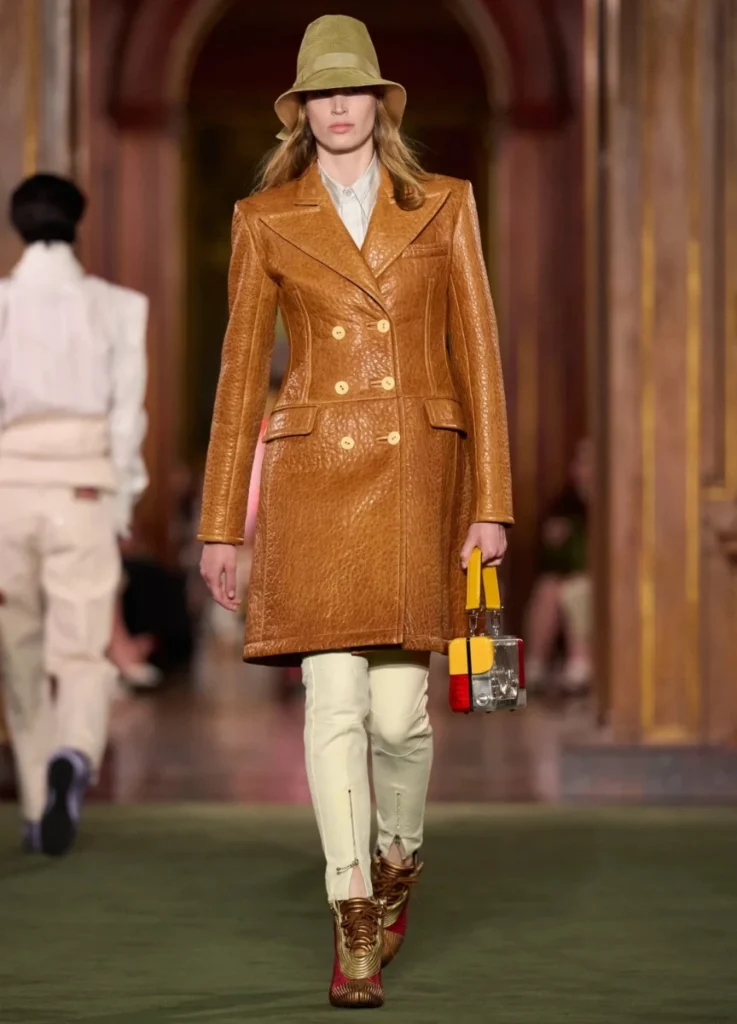
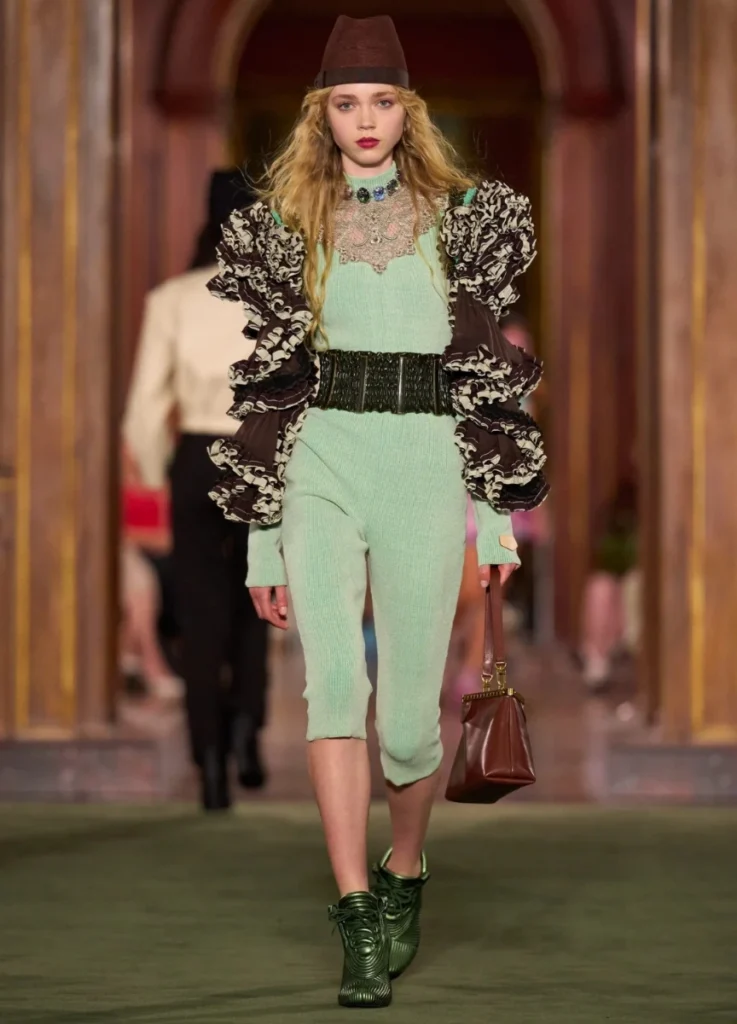
Suede, satin, leather, denim. The surfaces kept changing, but the structure stayed strikingly consistent. A rounded crown, a soft brim falling without rigidity. Some looks lean closer to bucket hats. Others read as softened fedoras. The point remains the same — nearly every look shares a closely related headwear language.
This level of repetition clearly exceeds ordinary styling logic.
Cruise has always used travel fantasy as a metaphor. Leisure, motion, the state of not yet having arrived. The hat is too familiar a travel signifier to ignore. The interesting thing this season is that the hat doesn’t function purely as decoration.
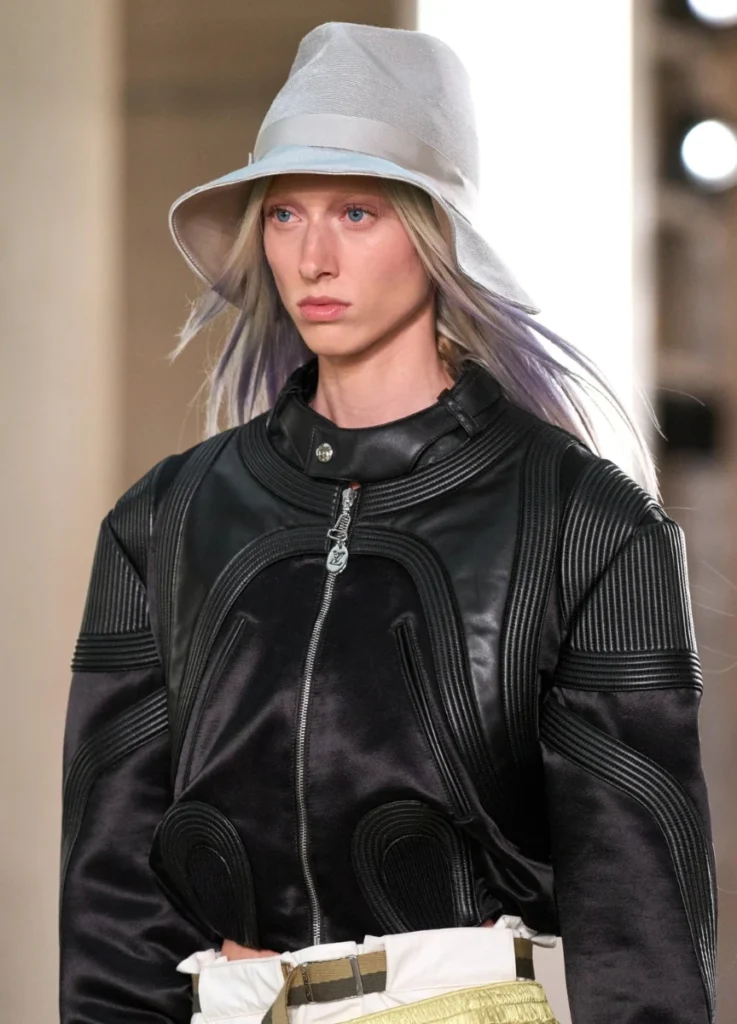
Here, the hat doesn’t signify travel. It constructs character.
The same outfit changes the moment the hat goes on. Urban tailoring becomes more cinematic. Casual denim turns into a constructed figure. The hat isn’t finishing the look — it’s framing the person.
The same pattern points to another category-expansion signal. If the shoe is the next accessory growth axis, the hat suggests Louis Vuitton is widening the lifestyle category as well.
The Bags — Louis Vuitton’s Version of Trompe l’Oeil
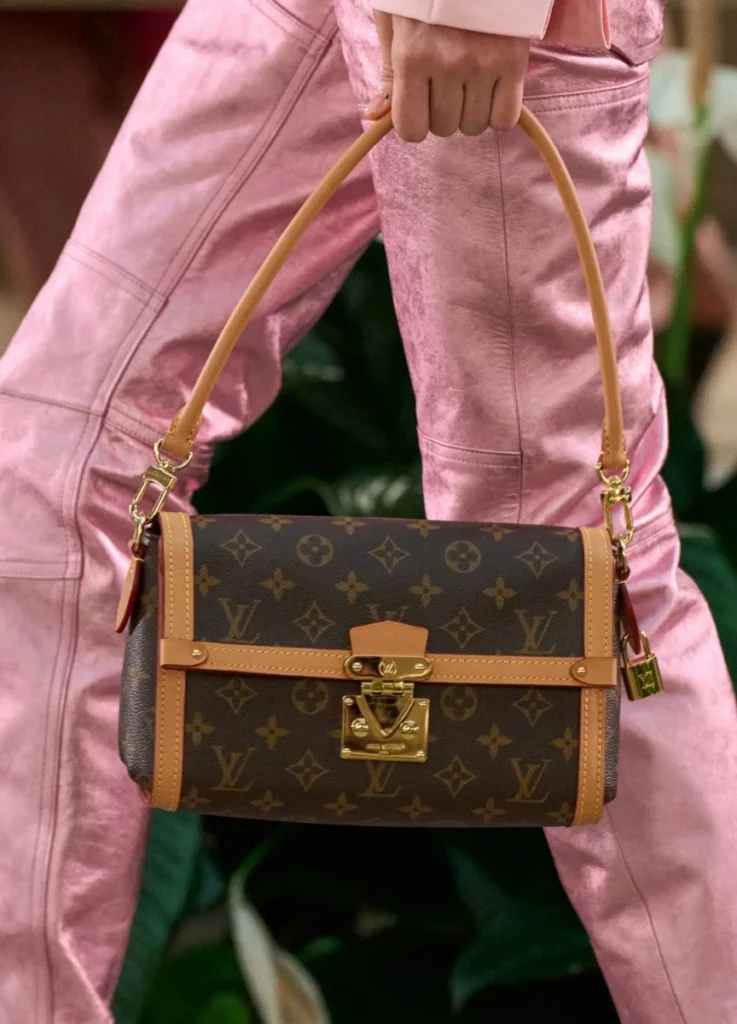
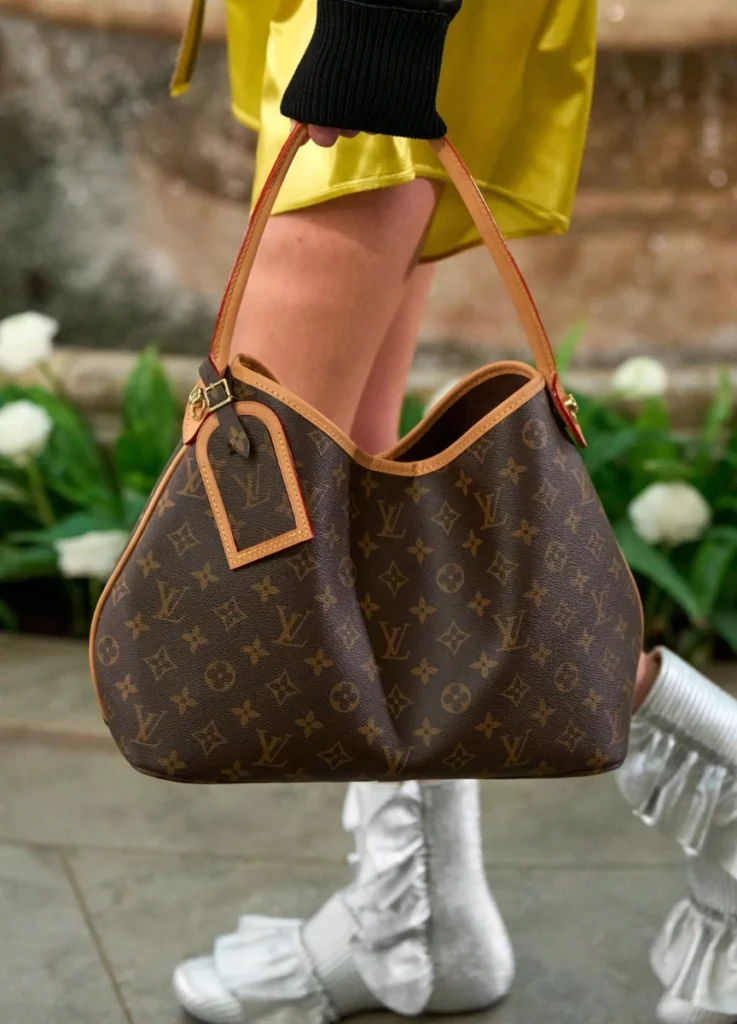
The bag strategy this season splits clearly into two tracks.
The first is the trompe l’oeil object line.
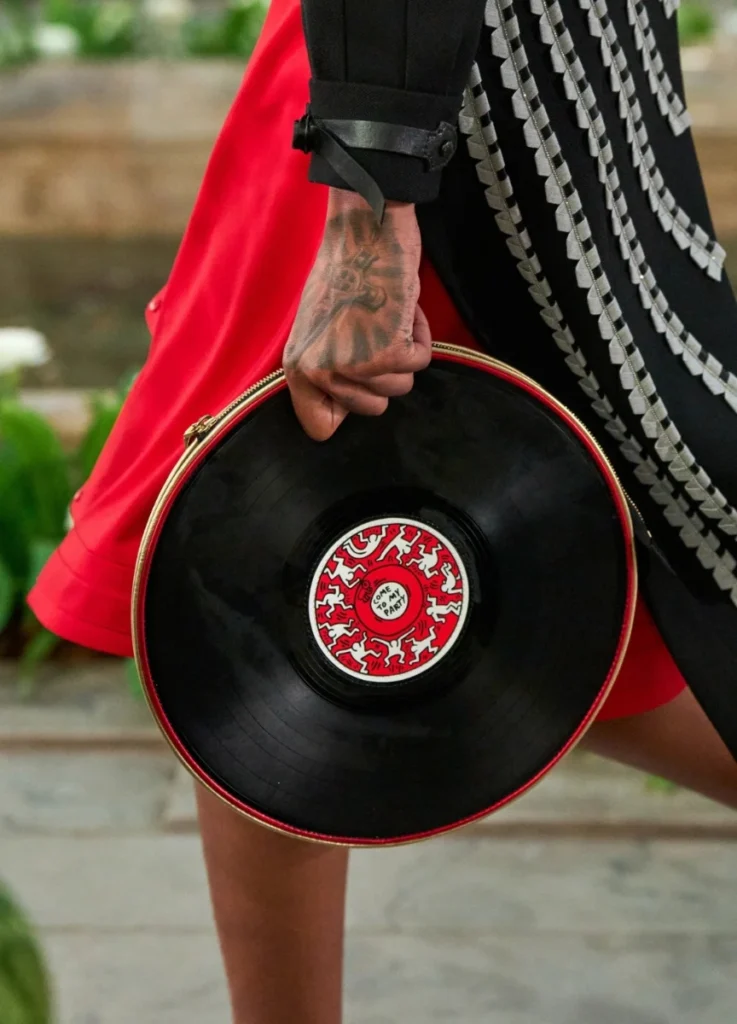
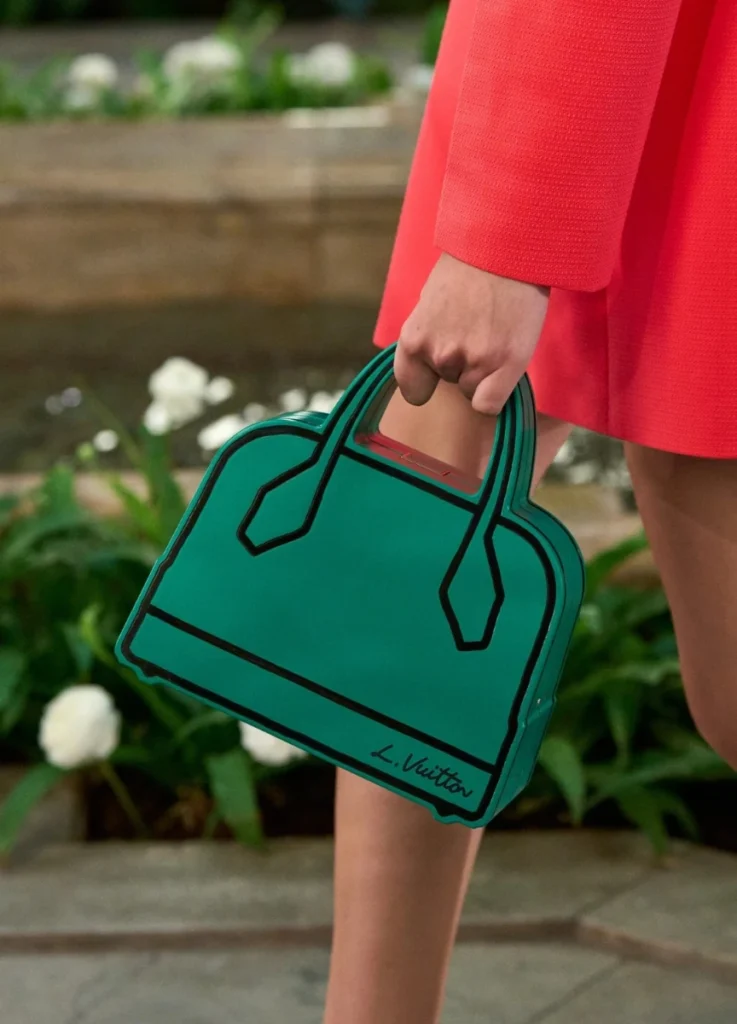
The opening suitcase reappears as a miniature. A clutch shaped like a vinyl record arrives. A glittering object replicates a Chinese takeout container. And the cleverest of them — an ionic column top-handle bag — translates the Frick’s architectural vocabulary directly into a bag.
The maison didn’t just borrow the venue, it turned the venue into a sellable product. Many houses consume runway spaces as mood, but few houses convert the space itself into sellable product the way Louis Vuitton did here. The cultural space doesn’t end as experience — it gets translated into object.
The second track is the core revenue line.
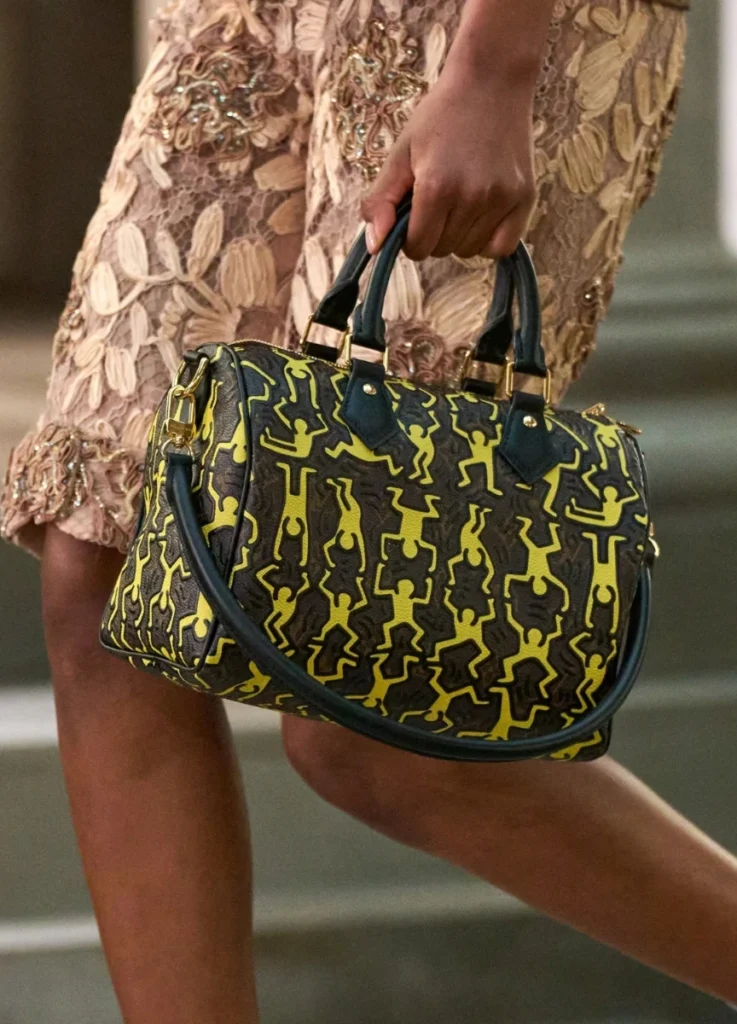
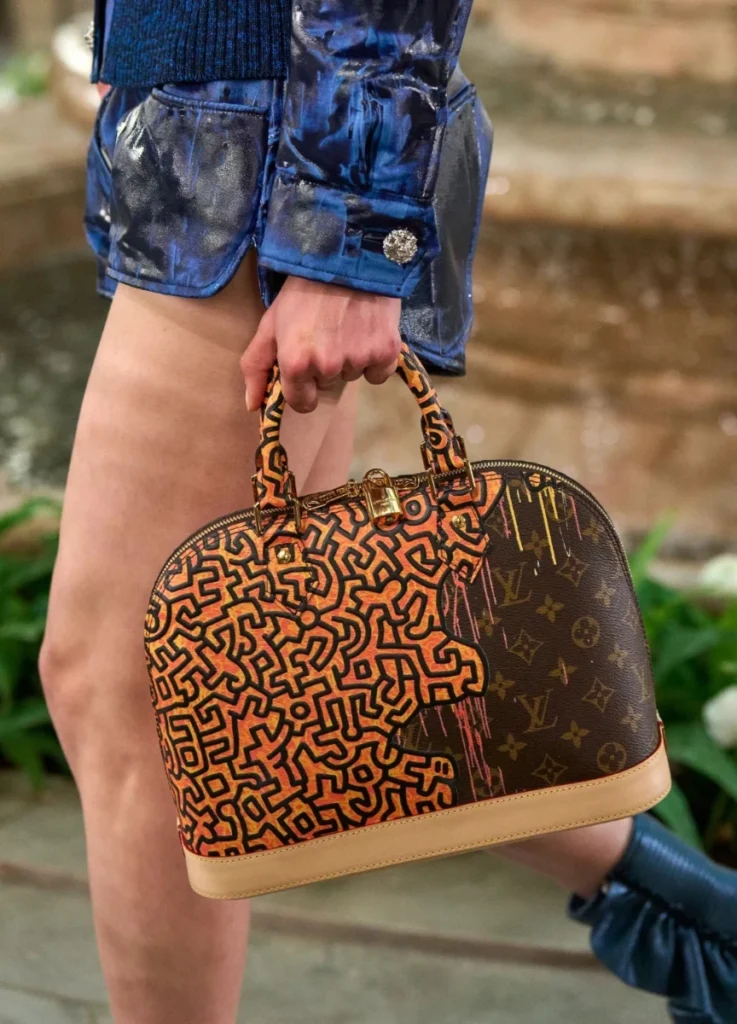
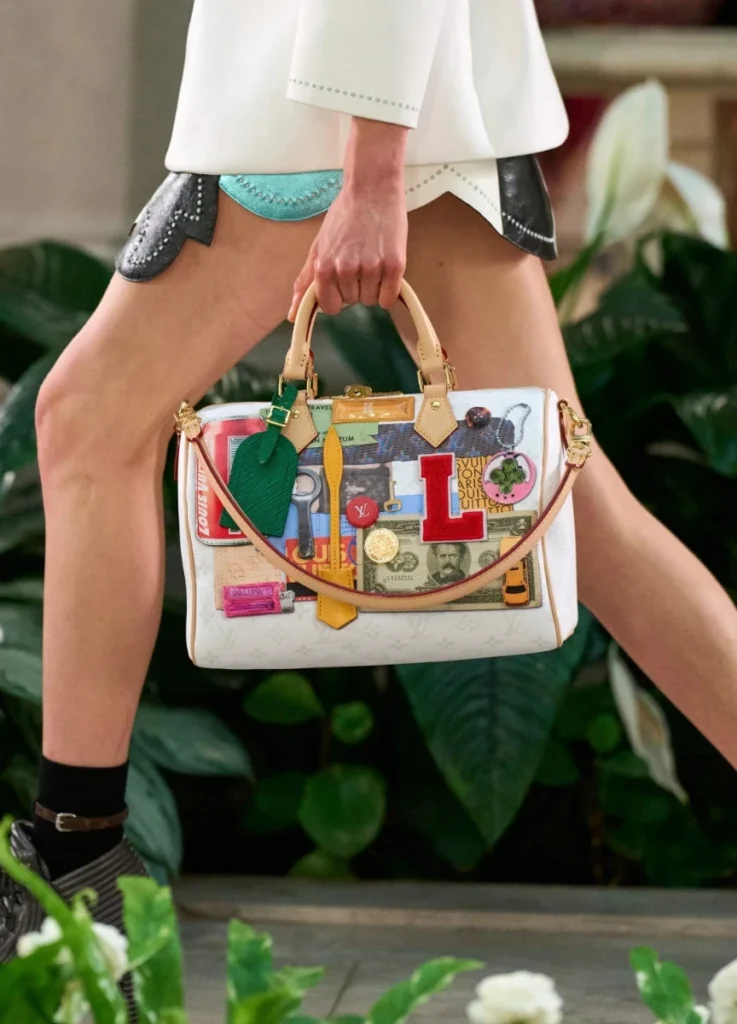
Monogram Speedy and Alma bags carrying Keith Haring drawings printed directly onto the canvas.
Ghesquière has had more than a decade to learn what Louis Vuitton customers actually buy. If the trompe l’oeil bags stimulate collector desire, the Speedy and the Alma drive sales.
And then the NYC patchwork line. Bags built from leather panels of different finishes, the patchwork itself forming a textural narrative of the city. These read as longer-cycle pieces, with a real chance of holding collectible value over time.
The bag strategy this season cleanly separates the bags that make the image from the bags that make the revenue, and Louis Vuitton continues to operate both layers as fluently as any house in the category.
Boxing Gloves — The Most Calculated Single Object of the Season
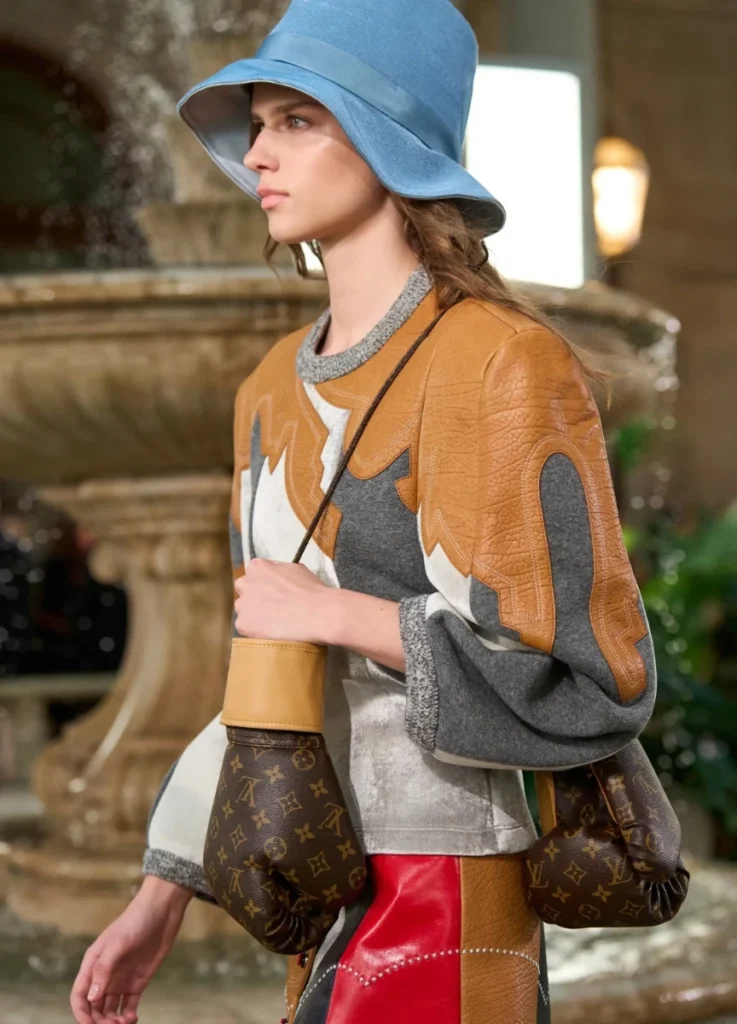
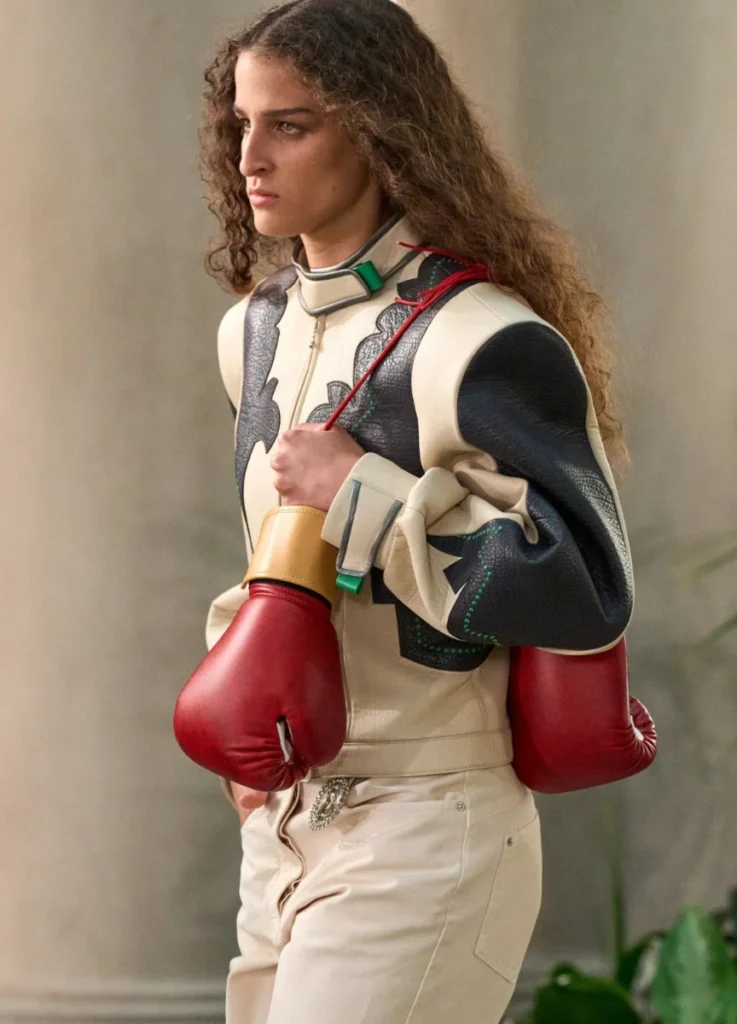
If only one object had to be chosen as the most witty and the most calculated in the collection, it would be the boxing gloves.
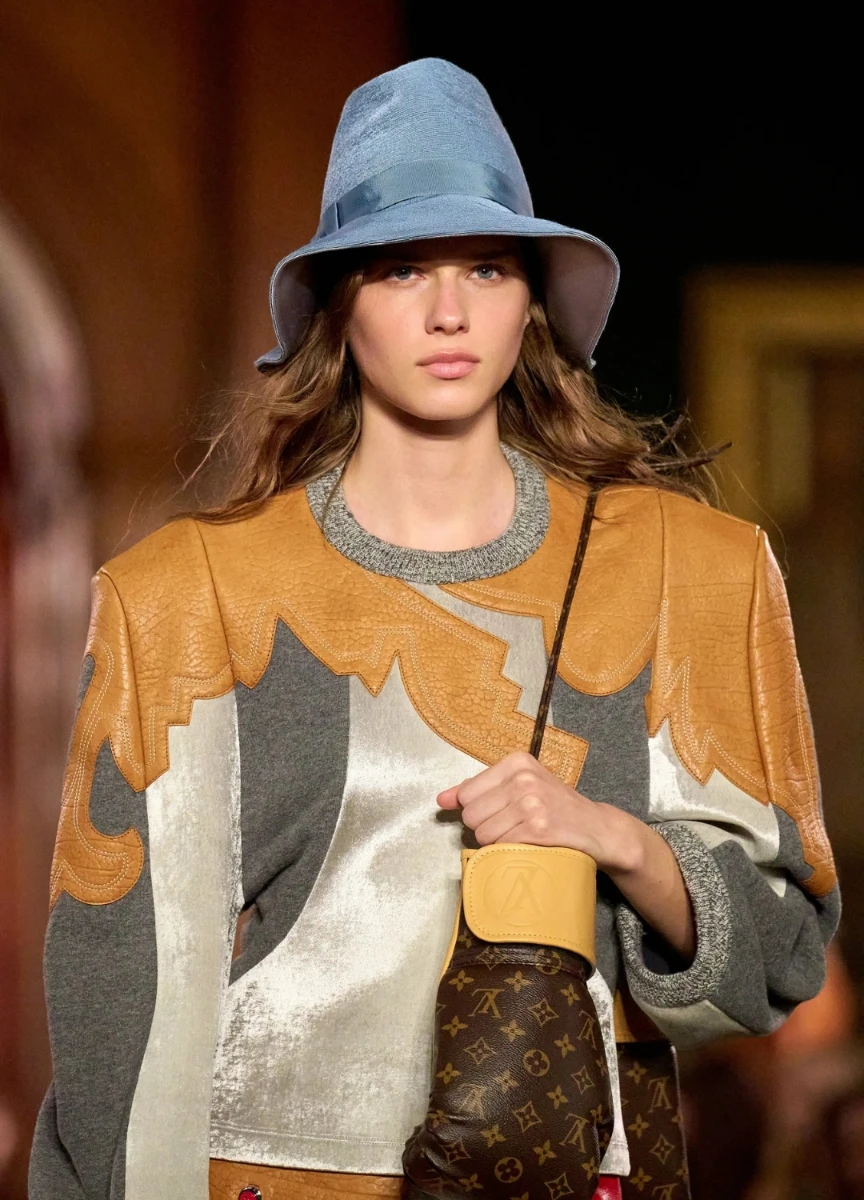
Monogram boxing gloves slung casually over the shoulders of the models. The first reaction is amusement — Louis Vuitton’s most recognized pattern placed onto an extremely direct athletic object. A luxury house’s signature meeting an urban sport’s most iconic gear. The collision pulls attention immediately.
What makes the object calculated, rather than simply playful, is that the three cultural axes the season has been building are compressed almost completely inside it.
Start with New York.
Keith Haring already carries the symbolic charge of New York street culture, but boxing is itself a deeply New York visual language. The gym, training, physicality, urban roughness. Boxing isn’t merely a sport — it’s one of the images the city has long consumed of itself.
The second layer is Ghesquière’s aesthetic.
His instinct has always run closer to slight friction than to pure elegance. He has consistently been more interested in importing objects from other cultural contexts into luxury craftsmanship than in producing perfectly refined items. The boxing glove is precisely that kind of object.
Then there’s Louis Vuitton itself.
The maison’s strongest visual asset remains the monogram. No silhouette, no season, no ready-to-wear identifies the brand more immediately than the surface language of that pattern.
The boxing glove sits at the point where three vectors — New York, Ghesquière, Louis Vuitton — meet inside a single object. With objects like this, the lower the practicality, the higher the collectible value tends to climb, and Louis Vuitton has repeated this mechanism often enough for the pattern to be recognizable. Every season, a deliberately limited cult object is planted inside the collection, and that object is left to drive the conversation of the entire season.
If the Mary Jane keyring played that role for Chanel Cruise 26/27, the boxing gloves play it precisely for Louis Vuitton this season — a calculated spike object, doing exactly what it was designed to do.
The Same Cruise Season, Three Entirely Different Choices — Demna, Anderson, Ghesquière
Reading Louis Vuitton Cruise 2027 in isolation misses a context worth holding onto.
Across the same season, three different maisons chose three different kinds of stages. Reading those three together makes Louis Vuitton’s choice visible in a way it isn’t when read alone.
Demna showed Gucci Cruise in Times Square.
The choice is direct. Crowds, noise, public spectacle, the city’s bright surface. Luxury walking out into the middle of the street, with the maison using public spectacle as strategy.
Jonathan Anderson showed Dior Cruise at LACMA.
A different decision entirely. Hollywood fantasy, West Coast light, a cultural space sitting on the boundary between cinema and museum. Dior connected itself less to the city itself and more to the image industry the city produces.
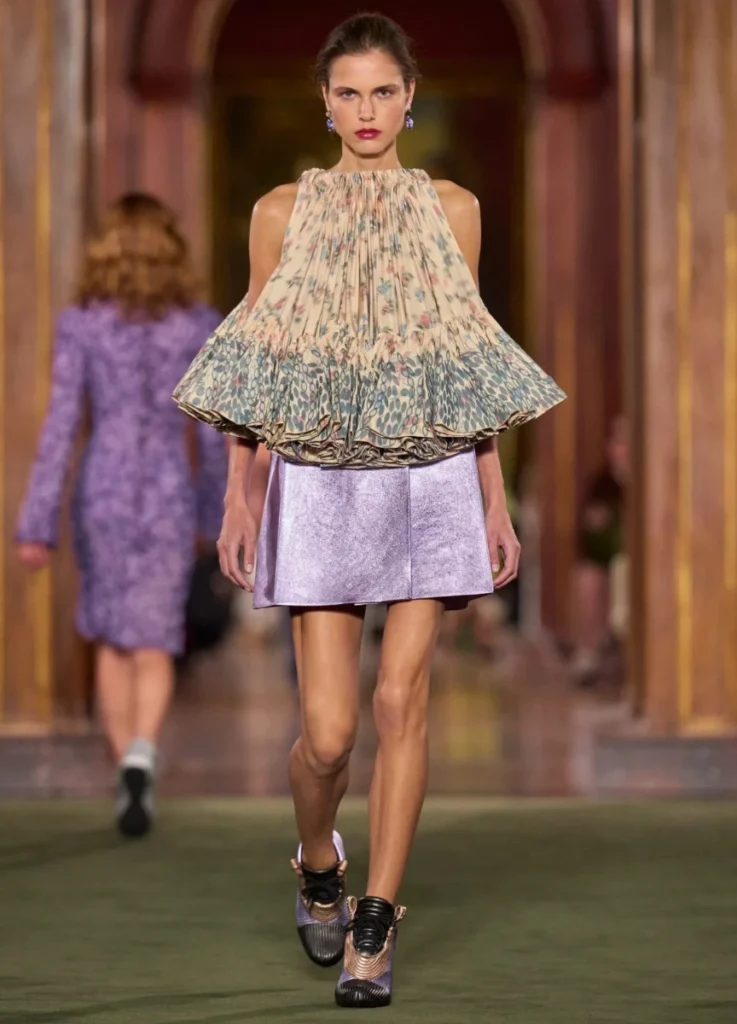
Ghesquière chose the Frick, and the register shifts completely. Where Times Square offers public visibility, the Frick sits at the near-opposite. Inside New York itself, it is one of the spaces furthest from mass spectacle. Quiet, enclosed, dense with the cultural taste of old capital.
Three choices, lined up next to each other, describe where luxury fashion is currently heading more clearly than any trend report could.
Demna works through public spectacle. Anderson through cultural image. Ghesquière through institutional authority.
Louis Vuitton’s choice looks the most conservative of the three and the most ambitious at the same time. The Frick lacks the immediate mass recognizability of Times Square, can’t generate that level of immediate virality, doesn’t carry the emotional accessibility of Hollywood.
But the same choice is also the most ambitious of the three. A three-year sponsorship with the Frick isn’t a single-season occupation of a stage — it’s a long-form cultural binding. Holding a public street for a day and structurally tying oneself to a cultural institution are entirely different orders of action.
Demna showed a season. Anderson showed a city. Ghesquière, a category.
On Gesture and Wearability — The Critique Worth Holding
Not all responses were favorable.
The strongest critique centers on one point: in several looks, the balance leaned too far toward image. The judgment carries some weight.
A handful of looks this season belong more to the territory of constructed character than to the territory of clothes that move through a daily life. The patchwork leather jacket is the clearest example. The structure and craft density are impressive, but how naturally that jacket actually translates into ordinary wear is a separate question. The oversized ruff-collar closing looks function similarly. Inside the Frick’s painterly context they’re entirely persuasive, while as ready-to-wear meant to enter a real closet, they aren’t.
A distinction worth drawing remains, though.
Cruise functions as an image-defining season by design. The wearable, commercial ready-to-wear circulates through the actual boutique network, and the split between the two layers is unusually clear this season.
The shoes, the hats, the Haring Speedy and Alma, parts of the ruffle line, and the entire family of the opening look read as the consumable axis. The boxing gloves, the ionic column bag, the patchwork jacket, and the Pop Art tops read as the statement and collectible axis. What’s interesting about Louis Vuitton is how increasingly fluent the maison has become at running these two layers in parallel.
Not every customer needs to buy the same product. Some chase the collectibles, some buy practical leather goods, some enter through the accessory tier. The layered strategy reads more clearly this season than it has in recent ones.
What It Means When a Maison Buys a Museum
The image that will hold longest from Cruise 2027 may not be a particular look at all.
The Haring suitcase was strong. The monogram boxing gloves were strong. The image of models moving past the Frick’s paintings was strong. The structurally most significant moment of the season was something different — what Louis Vuitton did.
It made a three-year commitment to a cultural institution.
Fashion houses using historic buildings as runway venues isn’t new. Most of these arrangements are one-time. A single season’s image production occupies a space briefly and then leaves. The venue is the backdrop. The collection is the subject.
The Frick functions as more than backdrop. The maison has positioned itself as a long-term cultural partner — more precisely, this is closer to treating a venue as a long-term brand asset. The maison is incorporating a particular cultural authority into its own brand asset structure.
Louis Vuitton already speaks this language fluently. LVMH has built cultural institutions directly through Fondation Louis Vuitton for years. Architecture, contemporary art, cultural patronage have long been part of the brand’s image strategy. But the Fondation is an internal institution — a cultural platform the maison built and houses inside its own authority.
The Frick is an independent cultural authority that already exists.
Old New York capital, European painting collections, art-historical weight, accumulated upper-class cultural taste. Louis Vuitton tying itself structurally to that, not as a one-off event but through ongoing agreement, is a different kind of motion altogether.
The arrangement is closer to a symbolic acquisition than to anything else. Not a literal acquisition — but in luxury consumption, where perception drives so much of the equation, the cultural effect runs surprisingly close. What customers ultimately consume extends beyond product into perceived belonging — the question of what the brand belongs to.
This pattern may continue to extend across the industry. Many maisons already operate cultural arms — Cartier Foundation, Prada Foundation, the in-house cultural institution model is by now well established. One possible next step is long-form binding with external institutions: beyond building one’s own cultural foundation, forming structural ties with existing cultural authority. Cruise 2027 is among the clearest seasonal signals of that shift.
In Closing — Ghesquière Didn’t Show a Season, He Declared a Category
This Louis Vuitton Cruise was, in the end, the clearest strategic declaration of the season.
Louis Vuitton today isn’t simply a house that sells clothes. It operates the history of travel, cultural authority, collectible objects, lifestyle categories, and core commercial product as a single composite platform — and Cruise 2027 made that structure visible in a way recent seasons hadn’t.
Demna pursued spectacle. Anderson built atmosphere. Ghesquière chose institutional authority — arguably the most recognizably Louis Vuitton move of the three.
All images unless otherwise credited: Vogue Runway
[ Related Editorials ]