The Return of the Discontinued Cartier Love Rainbow, and What the Maison Has Admitted
Cartier has brought color back.
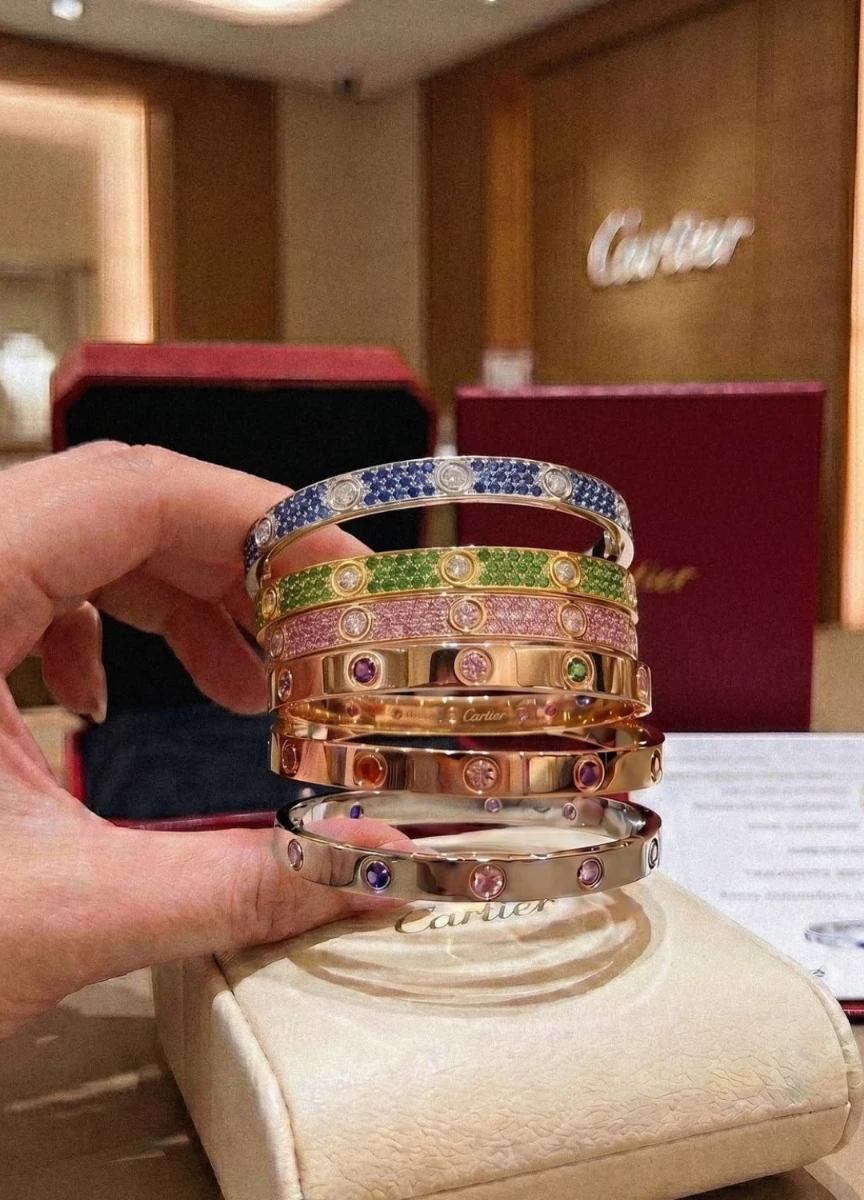
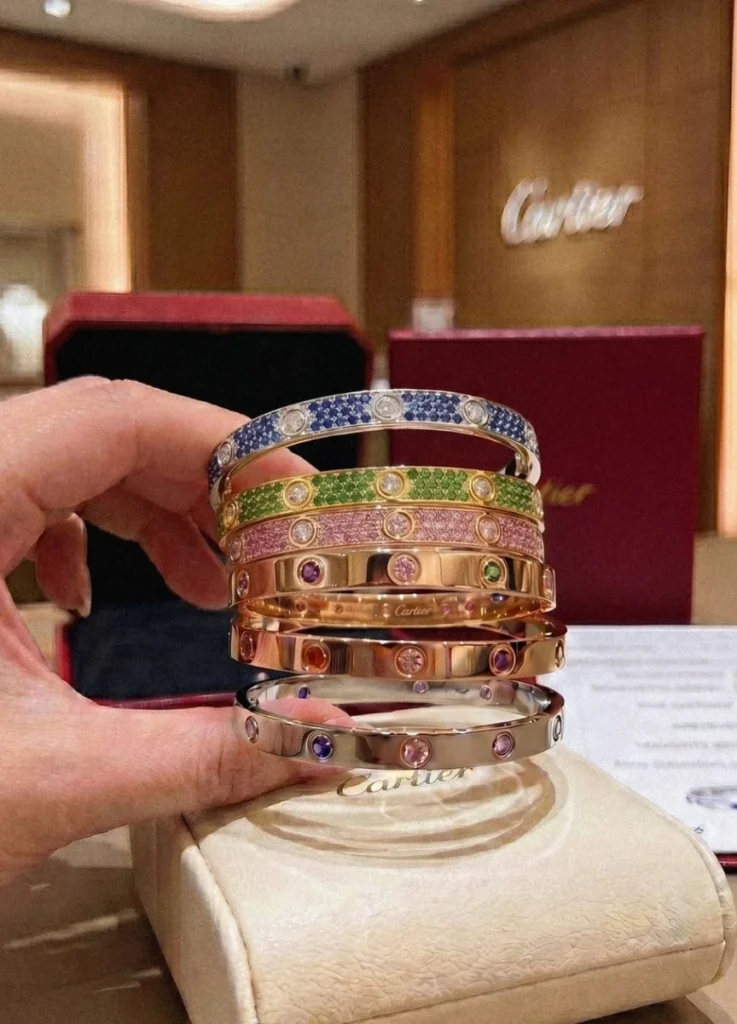
Not as a single addition, but as two completely different directions opened simultaneously inside the most stable icon the maison owns. One is the return of the Rainbow Love, quietly retired after 2021. The other is a full pavé trio that turns the bracelet’s surface into color itself. Same screw motif, same Love silhouette — one scatters color across the metal, the other becomes color.
Why now. And why both at once.
Part of the answer doesn’t sit inside Cartier. It sits in a collector market that has been moving outside the maison for over a decade.
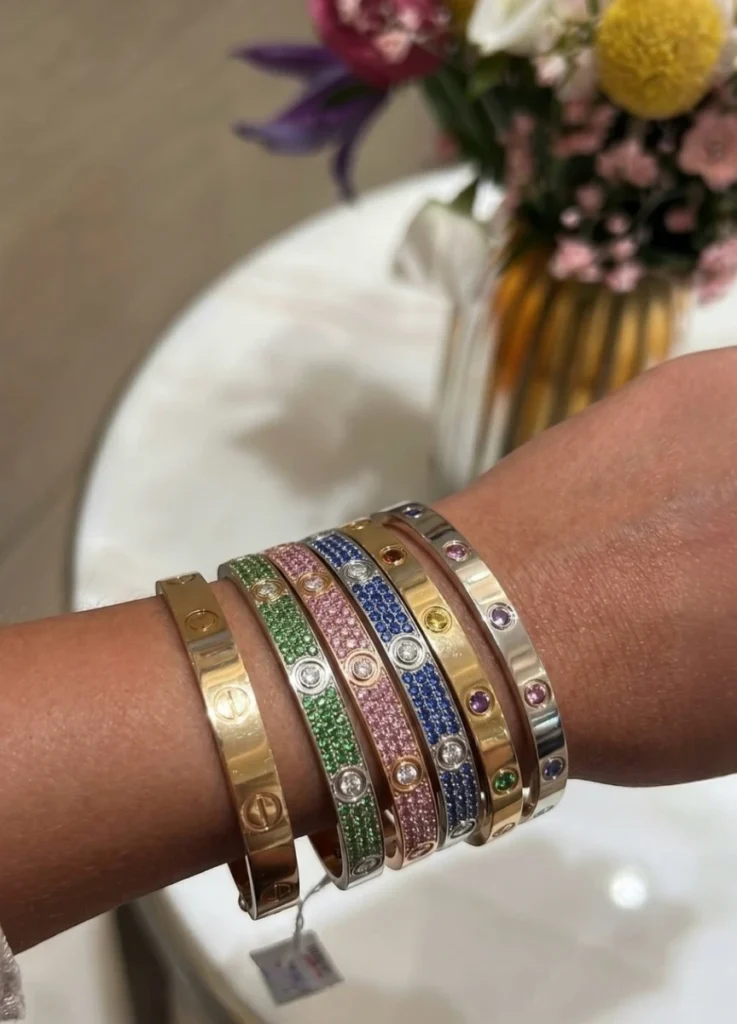
@tash_ps / Instagram
One Icon, Two Directions
The capsule splits cleanly into two categories.
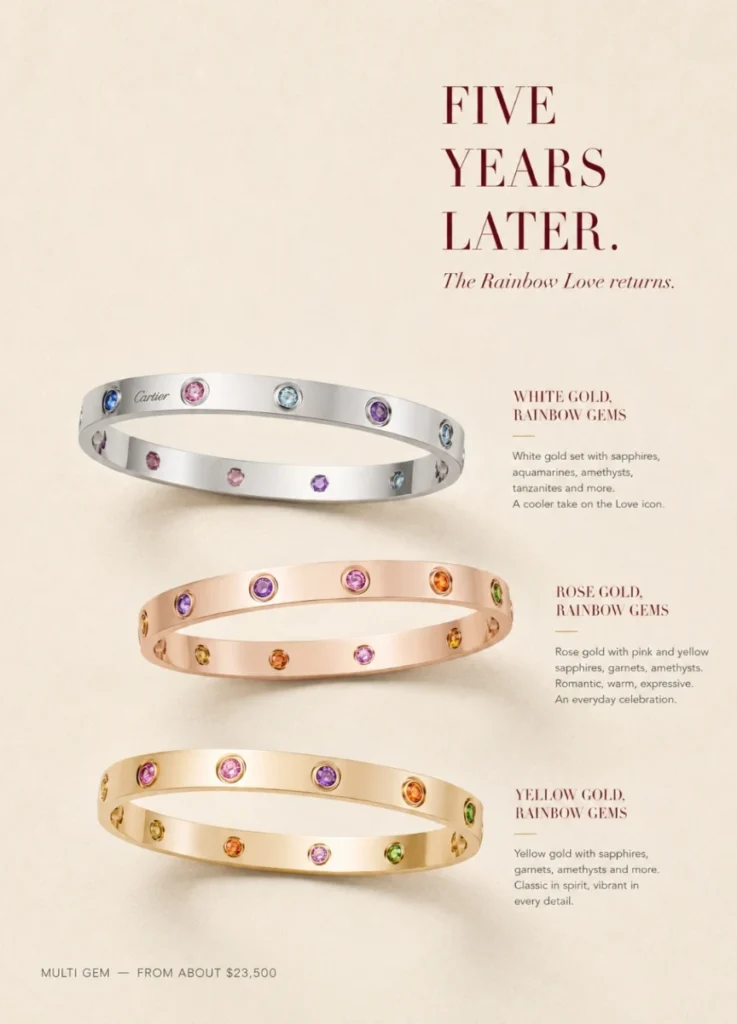
The first sets colored stones in bezel mounts at each screw motif — the Multi Gem Love, a return of the discontinued Rainbow. The second covers the entire surface in continuous pavé — the new Full Pavé Trio.
Multi Gem reads as a revival. It carries the rhythm of the original Rainbow Love back into the lineup. The Pavé Trio reads as something new. It erases most of the metal surface and pushes color forward as the first thing the bracelet says.
Both are Love bracelets. But they do different work. Multi Gem lays color onto the Love. Full Pavé turns the Love into color.
source: Cartier
Multi Gem Love Bracelet — Color With the Surface Left Open
The Multi Gem isn’t defined by how much color it carries. It’s defined by how much it leaves out.
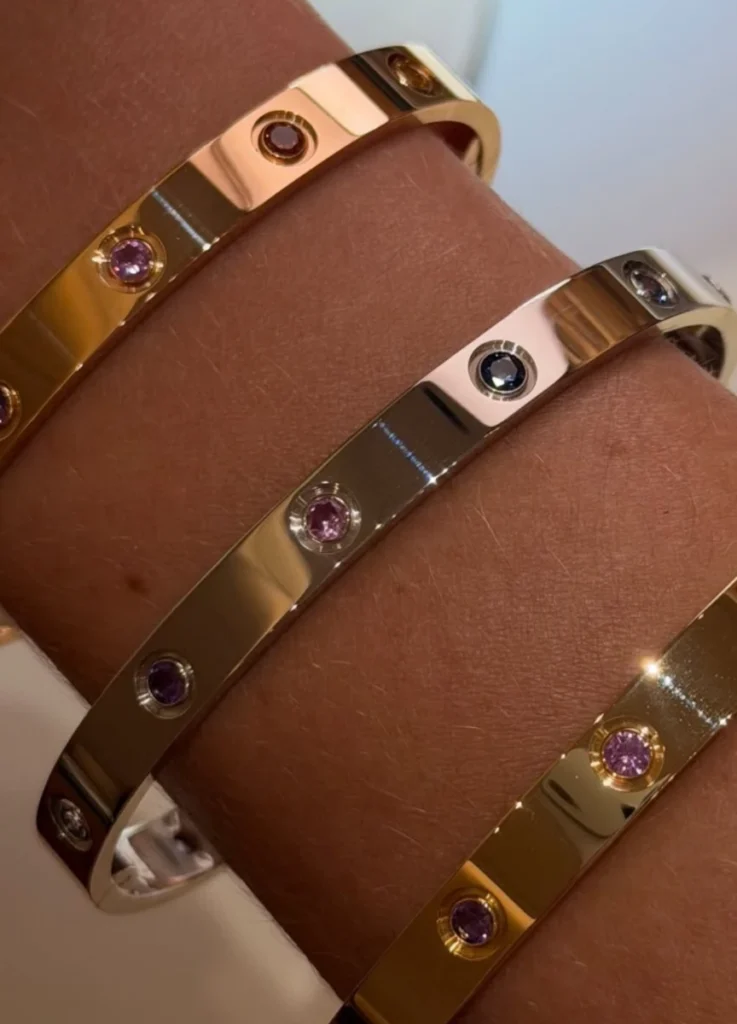
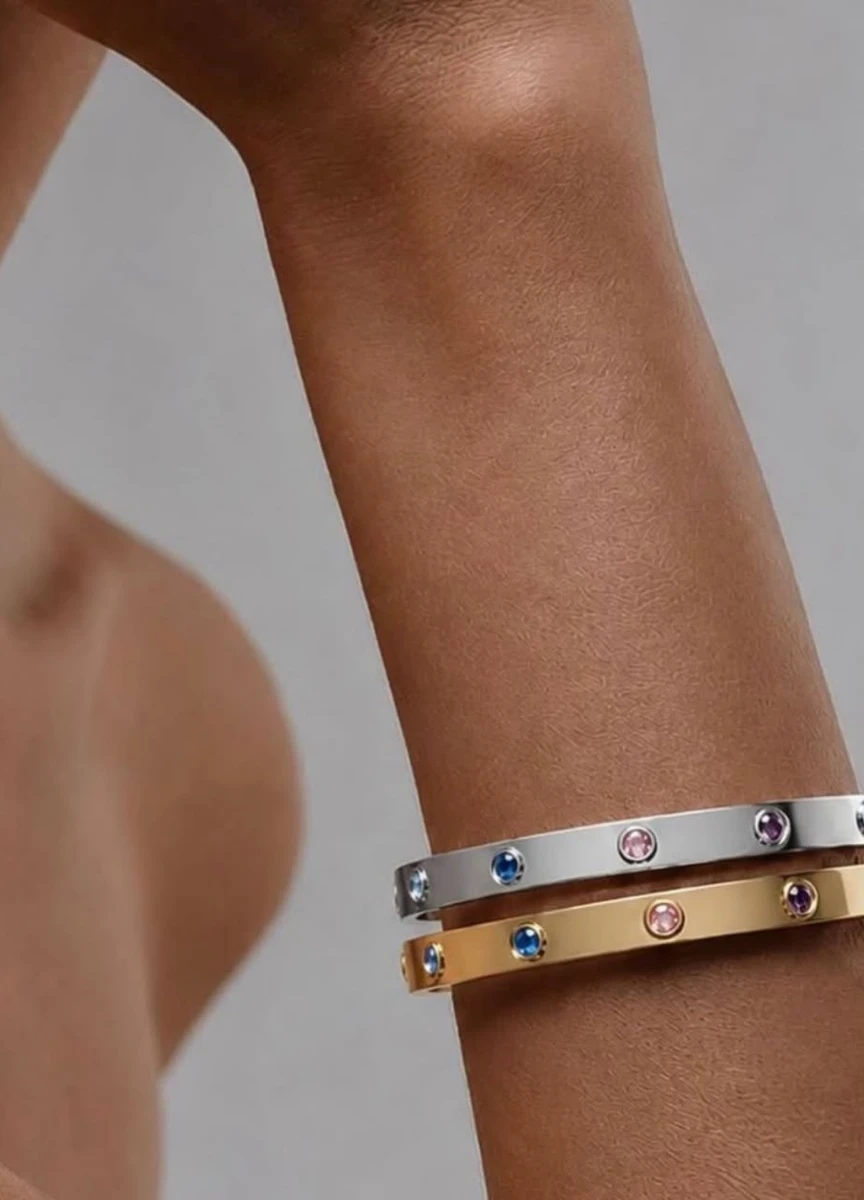
Stones sit in bezel mounts at each screw motif, and the metal between them stays open. That gap is what keeps the bracelet from closing into a solid color field. The eye moves from stone to stone, and the metal in between holds the cool, ordered structure that the Love has always been about.
The white gold version is reported to combine pink sapphires, purple spinels, aquamarines, amethysts, and blue sapphires. The rose and yellow gold versions read as pink and yellow sapphires with green and orange garnets, plus amethysts. The composition matters less than the spacing. Color enters as intervals, not as a continuous plane.
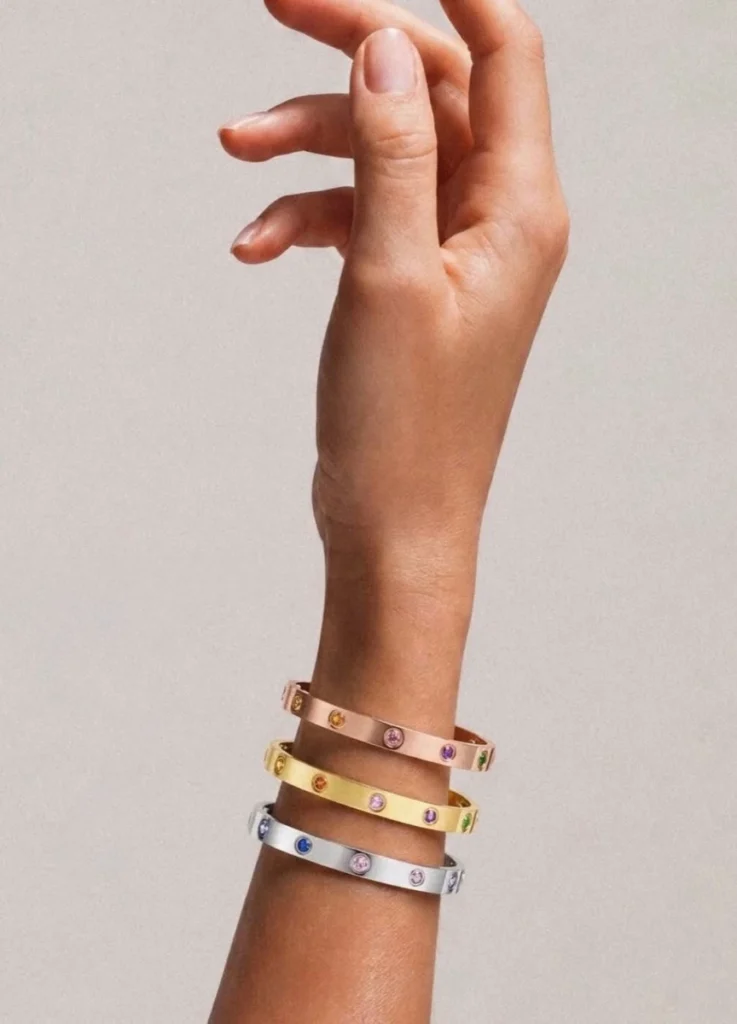
This makes the Multi Gem the easier of the two to wear. The Love’s width and horizontal structure stay intact, but because color doesn’t claim the entire surface, the bracelet reads lighter on the wrist — less blocked, less heavy. On narrower wrists, on wrists with more curvature, on shorter forearms, that difference works visually well beyond what the actual gram weight would suggest.
source: Cartier
Fit Architecture — Why Multi Gem Sits More Easily
The Love isn’t a bracelet that flows with the wrist. Its flat surface and clear horizontal proportion read first, before the body underneath. On a narrower wrist, or on a shorter forearm, the bracelet can announce itself before the wrist does.
Multi Gem softens this. Because the stones break across the surface at the screw motifs rather than running continuously, the eye doesn’t lock onto a single color mass. The metal showing through between the stones creates structural breathing room, and that room keeps the bracelet from covering the wrist completely.
For this reason Multi Gem doesn’t require a broad, flat wrist. It accepts narrower ones without strain. Color is present but the surface stays open; presence registers but the wrist isn’t overtaken. For collectors who wanted to experience the Love in color but found the original Love’s surface area too dominant, this is the more realistic entry point.
source: Cartier
Pavé Trio Bracelet — When Color Becomes the Surface
The Full Pavé Trio sits at the opposite end of the spectrum.
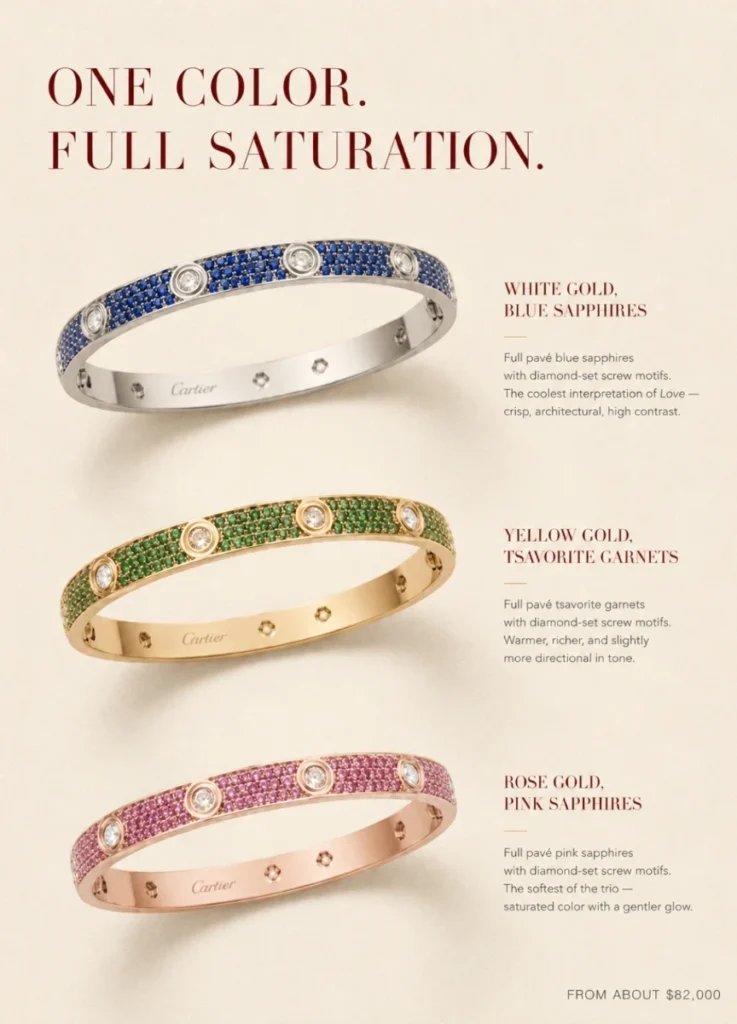
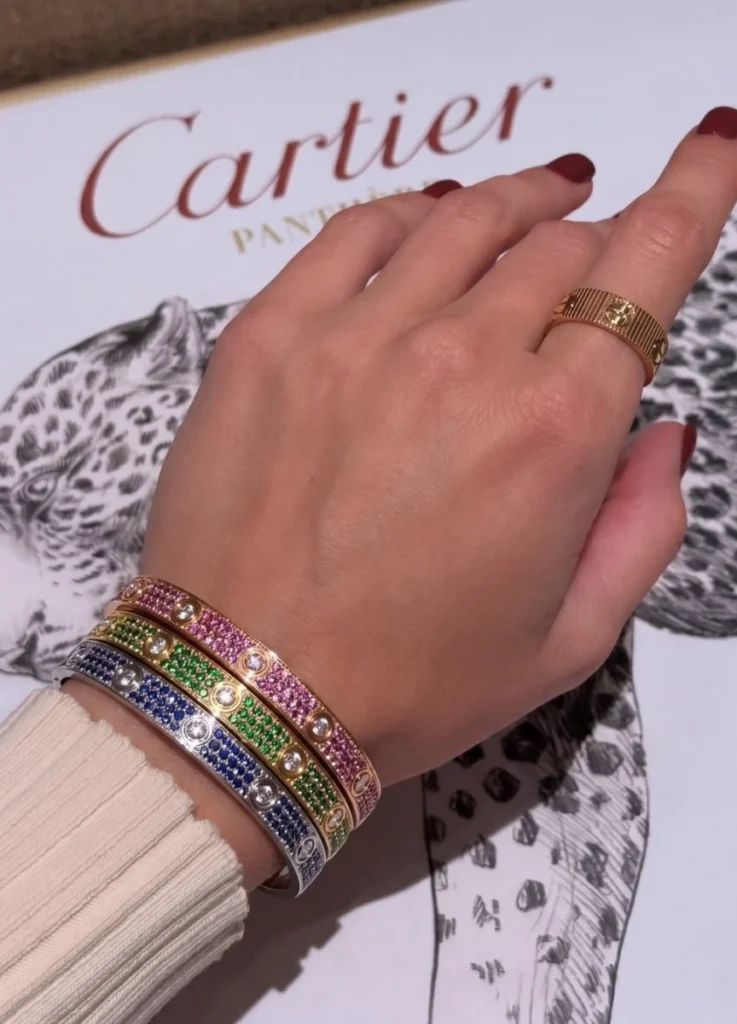
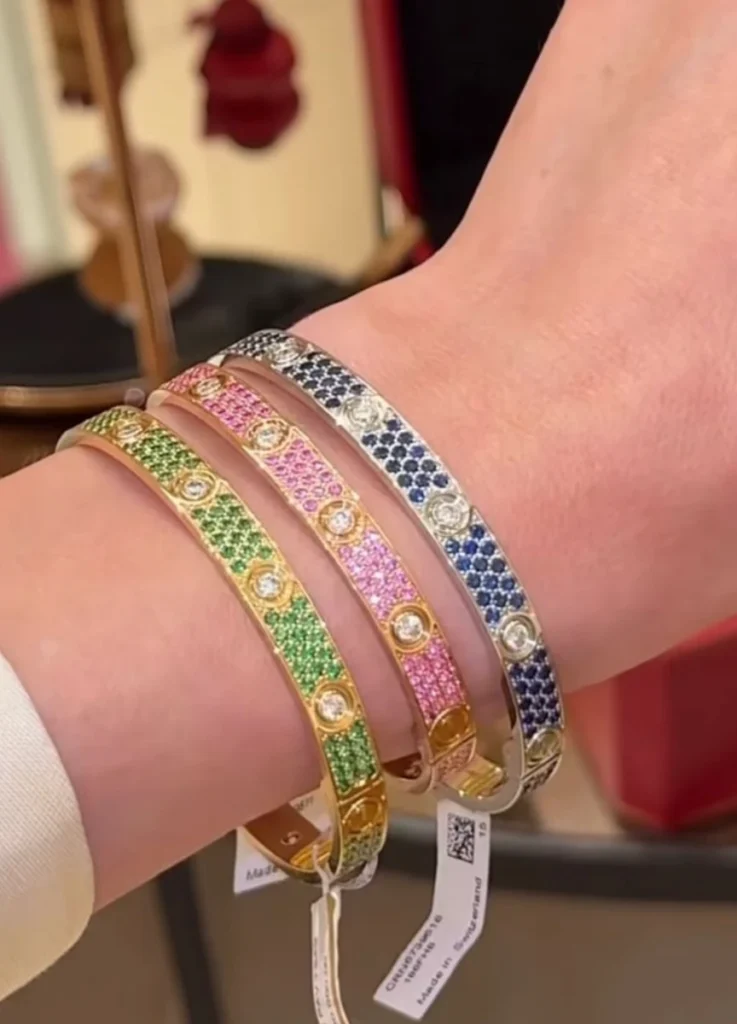
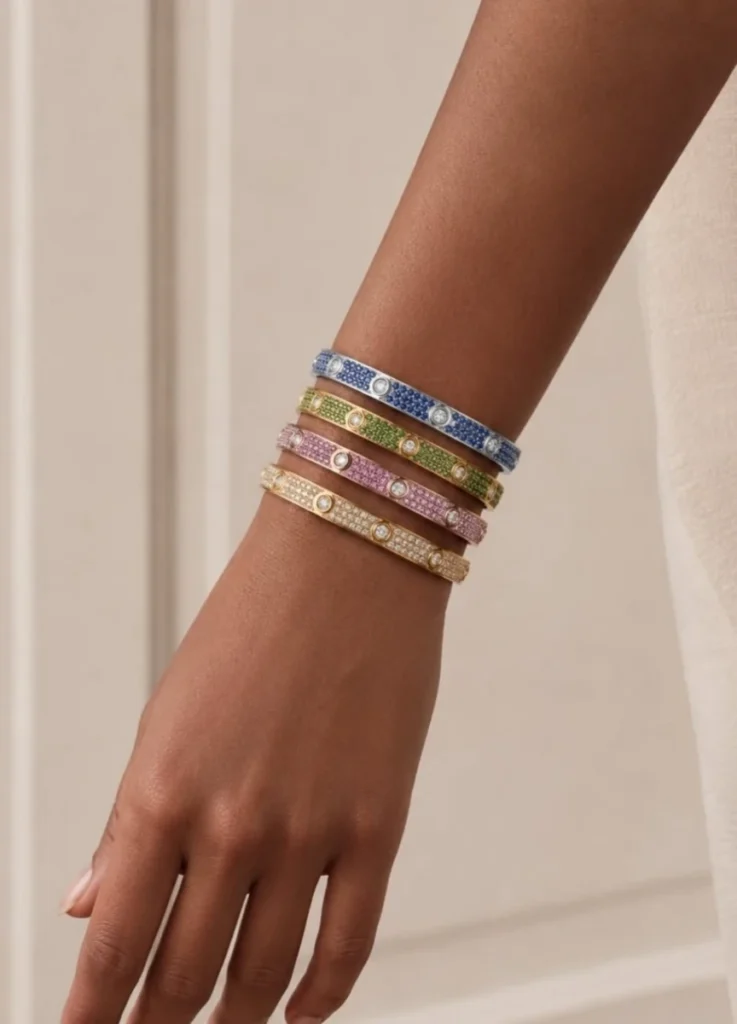
White gold carries blue sapphires, yellow gold carries green tsavorites, rose gold carries pink sapphires. Each color fills the bracelet’s surface almost completely. The metal is no longer the lead. It steps back into a structural role, and the colored stones become the dominant visual surface of the Love.
The diamonds set at each screw motif read less as decoration and more as structural markers — they reprint the Love’s original motif on top of a continuous pavé field. If the screws disappear, the Love loses its identity. If they become too prominent, the color field breaks. So the diamond screws function as anchors, holding the icon in place on top of a surface that would otherwise read as pure color.
On the wrist, this bracelet is significantly stronger. Where Multi Gem shows color as a rhythm, Full Pavé pushes it as a plane. The result is overwhelming in photographs and considerably more demanding in person.
@ezylifedxb / Instagram
Fit Architecture — Why Full Pavé Is the Harder Wear
The difficulty of Full Pavé isn’t about price or visual drama. It’s about closure.
When color runs continuously across the bracelet, the Love’s horizontal proportion reads even stronger. The metal’s breathing room disappears, and the eye loses places to rest. The result is that the bracelet sits on the wrist not as a line but as a solid block of color.
This structure is most stable on broader, flatter wrists. When the wrist can carry the bracelet’s surface area, the density of the pavé reads as luxury weight. On narrower or more curved wrists, the bracelet stops following the body and starts sitting on top of it.
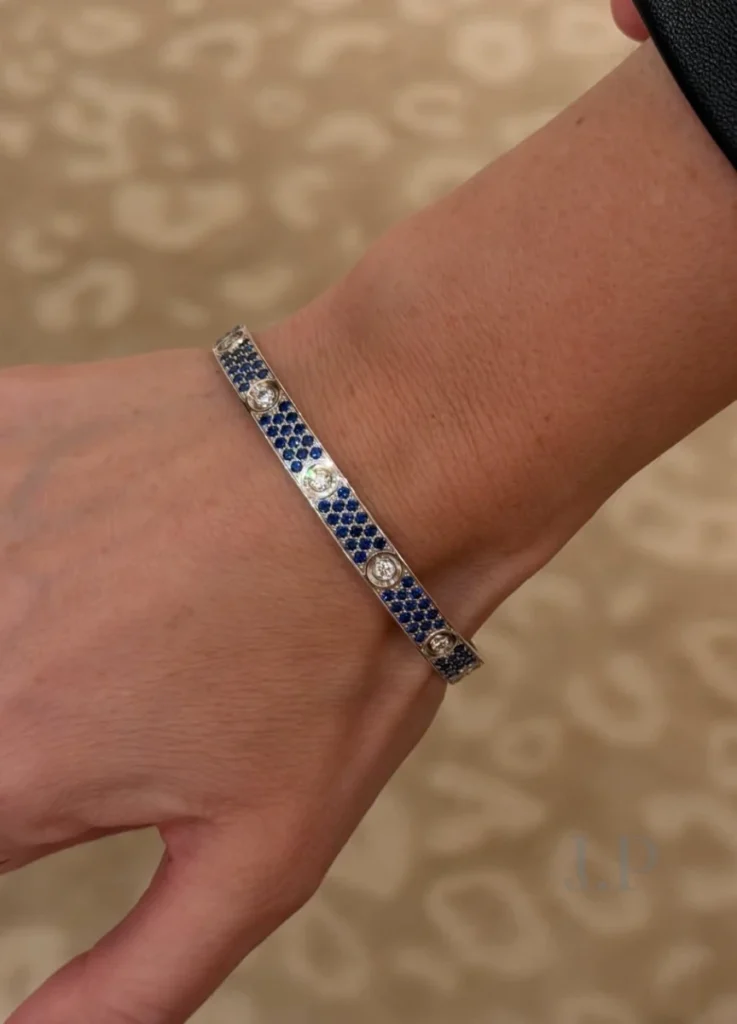
Blue sapphire pavé sits at the highest contrast end of the trio. Cold white gold paired with deep blue sapphire creates a density that registers on the wrist almost instantly. In editorial imagery it’s the strongest of the three. In daily wear it’s also the most demanding.
For a wrist around 14 cm, Multi Gem reads more naturally. Full Pavé is beautiful, but it asks the wrist to carry its structure.
Yellow Gold — The First Real Opening for Multi Gem
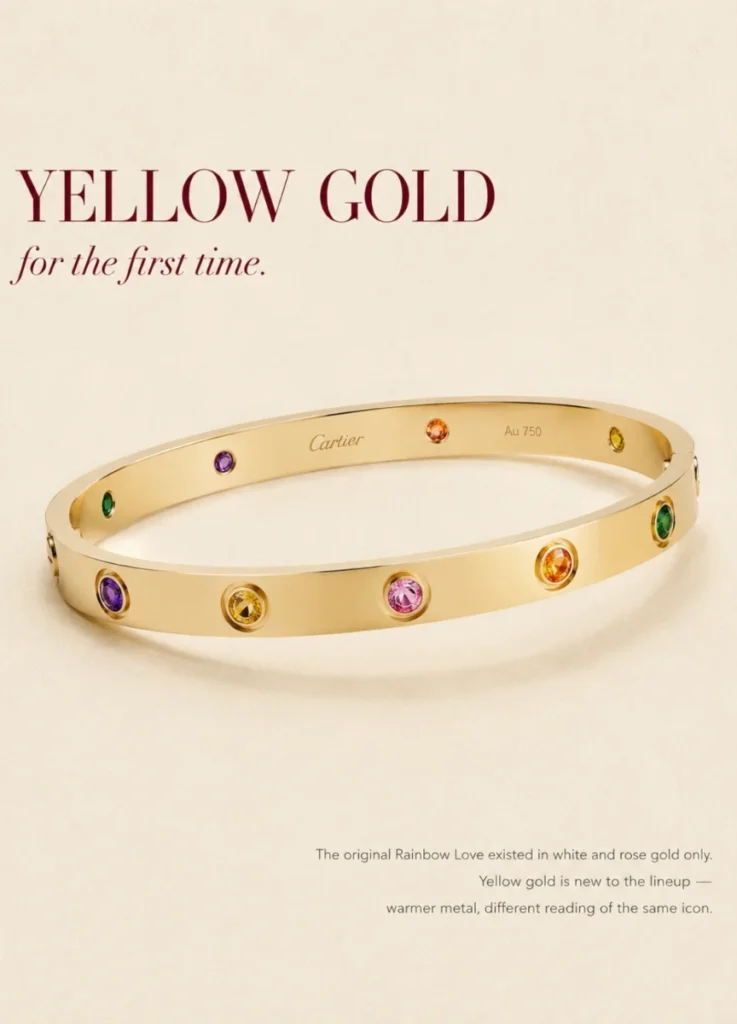
The most interesting move inside the Multi Gem line is yellow gold.
The original Rainbow Love lives in collector memory as white gold and rose gold. Bringing yellow gold into the Multi Gem isn’t a simple metal addition — it changes how the color reads.
White gold lifts color. Against a cool metal base, pink, blue, and purple stones cut sharp contrast. Yellow gold absorbs color differently. The same sapphire that pops against white gold settles into the warmth of yellow gold instead of jumping off it.
That shift matters on the wrist. White gold Multi Gem reads as a graphic color rhythm. Yellow gold Multi Gem reads as something closer to lived-in color jewelry. Because the metal warms the stones rather than spotlighting them, this version settles more naturally into different skin tones and wardrobe temperatures.
It also rewrites the secondary market reference set. The Rainbow Love that circulated from roughly 2016 through 2021 was white and rose gold territory. A yellow gold edition adds a new baseline to that comparison — same lineage, different demand structure.
@juli.prozzz / Instagram
Two Price Tiers — A Deliberate Separation
The most explicit move in the capsule is pricing.
Multi Gem opens around $23,500. Full Pavé sits near $87,000. Inside the same Love silhouette, that’s close to a fourfold gap. A gap that large isn’t explained by stone count alone. It’s about positioning.
Multi Gem is a piece that can enter a daily stack. It coexists with an existing Love, with Juste un Clou, with Trinity, with bracelets from other maisons, without overtaking the wrist’s center. Full Pavé isn’t really a stacking piece. It functions as a single acquisition — the kind of piece that pushes everything else on the wrist into a supporting role and takes over the wrist visually.
Cartier has split one icon into two price layers. One layer is wearable color. The other is color attached to allocation and scarcity. The two don’t compete. They target different collector desires inside the same maison.
(Pricing converted from regional retailer previews. Currency variation possible.)
@eliteusa / Instagram
The 50-Piece Question — Scarcity, Unconfirmed
A figure circulating ahead of release suggests fifty pieces per color.
If that number holds, the Full Pavé Trio becomes one of the most tightly controlled Love releases in recent memory. Fifty pieces globally, against Cartier’s boutique network, leaves almost no room for broad boutique distribution.
In that scenario the secondary market would move quickly. White gold blue sapphire pavé, the version with the strongest image impact, would likely command a premium almost immediately after release. The number remains industry chatter for now — not maison-confirmed. In this collection, scarcity is a meaningful variable, but a variable that still needs verification.
@juli.prozzz / Instagram
MAD Paris — The Aesthetic That Grew Outside the Maison
The most interesting context for this capsule sits outside Cartier entirely.
The color-pavé Love isn’t a visual language Cartier introduced. MAD Paris, the Paris-based customization studio, has been resetting second-hand Love bracelets in blue sapphire, ruby, and green stone pavé for years. For collectors who wanted Loves in colors the maison didn’t make, MAD Paris was the unofficial answer.
What matters here isn’t who arrived first. Customization and official maison product live in separate worlds from the start. What matters is that the image of a color-pavé Love had already taken shape outside Cartier, in collector demand, well before the maison released anything close to it. This official capsule lands inside a desire that was already mature.
Pricing makes the comparison unavoidable. A MAD Paris blue sapphire pavé Love runs around $43,000. The new Cartier full pavé in the same color sits near $87,000. At that point the buyer isn’t comparing stone count against metal grade. They’re deciding how much to pay for maison-backed provenance.
That’s an asset-structure decision more than a design one.
source: Cartier
Same Color, Different Asset
A MAD Paris custom Love and a Cartier official Color Capsule address the same visual desire on the surface. From a collector’s perspective they’re entirely different objects.
A customized piece loses the maison’s original warranty and certification structure at the moment of modification. Even if the base bracelet started as a Cartier, the modified result is no longer the maison’s final product. Resale channels narrow. The customized Love circulates inside a smaller, more idiosyncratic market — distinctive, but often treated as a depreciation risk by more conservative high jewelry collectors.
The official Color Capsule sits in a fundamentally different category. It enters Cartier’s official product registration, warranty coverage, boutique history, and archive. The buyer isn’t only acquiring a design. They’re acquiring a maison-sanctioned version of it.
So the premium on the official piece doesn’t come from the stones alone. It attaches to provenance — whether the maison made the Love, or whether someone remade a Love that the maison originally made.
In collector terms, that distinction carries significant weight.
source: Cartier
What the Maison Has Admitted
The most important shift in this capsule isn’t the price tier or the rumored allocation. It’s that Cartier has redrawn the boundary of what the Love is allowed to look like.
The Love has been a stable icon for a long time. It sold for years with relatively little variation, and it carried weight without needing to push far from its original form. Placing a full color pavé surface on top of that icon isn’t a decorative update. It moves the Love closer to a collectible object than a quiet everyday object.
The secondary market had already moved beyond the maison’s own catalog, and customization studios had been filling the gap in plain sight. When collectors wanted a version the maison didn’t make, the demand moved elsewhere. This capsule is Cartier’s official response.
Color pavé is no longer peripheral taste. It isn’t too niche or too eccentric for the maison to engage with. It has become a language the Love can speak inside official channels.
Which is why this collection isn’t just a beautiful Love.
It’s the return of the discontinued Rainbow, the maison’s absorption of a desire that grew outside it, and the repositioning of the Love bracelet into a vocabulary of price tier and scarcity.
The icon is the same.
What’s changed is that what matters now isn’t only what you wear — it’s what the maison agrees to sign its name to.
@tash_ps / Instagram
[ Related Editorials ]