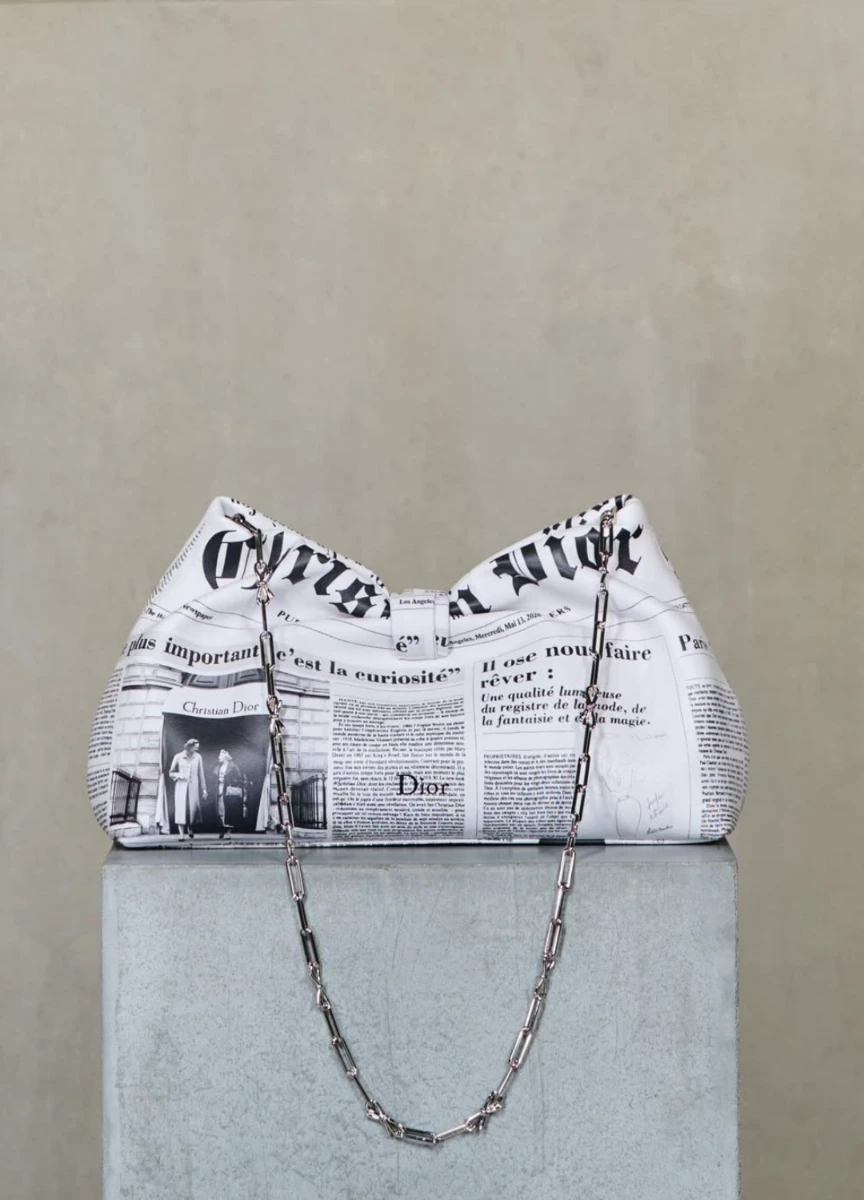
A bag dated for the show day, printed in Christian Dior Daily, twenty-five years after Galliano.
Inside The Newspaper Bag at Dior
On May 12, 2026, Jonathan Anderson released the first teaser for his Dior Cruise 2027 collection — a single bag, printed in newspaper.
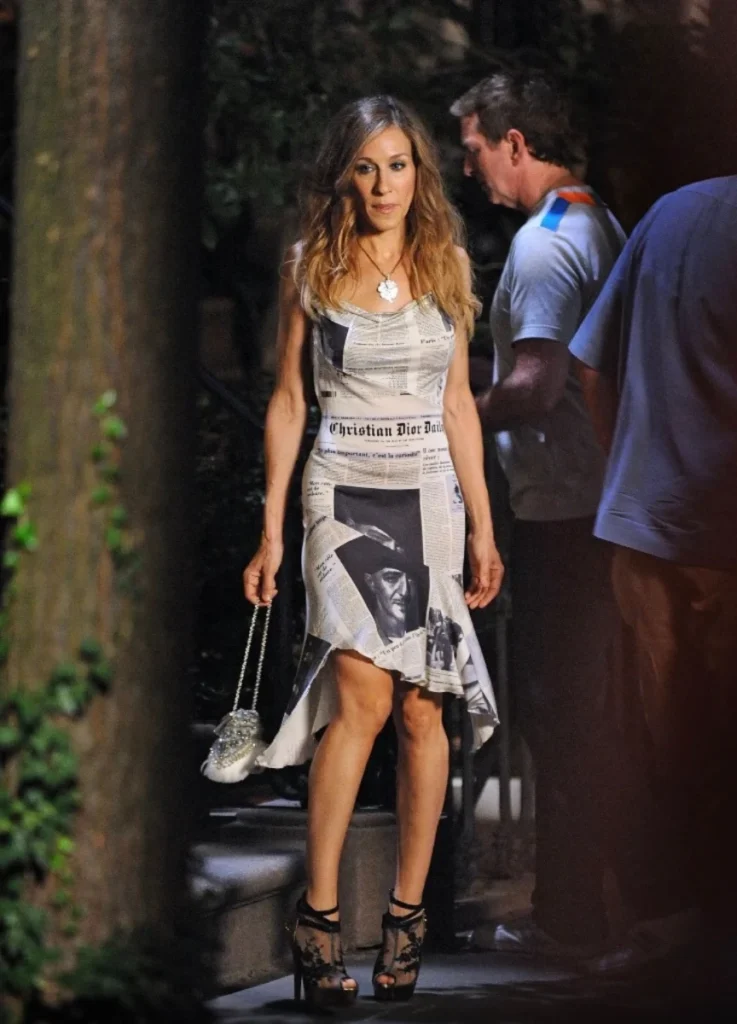
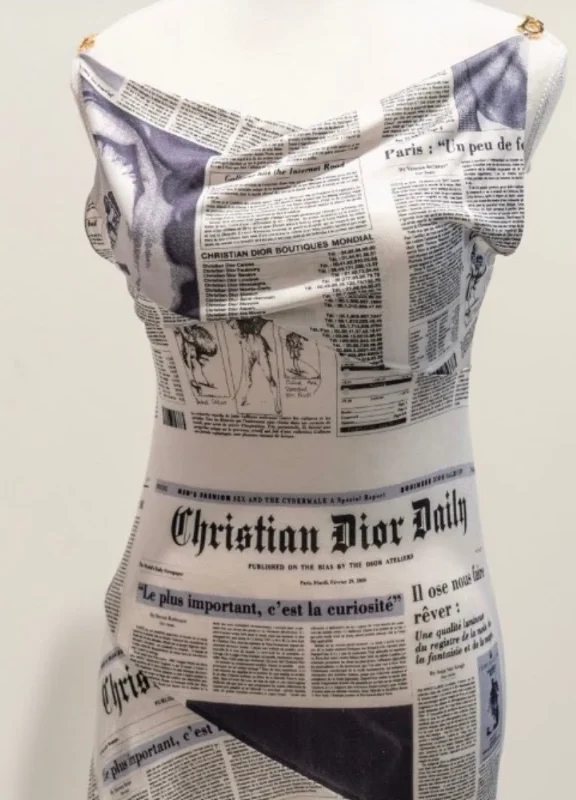
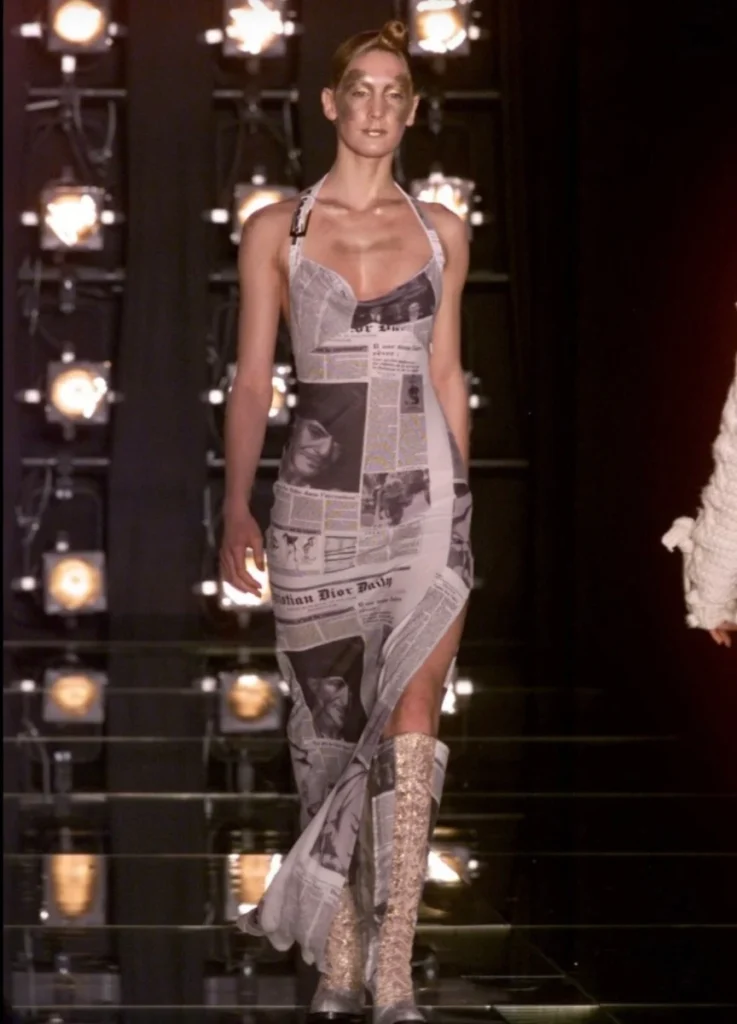
The reference seems obvious. Galliano’s Fall 2000 ready-to-wear, the dress Carrie Bradshaw wore in Season 3 of Sex and the City, the print that became one of Dior’s most-cited archive pieces. 1stDibs currently lists a Galliano newsprint slip at £183,891, and a similar dress sold at Kerry Taylor Auctions in June 2024 for €72,000 — a steep climb from the €15,300 Bonhams sale just two years earlier.
But the reference chain runs deeper than the obvious Galliano callback.
The Bag, Before the Show
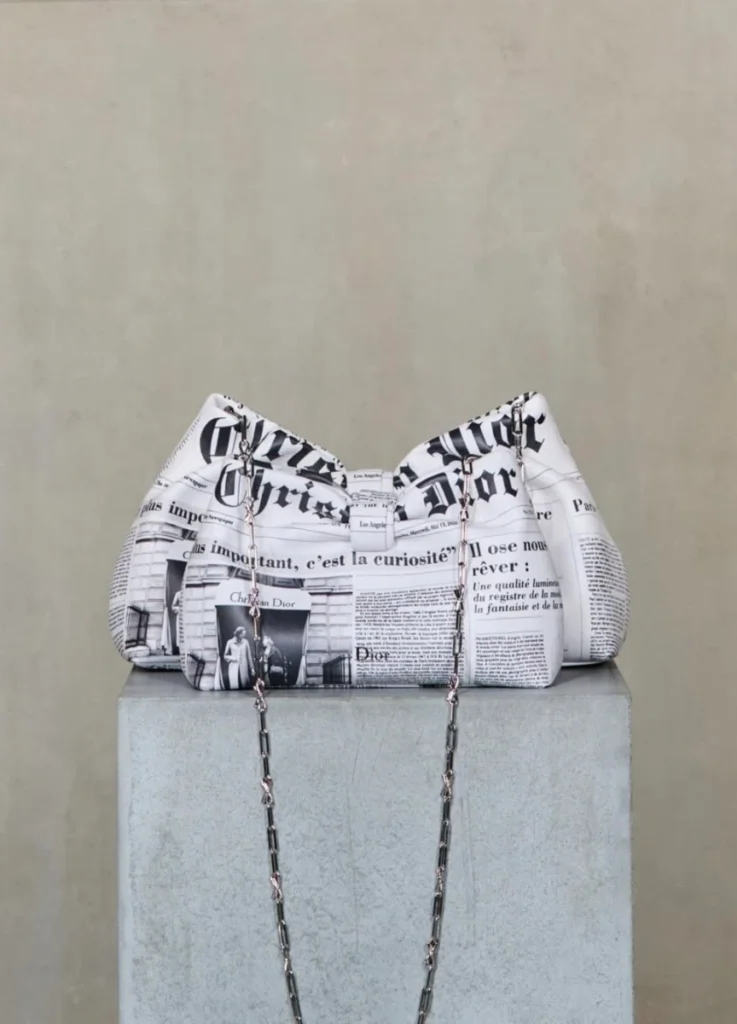
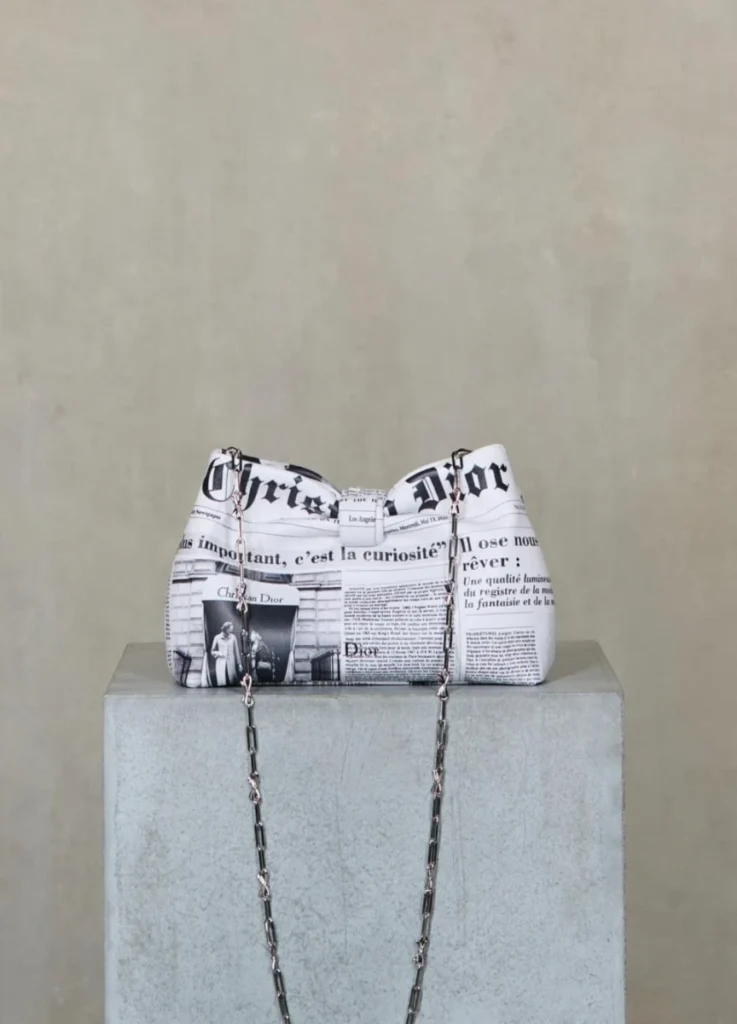
The bag is large, soft, almost slouched — a hobo silhouette in printed silk over what appears to be a leather base. The chain handle runs long in silver hardware, with squared links rather than oval. The print covers the entire surface — a fictional newspaper headed Christian Dior Daily, dated Los Angeles, Mercredi, May 13, 2026. The day of the show.
The headlines read: “Le plus important, c’est la curiosité.” And: “Il ose nous faire rêver.” Below, in smaller body type, what looks like editorial copy fills out the columns. Black-and-white archival images sit interleaved with the text — vintage Dior boutique storefronts, mannequins, sketched silhouettes.
The whole object looks less like a bag with a print and more like folded paper held by chain.
For anyone who has seen the Galliano original, the visual language of the print is immediately recognizable. Christian Dior Daily was the name Galliano gave his fictional newspaper. “Le plus important, c’est la curiosité” was one of the actual headlines on his 2000 print. The wording on Anderson’s bag closely matches headlines from the Galliano original — not merely the motif, but specific copy.
The date, though, is new. The Galliano original was dated February 28, 2000 — the day of his Fall 2000 ready-to-wear show. Anderson’s version is dated May 13, 2026, the day of his cruise show. The bag carries its own occasion on its surface.
@jonathananderson / Instagram
Galliano’s Two Newspapers
The Galliano connection is the obvious first reference. But Galliano printed Christian Dior Daily on more than one collection, and the histories of those collections diverge sharply.
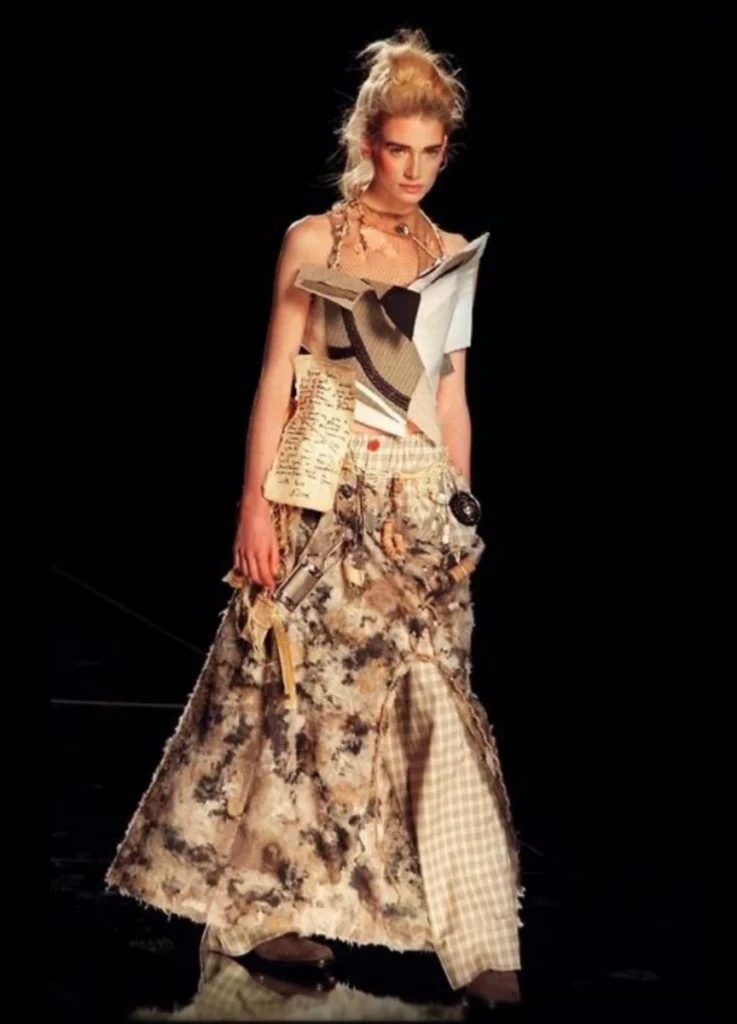
Spring 2000 Haute Couture │ “Hobo Chic”
The first appearance of newsprint at Dior came on January 17, 2000, at Versailles. The collection was titled “Hobo Chic” — sometimes referred to as “Hobo Couture” — and Galliano staged it against the Palace’s decadent interiors. Models walked in dresses, coats, and trousers that looked stretched, slashed, distressed; their accessories included miniature whiskey bottles, tin cups, bent kitchen utensils. Some of the silhouettes were layered with what appeared to be actual newspapers piled on for warmth.
The collection’s inspiration, Galliano said, was Paris’s homeless population — figures he claimed to observe while jogging along the Seine. A secondary reference was the “Tramp Ball” tradition: Parisian elite parties from the 1920s and 1930s at which the wealthy dressed up as homeless people for sport.
The reaction was sharp. The French homeless community staged a protest in front of Dior’s headquarters in the 8th arrondissement, carrying signs that read “Cynicism isn’t cool” and chanting “Respect the homeless.” In the United States, Maureen Dowd at The New York Times compared the show to then-Mayor Rudolph Giuliani’s street sweeps of the homeless. Ten days later, Galliano issued a statement: “I never wanted to make a spectacle of misery.”
The collection survives in fashion history as one of the most controversial couture shows of the past three decades. The Zoolander film parodied it the following year, with Mugatu’s “Derelicte” collection — “a fashion, a way of life inspired by the very homeless, the vagrants, the crack whores that make this wonderful city so unique.”
source: Vogue Runway
Fall 2000 Ready-to-Wear │ “Fly Girl”
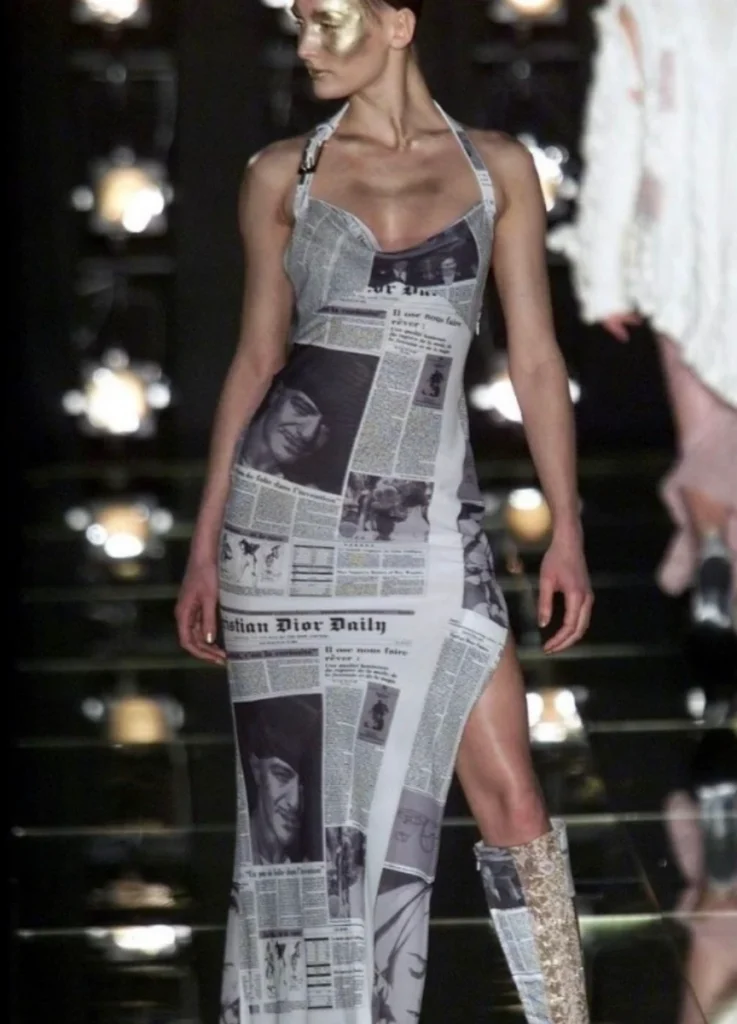
A month after the couture controversy, on February 28, 2000, Galliano presented his Fall 2000 ready-to-wear collection in Paris. The collection was titled “Fly Girl,” and the newspaper motif returned, now formalized.
For this collection, Galliano created the fictional Christian Dior Daily in detail. He had it printed onto chiffon, leather, and the reverse side of furs — chinchilla, sable, mink. The press clippings used were from the International Herald Tribune, including reviews of his own earlier collections. The fictional newspaper was, in part, about Galliano himself.
The bias-cut slip dress with the gold chain straps — the one later worn by Carrie Bradshaw in Season 3, Episode 17 of Sex and the City — debuted in this collection. It was first worn on the runway by model Angie Schmidt.
The print itself, by Galliano’s own account, drew on Elsa Schiaparelli’s 1935 newsprint pattern. The citation chain was already two layers deep at that point.
source: Vogue Runway
What the Distinction Means
It matters whether Anderson is citing “Hobo Chic” or “Fly Girl.” The visual motif is the same, but the political content is not.
“Hobo Chic” was staged poverty performed by haute couture, and the print carried that staging directly. “Fly Girl” softened the gesture — the newspaper became Galliano’s self-mythologizing, his own press reprinted into the cloth. By the time Carrie Bradshaw walked through Manhattan in the slip dress, the print had been almost completely separated from its couture origin.
Anderson appears to be citing “Fly Girl” — the Christian Dior Daily, the headlines, the typographic feel. But the older controversy never fully disappears, and a newspaper print made at Dior in 2026 inevitably sits on top of all of that history. The bag refers visually to the dress while carrying the weight of the earlier couture.
Schiaparelli, 1935
Galliano did not invent the newspaper print either.
In 1935, Elsa Schiaparelli — at the height of her surrealist period — used newsprint as a pattern for scarves, blouses, and accessories. Her source was Danish fishwives, women in the markets of Copenhagen who folded newspaper into hats to keep their hair dry in the rain. Schiaparelli photographed the gesture, brought it back to Paris, and printed the texture onto silk.
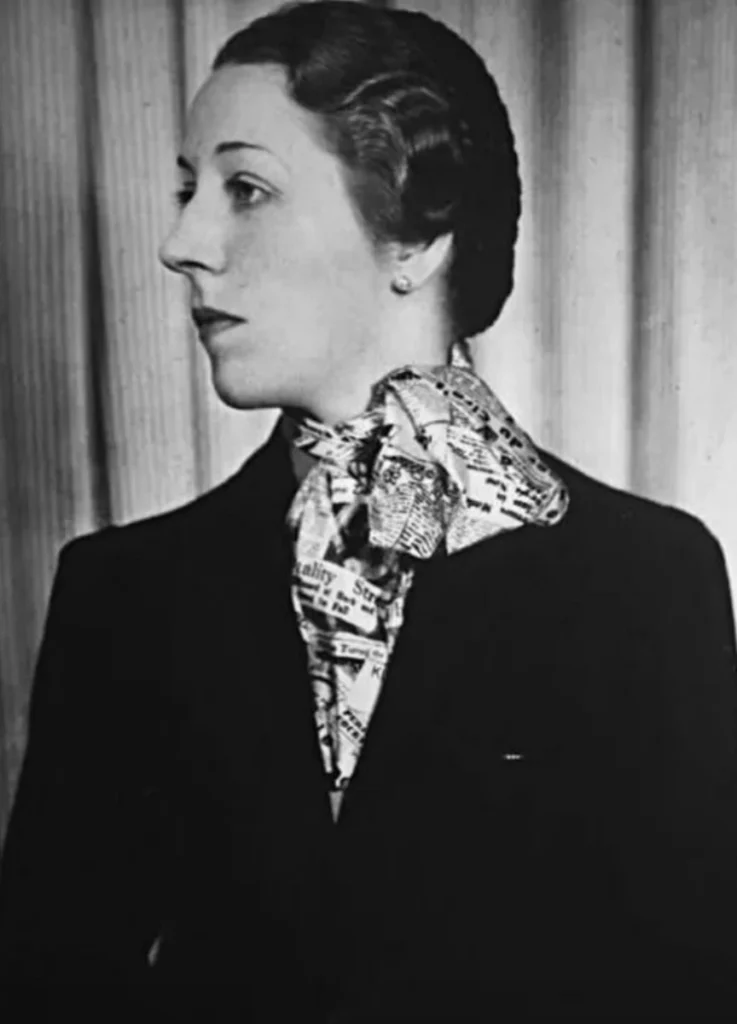
Cecil Beaton photographed her in one of the resulting scarves in 1935. The photograph survives in the Condé Nast archive — Schiaparelli in profile, in a dark jacket, a small newsprint scarf knotted at her throat. The newsprint there is barely louder than a tie.
source: Condé Nast Archive
What Schiaparelli was doing in 1935 was characteristic of her broader practice: taking objects from working women’s lives and lifting them into couture. The lobster on Wallis Simpson’s dress, the shoe-shaped hat, the desk-suit with pockets like drawers — these were a designer’s wit, but they were also a designer’s politics. Surrealism met domestic labor at the seam.
Galliano, citing Schiaparelli sixty-five years later, was doing something more theatrical and arguably less reflective. The poverty in his couture collection was aestheticized rather than interpreted, and by “Fly Girl,” even the staging had thinned to self-reference.
Anderson, working at the third layer, is citing Galliano who was citing Schiaparelli.
Newspaper print in fashion has always been a form of citation. It has always pointed somewhere — to working women, to literal reading material, to the news of a particular day. The fabric never quite resolves into pure pattern; it always carries content.
The Paper Dress Era │ A Brief Interlude
Between Schiaparelli and Galliano, there was a period when fashion printed newspaper onto actual paper.
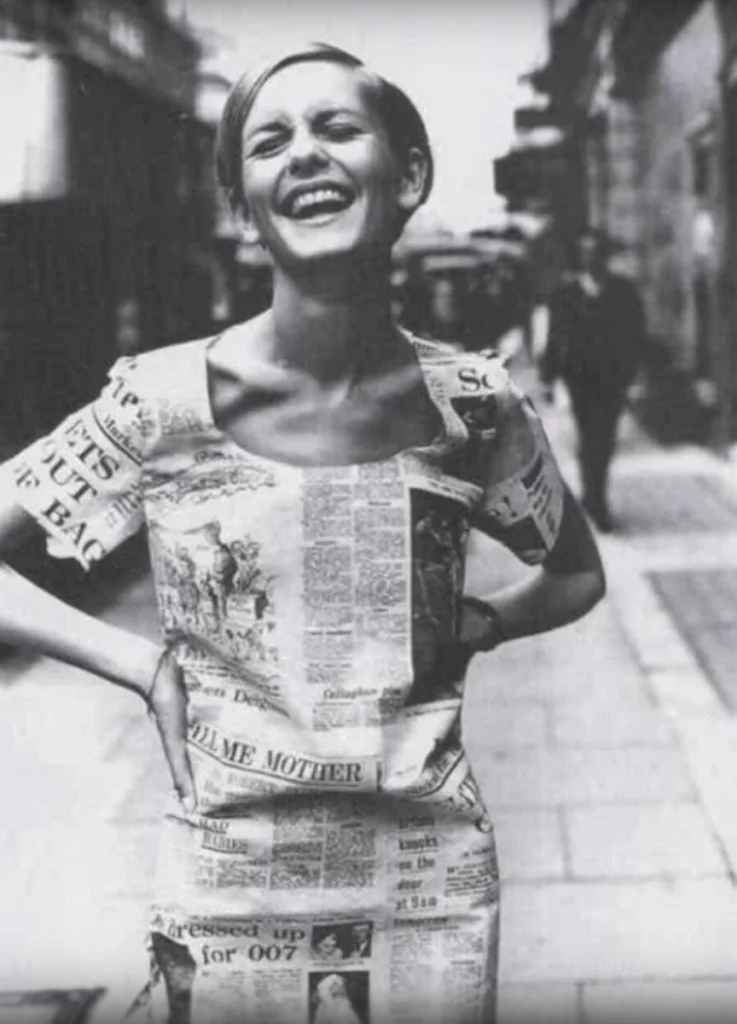
In 1966, the Scott Paper Company launched the “Paper Caper” — a sleeveless A-line dress printed in pop-art designs, made of bonded cellulose, sold by mail order for $1.25. Within months, the paper dress had become a fashion craze. Imitators followed. Some carried advertising. The Chicago Sun-Times produced a paper dress printed with its own front page, sold as a marketing item. Bonwit Teller carried paper dresses in Op Art prints. Twiggy was photographed in a newspaper-print paper dress in June 1967.
By 1968, the craze was largely over. Paper dresses tore, stained, and ran during rain.
The interlude clarifies something. Newsprint becomes a fashion motif most strongly when newspapers themselves feel disposable — when the daily paper sits closer to packaging than to civic infrastructure. The 1960s paper-dress era arrived at the same moment as television’s first dominance, when the printed daily was losing its monopoly on the day’s news. The motif comes back, decades later, with the rest of newspaper culture about to leave for good.
source: archival
Anderson Reads the Moment
The Dior Cruise 2027 show is scheduled for Tuesday, May 13, 2026, at LACMA’s David Geffen Galleries in Los Angeles.
LA is a meaningful choice for this collection, and not only because cruise shows have become increasingly globalized. Through 2024 and 2025, the Los Angeles Times underwent some of the most public newsroom collapses in recent American media history — repeated rounds of mass layoffs, a one-day strike by the LA Times Guild, the resignation of senior editors, ongoing instability over ownership and editorial direction. The paper that gives the city its civic voice has been gutted in real time, in front of its readers.
The same period has seen turmoil at the Washington Post, the closure of dozens of regional newspapers across the United States, and the acceleration of a decline that began two decades ago. Print media, as a category, is moving toward its last act.
Anderson dating the bag Mai 13, 2026, Los Angeles — printing that line into the cloth alongside Christian Dior Daily — can be read as marker rather than decoration. The bag carries the date of the show in the city whose actual newspaper is in collapse, and the pairing is difficult to dismiss as coincidence.
What the newsprint motif tends to do at this moment is take something in decline — visibly so, though not yet gone — and translate it into a fashion object likely to outlast it. The bag will probably outlast much of the print culture it draws from.
That gesture leans closer to preservation than revival.
Material and Form │ Notes from the Image
A close reading of the teaser images, before the show:
The bag appears to be made of printed silk over a softly structured base. The print is photographic in quality rather than woven — a true reproduction of the Christian Dior Daily, including the photographic insets within the columns. Some of the print blurs at the folds in the way a silk scarf would crumple a printed pattern, indicating that the silk has been used as flat panel rather than constructed in shaped pieces.
The chain handle is silver-toned, with squared links, longer than a typical day-bag handle. This allows the bag to be worn cross-body, hanging at the hip — consistent with the slouched silhouette.
The base of the bag rests on a concrete pedestal in the teaser image, which is the only finished construction detail visible. The bag itself looks designed to hold its shape lightly — a hobo, rather than a tote or structured shoulder bag.
These observations are preliminary. The boutique pieces — and their materiality, weight, and finish — will tell more once the collection lands in store. Pricing has not been confirmed; early Anderson-era Dior bags are likely to sit in the four-figure range, though this should be confirmed at boutique level after the show.
@jonathananderson / Instagram
The Market Math │ Archive Value
The Galliano original’s auction history clarifies why this teaser carries the weight it does.
In June 2022, Bonhams sold a Galliano Christian Dior Daily newsprint dress for €15,300. In June 2024, Kerry Taylor Auctions sold a similar piece for €72,000, roughly five times higher in two years. 1stDibs currently lists a Galliano newsprint slip from the same collection at £183,891, with the listing bookmarked by more than nineteen hundred users. That is roughly twelve times higher in three years.
This isn’t simple inflation. Several archive dynamics converge in it: the Galliano firing in 2011 and the subsequent freezing of his Dior output as a finite archive; the Sex and the City effect, which made the dress recognizable far outside fashion’s narrow audience; the broader 2020s-era surge in Y2K archive collecting; and, most recently, the Anderson appointment, which has begun to renew interest in earlier Dior chapters.
source: HBO
What that math means for the Cruise 2027 newspaper bag depends on how it is distributed and what tier it lands in. Bag, rather than dress, makes secondary-market trajectory harder to predict — bag archives tend to follow different curves than dress archives. But the citation runs direct enough that the bag may carry archive weight from the moment it ships.
Collectors thinking about a bag at this level may want to read the print itself carefully. The bag is, among other things, a dated object — a bag printed Mai 13, 2026 will register differently in 2031 than it does now.
The Loewe Continuity │ Anderson’s Voice
There is also a reading that runs through Anderson’s own work, separate from Galliano.
For a decade at Loewe, Anderson made craft and text two of his most consistent themes. Letters embroidered onto leather. Letter-shaped heels in Spring/Summer 2023. Bags shaped like books, books shaped like bags, the boundary between reading object and wearing object steadily dissolved. Under Anderson, Loewe became one of contemporary luxury’s most consistent users of text as design language.
Newsprint also sits within that vocabulary. Whatever the primary reference for the Cruise 2027 bag, the motif is not foreign to Anderson’s design language; it can be read both as Dior archive citation and as continuation of his Loewe vocabulary.
That doubled reading is part of what makes the teaser interesting. The bag may register both as Anderson reading Dior and as Anderson continuing his own design language, which would make it less nostalgic than referential.
If Anderson continues to translate Loewe’s text-and-craft language into Dior house codes across his tenure, the Cruise 2027 bag could read in retrospect as an opening statement rather than an isolated reference. The Spring 2026 ready-to-wear and Fall 2026 collections, already presented, hinted at this kind of synthesis. The newspaper bag brings it closer to the surface.
source: CNN
Reading the Teaser as Thesis
The closer reading is that this is preservation more than revival — newsprint carried into the form of a wearable object as the original kind of newsprint disappears, returning the motif while changing its use.
The Cruise 2027 show happens on Tuesday, May 13, 2026, at the David Geffen Galleries at LACMA. The bag will appear on the runway, probably alongside other newsprint pieces — the standard pattern for cruise lead-ups is for a single teaser to extend into a small section of the collection. Whether Anderson develops the print into a full house code, the way Galliano did across chiffon, leather, and fur, will be one of the things to watch.
For collectors, the bag is one of the more legible early reads on Anderson’s Dior. For readers, it rewards a layered approach — surface print, citation chain, market math, civic timing — none of which fully reduces to any of the others.
The bag carries the date of its own show. Anderson dated the cloth before the cloth was worn, and that gesture, small as it is, says more than most opening collections do before the clothes arrive.
source: Vogue Runway
Featured Image via @jonathananderson / Instagram
[ Related Editorials ]
- Dior Fall 2026 In-Person Review │ Anderson’s Reading of Bar, Bow, Lace, and Cannage in Real Wear
- Dior 2026SS Bags | Jonathan Anderson’s First Bag Line-Up — Structure as Strategy
- Dior 2026 Fur Collection | From Micro Cannage to Structured Fur Jackets
- Dior Fall/Winter 2026 RTW Review – Light Over Water and the Return of Structure