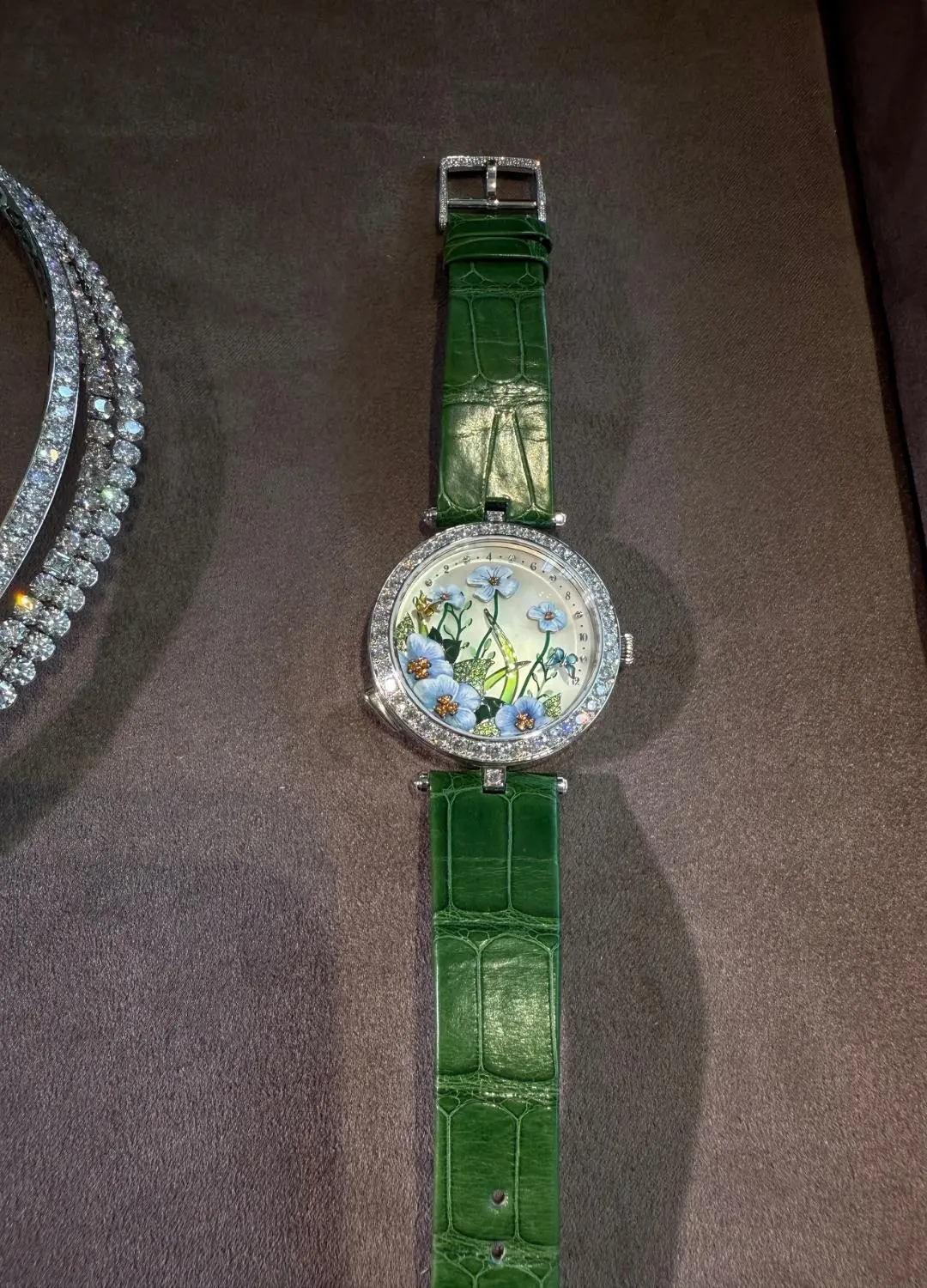
Introduction: Time That Is Felt, Not Read
The Lady Arpels watch is closer to a watch you feel than a watch you read.
Brise d’Été stayed with me longer than most pieces I have seen — not because of the flowers or the diamonds, but because of how the dial moved. The butterflies rotate. The petals tremble. What the watch captures is not botanical beauty. It is the sensation of a summer breeze passing through living matter.
My first impression was not precision. It was the feeling of plants swaying in soft air.
This is not a still botanical specimen. It is the moment when stems and petals move at slightly different speeds inside an almost imperceptible current. Brise d’Été is less a floral watch and more a watch that stages wind.
This piece covers the Lady Arpels category structure, the specific aesthetic of Brise d’Été, and the body structures where a 38mm high jewelry watch actually works — and where it does not.
$ 188,000 Excluding taxes
The Origin — Van Cleef & Arpels and the Poetry of Time
To read Brise d’Été properly, you have to start with its framework.
Van Cleef & Arpels has long treated watches not as mechanical instruments first, but as convergence points of horology, métiers d’art, and narrative composition. The maison’s concept of Poetry of Time frames this approach: time is not displayed but interpreted, not consumed through numbers but experienced through scene and emotion.
Within this framework, Brise d’Été belongs to what can be called the Enchanted Nature axis — a category where time is expressed through organic motion rather than linear progression.
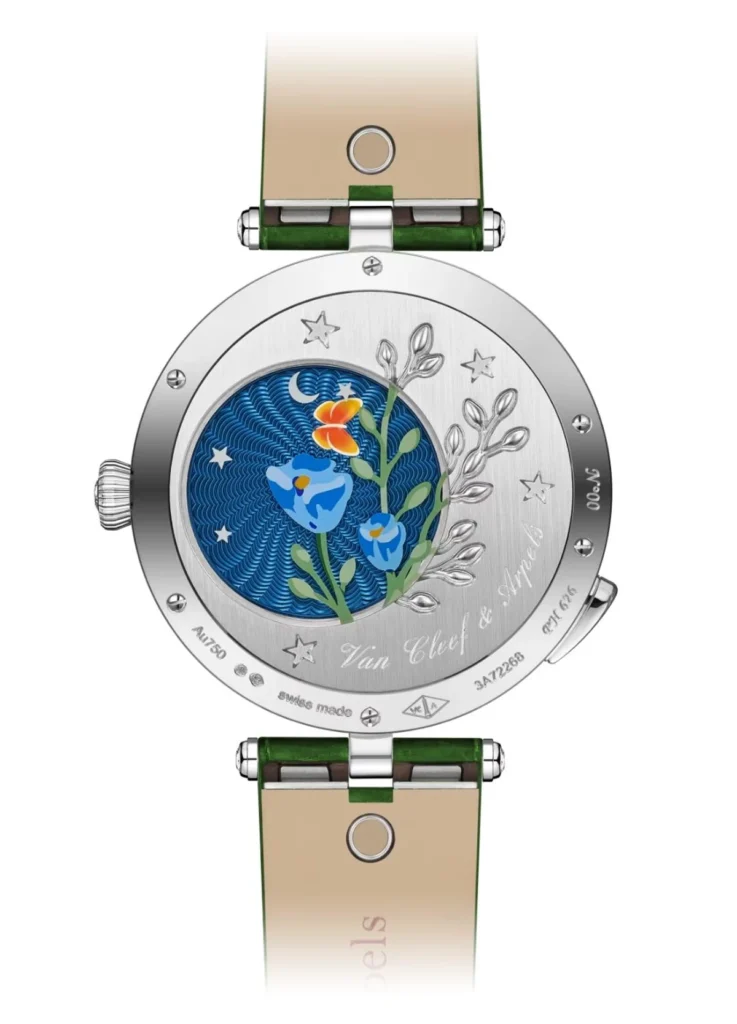
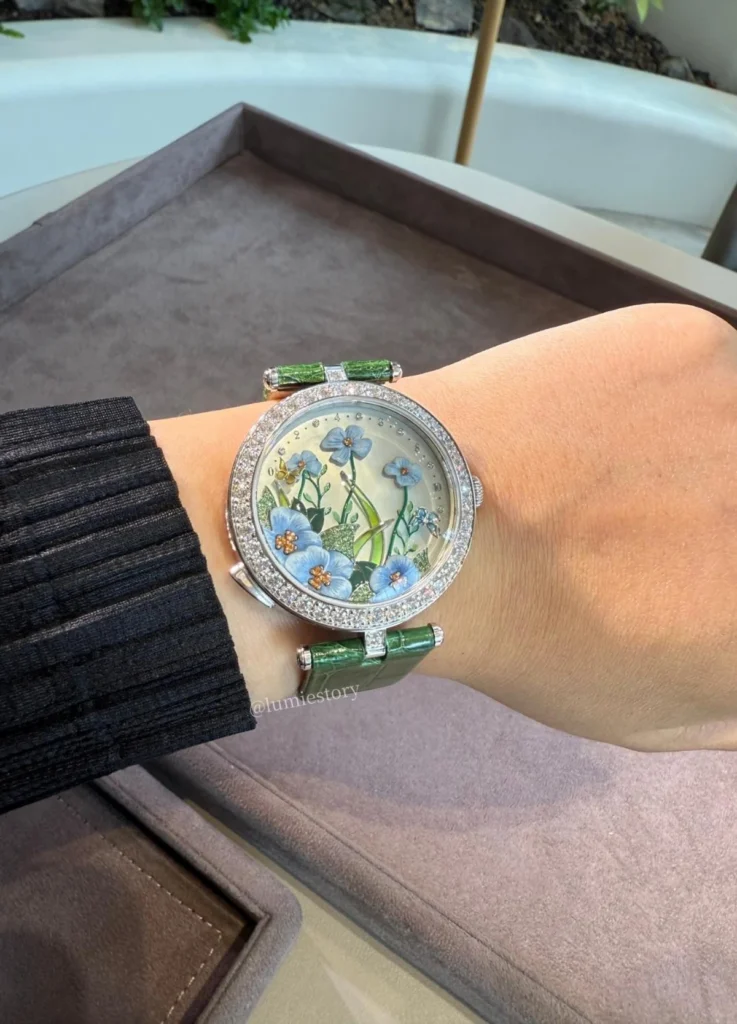
The watch was introduced during the 2024 Watches & Wonders presentations. The 38mm white gold case is set with diamonds and combines mother-of-pearl, tsavorite, and spessartite garnet. Two butterflies in white and yellow gold indicate the hours, swapping roles at noon and midnight. On demand, they take flight while the flowers vibrate as if responding to a passing breeze.
The craftsmanship layered into this dial is extraordinary. Miniature enamel painting, vallonné enamel, champlevé enamel, plique-à-jour enamel, curved plique-à-jour enamel, and decal application — techniques rarely combined at this density. The piece later received the Ladies’ Complication Watch Prize at the 2024 Grand Prix d’Horlogerie de Genève.
This watch is not defined by awards or specifications. Its real significance lies in how it translates movement.
source: vancleefarpels.com
The Aesthetic — Not Flowers, But the Rhythm Between Them
The most striking quality of Brise d’Été is what it refuses to do: place one large flower at the center and fix the eye there.
Instead, several blue flowers are dispersed across the dial. Stems and leaves rise diagonally, crossing and overlapping. The composition prevents the gaze from settling. The eye travels along a gentle diagonal — not resting, but drifting.
The flowers are rendered in vallonné enamel with soft, almost translucent blue tones. Their centers carry spessartite garnets — points of warmth that anchor without disrupting. The stems beneath are constructed in curved plique-à-jour enamel, woven together like a lattice of living lines.
On the wrist, the dial reads as organic before it reads as precise. The surface does not behave like a painting. It behaves like something alive. Flowers are open. Stems are intertwined. Butterflies do not stay still.
The watch does not ask you to read time. It asks you to notice time passing — translated into the trembling of plants.
This is where Brise d’Été separates from other watches in the Lady Arpels line. Pont des Amoureux is narrative. Planétarium is cosmic. The Papillon series emphasizes transformation and chromatic density. Brise d’Été works with something far more subtle — the nearly inaudible vibration of air.
A high jewelry watch that is, paradoxically, quiet in how it asks to be seen. It does not overwhelm. It draws the viewer closer.
That restraint is its authority.
On the Wrist — Why the Head Feels Larger Than Expected
Now the practical reality.
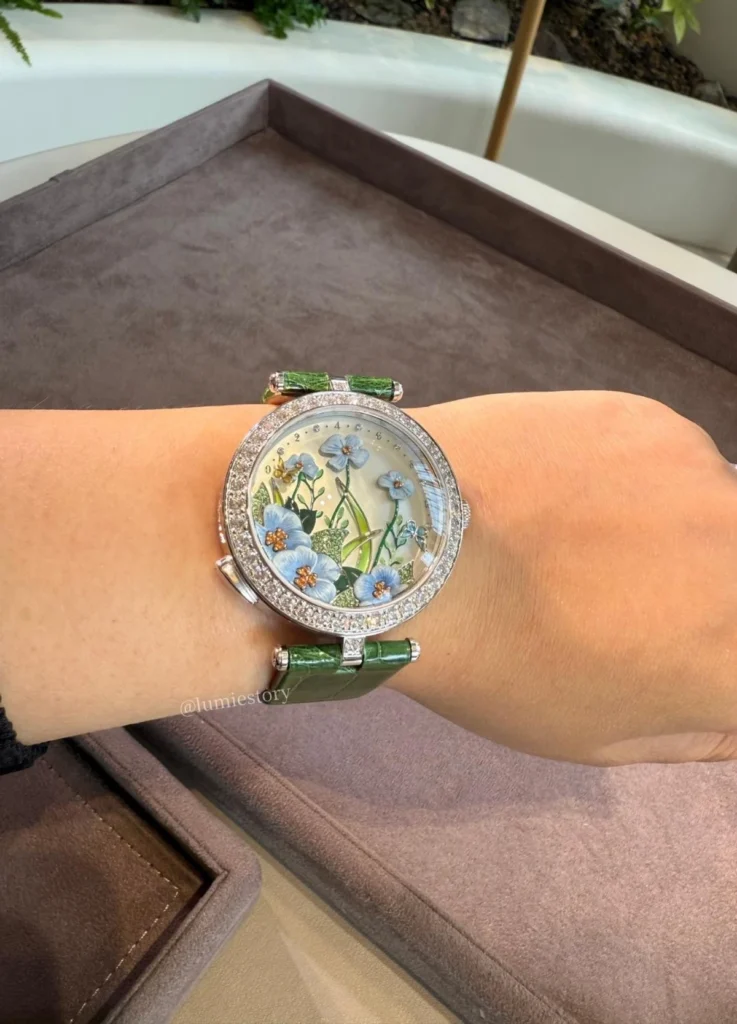
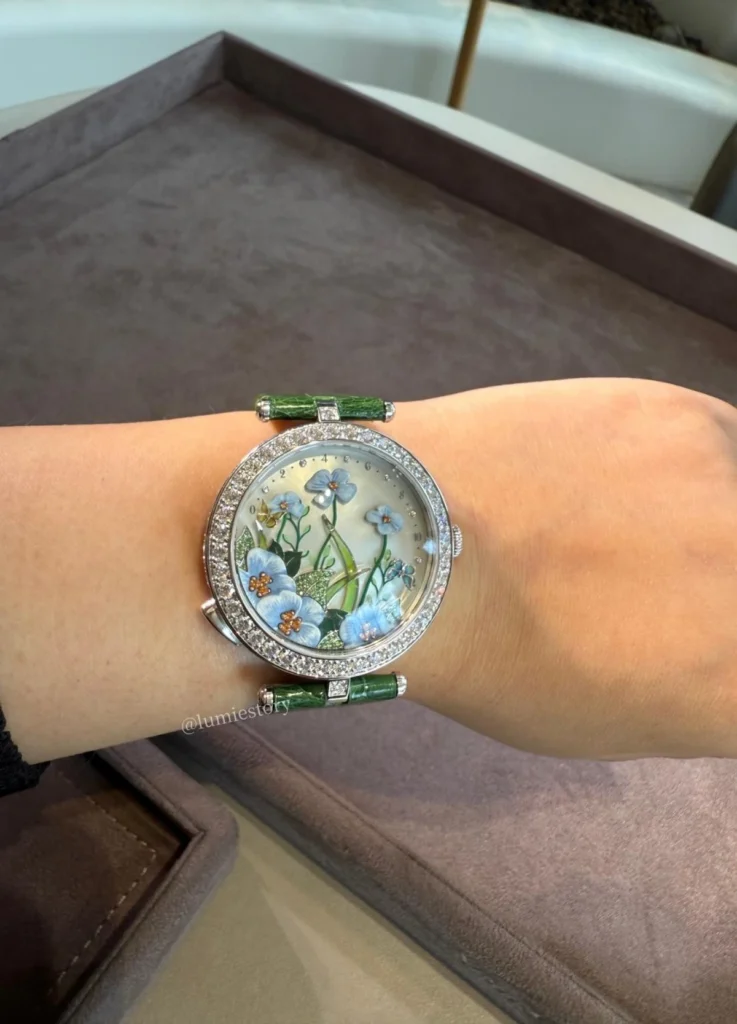
Despite its delicacy in detail, Brise d’Été is not a small watch. At 38mm, it occupies serious visual space within women’s dress watches. And the movement mechanism makes the case notably thick.
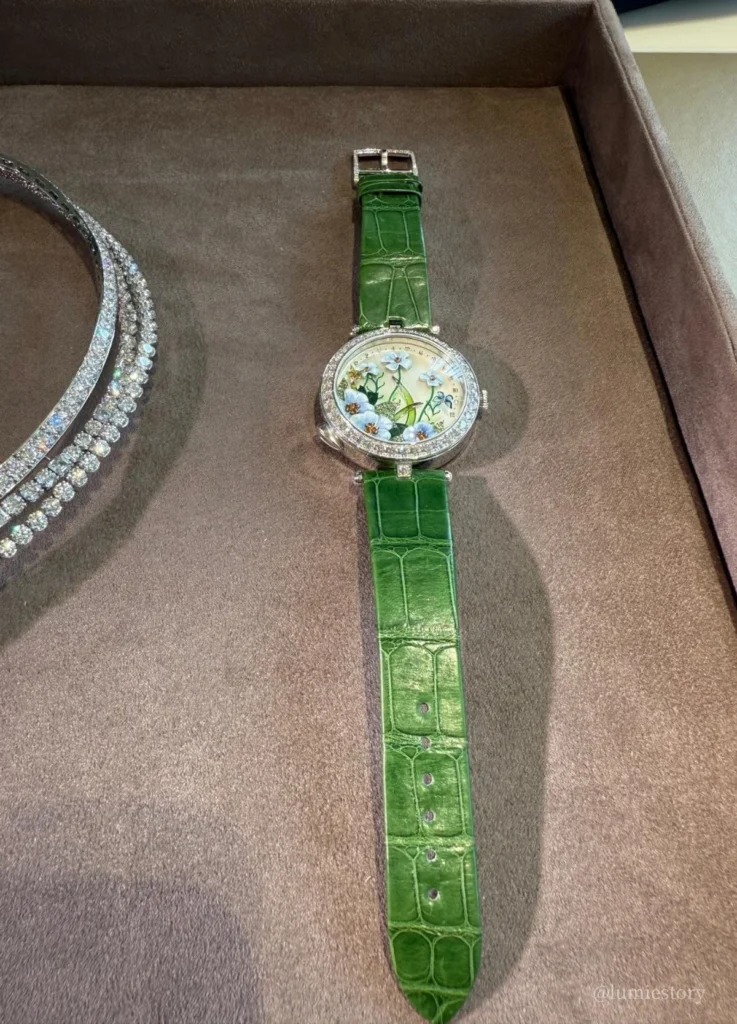
Its perceived size builds from several factors. The full diamond-set bezel increases brightness and edge definition, making the boundary of the watch wider and more luminous. The dial’s dispersed floral composition spreads visual weight outward rather than concentrating it at the center. The saturated green strap extends the watch’s presence beyond the case.
The result: the watch does not sit quietly on the wrist. It asserts itself.
When I wore it, the dominant impression was that the head strongly occupied the width of my wrist. The combination of case diameter, bright bezel, outward-spreading botanical composition, and the strong presence of the strap color acted simultaneously. No single element was the issue. Together, they amplified each other.
On a narrow wrist with limited horizontal surface, the watch reads as an object placed on top of the anatomy rather than integrated into it. That distinction determines whether the watch looks worn or displayed.
Body Structure — Where 38mm Works and Where It Does Not
Brise d’Été is not the type of watch that delicately emphasizes a slim, fine wrist. It requires a body that can receive it.
Wrist width matters more than wrist circumference.
Most people think in terms of circumference — 14cm, 15cm. But what the watch actually sits on is the top surface of the wrist. A wrist that is thin but wide can carry a large case with stability. A wrist that is thin and narrow creates the impression that the watch is perched rather than worn.
For 38mm to sit naturally, the top surface width should be at least approximately 50mm. Below that, the watch begins to dominate rather than integrate.
Flat wrists carry large watches better than round ones.
A flat wrist profile keeps the dial level and centered. A rounded profile introduces tilt and visual imbalance — the watch leans rather than rests.
The hand-wrist-arm line needs continuity.
If the hand and wrist are too small relative to the case, the watch appears detached — a separate object rather than part of the body’s line. When the proportions flow, the watch absorbs into the silhouette.
Arm length is easily overlooked but critical.
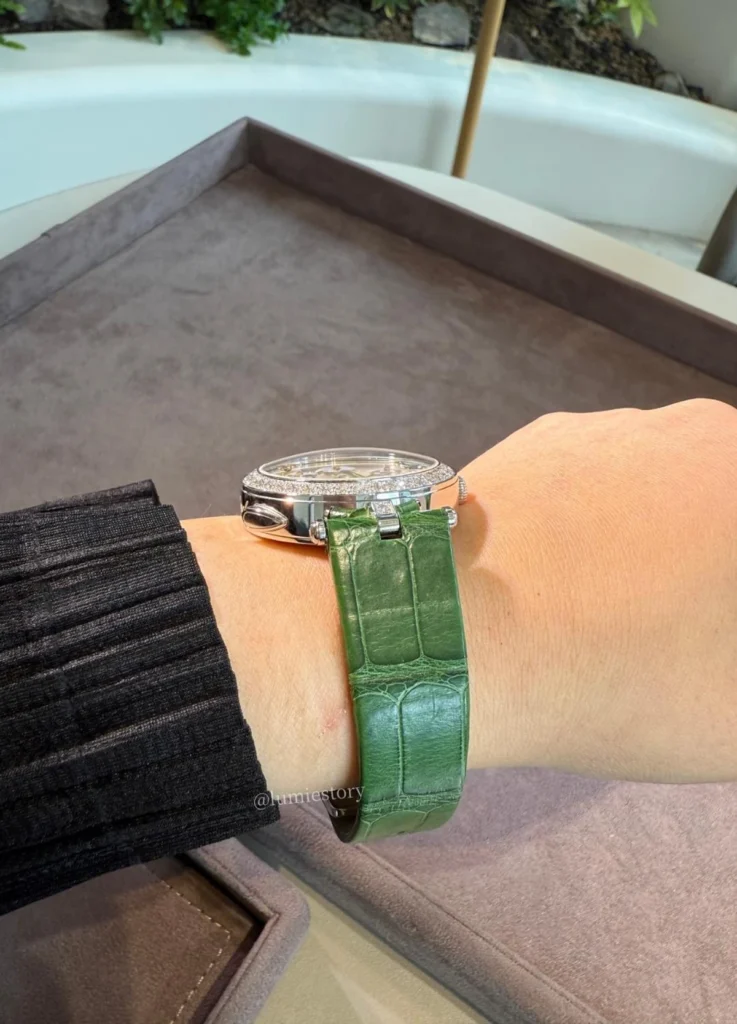
A 38mm watch acts as a visual anchor point on the arm. On a shorter arm, the watch arrives before the body does — it compresses the proportions and makes the arm look shorter. On a longer arm, the watch becomes a balanced focal point within a continuous line.
What I felt as “the head looks too large” was likely not a wrist problem alone. It was an arm-length proportion effect — the watch creating a center of gravity too close to the hand on a shorter forearm.
Volume in the hand and wrist helps.
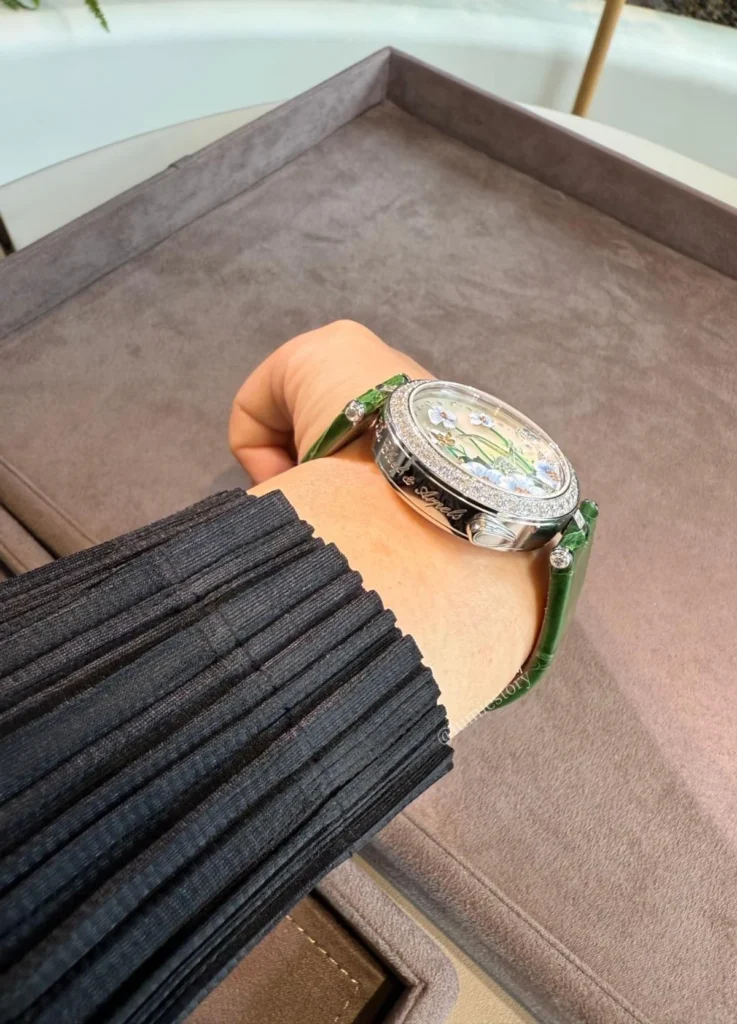
A wrist with some softness and curve suits this watch better than one with extremely prominent bone structure. The case is round, the flowers are curved, the stems are curved, the butterflies move in arcs. Every element speaks in curves. On a wrist where bone angles dominate, the watch’s lyricism diminishes and only the volume of the head registers.
Who This Watch Serves
Wrist circumference 15cm or above. Wider, flatter wrist structure. Moderate to long arm length. An upper body frame with some presence — not necessarily large, but not extremely delicate.
Under these conditions, the watch is absorbed into the body. The dial’s miniature landscape unfolds as a composition rather than a mass. The watch is worn, not displayed.
Who May Find It Difficult
Wrist circumference below 14cm. Narrow, rounded wrist profile. Short arm length. Small, thin hands. Very fine bone structure throughout the upper body.
Under these conditions, the watch reads as an independent object. The head dominates perception. The narrative detail of the dial is lost behind the sheer presence of the case.
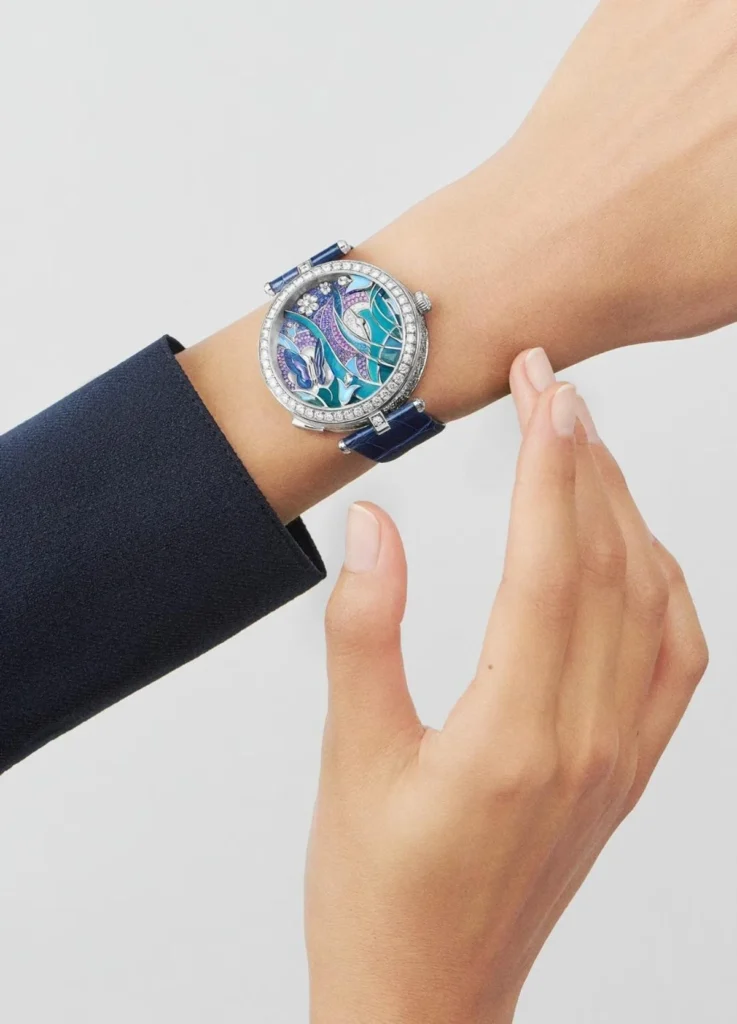
18K white gold, Diamond, Mother-of-pearl, Sapphire, Enamel
$ 367,000 Excluding taxes
source: vancleefarpels.com
Four Ways Van Cleef & Arpels Translates Time — The Lady Arpels Taxonomy
The Lady Arpels collection makes more sense when read not by model name or release date, but by how the maison chooses to express time. Four distinct axes structure the line.
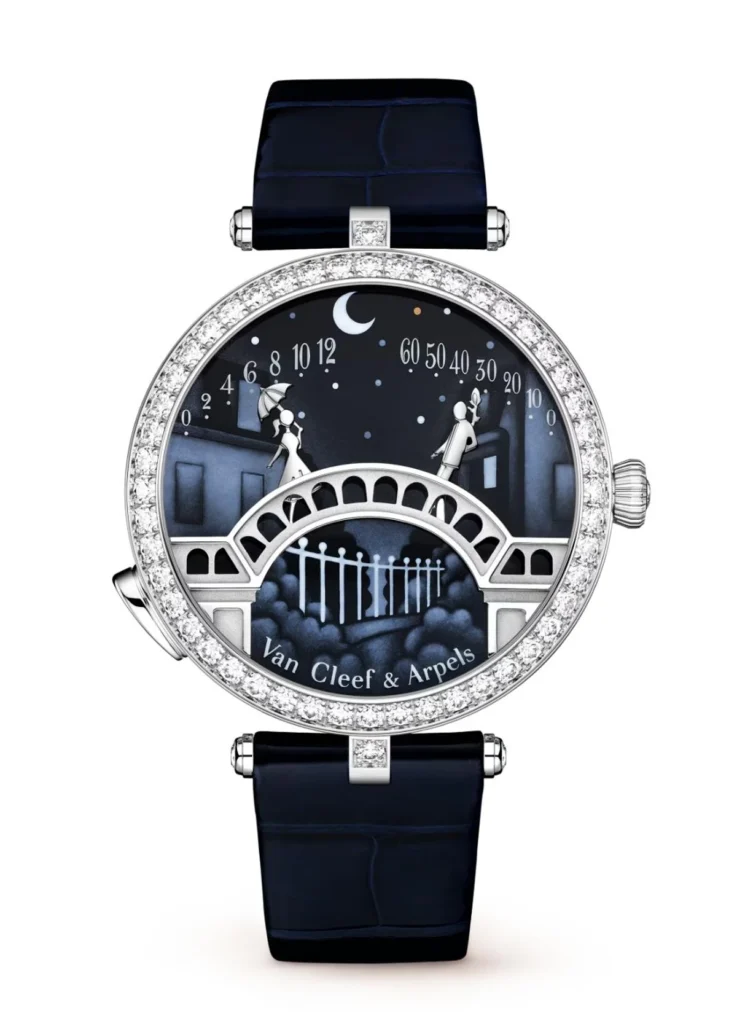
18K white gold, Diamond, Enamel
$ 149,000 Excluding taxes
source: vancleefarpels.com
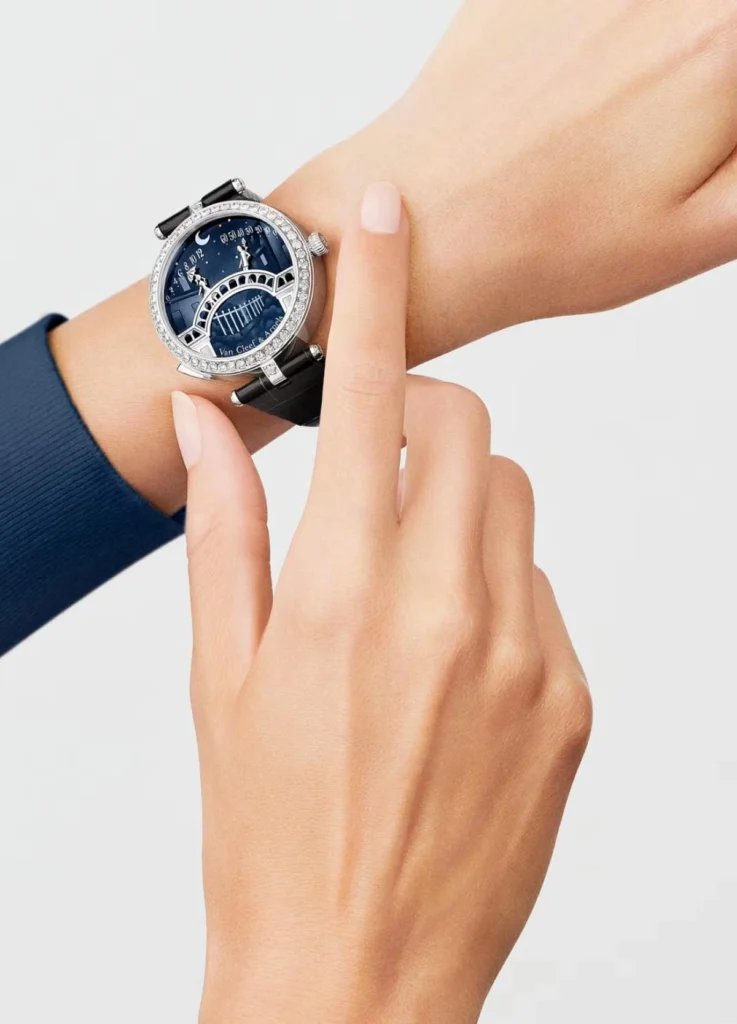
1. Narrative Complication
Time as story. Characters represent hours and minutes. Movement reflects emotional progression. Time accumulates and resolves. Pont des Amoureux is the defining model. The impression is romantic, emotionally driven.
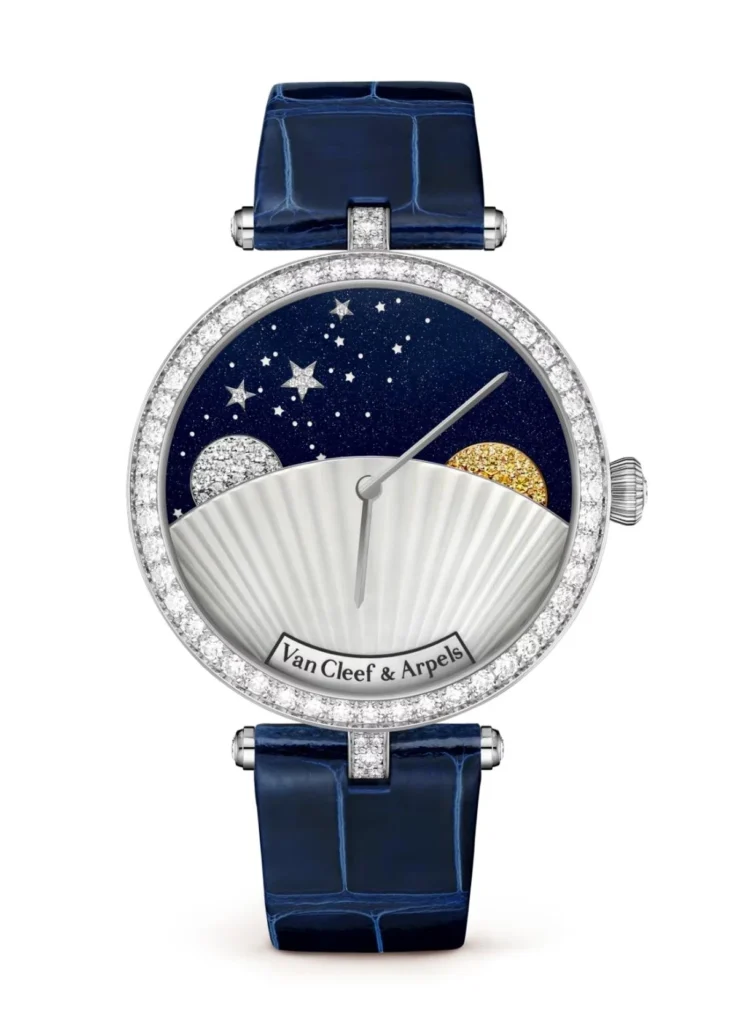
18K white gold, Aventurine, Diamond, Mother-of-pearl, Sapphire
$ 126,000 Excluding taxes
source: vancleefarpels.com
2. Astronomical and Cosmic Time
time as universal order. Planetary orbits and celestial systems determine the display. The framework is intellectual and highly structured. Lady Arpels Planétarium represents this axis. The most conceptual category within the collection.
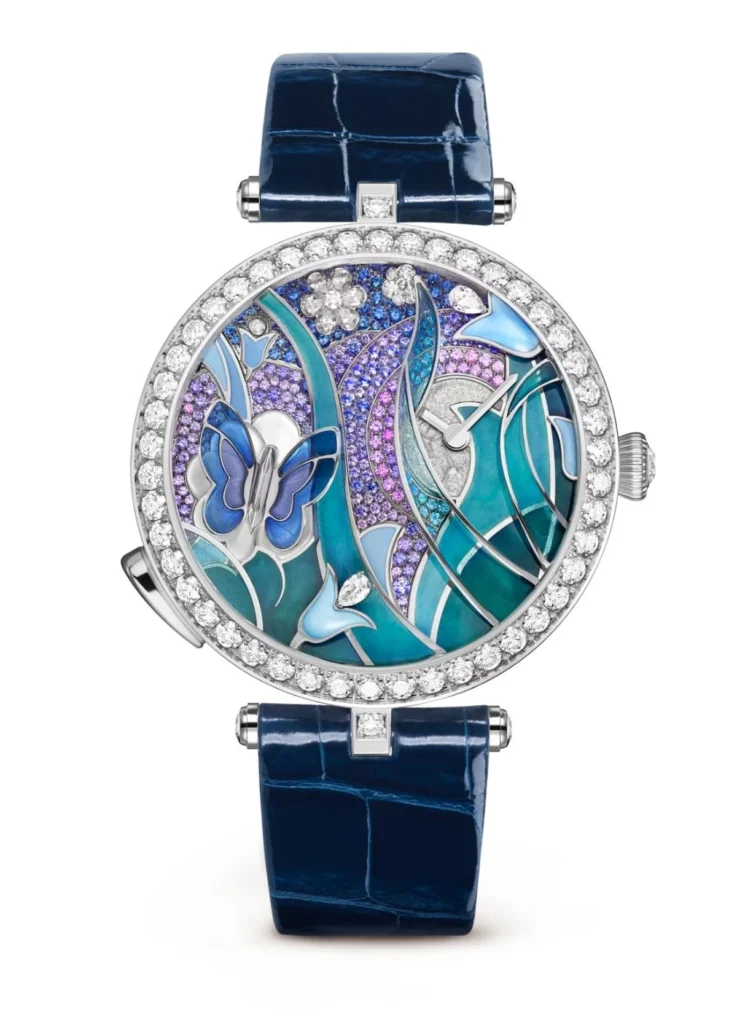
18K white gold, Diamond, Enamel
$ 149,000 Excluding taxes
source: vancleefarpels.com
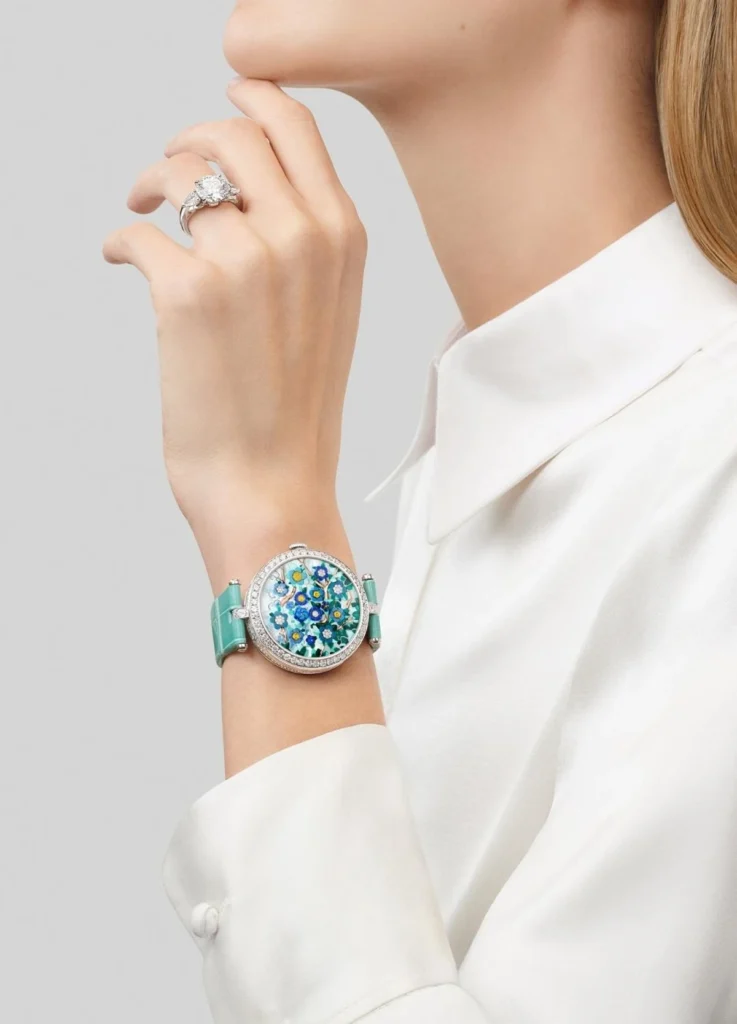
3. Enchanted Nature
Time as organic motion. Butterflies, flowers, and air. Time is not measured but felt through natural rhythm. Brise d’Été belongs here, alongside the Papillon series. The most sensory and poetic axis, and often the most dense in métiers d’art.
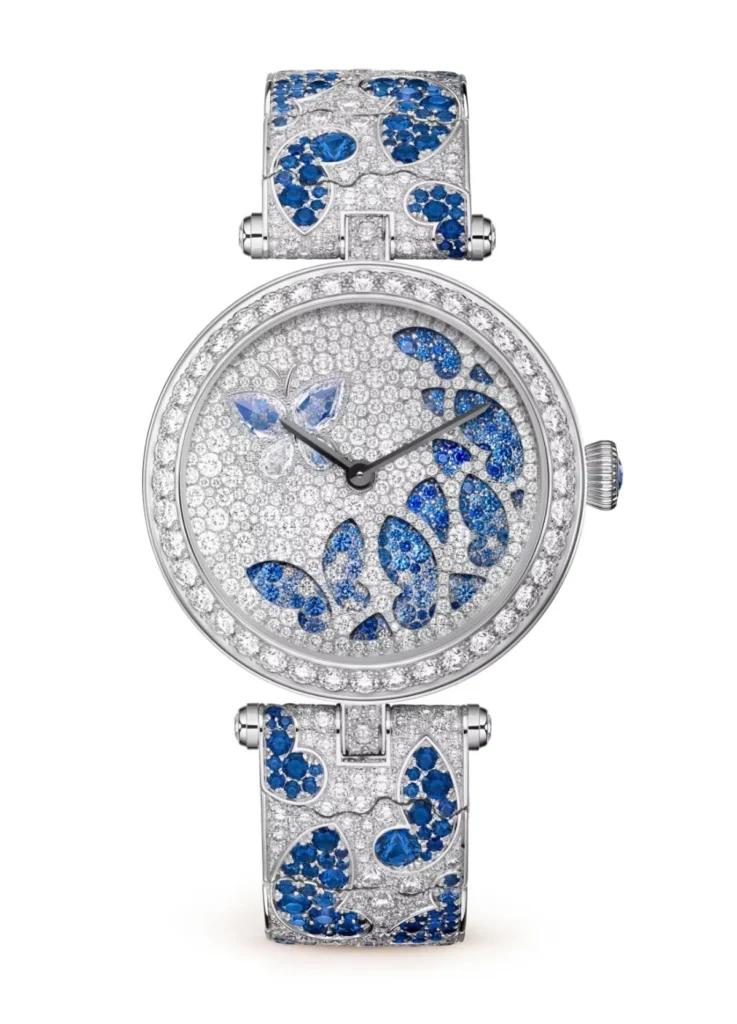
18K white gold, Diamond, Sapphire
$ 367,000 Excluding taxes
source: vancleefarpels.com
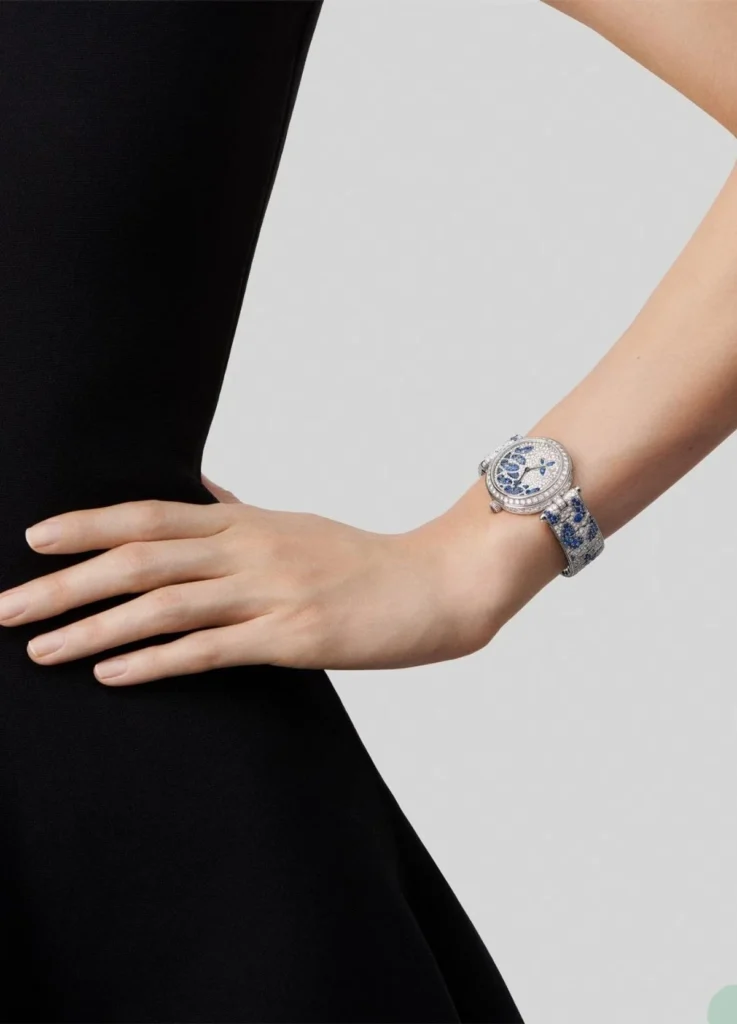
4. Decorative Jewelry Watches
Time is secondary to ornament. Visual presence and gem-setting take priority. The watch functions as a styling centerpiece rather than a timekeeping instrument. Certain High Jewelry pieces occupy this category.
18K white gold, Diamond, Sapphire
$ 367,000 Excluding taxes
source: vancleefarpels.com
Within this structure, Brise d’Été sits clearly. It does not narrate. It does not calculate. It does not merely decorate. It visualizes something intangible — the movement of air through matter. That is what gives the watch its quiet authority.
18K white gold, Diamond, Mother-of-pearl
$ 282,000 Excluding taxes
source: vancleefarpels.com
Lady Arpels Watch Categories at a Glance
The Lady Arpels collection reads more clearly when sorted not by release date, but by how Van Cleef & Arpels translates time. Four approaches define the line.
| Category | Core Idea | How Time Is Expressed | Representative Models | Overall Wearing Impression |
|---|---|---|---|---|
| Narrative Complication | Relationship, story, emotional progression | Time is conveyed through the movement of characters or figurative elements | Pont des Amoureux, Pont des Amoureux Aube / Soirée | Romantic, lyrical, emotionally driven |
| Astronomical / Cosmic Time | Universe, order, celestial rhythm | Time is structured through planetary motion, stars, or astronomical systems | Lady Arpels Planétarium, Midnight Planétarium | Intellectual, conceptual, highly structured |
| Enchanted Nature / Transformation | Nature, change, organic motion | Time is translated through butterflies, flowers, wind, and subtle movement | Lady Arpels Brise d’Été, Papillon, Fleurs | Organic, poetic, sensorial |
| Decorative Jewelry Watch | Ornament, gem-setting, visual presence | Timekeeping is reduced or secondary to jewelry artistry | Lady Arpels Heures Florales (certain variations), High Jewelry pieces | Object-like, ornamental, presence-driven |
Within this framework, Brise d’Été belongs most clearly to the Enchanted Nature category. It does not narrate time through plot, nor organize it through cosmic order. Instead, it renders time as atmosphere—something felt through motion, air, and the quiet instability of living forms.
source: vancleefarpels.com
Styling
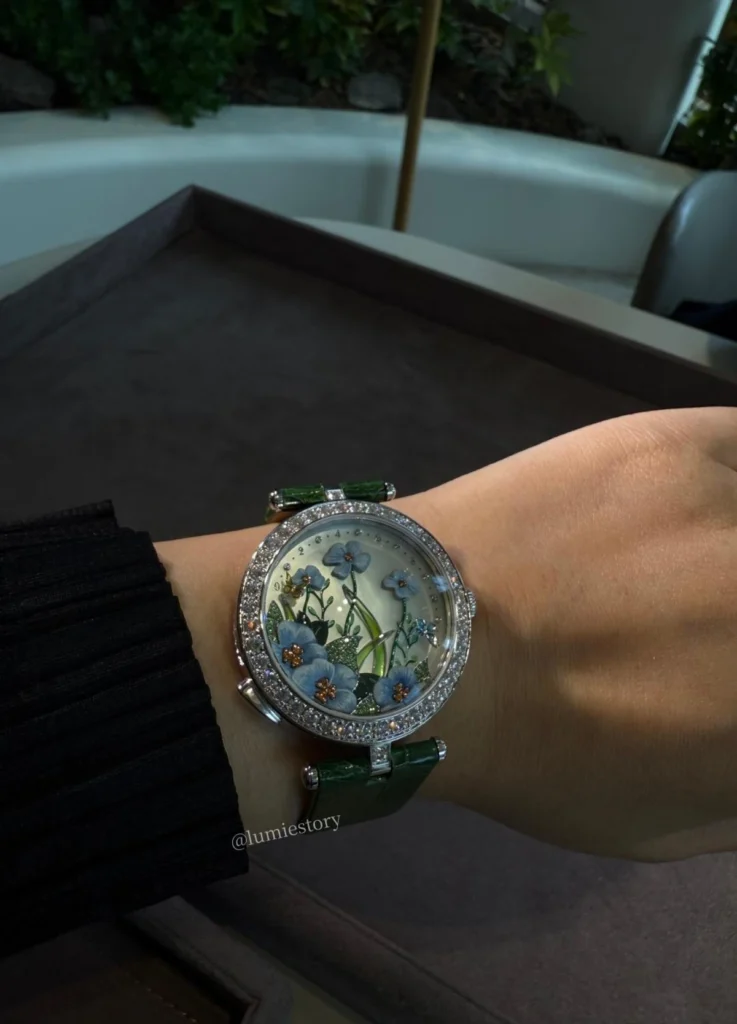
The green strap is not a decorative accent. It completes the composition. The green acts as a continuation of the stems inside the dial, extending the botanical narrative from the case onto the wrist.
This makes pairing deliberate. The watch works best against beige, cream, warm grey, olive, and deep navy — tones that let the dial’s internal world breathe without competition.
On a smaller wrist with lighter styling, the strap color can arrive before the watch does — enlarging the perceived scale further. The strap is an asset on the right frame and a risk on the wrong one.
Final Reflection
Lady Arpels Brise d’Été represents one of the clearest statements Van Cleef & Arpels has made in watchmaking.
The maison does not compress time into numbers. It does not dramatize time through plot. Instead, it allows time to pass through something else — through flowers that tremble, stems that cross without rigidity, butterflies that move without urgency.
A beautiful watch is not always the right watch.
Brise d’Été is an exceptional piece. It does not bloom the same way on every wrist. It is not a delicate miniature dressed in refinement. It is a high jewelry object with presence, structure, and narrative weight. When the body’s frame can receive that weight, the watch becomes something beyond jewelry — an object that shifts the temperature and air of a day.
What stays with me most is not the color of the flowers or the sparkle of the diamonds. It is the moment when the stems and petals begin to move at different speeds inside an invisible current. Van Cleef & Arpels does not ask you to read time. It places the sensation of time passing — the feeling of it brushing past — directly onto the wrist.
That is why this watch remains, for me, not just a beautiful watch but a Van Cleef & Arpels watch.
All images unless otherwise credited: © Lumie Story
[ Related Editorials ]