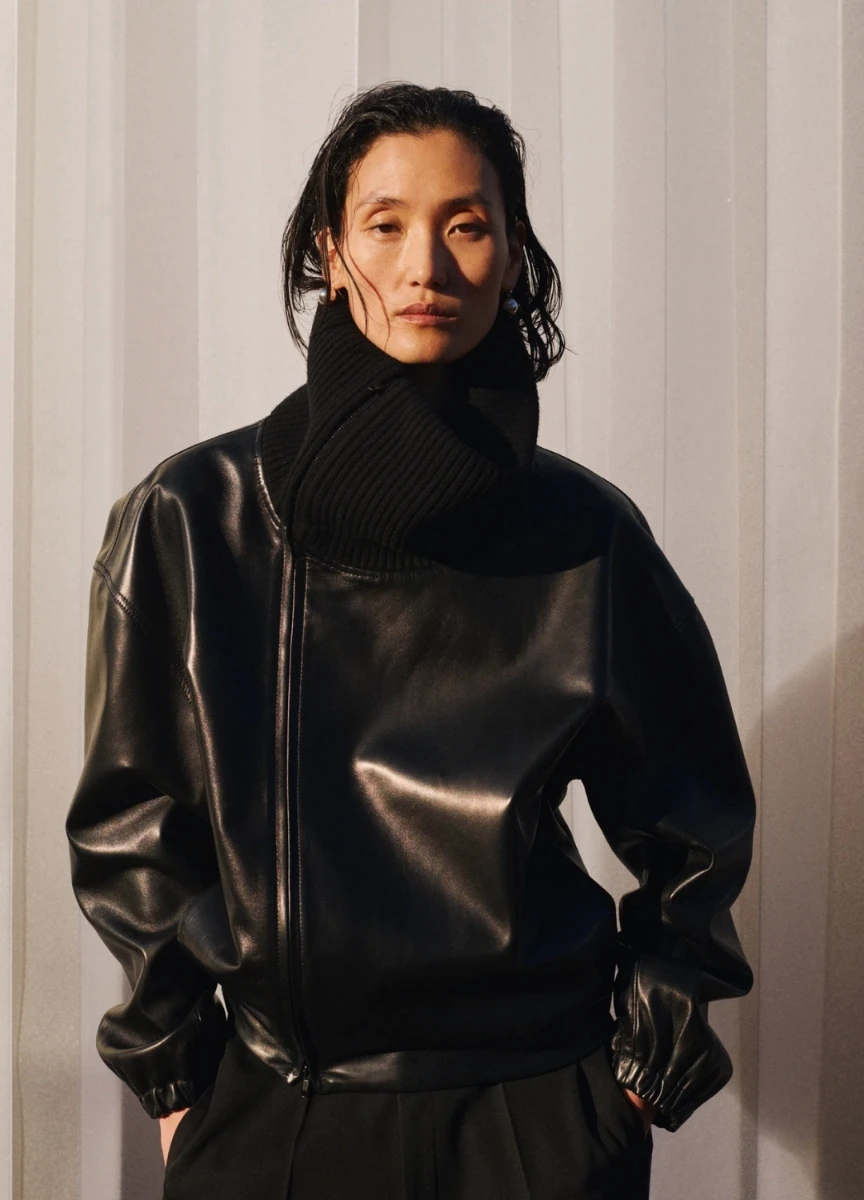
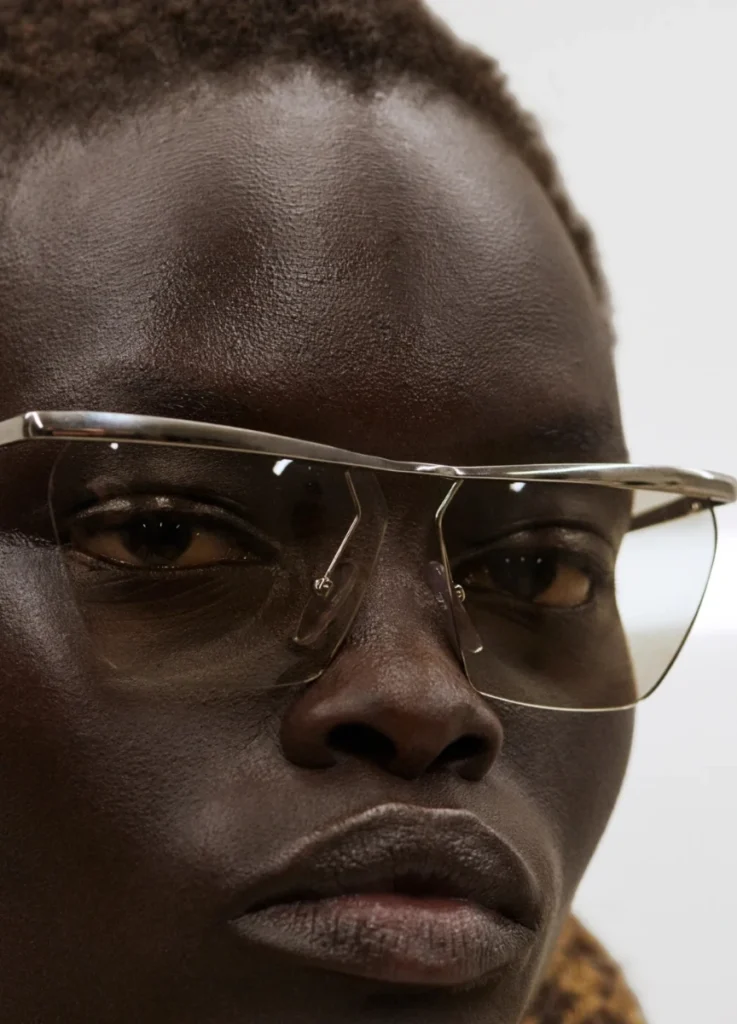
photographed by Alasdair McLellan
Why “the Body,” Now
Phoebe Philo’s Collection E arrived in the most quietly disruptive way possible — privately presented during Paris Couture Week in January 2026, then unveiled publicly through a lookbook photographed by Alasdair McLellan and released on March 19th. Deliveries begin in June. The fall/winter offering arrived not on a runway but in the austere offices of Paris architect Dominique Perrault, an unmistakably Philo-esque venue choice — architectural, restrained, free from theatrical staging.
Collection E matters less for the lookbook itself than for the moment it arrives in.
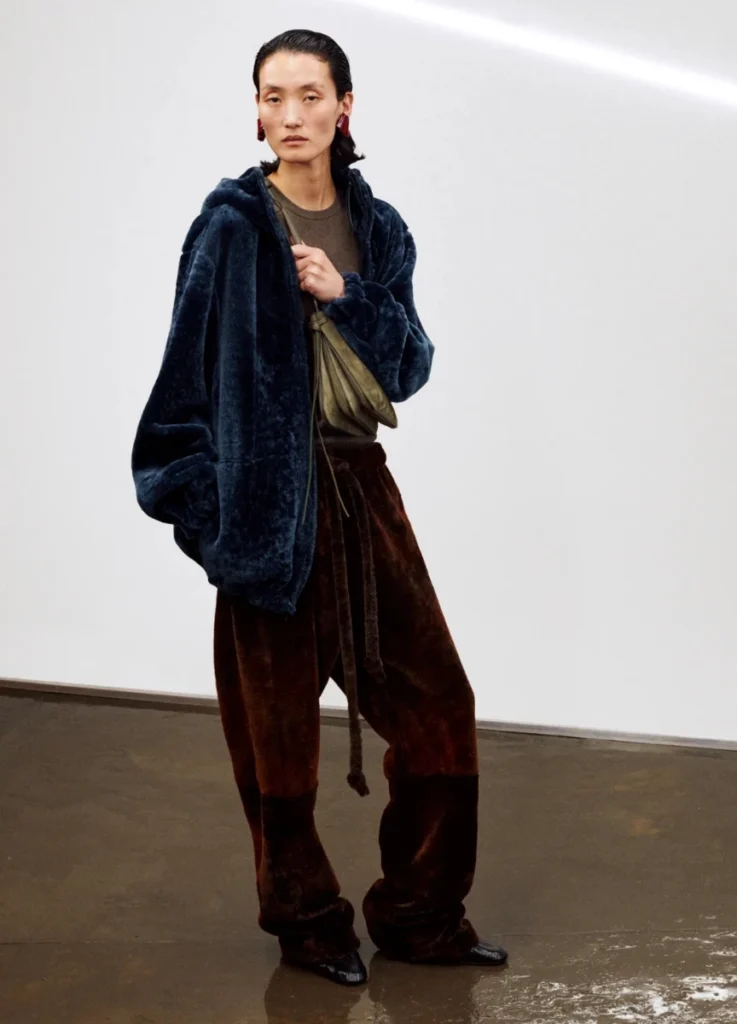
photographed by Alasdair McLellan
Contemporary luxury has entered a peculiar exhaustion. Two parallel currents — logo-forward maximalism on one side, extreme quiet luxury on the other — have converged on the same outcome. Both have started erasing the body.
Logo-forward luxury made the wearer secondary to the brand image. Garments became surfaces for recognition rather than constructions for movement. Extreme minimalism, from the opposite direction, abstracted the body so completely that silhouettes drifted toward architecture rather than anatomy.
Oversized, neutral, structurally vague — the formula spread across runways until many collections began reading as variations on a single template. Garments became cleaner. Sensation faded.
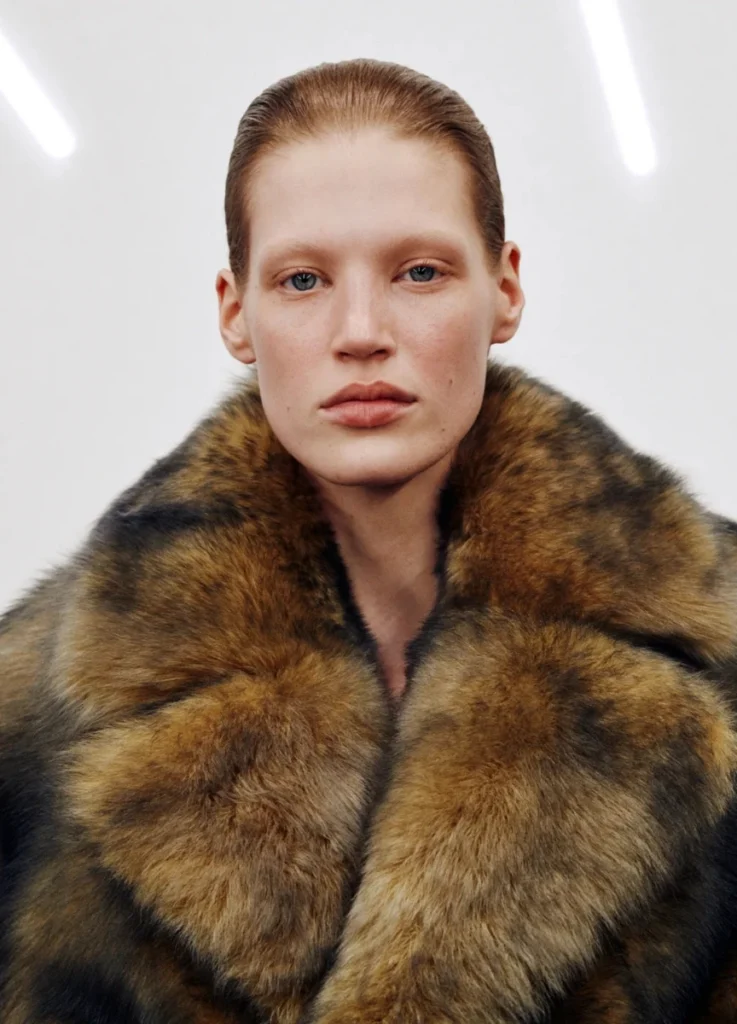
photographed by Alasdair McLellan
The post-pandemic fixation on comfort and quietness hardened into a vocabulary: oversize silhouettes, neutral palettes, blurred construction, emotion-stripped styling. It looked sophisticated at first. After enough seasons, looks became increasingly difficult to distinguish from one another. Wide pants.
Deconstructed tailoring. Coats abstract enough to read as conceptual sculpture. Fashion increasingly consumed as image rather than as material on a body.
photographed by Alasdair McLellan
Collection E arrives directly into that fatigue.
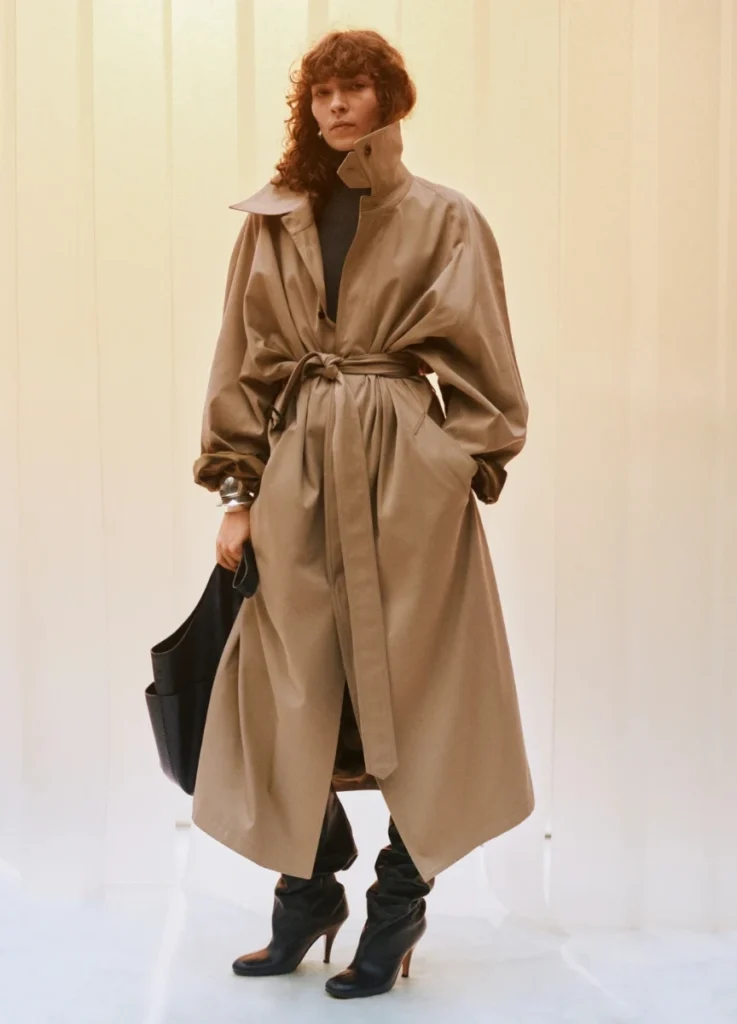
Philo doesn’t reject the prevailing direction. The collection is still neutral-driven, still restrained, still committed to negative space. What it refuses to do is erase the body. The body returns to the foreground — but this isn’t the body of past sexuality, with cinched waists and exaggerated curves. It’s a body articulated through fabric and movement rather than through silhouette compression.
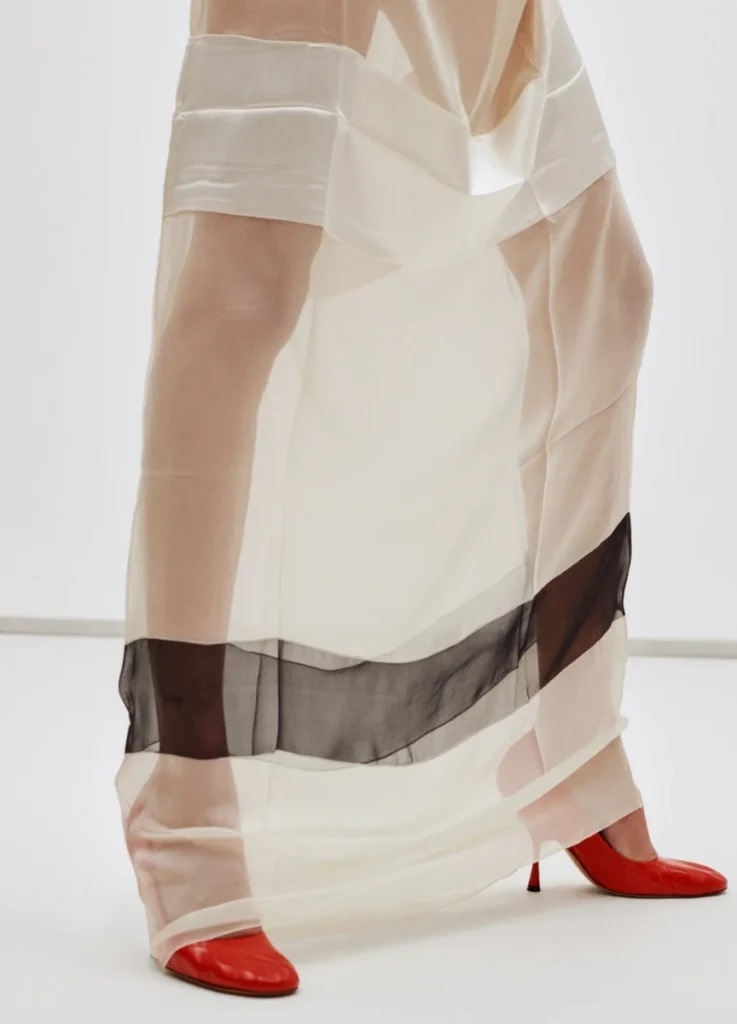
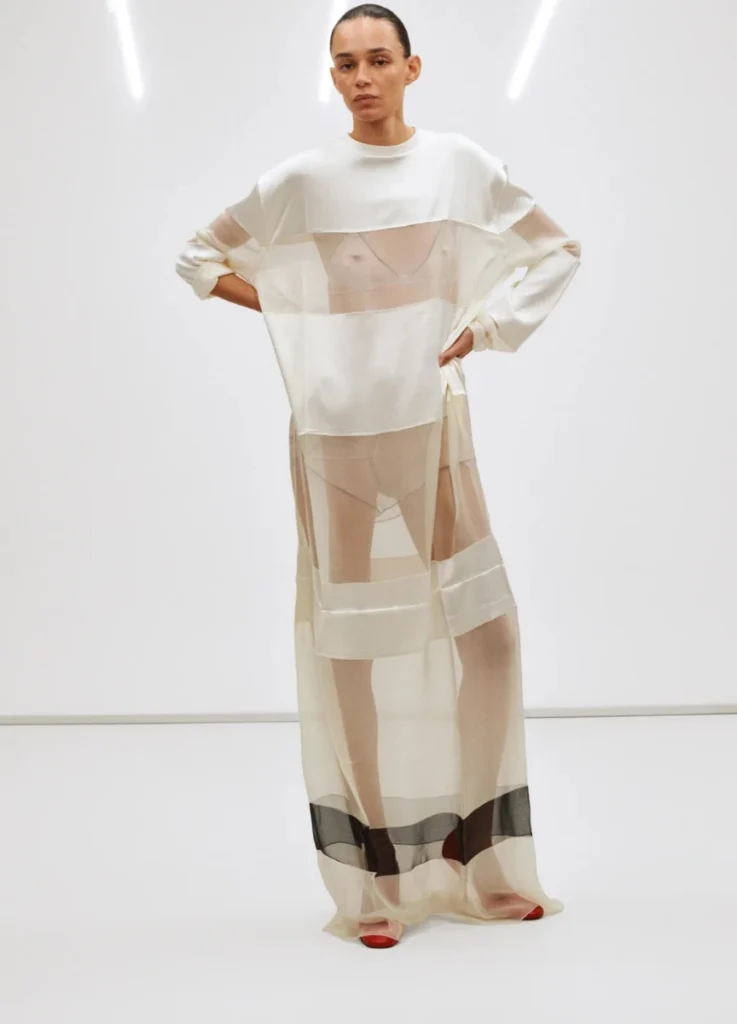
The slip dresses of the season register this most clearly. They don’t cling. They don’t separate either. They sit in a specific middle distance — fabric tracing the body without performing it. The pants follow the same logic. They don’t conceal the lower body. They follow the movement of the hip and leg without insisting on it. Tension stays. The wearer remains visible inside the garment.
photographed by Alasdair McLellan
“It’s Just Clothes” — The Most Important Compliment in Fashion This Year
It’s just clothes. That was AnOther’s Alexander Fury, recounting an editor’s framing of Philo’s alphabet-named collections over the past few years — a phrase delivered as the highest of compliments. Fury’s reading of why this works for Collection E is precise: Philo’s clothes are presented in a direct way freed of the demands of catwalk theatrics. They have a resolute reality to them.
That is Collection E’s structural achievement. Inside an industry where attention rewards escalation — bigger gets bigger, minimal gets more minimal, sloppy gets sloppier — Philo has built a brand on the inverse logic. Lookbooks rather than runway. Incremental drops rather than seasonal cycles. Clothes positioned to land in the wardrobe rather than to dominate a single image.
photographed by Alasdair McLellan
WWD’s Miles Socha read the collection through a similar register — Philo operates outside the fashion rat race, which surely limits the attention her fine clothes deserve. But her low-key presentations let the impact of her clothes sink in, so they end up being more memorable. That trade-off — visibility surrendered for durability — is the calculation Collection E rests on.
Fury also identifies the influence loop. They are also influential, he writes, noting that three of Philo’s former colleagues now head different houses. The fingerprints of her work at Celine continue to circulate through contemporary luxury. Furry shoes — which Philo essentially reintroduced in 2012 — are emerging as a new micro-trend. Collection E adds to that influence rather than chasing it.
-style jacket, photographed by Alasdair McLellan
The Material Vocabulary — Shearling, Leather, and the Discipline of the Hand
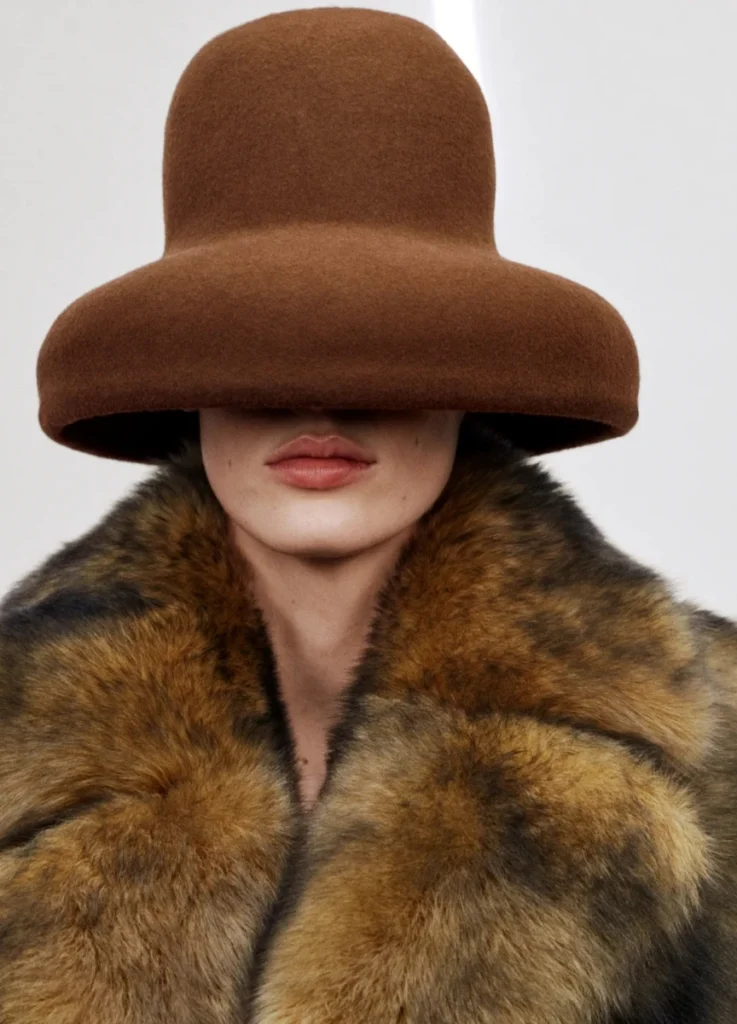
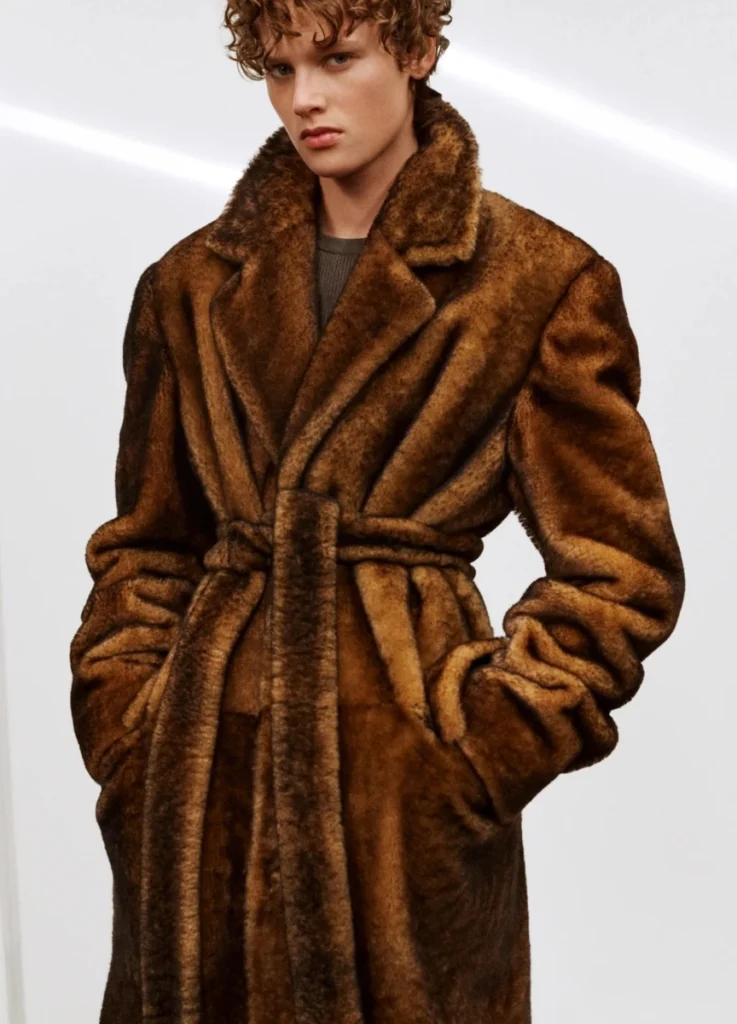
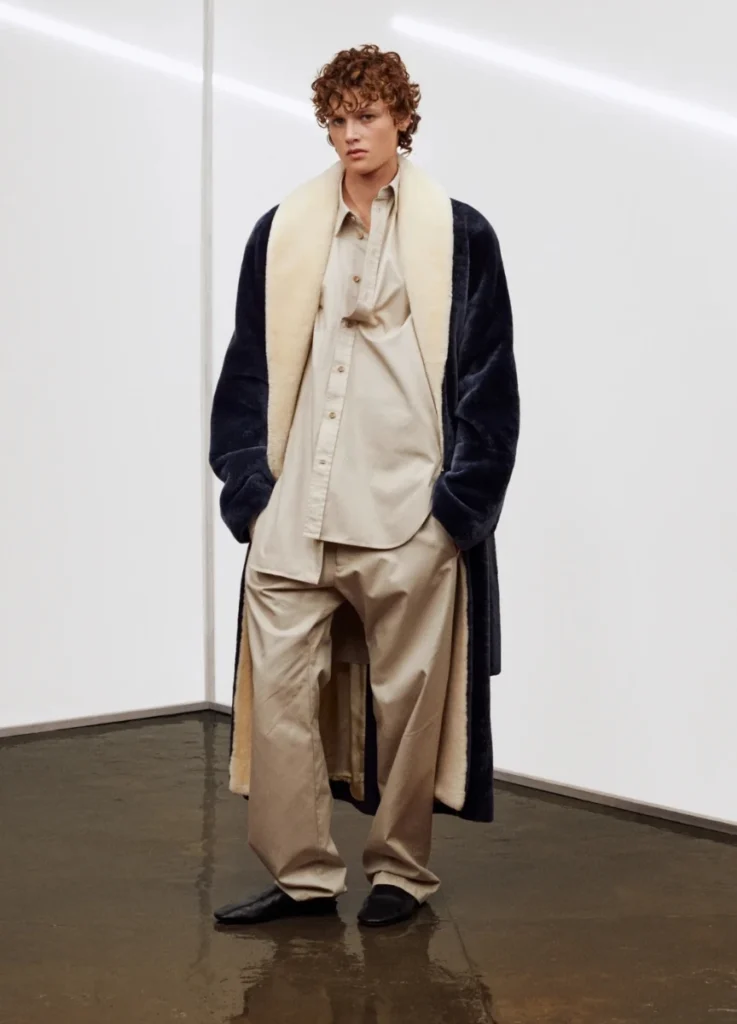
What gives Collection E greater force than its alphabet predecessors is the material thinking. Even after a fashion month rich in terrific leather jackets and luscious shearlings, Phoebe Philo’s still impress — that was Socha’s read. The shearlings come in colors to get lost in: dark cherry reds, inky blues, VSOP-cognac browns. Some are hand-painted at the tips or roots to evoke variants of idealized fur. The technique is invisible at first glance. It registers as patina once the garment is in the hand.
The applications run from bathrobe-like coats to drawstring pants to peplum jackets cinched tightly at the waist — the cinch sharpening the notched lapels into projection. Beefy batwing bomber jackets. Sleek, papery shirts. A wrap coat with peaked lapels and roomy sleeves that AnOther called fiercely chic.
photographed by Alasdair McLellan
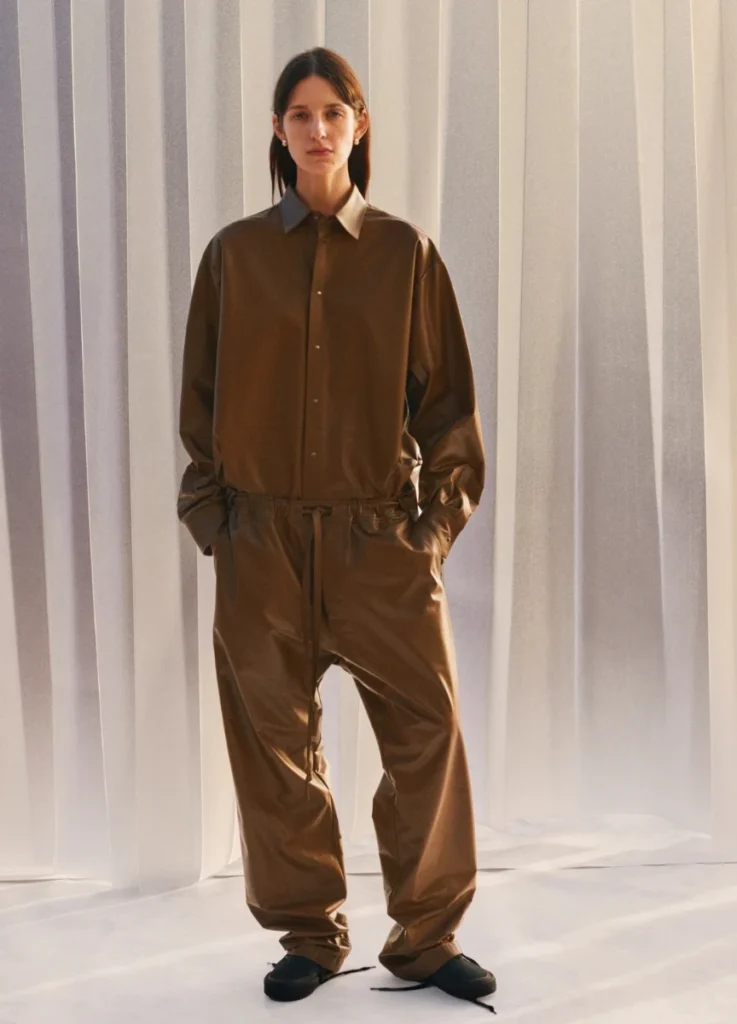
The leather goes through similar treatments. Some pieces washed (or loved, in Philo’s phraseology). Others pressed into stiff ridges as if freshly unpacked from longer storage. Different weights. Various treatments — parachute-fine leather for tracksuit-style trousers, cashmere velvet for the pyjama register. Shearling shaved into drawstring pyjamas and coats.
The colors extend beyond shearling into the broader palette: a tart acid yellow rendered best in chewed-up wool melange, a red the color of dried and scabbing blood. Petroleum-leaning, vaguely 1980s hues. Olive and dark brown. Dusty pink. Old ivory. Moss green. The neutral palette here carries layered time rather than performing freshness — not the cold neutrality of recent quiet luxury, but the warmer surface of fabric that has lived somewhere before reaching the wearer.
photographed by Alasdair McLellan
The Trousers — Why This Pair Anchors the Season
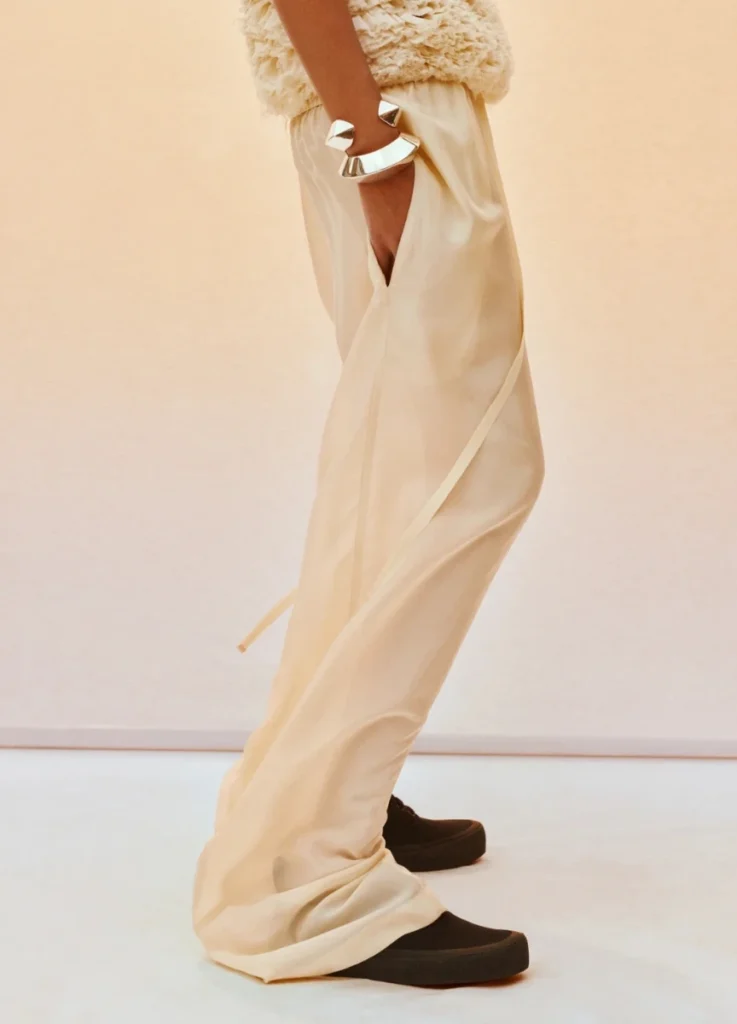
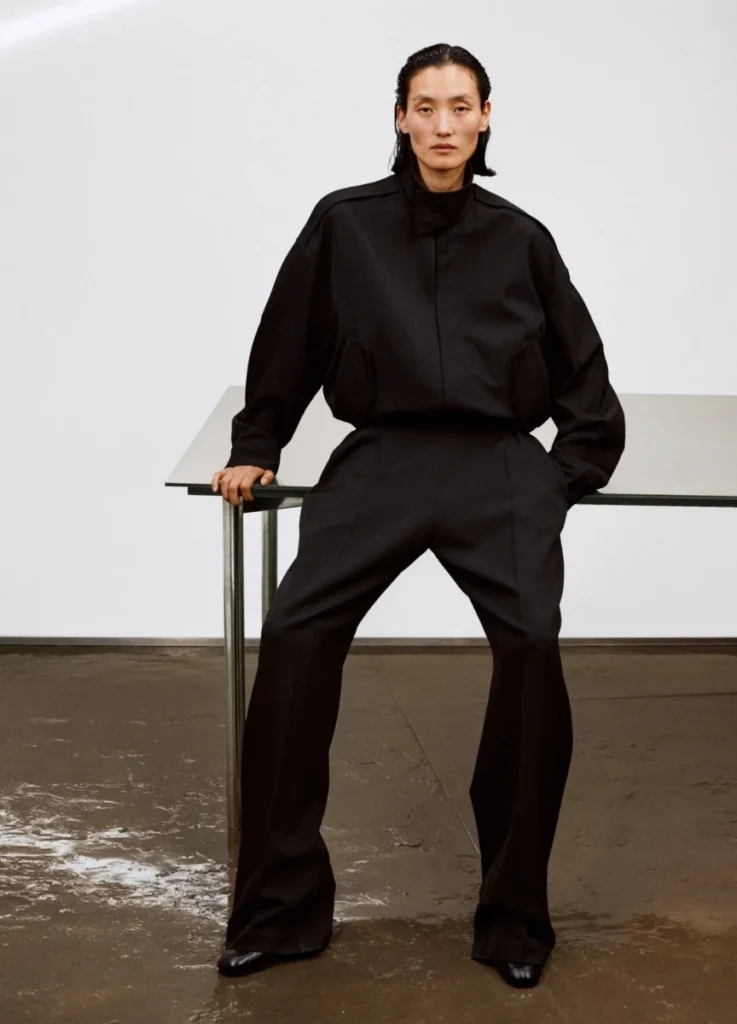
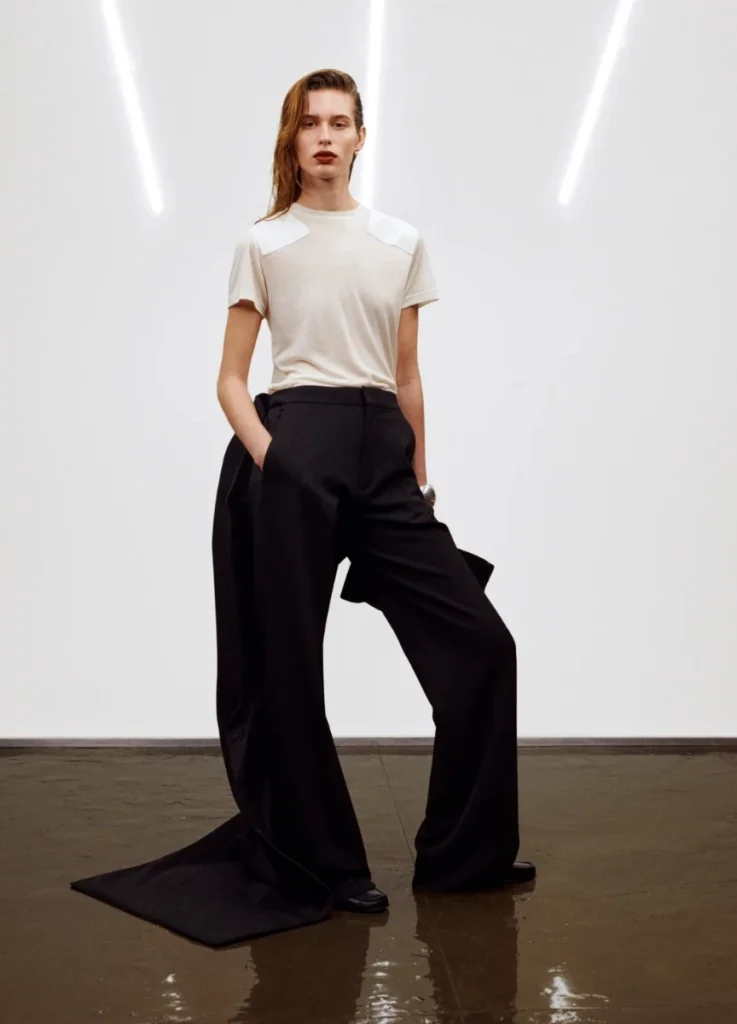
The trouser is the structural axis of the collection. Wide-cut, falling close to the floor, light enough to move with the body rather than collapse onto it.
Most contemporary wide-cut trousers fail in one of three ways: too oversized, too long, or so deliberately deconstructed that the silhouette flattens. Collection E’s trousers sit differently. There’s slight tension at the hip, a release through the thigh, and a continuous line down to the floor that reads as length rather than weight. The ivory and the black both fall to the ground without sinking. The wearer reads taller, not larger.
photographed by Alasdair McLellan
That balance is rare at this scale. Philo’s predecessor signatures — the Strap trouser, offered a few seasons ago in grey and now in black; the navy cotton utility jacket with patched pockets; the cropped bomber jacket reissued in brown leather — all extend her seasonless, continuous body of work commitment. Collection E rewards customers who recognize what’s been carried forward and what’s new.
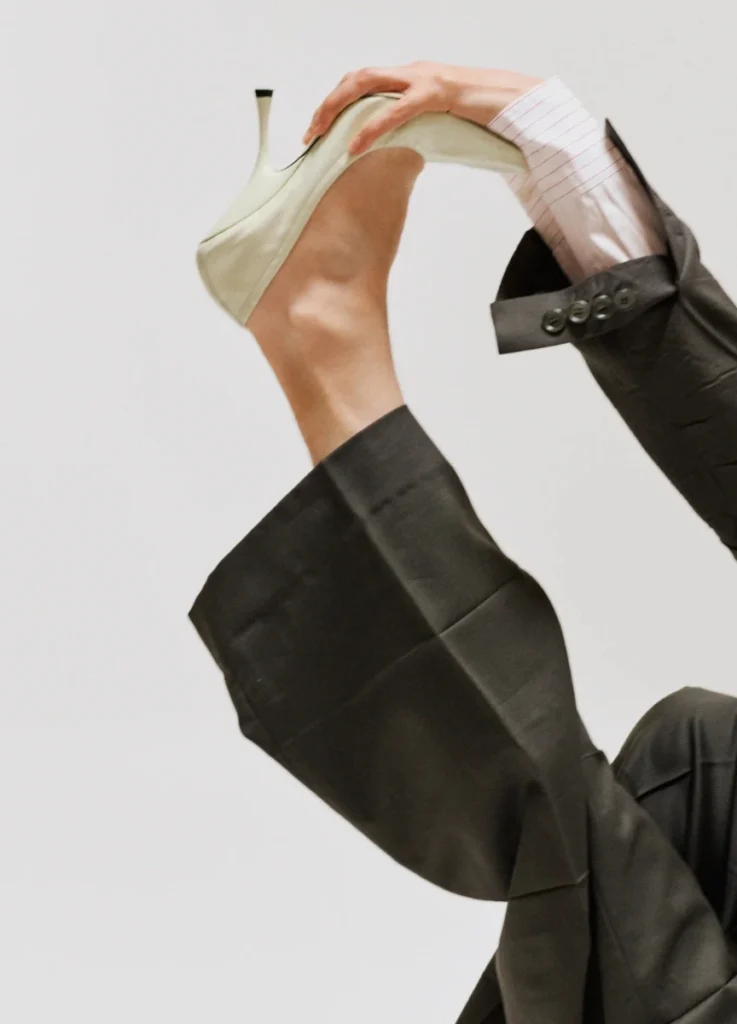
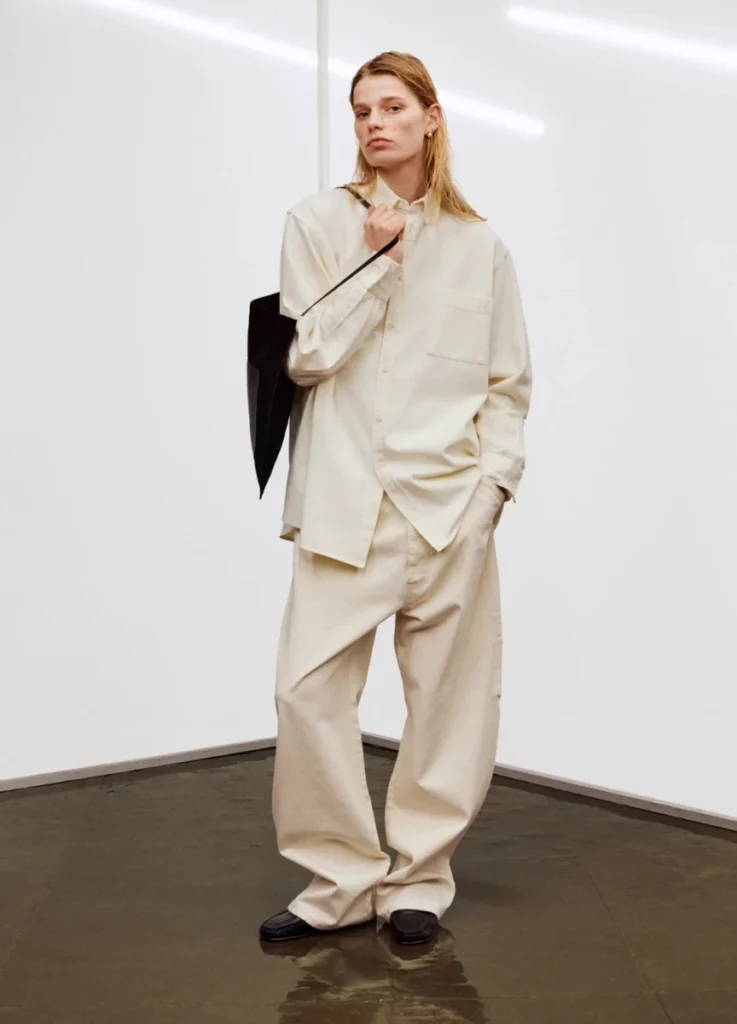
The Utility twinsets — matching big trousers and bigger shirts in cotton, cut like industrial uniforms — sit in the same continuity. They’re not new ideas. They’re refined applications of Philo’s core vocabulary, calibrated for a moment when most of the industry has lost the discipline to refine rather than restart.
photographed by Alasdair McLellan
Furs and the Body — The Shoulder as Structure, Not Status
Recent luxury has handled fur in two registers. Either too retro, recycling 1970s glamour codes, or too commercial, treating fur as a wealth signal independent of construction.
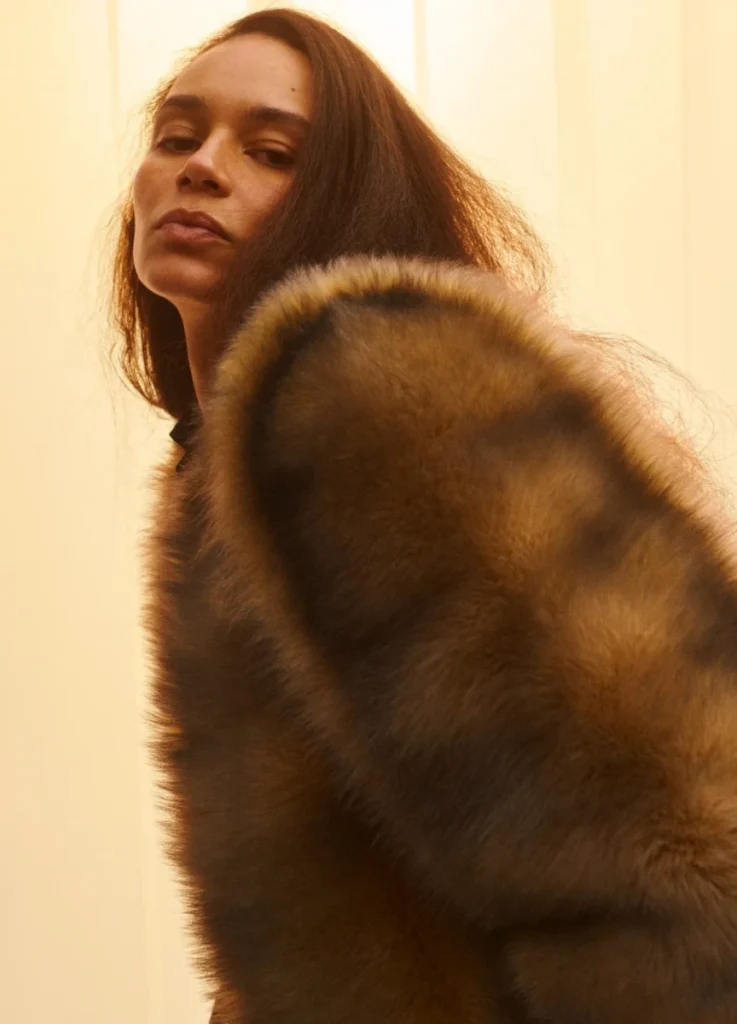
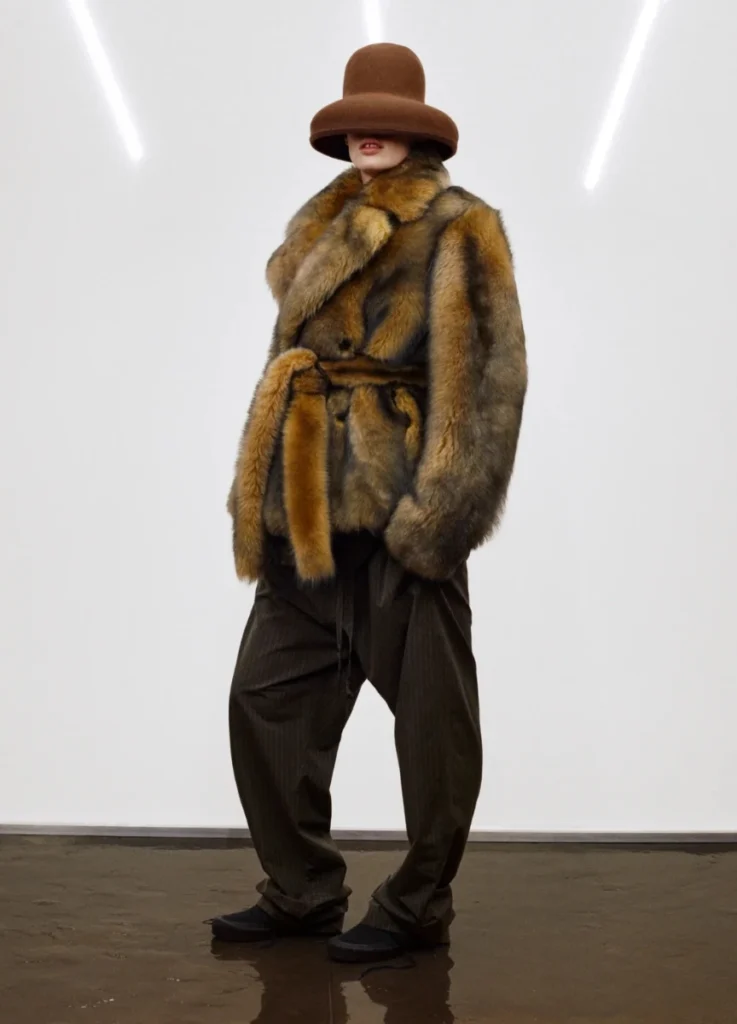
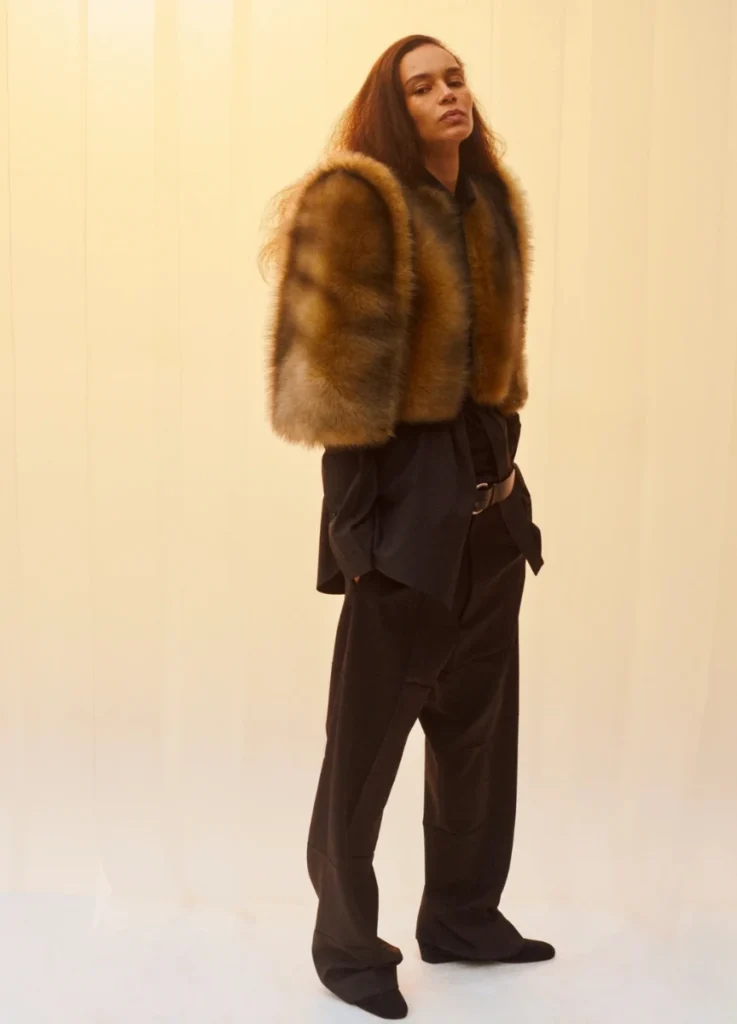
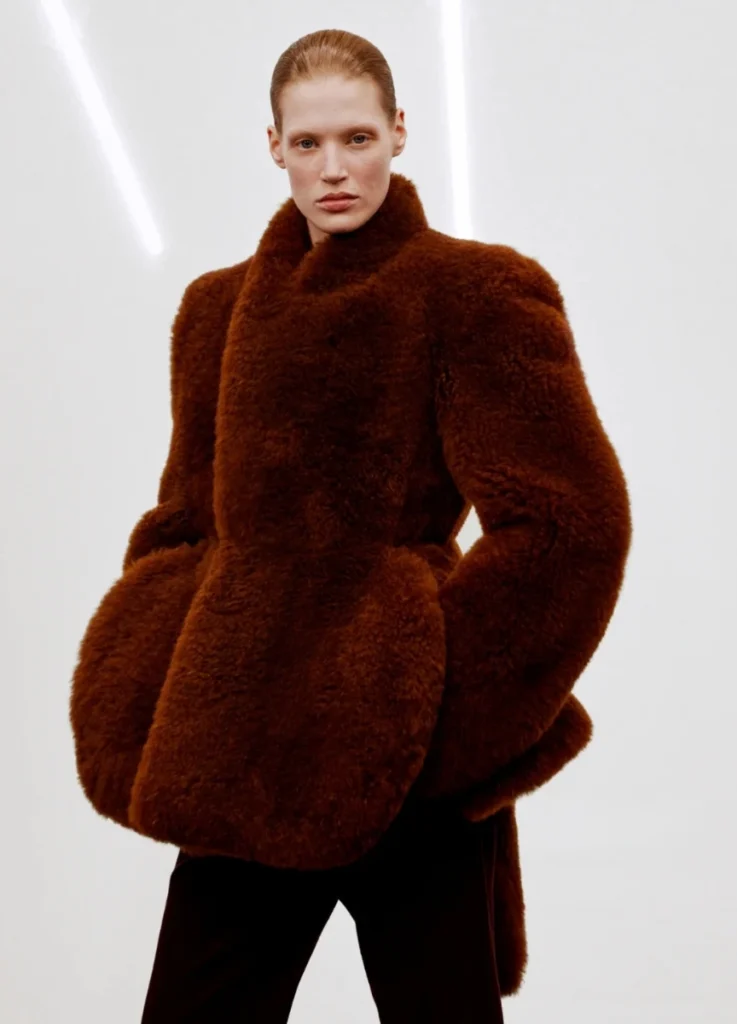
Collection E’s fur reads structurally. The brown fur jacket and dark fur coats don’t simply cover the body — they reconstruct the upper torso. The rounded volume that forms around the shoulder makes the face read smaller while giving the entire silhouette a clear weight center. The technique echoes 1970s vocabulary without recycling it.
photographed by Alasdair McLellan
Whether these fur pieces work in actual wear depends on body proportion. The runway images read convincingly. The shorter fur lengths combined with downward-flowing black trousers demonstrate how carefully Philo manages weight distribution across the silhouette. For wearers with taller frames or specific shoulder builds, the structural weight will translate. For others, the same pieces may sit differently than the lookbook suggests.
The pieces that translate most reliably across body types are the trousers, the shirts, and the cropped jackets — the items that depend on Philo’s tailoring discipline rather than on volume.
photographed by Alasdair McLellan
Color and Accessories — Where Discipline Meets Discreet Surprise
Edward Kanarecki at Design & Culture by Ed read the lookbook as a testament to Philo’s profound, instinctive understanding of women: nothing superfluous, no noise, no strings attached. Philo simply delivers, he wrote, a collection so concise and assured you can rely on it without a shade of doubt.
photographed by Alasdair McLellan
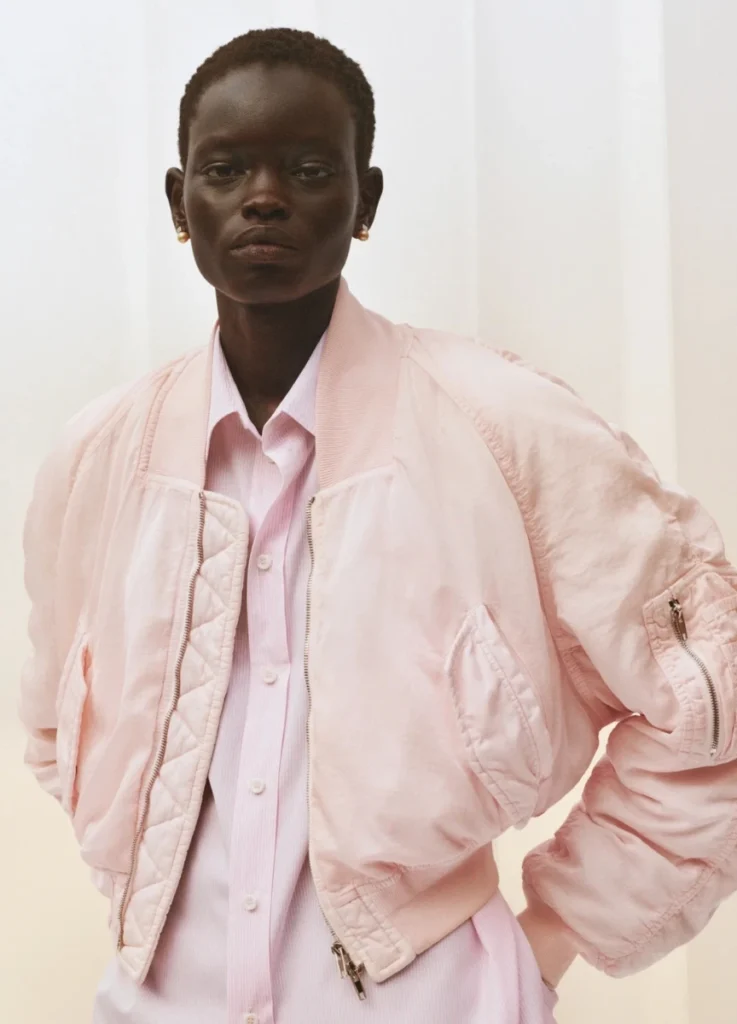
The color choices reinforce it. The neutral base — black, white, olive, oxblood — is interrupted strategically. A pale pink bomber jacket appears within the otherwise dry styling without breaking the season’s tension. The placement is the achievement. A less disciplined designer would have rendered the pink louder. Philo lets it sit quietly, integrated rather than performing.
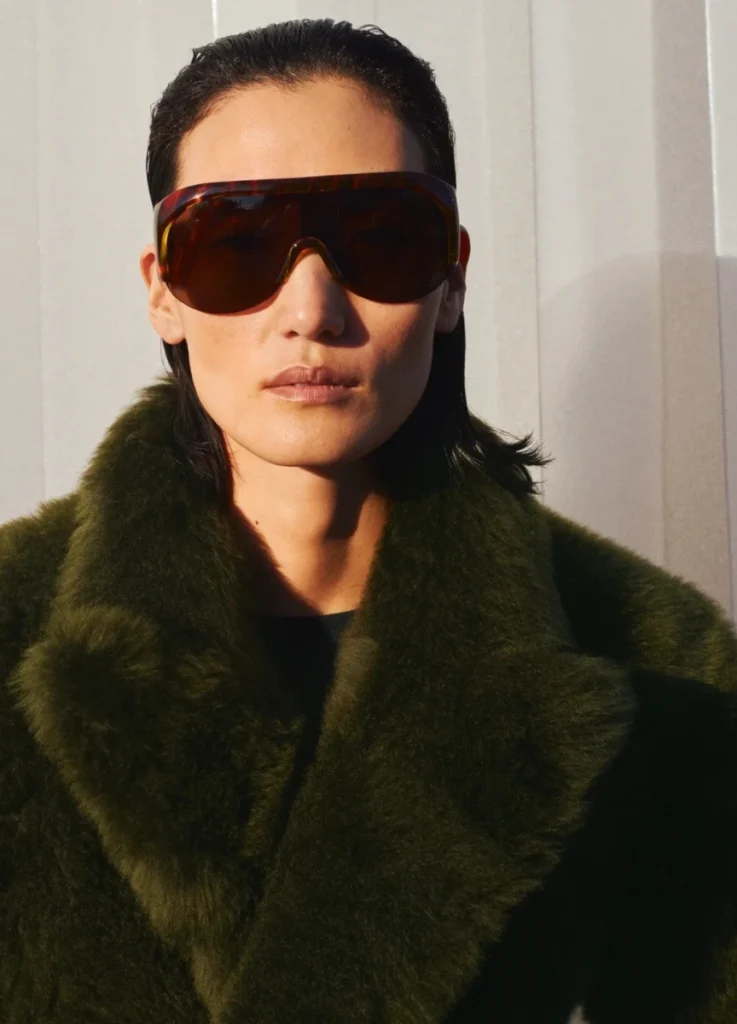
The accessories play structural roles rather than decorative ones. Oversized sunglasses extend the architectural register. Sculptural earrings draw the eye upward, recovering the visual center after long silhouettes pull it downward. Thick metal bracelets weight the wrist. Hypebeast read these accessory choices as part of a masterclass in effortless sophistication — a bold yet understated range defined by sensuous draping and utilitarian tailoring.
Five Looks That Define Collection E
photographed by Alasdair McLellan
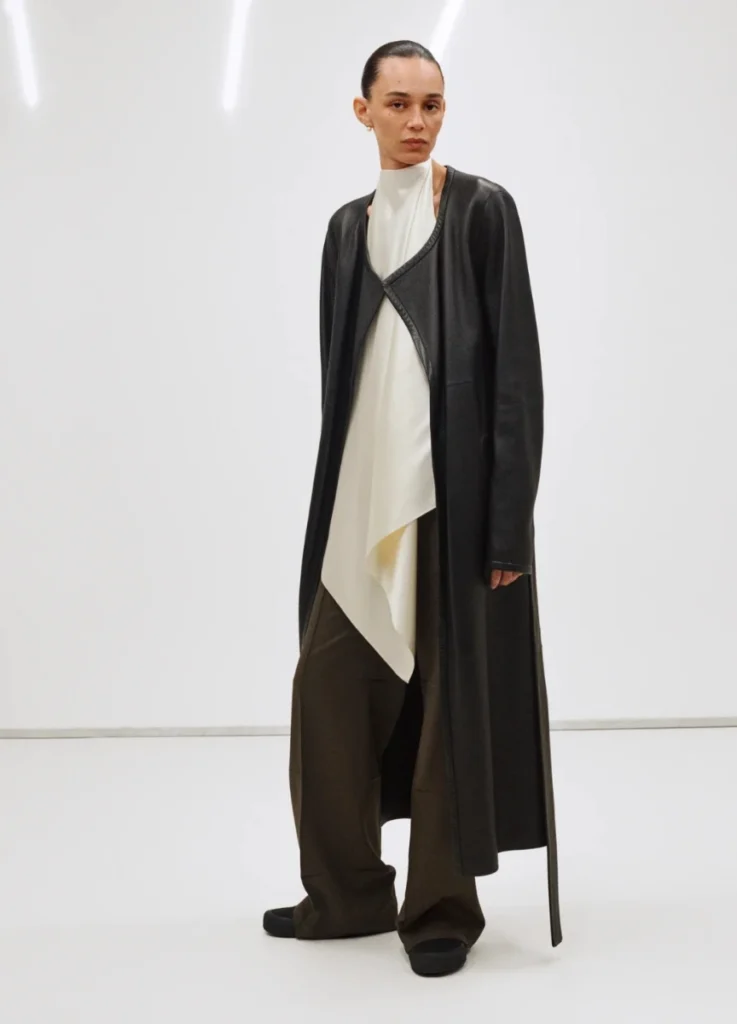
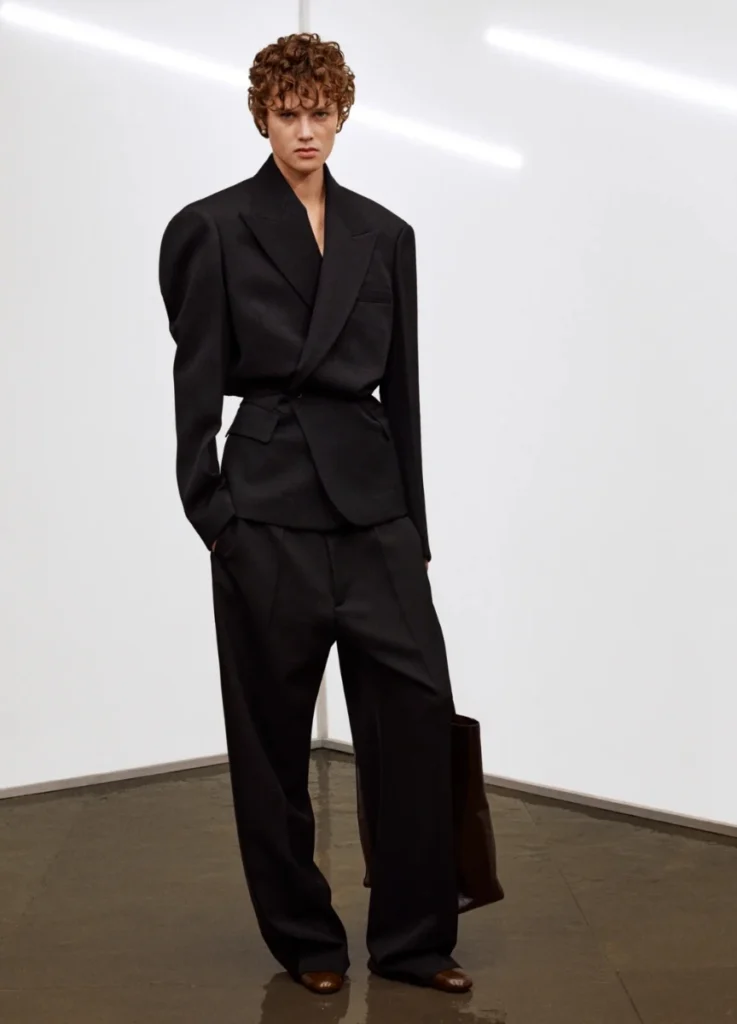
The black tailored jacket and long trouser look. The waist of the jacket twists slightly as it wraps the torso — not constricted, not loose, structurally exact. The trouser falls long, clean, refusing to weigh down the silhouette. The proposition isn’t power dressing. It isn’t 1980s authority. It’s a different kind of presence — quiet control rather than performed strength. In a market where oversized tailoring frequently reads as the garment consuming the wearer, Collection E’s tailoring reads as engineered for the body underneath.
photographed by Alasdair McLellan
The ivory slip dress. Thin straps. Almost no decoration. The fabric weight is calibrated to the millimeter. Too light and it loses force. Too heavy and the sensuality disappears. This dress holds the middle. It doesn’t follow the body but moves the air around it. The fine creases that gather near the floor read as the season’s signature gesture — slow movement made visible. Compared to the recent drift of minimal dresses toward sportswear, this dress operates at a different temperature.
photographed by Alasdair McLellan
The brown shearling jacket. Collection E’s most sculptural piece. Familiar material, but not used as the standard luxury code. The shearling reconstructs the line around the shoulder and reframes the neck and face.
The 1970s reference is clear, but the construction is contemporary. The combination of cropped shearling length and downward black trouser shows how carefully the season manages weight balance across the vertical axis.
photographed by Alasdair McLellan
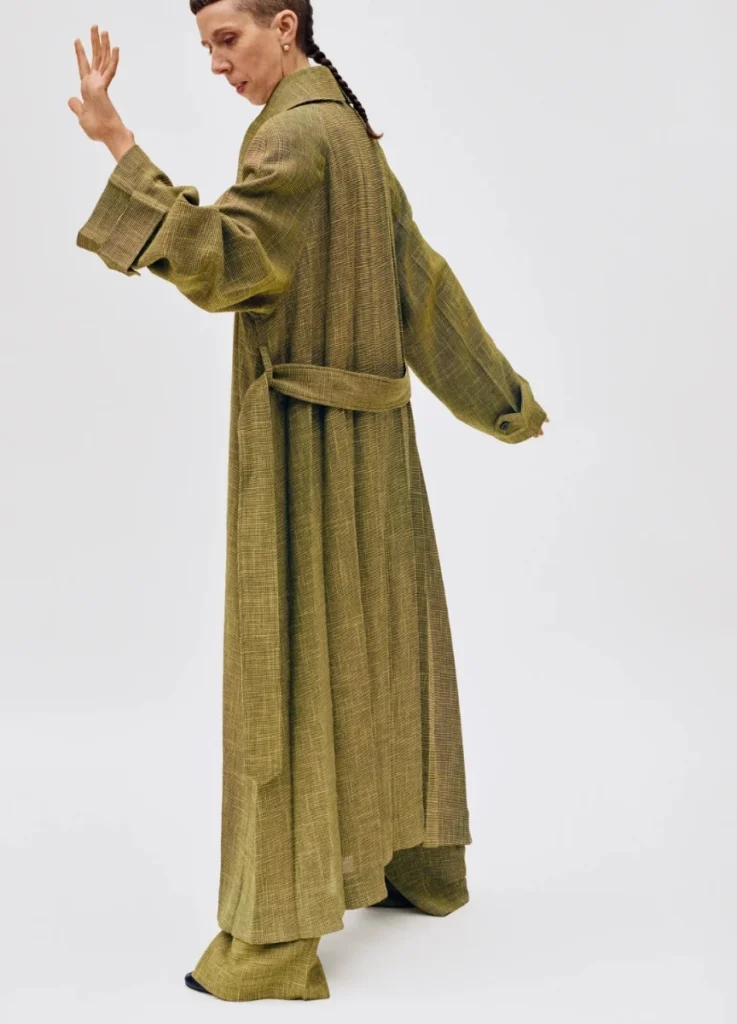
The olive long coat with matching trouser. Possibly the most quietly resolved look in the lookbook. The coat falls almost like architecture, but the fabric retains enough flex to avoid stiffness. The waist isn’t articulated, yet the silhouette doesn’t lose its center.
The olive itself is the achievement — warmer than the cold neutrals dominating recent quiet luxury, holding what reads as fabric memory rather than freshly woven surface. This look encapsulates what separates Collection E from minimalism more broadly: layered time rather than abstracted simplicity.
photographed by Alasdair McLellan
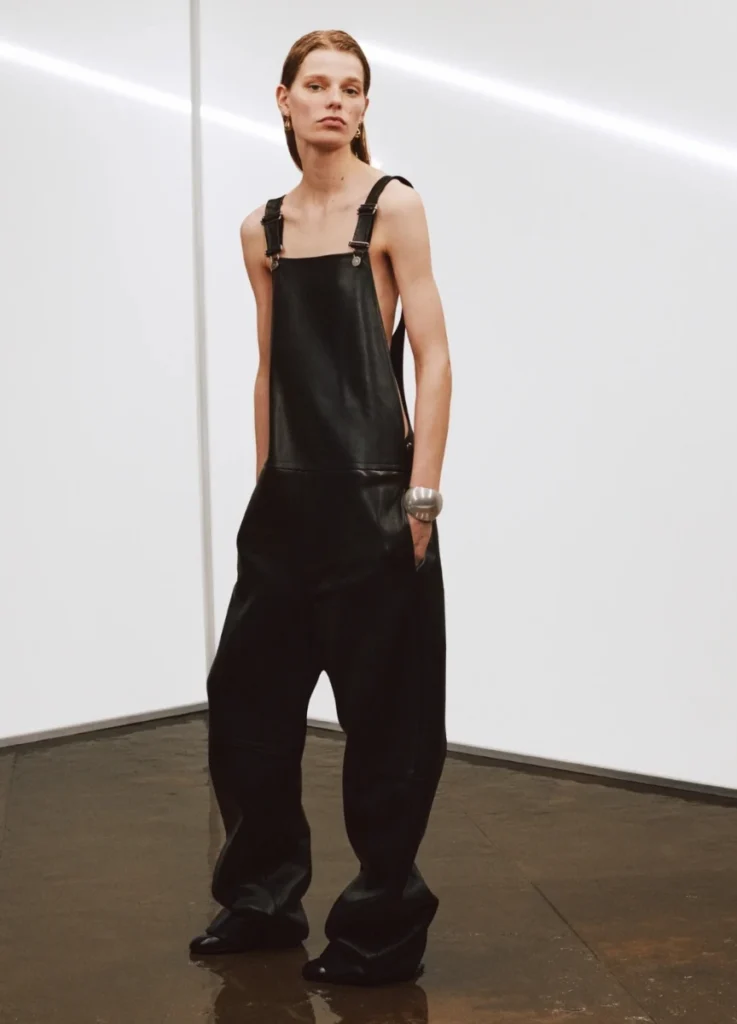
The black leather sleeveless look. Deep back line. Solid leather construction. The piece delivers the season’s most direct argument for the body — but the argument isn’t about exposure. The body here is treated as structure rather than as object.
The leather doesn’t compress. It doesn’t flow freely either. It holds tension between the two registers. The light-absorbing surface of the leather creates a register that’s distinct from conventional sensuality. This look is the clearest demonstration of why Collection E can’t be reduced to quiet luxury.
The Row vs. Phoebe Philo — Two Minimalisms, Two Different Bodies
The collection has been described as more sensual, less intellectual than its predecessors. The reading is partially accurate — sensation has come forward — but it’s not a return to conventional sensuality. More accurately, body returned to structure. Philo maintains form but refuses excess abstraction.
This is where the comparison to The Row matters.
The Row currently holds the most refined position in contemporary minimalism. The vocabulary is essentially architectural: clean lines, abstracted bodies, deliberate distance between garment and wearer. The brand’s strongest looks approach silence as aesthetic strategy. Beauty that doesn’t reach toward the viewer.
Collection E operates differently. Philo’s silhouettes aren’t built solely from straight lines. The collection actively uses the curves and flows that emerge when fabric meets a moving body. Same neutral foundation. Different result entirely.
photographed by Alasdair McLellan
The Row’s leather, for instance, smooths surfaces and simplifies form. Philo’s leather flexes with the body, folds with movement, holds light and shadow at the seams. The contrast surfaces most cleanly there — refined abstraction on one side, structure with sensation preserved on the other.
The frame I’ve used elsewhere is that Collection E delivers a body inside the structure where The Row delivers a structure that doesn’t require a body. Both readings are valid. They’re answers to different questions.
The market also differentiates them. The Row functions as a closed-circuit reference point for industry insiders and a small cohort of collectors. Philo’s position is more porous. Collection E offers more wearable density across the wardrobe — trousers, shirts, cropped jackets, the black tailored looks.
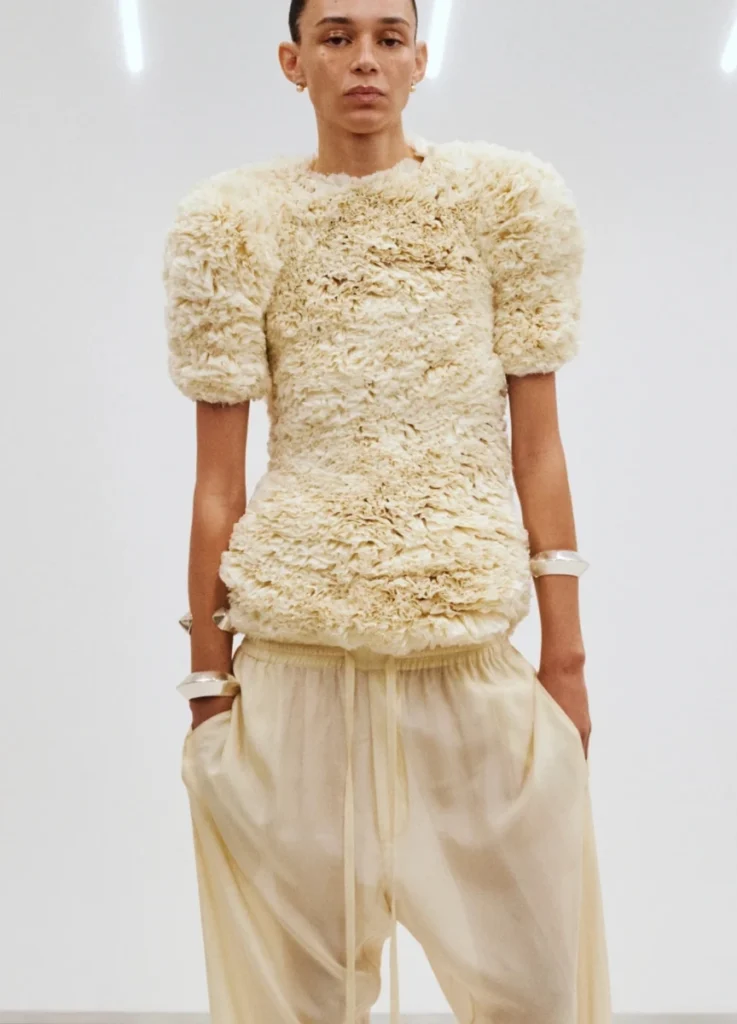
They survive translation from runway to actual life. They also retain enough of the brand’s signature tension to avoid disappearing into the everyday. That balance is rare at this price point.
photographed by Alasdair McLellan
Reading Collection D and Collection E Together
Collection E sits inside an evolution arc rather than a singular statement. Collection D — released in late 2025 — established the framework I’ve previously described as Philo embedding emotion into structure against Matthieu Blazy’s constructing order at Bottega and now Chanel. Collection E refines that framework rather than departing from it.
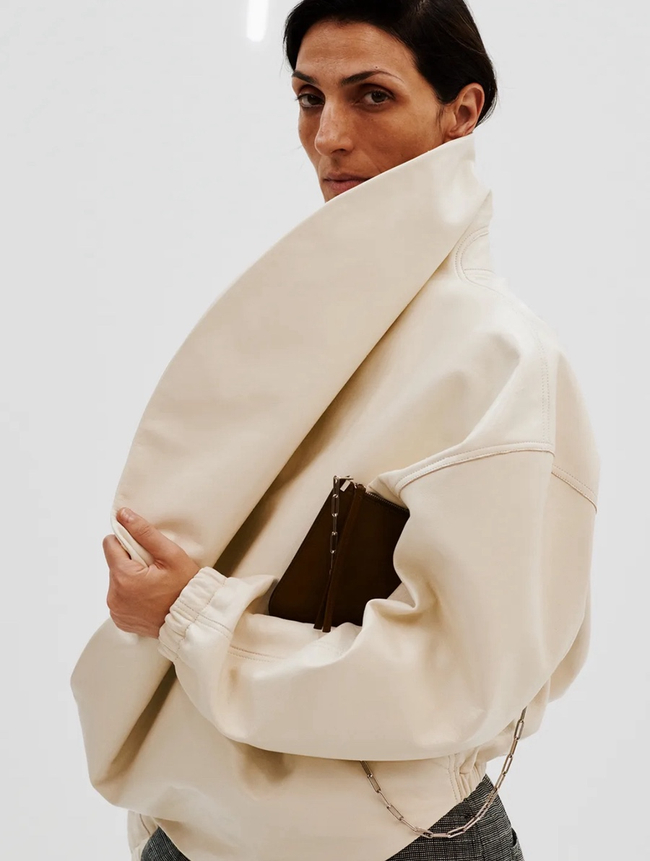
The continuity is deliberate. Philo described her work from the start as a seasonless, continuous body of work. Collection E literally re-issues several Collection D pieces in new colorways — the Strap trouser in black after grey, the cropped bomber in brown leather after cognac and black nylon, the navy utility jacket reissued from earlier brown.
The repetition is part of the proposition. Customers who missed the earlier release have access through the next one. Customers who own the earlier piece can build through the system rather than replacing across cycles.
photographed by Alasdair McLellan
This continuity also clarifies why Collection E reads as a return to the body without functioning as a pivot. The body has been central to Philo’s work throughout her career. What changed in Collection E isn’t the priority. It’s the visibility of the priority. The body has moved from background condition to surface argument. The slip dress, the leather sleeveless look, the trouser cuts — these are all directly answerable to the question what does this fabric do to the body wearing it.
That question has been mostly absent from luxury runway conversations for the past several seasons. Collection E reintroduces it without overstating it. The discipline is the achievement.
Why This Collection Matters Now
Collection E reads as the most important quiet luxury statement of 2026 not because it’s the loudest or the most innovative, but because it answers the right question at the right moment.
The body has been disappearing from luxury fashion for several years. Logo-forward maximalism erased it through brand priority. Extreme minimalism erased it through architectural abstraction. Both currents converged on the same outcome — clothes increasingly designed for screens rather than for skin.
Collection E doesn’t fight either current directly. It simply restores the third option. The body comes back without theatrics. Structure stays without rigidity. Sensation returns without sensuality. The technical balance — fabric weight calibrated to the millimeter, color choices that hold time rather than performing freshness, accessories that recover the vertical center after long silhouettes — is what makes the collection feel like a recalibration rather than a continuation.
For collectors approaching Collection E, the practical reading is clear. The trousers, the shirts, the cropped jackets, the black tailored looks all translate from runway to real wardrobe. The shearling and fur pieces require taller or more specific frames to fully translate. The slip dresses and the leather sleeveless look reward considered fitting — they’re at the edge of where Philo’s tension calibration depends on body specifics.
photographed by Alasdair McLellan
Across the broader market, Collection E is a reference point that other brands are likely to study. The trouser cut alone will surface in next season’s reproductions. The color palette — VSOP-cognac, dried-blood red, acid yellow against neutral foundations — has already been flagged as a leading-edge signal for fall 2026. Philo’s influence loop, which Fury identified as the structural feature of her career, continues to expand through this collection.
The garments rarely shout. They reward the wearer who returns to them. They survive past the moment of release. They become the items that anchor the wardrobe rather than rotate through it.
That’s the position Phoebe Philo has been building toward since the brand’s first edit launched in 2023. Collection E is where the position becomes fully visible.
photographed by Alasdair McLellan
All images referenced in this post are drawn from int.phoebephilo.com.
[ Related Editorials ]