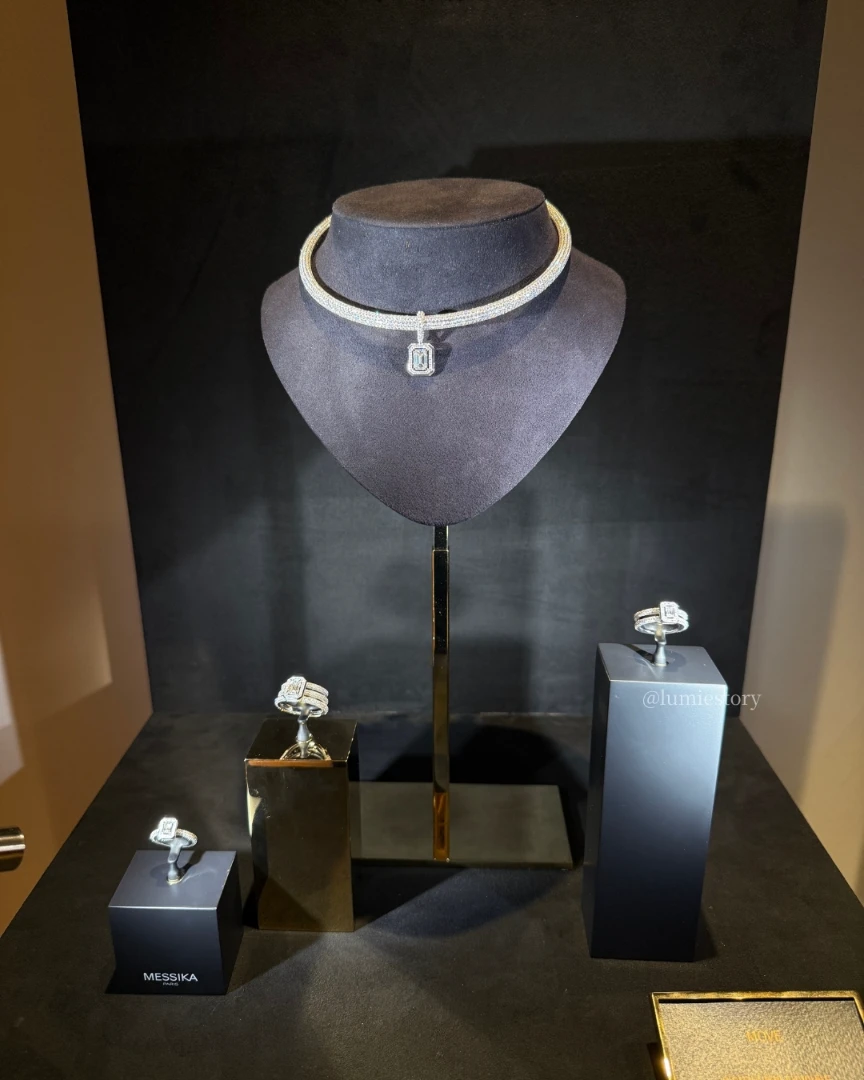
When we talk about high jewelry, we usually start with the specs of the diamond. How many carats, which cut, what color, whether it’s flawless. Behind that habit sits a common assumption — that structure exists to elevate the stone, and that design functions as a frame built to show it at its most beautiful.
Divine Enigma reverses the order.
What stays with me from this collection isn’t the diamonds. It’s the concentric build wrapping the neck, the two rigid bands running parallel across the finger, and the geometry that holds a complete symmetry around a central emerald cut. The diamonds are unmistakably brilliant, but they don’t sit in the position of a protagonist. They’re used more like material for explaining a shape.
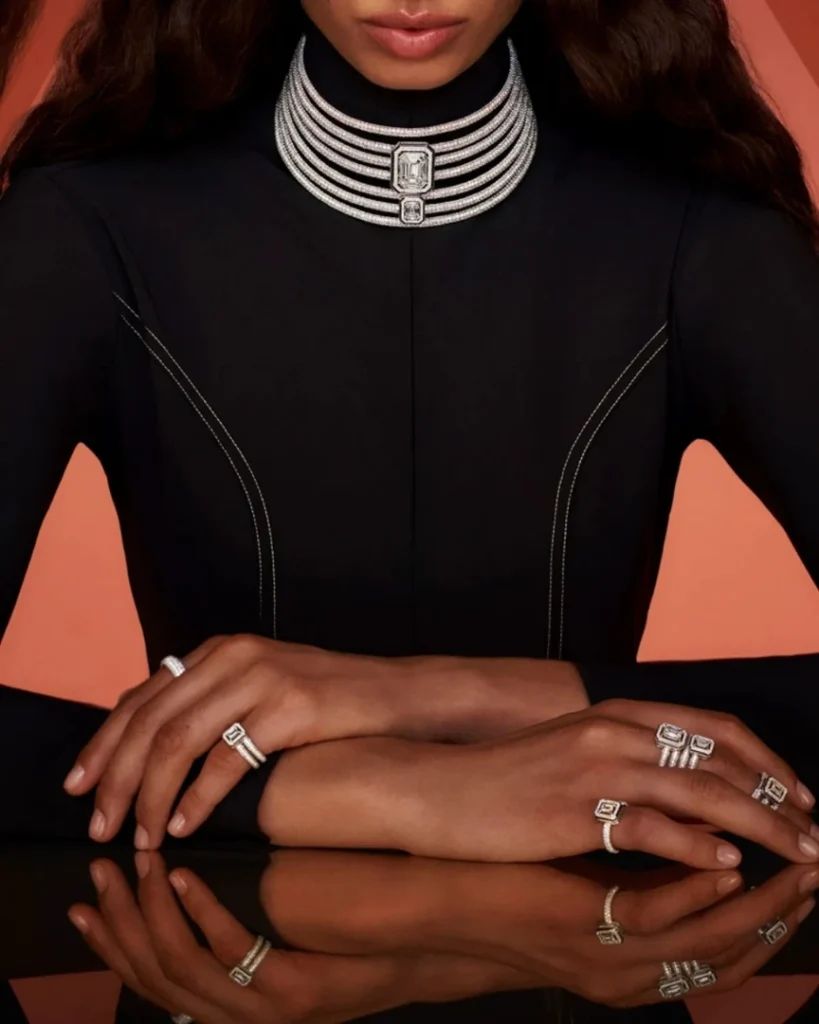
source: messika.com
The history of high jewelry has for a long time been a history of developing better ways to present a rare stone. Each maison built its own settings and proportions, but the diamond was always at the center. The designs differed; the order didn’t. In Divine Enigma the eye starts at the emerald cut and doesn’t stop there — it expands outward, moving along several concentric layers. So what remains after seeing the collection is the silhouette, not the carat weight.
Messika also starts from a different line than the older maisons of Place Vendôme. Cartier has repeated the panther, Van Cleef & Arpels the Alhambra, Boucheron the Quatre, accumulating a brand language across decades. When a new collection arrives it’s read inside the maison’s history. The client buys design and time together.
Messika doesn’t have that archive yet. The brand’s history is short and its symbolic motifs are few. So where does its own language come from?
Messika’s answer was the way it handles diamonds. Looking back at the early collections, the thing that recurs has never been an animal, a flower, or a particular pattern. It has been movement, tension, settings that seem to float, and experiments with how a diamond exists inside space. Messika is a maison that accumulates architecture rather than symbols, and Divine Enigma is where that thinking appears most purely.
Structure │ A House Without an Archive
First shown in Beyond the Light, Divine Enigma is usually introduced as a collection inspired by ancient Egypt. The method is the interesting part.
Egypt is familiar territory in high jewelry — lotus, scarab, falcon wings, papyrus, hieroglyphs. Most maisons take a symbol and reinterpret it in contemporary terms. These are devices that let you name the civilization on sight.
Divine Enigma goes almost the opposite way. It removes nearly every symbol that would explain Egypt directly and keeps only the architecture: the high collar, the completed circle, the repeating parallel lines. It translates a civilization into proportion and geometry rather than into ornament. So the collection does bring Egypt to mind, and at the same time it’s startlingly contemporary. The more the specific symbols disappear, the less the form itself belongs to a period.

source: messika.com
That approach carries into the materials. Colored stones don’t appear, and the metal isn’t handled as sculpture. The visual variables are extremely limited. Emerald cut, full pavé, circular geometry. For most designers those are conditions that risk monotony.
But that constraint is exactly where Divine Enigma gets its strength. As the means of expression narrow, small differences begin to change the whole impression. The thickness of a single band, the gap between two of them, the curvature of the circle, the proportion of the emerald cut. These minor variations build the collection’s hierarchy.
So the useful question here has nothing to do with how big the diamond is. It has to do with how the build changes.
Put the Divine Enigma pieces side by side and a common thread appears. Necklaces and rings, earrings and bracelets all share the same formal language, but the variable that distinguishes them is density rather than stone size. One band, or two, or three. How many lines are making the space.
In a sense, Divine Enigma is selling structure rather than diamonds.
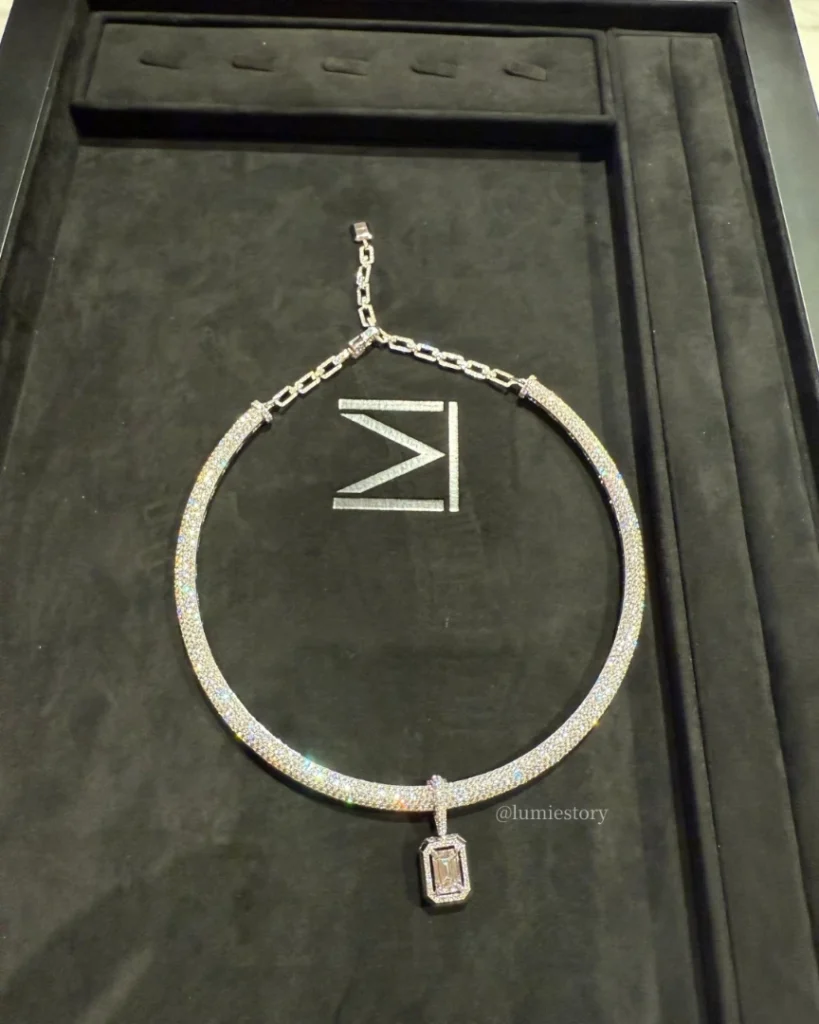
The Necklace │ Where the Geometry Begins
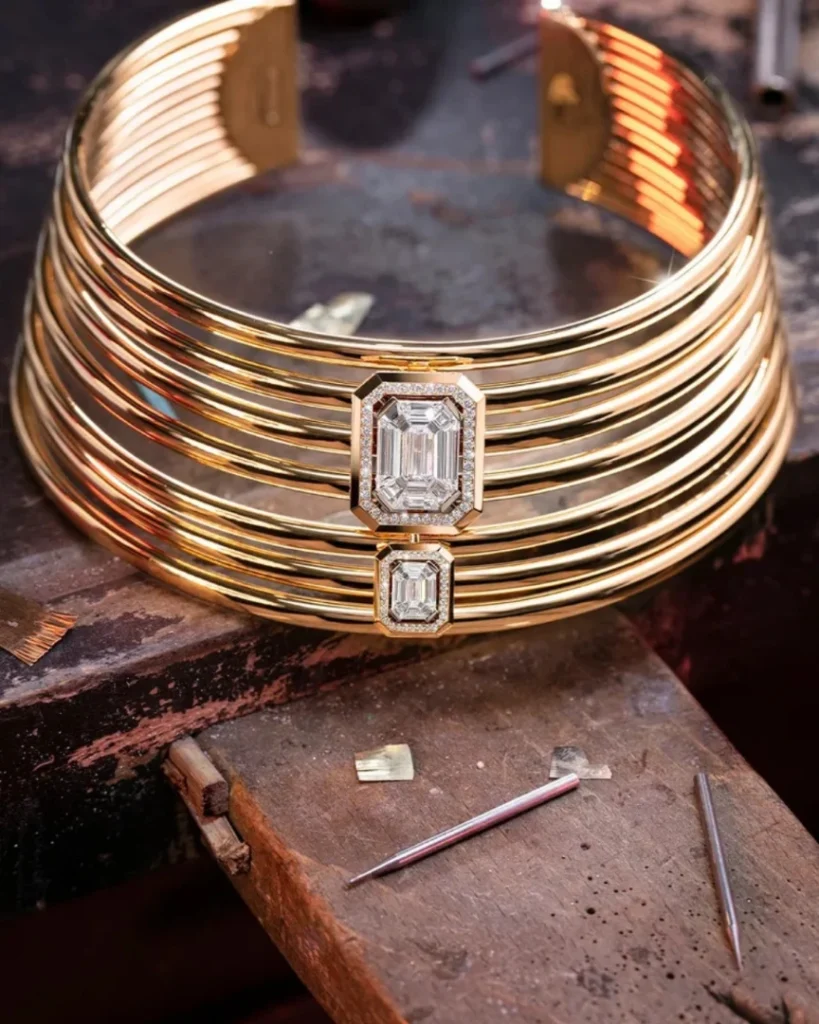
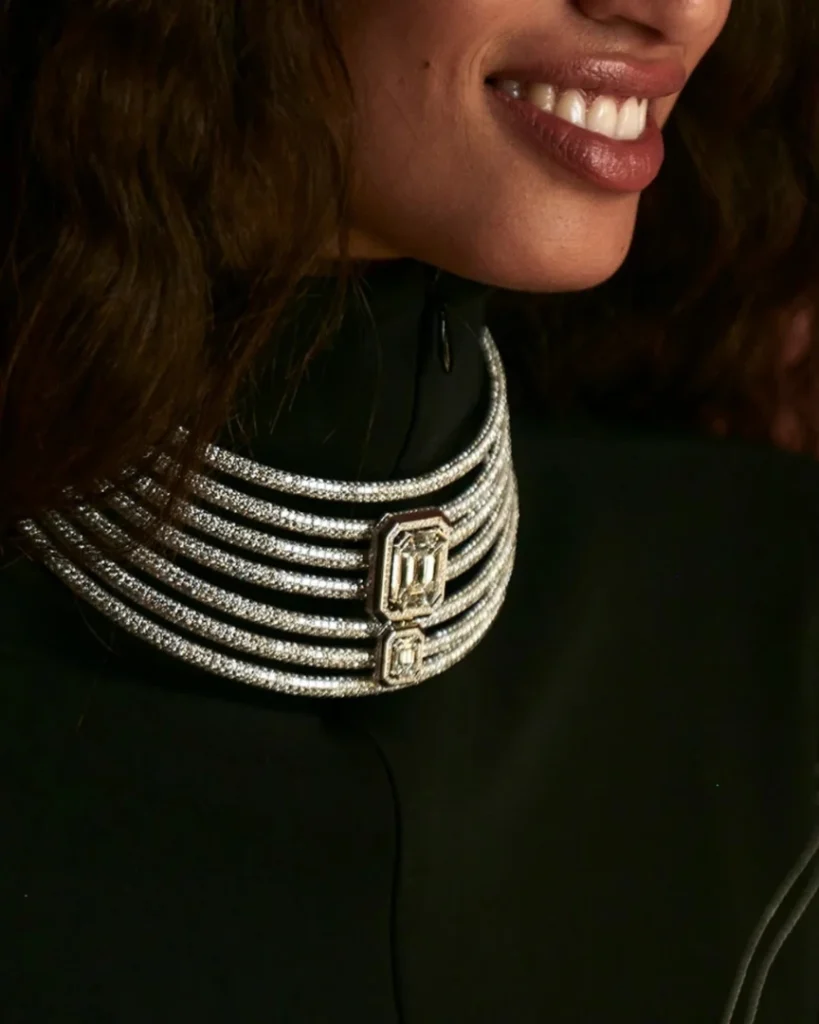
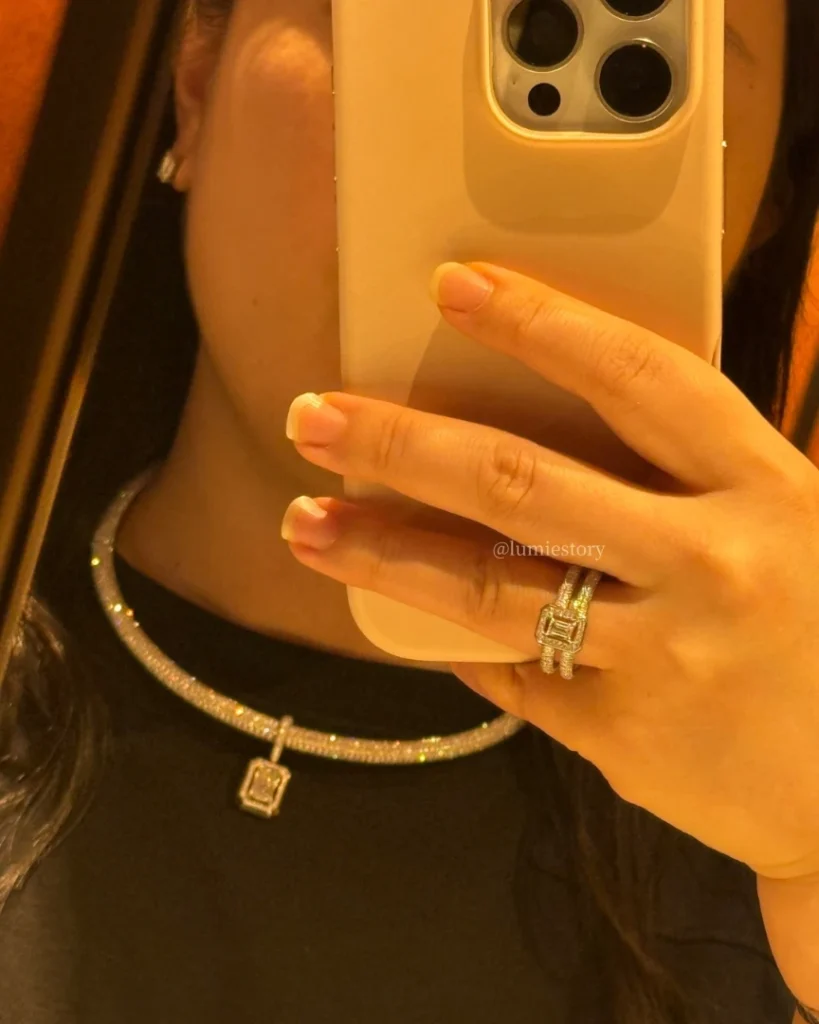
Divine Enigma begins at the neck. The high necklace, with its several layers of rigid circles, is closer to the prototype of the whole collection than simply its largest piece, and everything the rings later attempt is already resolved here.
In photographs the light output of the full pavé is what you see first. Once it’s on the neck, what registers most strongly is the contour rather than the diamonds. Where a typical high jewelry necklace flows down along the collarbone or changes shape to follow the curve of the skin, Divine Enigma maintains its own form instead of complying with the body. It sits less on the neck than as a closed circle standing around it.
The difference is clear from the moment you put it on. A flexible link necklace scatters light as its small joints move with every turn of the head or shift of the shoulder. Here the frame stays almost fixed while only the light on the surface moves. The body moves and the form doesn’t collapse. Because of that, the impression the necklace leaves is architectural rather than decorative.
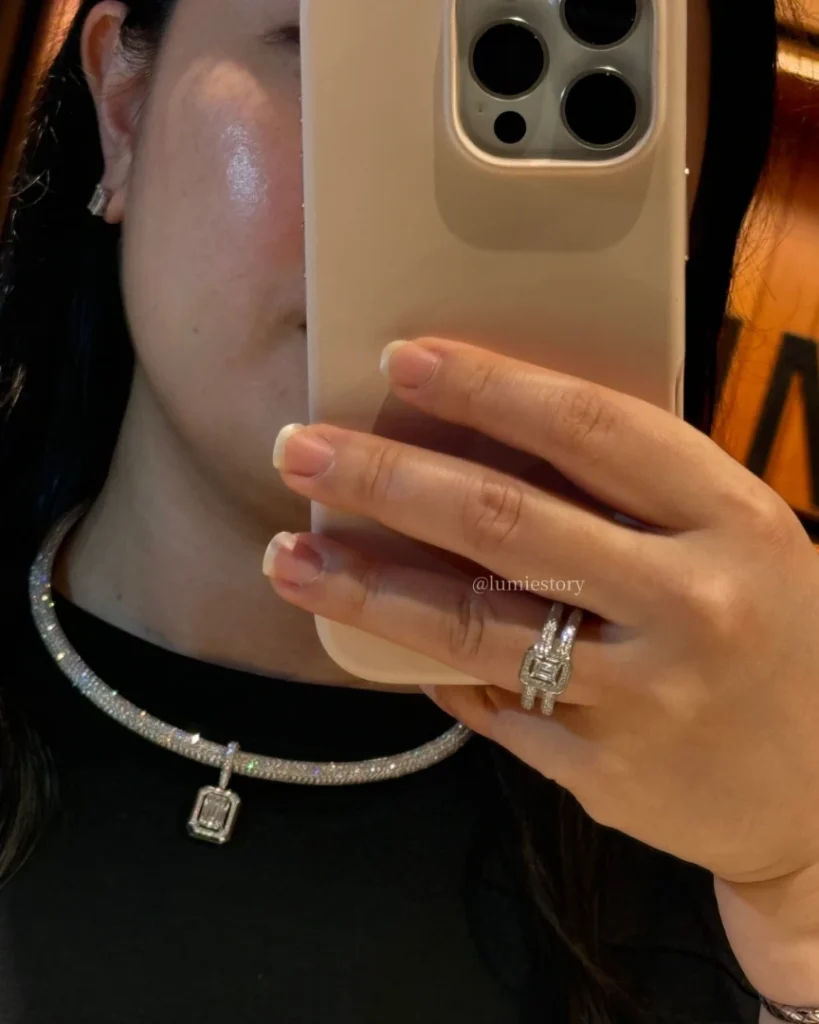
The slight gap between the neckline and the collar matters too. A rigid piece that doesn’t sit completely flush casts a thin shadow on the skin, and that shading separates each row. From the front, several layers of pavé look like one strong plane; the moment you turn your head, the spacing and the height between the circles reveal themselves. For a piece carrying this much light, it’s the empty space that lets you take in how it’s put together.
The central emerald cut works differently here than a typical center stone. In a solitaire necklace the center stone pulls all attention onto itself. At 2.02 carats, Divine Enigma’s emerald cut is large enough to do the same, and it doesn’t. It sets a direction instead of holding the eye. You begin at the linear step cut, move outward along the pavé lines on either side, and end up taking in the whole circle.
A brilliant cut would likely have buried the design under an explosion of light. The emerald cut shows planes and lines rather than output. Its long table and stepped facets sit as a single quiet surface in the middle of a field of scattering brilliants, and they don’t collide with the linear order of the rigid bands. In this collection the emerald cut is less the most brilliant element than a visual hinge holding the whole assembly from coming apart.

In the versions with several rows layered, the effect gets sharper. Each band repeats the same circle, but in wear they shine at different speeds depending on the angle of the neck and the lighting. One row lifts brightly in the frontal light while another sinks into shadow. A perfectly symmetrical design keeps producing a different expression on the body. That tension between a static frame and moving light is the central beauty of the piece.
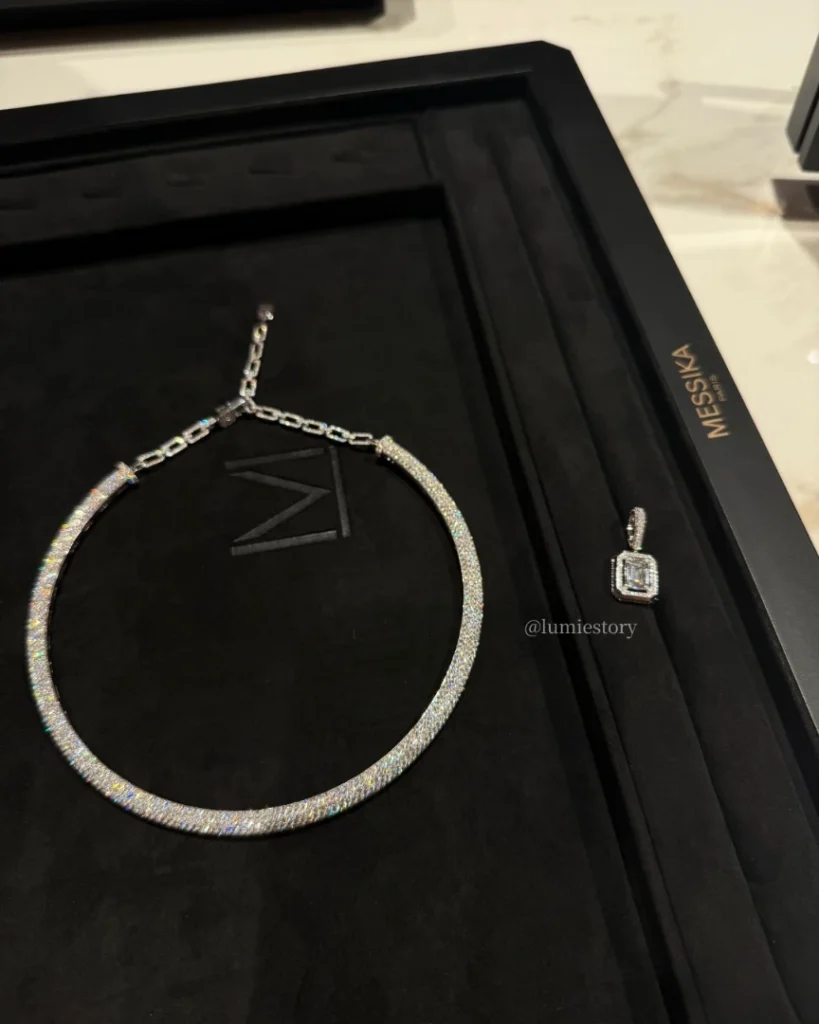
Then comes the part that decides the whole collection. The high necklace built from seven rigid rings becomes five rows, then three, and finally resolves into a single rigid collar carrying the 2.02-carat pendant — and the identity survives the entire reduction. It doesn’t look like a cheap miniature of the original. It comes across as the same geometry translated at a sharper, more everyday density.
That’s because the protagonist here was never the number of rows. A completed circle, the emerald cut at the center, the symmetry connecting the two. Keep those and anyone recognizes Divine Enigma immediately, whether it’s seven rows or one. On the neck, the row adjusts presence rather than defining the design.
Which raises the obvious question. If reduction works this well at the neck, why does it fail on the hand?
source: messika.com
The Row Ladder │ How Structure Becomes Product
A ring has to compress everything onto the narrow surface of a finger. It can’t use a large silhouette the way a necklace does, and it can’t build a long flow the way a bracelet can. The design has no choice but to become extremely simple. That’s exactly where the row emerges as the central variable — and where Divine Enigma starts to look less like a collection than a design experiment.
One Row │ The Form Survives, the Language Weakens
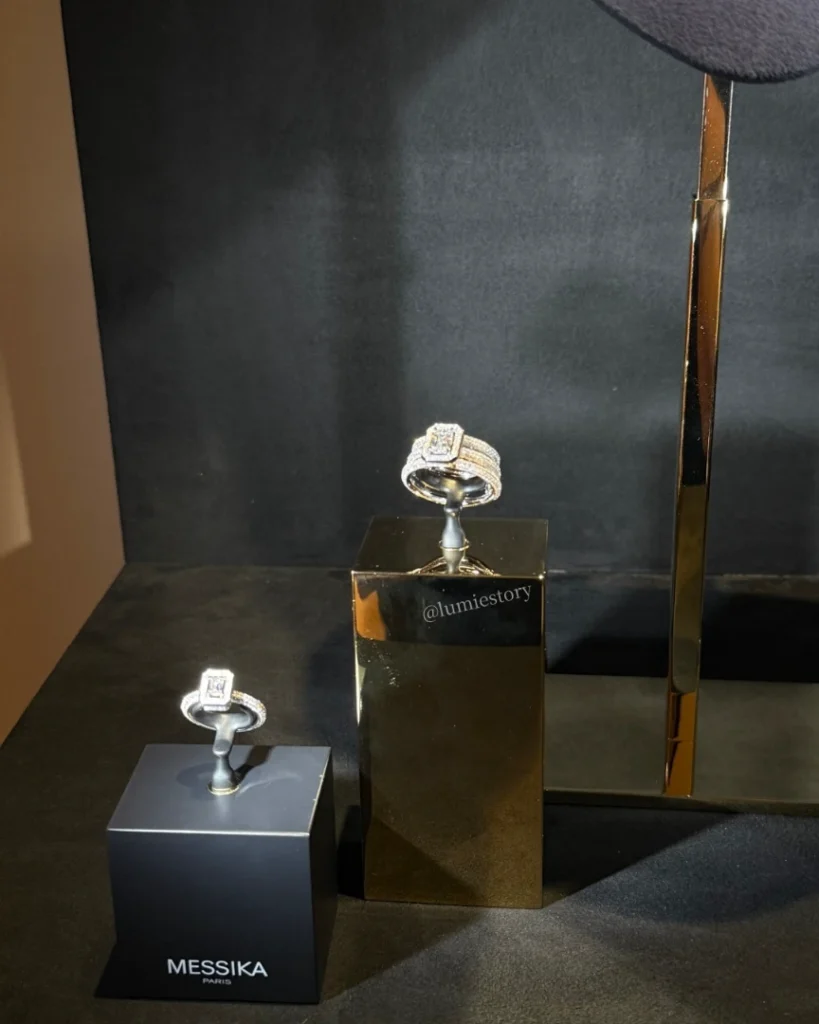
The one-row ring holds a very stable proportion — a central emerald cut, the halo surrounding it, a thin pavé band. Its wearability is strong enough that “daily high jewelry” fits it better than any other description.
Structurally, though, this is the weakest piece in the collection, and the reason is worth being precise about.
On the neck, the rigid circle is itself the argument. It’s visible from every angle, so the row count can drop to one and the identity survives. On the hand, the band disappears under the finger. You never see the circle. The only formal information left in view is how many lines are crossing the top of the finger — and when that number is one, nothing is left.
So the one-row ring is a central stone, a halo, and a band. That’s the grammar of a solitaire, and at conversational distance it comes across as one. A very well-resolved solitaire, considerably more graphic and contemporary than most, but a solitaire. The buyer acquires a Divine Enigma and wears something the collection didn’t need to invent.
This isn’t a matter of taste. It’s a consequence of where the piece sits on the body.
Two Rows │ Where the Build Passes the Diamond
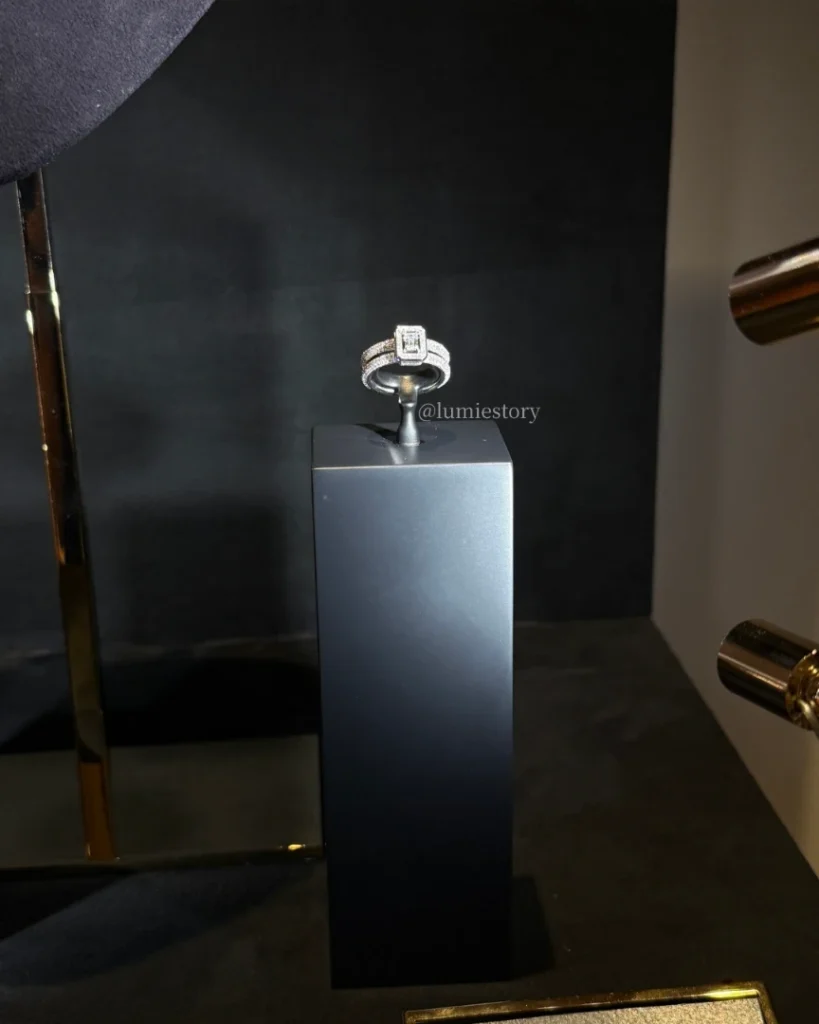
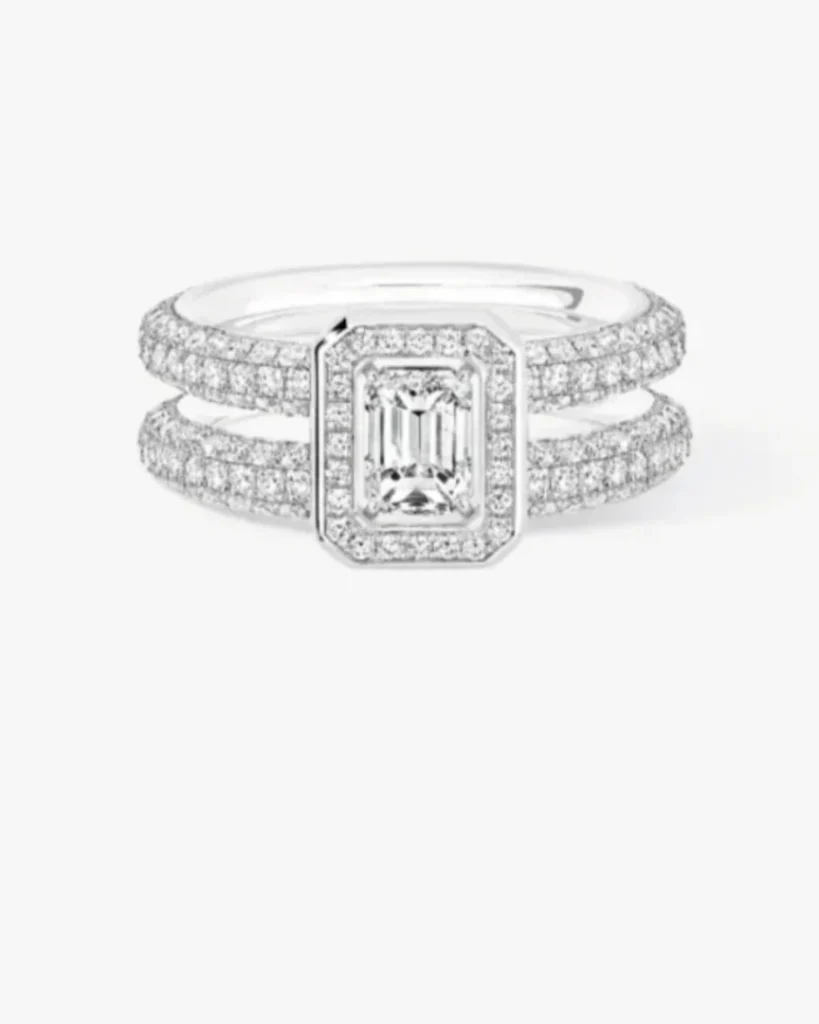
The moment the second band arrives, a surprising change happens. Physically, all that’s been added is one line of metal. But the eye no longer stops at the single emerald cut in the middle. It travels along the two parallel lines, and it starts taking in the empty space between them as part of the form.
That small change alters the whole collection.
We usually explain a ring’s presence through the size of the diamond. Not in the two-row. What creates presence here is the distance between the two bands.
Worn, the first thing you see isn’t the sparkle of the pavé. It’s the very thin shadow that forms between the two bands.
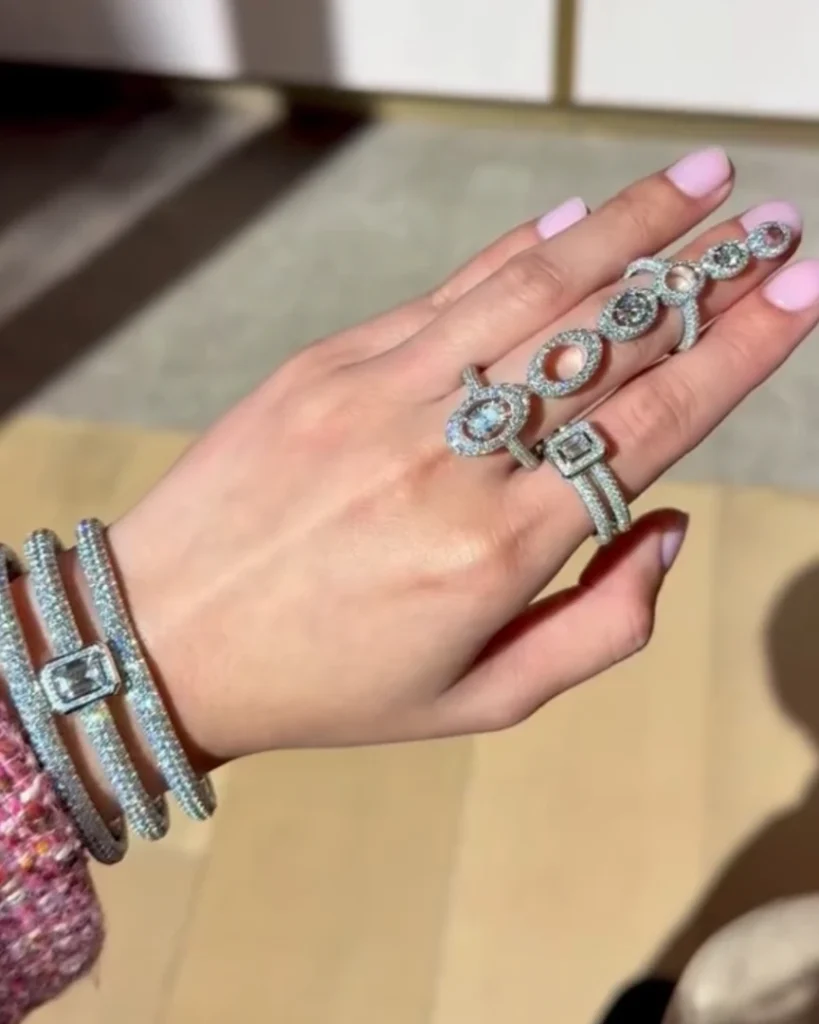
That shadow separates the two lines, then binds them back into one object. On the finger, air looks designed before metal. The shading makes the geometry, and the geometry in turn makes the diamond visible.
In a frontal photograph it looks like nothing more than an extra band. Worn in person, the smallest movement of the hand keeps the space between the two lines opening and closing, building a rhythm of light. What moves is the framework, not the diamond. The center stone is 0.3 carats, and yet the overall presence amplifies.
This is where Divine Enigma goes past being simply a pavé ring. The diamond doesn’t ornament the structure. The structure begins to explain the diamond.
source: messika.com
Three Rows │ More Isn’t Always Better
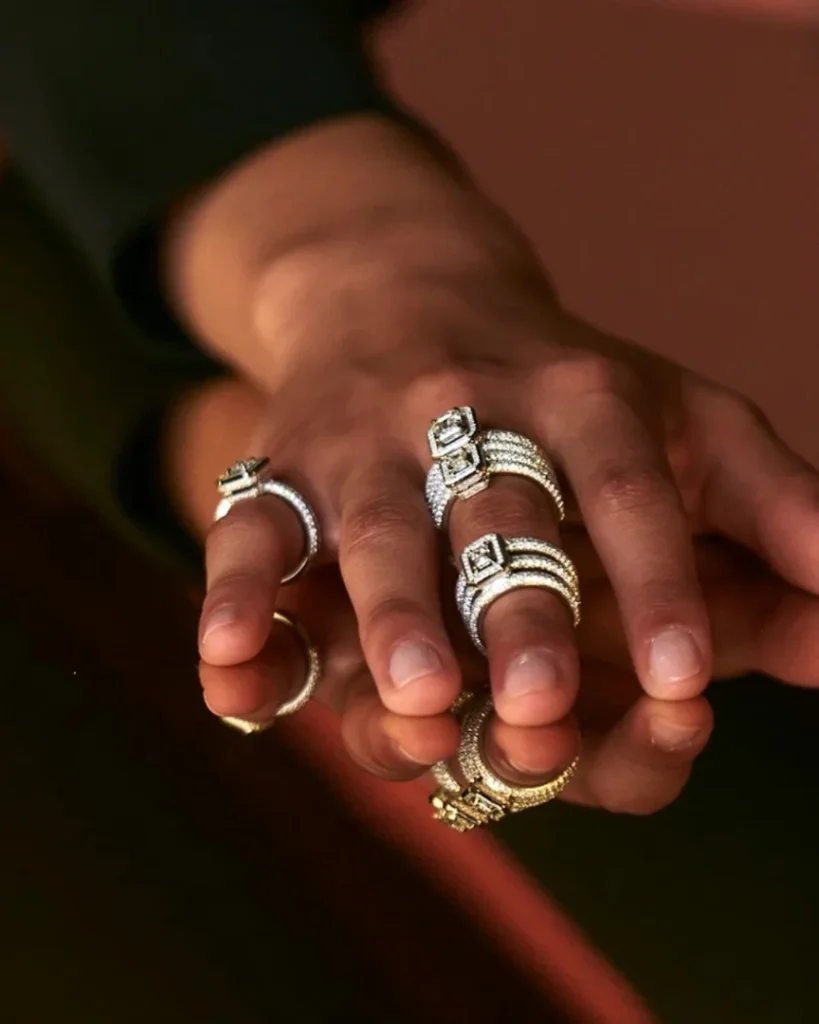
The three-row is without question the most commanding model. The pavé area grows, the quantity of light grows, and a single ring becomes the center of the entire hand.
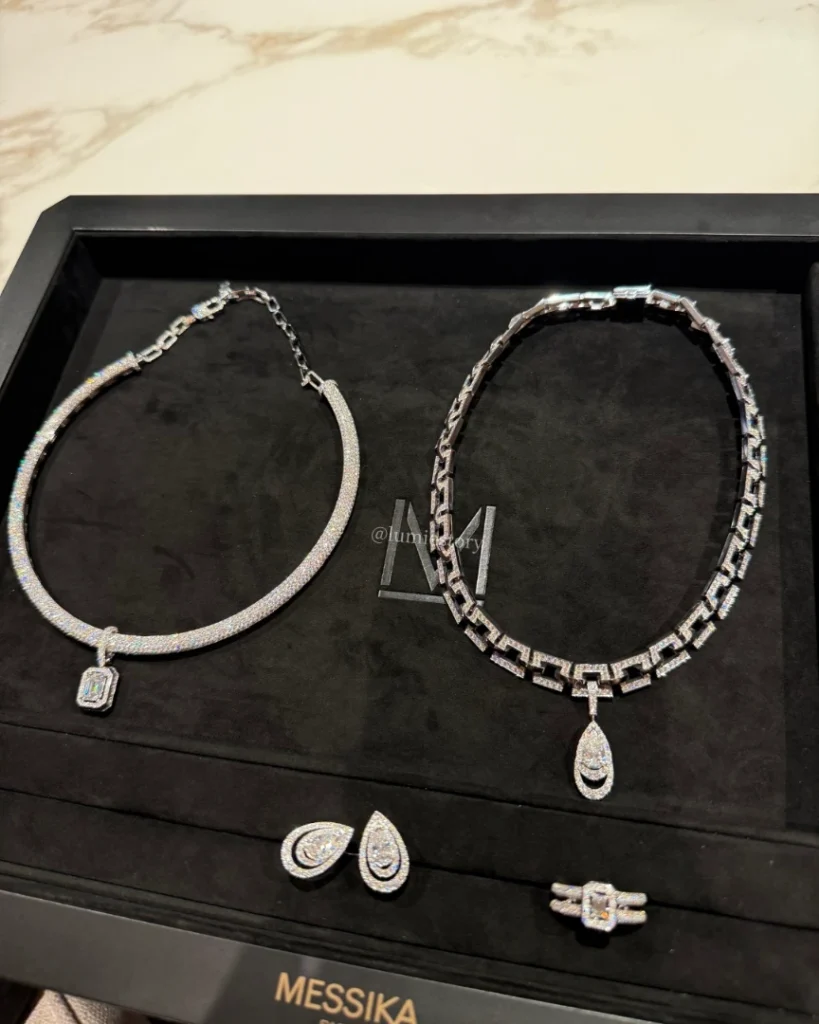
But seen next to the two-row on the same tray, the difference is easy to name. With two bands, the eye keeps returning to the gap — it measures the interval, then takes in the pair as one object held apart. With three, the gaps become a pattern instead of a relationship. The eye registers the total quantity of pavé first and stops counting lines. Density has replaced tension.
There’s a practical consequence too. The third row pushes the width past the point where the ring still behaves like a band. It occupies most of the first phalanx, it can’t be stacked, and worn alongside the necklace the two pieces start arguing rather than agreeing. The three-row is the most spectacular model in the collection, and the one where the design is hardest to see.
If someone asked me which of the rings best explains this collection, I wouldn’t choose the most expensive piece or the largest one. I’d choose the moment when two parallel lines first begin to make a single space. That’s where Divine Enigma’s language takes its most definite form.
On the Body │ Who a Rigid Circle Selects
Rigid jewelry makes a demand that flexible jewelry doesn’t. A chain adapts to whoever puts it on, while a closed circle arrives with its diameter already decided and asks the body to accommodate it. Every wearing question in this collection follows from that one fact.
Because the necklace sits high on the neck rather than draping from it, the width of the collar and the width of the jaw end up inside the same frame. A narrow, tapered jaw wears that best, since the roundness finally has something to push against. On a fuller or rounder face the circle repeats a line the face already has, and repetition flattens both. This is the single place where the necklace is genuinely more conditional than the ring, and no amount of pavé quality resolves it.
The pendant is the correction built into the design. Bare, the collar is one uninterrupted horizontal, which is the last thing a shorter neck wants. Clip the emerald cut back on and a vertical axis cuts through the circle, so the eye drops instead of traveling sideways and the neck lengthens. Two silhouettes for two different builds — a better argument for the detachable construction than versatility ever was.
The hand works by the same logic inverted. Two bands crossing a finger should in theory shorten it, and they don’t, because the space between them stays open. Light passes through and skin shows behind the metal, so the ring covers less than its measured width suggests. A solid band of the same dimension segments the finger; this one lets the line pass through. The emerald cut set lengthwise adds a vertical that interrupts the two horizontals, and on a fuller or shorter hand that combination is what keeps the piece from sitting heavy. It’s also why a two-row comes across as generous on a hand where a wide band would look blunt. And because nothing spreads past the knuckle, the ring stays inside its own footprint, which keeps it in proportion with contained, precise features rather than large ones.
One honest caveat belongs here. At the distance people actually see your hands, the two-row doesn’t announce its own design. The argument about two bands suspending a stone is legible within about a foot; beyond that it registers as a bright, well-made white ring. For a piece meant to be worn daily that quietness is a specification rather than a fault, since jewelry that argues loudly is jewelry you stop wearing. But anyone expecting a statement at across-the-room distance should know which piece they’re buying.
Contemporary High Jewelry │ Competition After the Rare Stone
Divine Enigma’s value is hard to judge from Messika’s internal success alone. The collection shows fairly clearly what contemporary high jewelry has taken as its competitive ground.
High jewelry’s traditional authority came for a long time from gemstones. How large and rare a diamond a maison had secured, how uniform a set of emeralds and sapphires it had gathered into one work — that proved its power. Excellent design mattered too, but the ultimate admiration often started from the rarity of the material.
That order hasn’t disappeared. Exceptional rough is still the core of high jewelry, and the best maisons hold a clear advantage in supply chain and appraisal. What has changed is that rarity alone no longer explains a brand’s individuality. Which stone was used matters, and so does whose language it was made in.
The shift is especially harsh on a young maison. An older brand can secure identity just by repeating its archive and its symbols. Motifs already accumulated — a panther, a snake, a flower, a ribbon — give a new work immediate context. When a young brand stages the same kind of historical authority, it easily looks like borrowing. Building a formal language that works in the present must have been more urgent for Messika than reproducing a past.
Divine Enigma is a fairly persuasive answer to that problem. It takes ancient Egypt as a starting point but doesn’t repeat surface iconography like the scarab or the papyrus. Instead of ornament that makes the historical reference recognizable, it extracts only the circularity of the collar, the repeating bands, and the strict symmetry. And the rigid form it arrives at solves a second problem at the same time: it doesn’t flow along the body, and precisely because of that resistance it stays in continuous relation with the wearer’s movement.
Another important point is how the collection builds hierarchy. A typical high jewelry line grades price and authority by center-stone carat, rarity, and the volume of pavé. Diamond quantity and scale affect price in Divine Enigma too, but visually the row count creates the more direct hierarchy. The buyer chooses at what density to wear an idea rather than simply choosing a bigger diamond.
Commercially that’s a clever move. The concept of the high necklace comes down to the one-row necklace and to the ring without its core being fully diluted. The client buys another version of the same formal grammar rather than a small product imitating the look of a top piece. The break that usually opens between a high jewelry concept and its commercial products has been bridged by repetition.
The strategy carries limits, though. A design leaning on diamonds and white gold, strict symmetry, and rigid circles can come across as cold. To a client who prefers the emotional richness of colored stones or organic form, it may read as excessively calculated. And as repetition by row count continues, there’s a risk that a new collection feels like an extension of what already exists rather than something new.
Still, Divine Enigma means something because it doesn’t try to satisfy everyone. Rather than a young maison asserting a universal beauty the way a traditional brand would, it presents one formal position clearly. It steps out of the convention that a diamond should be a soft, feminine ornament and treats it as material for making hard geometry and space.
Once diamond quality becomes the default, what’s left? Divine Enigma’s answer is line and interval, repetition and tension. If Move built Messika’s fine jewelry identity through movement, Divine Enigma constructs a high jewelry language through structure.
Final Assessment │ Precision Over Spectacle
What lasts after actually wearing Divine Enigma isn’t the quantity of pavé. It’s the contour of the rigid necklace making a completed circle around the neck, and the shadow between the bands floating parallel on the finger.
The necklace shows that philosophy at the grandest scale. The layered circles convey the authority of the ancient collar without describing it directly, and the hard frame contrasts with the wearer’s movement to create a distinctive tension. Because silhouette and symmetry survive when rows are removed, the necklace line keeps the collection’s concept relatively intact — and the 2.02-carat pendant lifting off turns one purchase into two proportions.
The ring is stricter. At one row the emerald cut becomes the center again and the collection’s argument disappears with it. The moment there are two, space opens between the lines and the geometry gains a weight equal to the diamond’s. At three, light and presence are maximized while the exact tension the two rows created gets absorbed into density.
So I rate the two-row as the most impressive ring not because it’s the most spectacular, but because it’s the point where line, space, symmetry, and diamond hold without any one of them overpowering the others. The circular thinking that started at the neck reaches its most compressed and clearest completion on the finger.
Whether Divine Enigma remains a permanent icon for Messika isn’t knowable yet. An icon isn’t made by one successful collection; it has to survive time and repetition. But at minimum this collection proved that Messika can argue for high jewelry without borrowing an older maison’s grammar.
There’s plenty of high jewelry that shows a rare diamond. There’s much less that makes you remember a structure built from diamonds.
Divine Enigma’s value sits exactly in that difference.

All images unless otherwise credited: © Lumie Story
[ Related Editorials ]
- [Cartier] Love Unlimited Collection
- Cartier at Watches & Wonders 2026 | The Restoration of Form, the Weight of Material, and the Quiet Shift Toward Jewelry
- Cartier Love Bracelet Full Pavé 2026 | Small vs Medium vs Classic — Size Guide and How Each Wears
Cartier LOVE Multi-Wear Necklace Review | Four Ways to Wear One Chain