When the cannage becomes texture
Four new necklaces, and the quiet logic behind reducing a house signature to a single small unit on the neck.
Ask most people to picture Dior and the Lady Dior bag arrives first — the held, structured silhouette, the metal charms, and above all the cannage that wraps the whole surface. It’s the most direct way to read the house’s visual language.
More interesting to me is how differently that cannage behaves depending on scale.
On the Lady Dior, the cannage is structure. It’s the order that organizes the surface of the bag, and the device that carries the house identity across the widest possible area. Move it into jewelry and the same quilted lattice starts to behave like texture instead — the small grain you expect to feel under a fingertip, the kind of metal you remember as touch before you remember it as light.

@dior / Instagram
My Dior is one expression of that translation.
That was the first thing on my mind looking at the necklaces Dior added to the line this June. The collection works less like a diamond necklace than the category would suggest. It’s closer to taking the surface language Dior has worked for decades and reducing it to the smallest object you can hang at the neck. Put plainly, buying into this line feels less like buying a diamond and more like buying a texture you set against your clothes.
Four configurations join the line:
- a yellow gold solitaire
- a pink gold solitaire
- a white gold full-pavé solitaire
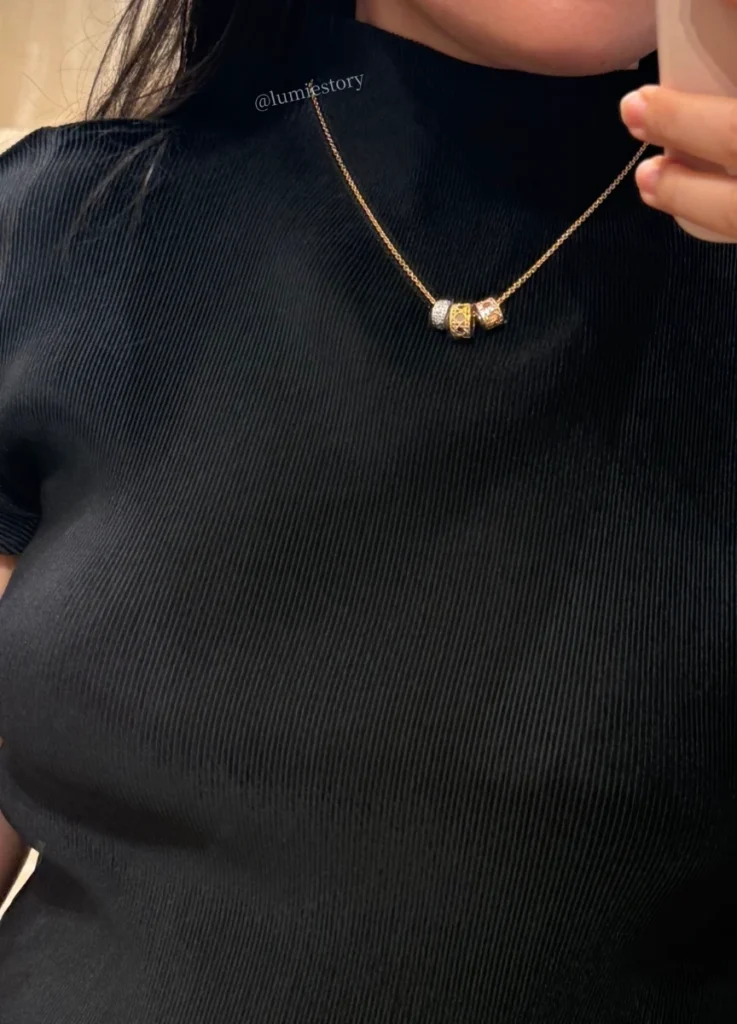
- a trio that runs three-color pendants along a single chain
Within Dior’s fine jewelry strategy, this arrival counts as a meaningful move rather than a routine seasonal drop.
@dior / Instagram
The origin of the cannage, and where My Dior sits
The cannage begins in 1947, in the salon at 30 Avenue Montaigne where Christian Dior showed his first collection. The guests sat on Napoléon III chairs, and the woven pattern of those chair backs became one of the oldest signatures the house still carries.
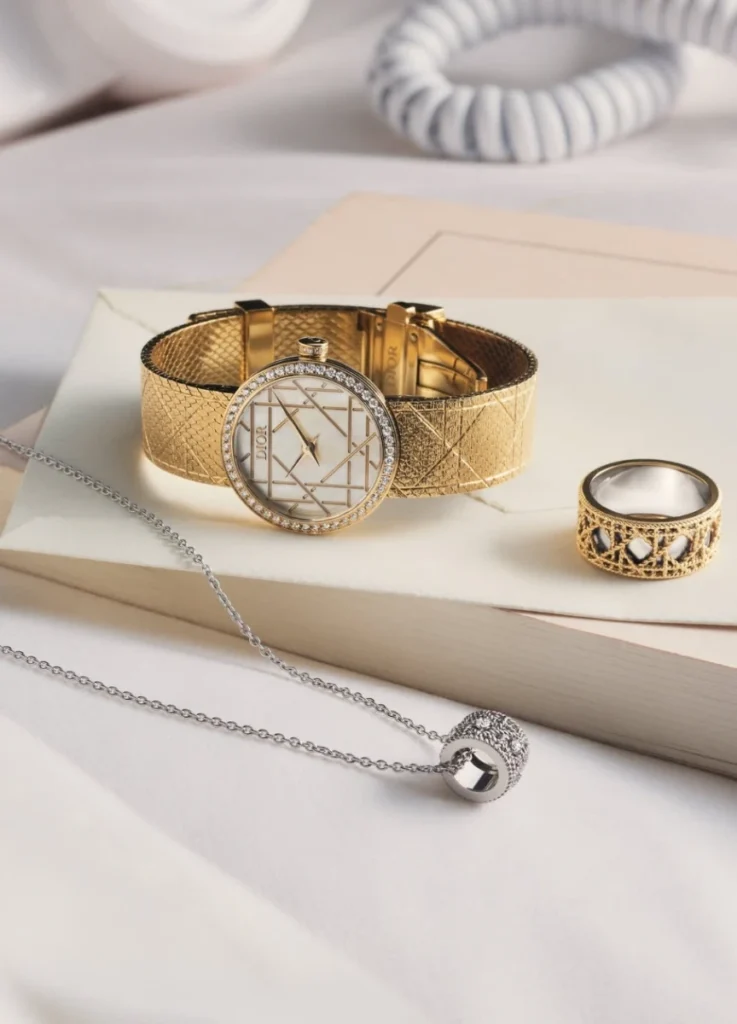
Most people file the motif under the Lady Dior, and fairly so — the bag is where the cannage is built into its most fully structured form. But within fine jewelry, the line that translates the same language most precisely is My Dior.
@dior / Instagram
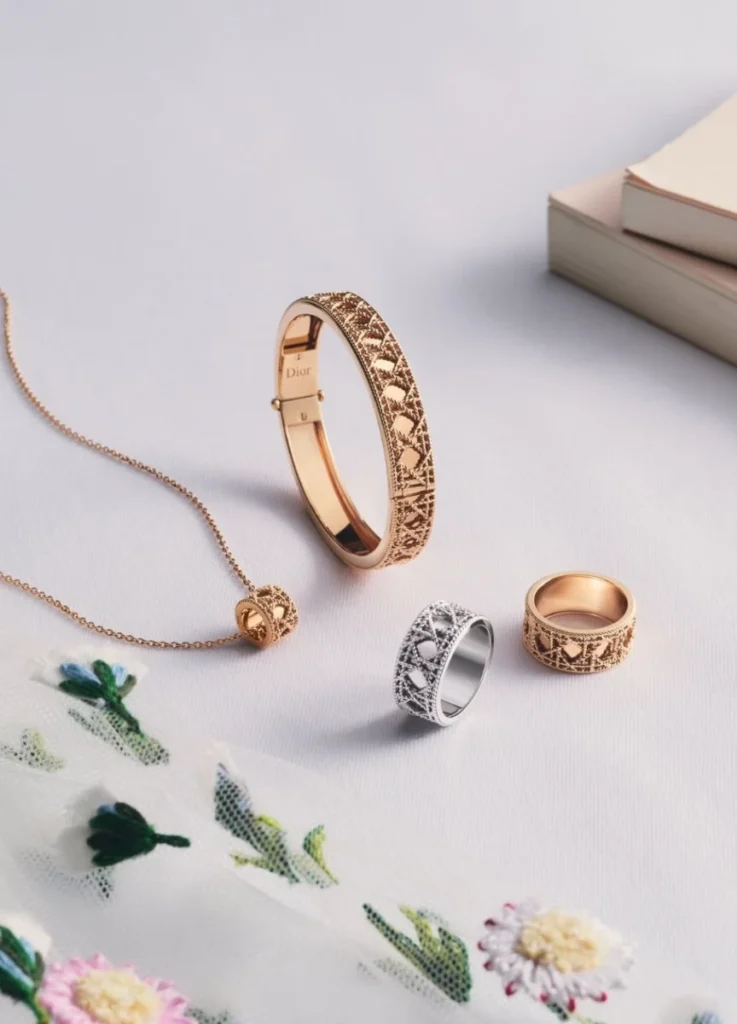
Victoire de Castellane introduced it in 2012. Her starting point was very Dior in spirit: she wanted to take the woven feel of natural materials — raffia, straw, things made by hand — and render it in metal. From the beginning the line was surface-led rather than stone-led. The question was never how large a diamond to set, but how to carry Dior’s texture into gold.

In 2024 the line returned with a new construction Dior described as a Ribbon of Gold — a thin gold ribbon threaded so it shows faintly between the cannage lattice, giving the surface far more depth than before. It barely registers in photographs. In person it’s a different object: the lattice isn’t simply engraved, it catches slightly different light as the angle shifts.
And now, June 2026, the line extends properly into necklaces.
On a timeline:
- 2012 — the line is born
- 2024 — the structure is relaunched
- 2026 — the necklaces complete the lineup
Taken together, this is closer to Dior settling My Dior as a finished line of everyday fine jewelry than to a one-off addition.
Yellow, Pink and White Gold with Diamonds
Length: 44 cm / 17.25 inches with rings to adjust the chain to either 40 cm / 15.75 inches or 42 cm / 16.5 inches
Four pieces, but really two strategies
Once you’ve seen them in person, the interesting part is that four pieces resolve into two: solitaire and trio. They aren’t variations on a single idea. They behave differently.
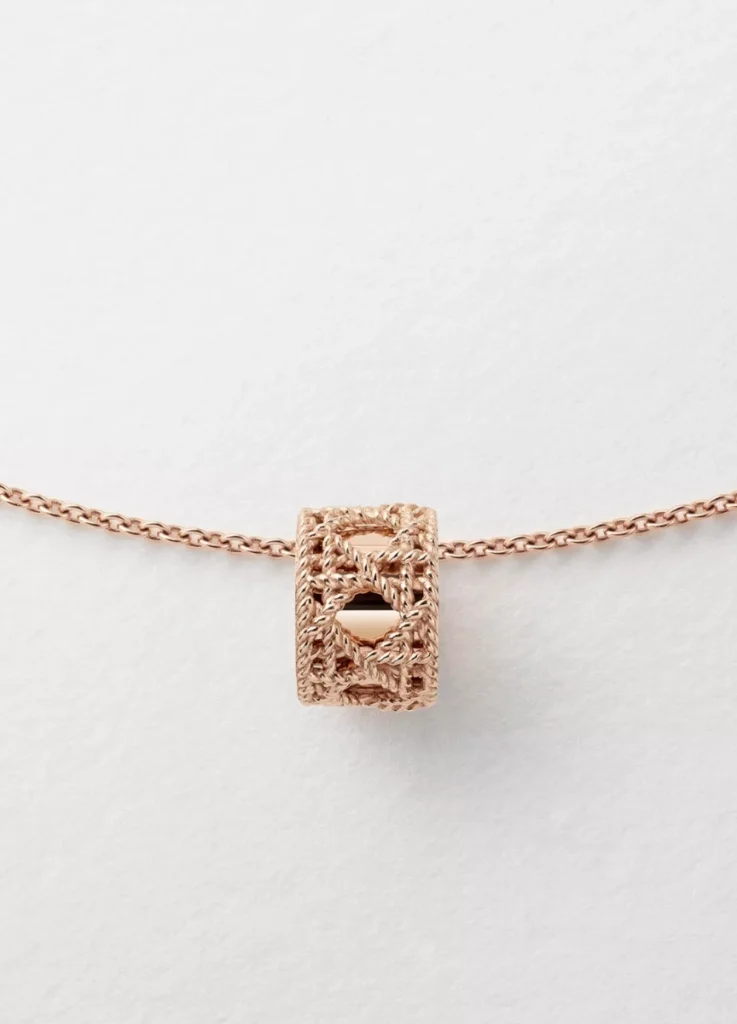
Pink Gold
The solitaires
The three solitaires share a small scale.
| Version | Pendant metal | Pavé | Visual weight |
|---|---|---|---|
| Yellow gold | YG | none | lightest |
| Pink gold | PG | none | light |
| White gold | WG | full pavé | strongest of the three |
The thing to hold onto is that the small scale isn’t a shortcoming. This line was never built to make a large structural statement. Its purpose runs the other way — to compress Dior’s texture into a small unit.
Yellow gold is the quietest of the three. The geometry of the cannage is fully present, but the warmth of yellow gold softens it, so the temperature of the metal reaches you before the structure does. It’s the purest entry point into the Dior code.
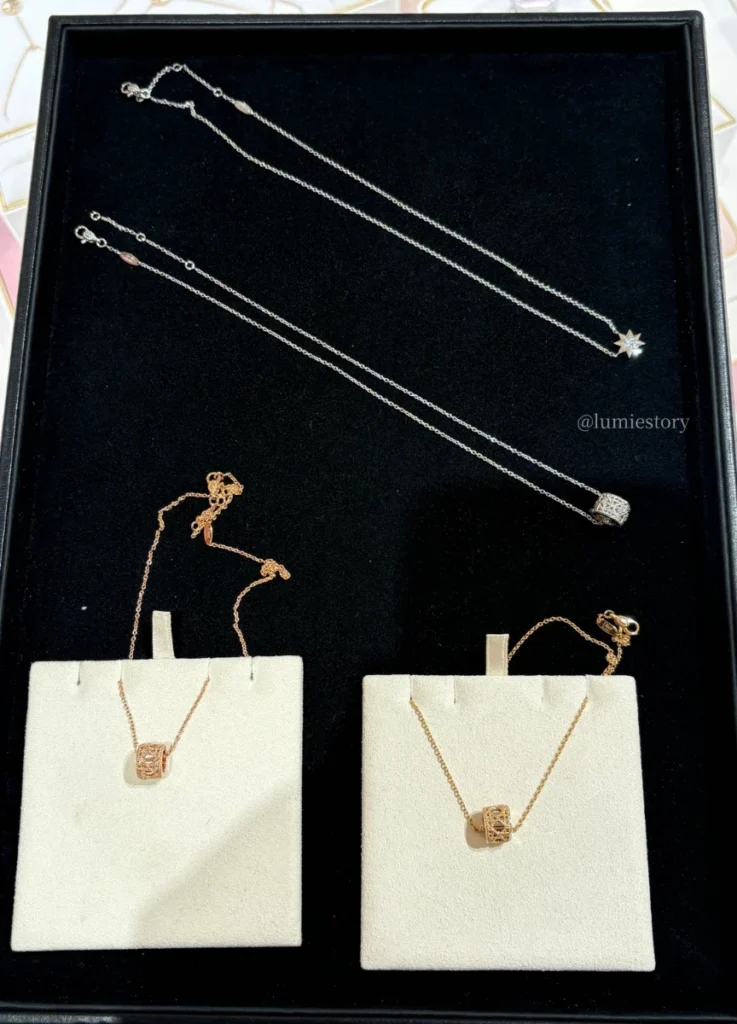
Pink gold goes softer still. The structural tension of the cannage loosens another notch. It’s the easiest of the three to wear daily, though the signature clarity Dior is known for thins a little in the process. For someone with a defined eye, it may leave less of an impression than the yellow or the white gold.
White gold full pavé changes the structure entirely. The form is the same; the surface is not. With micro-pavé set into each small facet of the cannage, the metal stops reading as structure and starts behaving like a grid of light. The sparkle scatters finely across the whole surface — present, but never loud. That restraint is the strangest, and best, part of the piece.
The trio — not the most expensive piece, the most different one
The trio looks like an expanded solitaire and comes across as something else entirely in person. Photographs don’t carry the difference well.
Scale is the first thing you notice. Where the solitaire pendant is a small barrel with fine detailing, the trio is a larger unit across the board — the pendant gains width and thickness, and the chain is visibly heavier. It isn’t one more charm added on; the proportion itself shifts.
That adjustment makes functional sense. A chain carrying three pendants has to be thicker. But the effect on how the piece wears is far larger than the change looks on paper, and the chain carries more presence as a result.
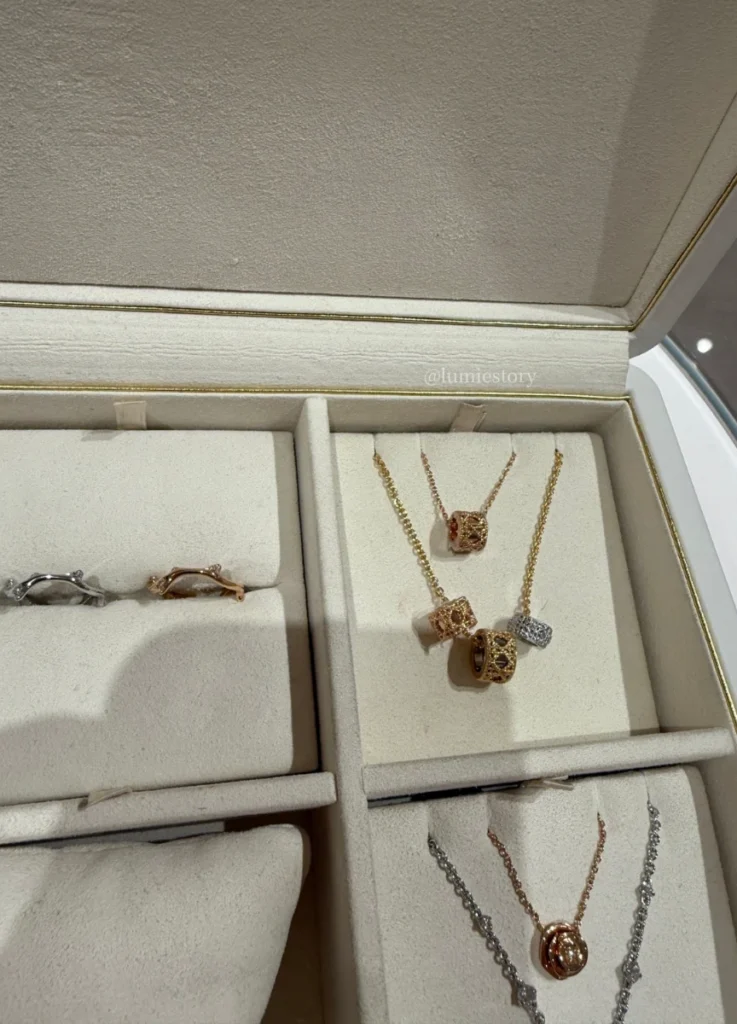
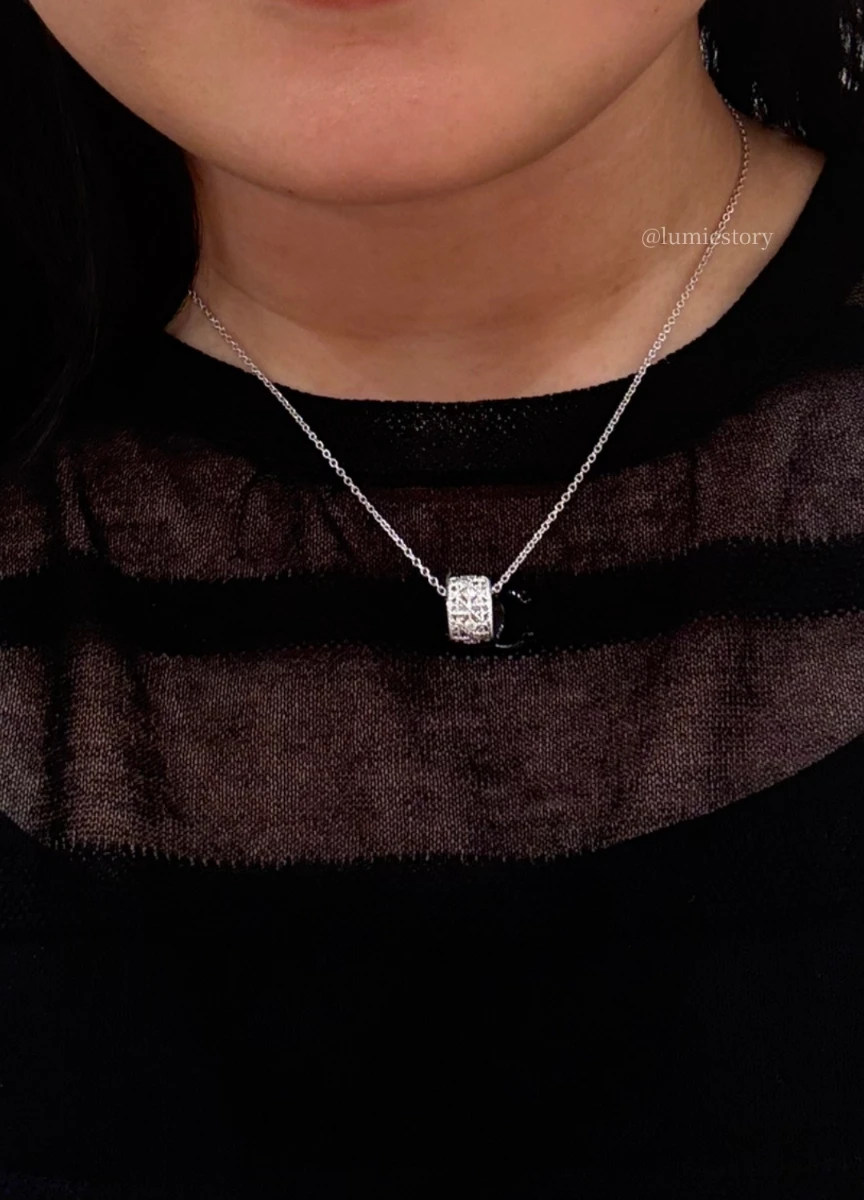
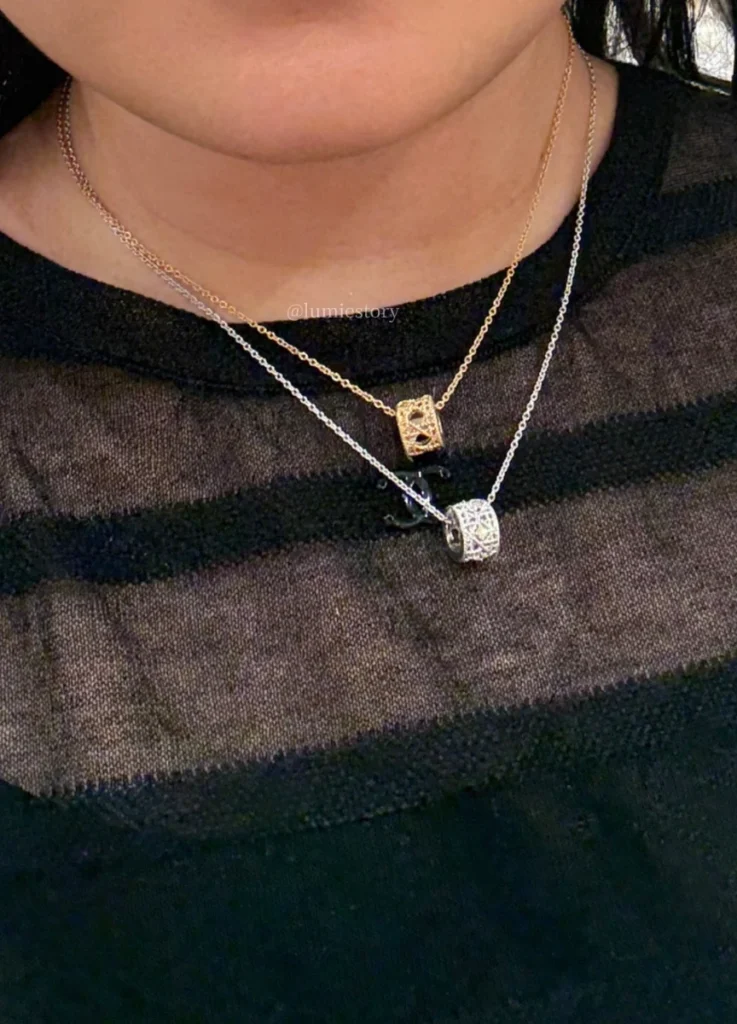
The most interesting thing about this version is the three metals running together — yellow, pink, and white gold, with pavé on the white. From a collector’s point of view, that’s a smart bit of design. Someone whose collection is already built in yellow gold, and someone whose collection runs to white gold watches, can both use this single piece as a connector. It conflicts less with what you already own, and it layers more freely with other houses.

The same strength is also its limit. The trio is already so complete that it leaves little room around it. A solitaire allows a little tension with the rest of your jewelry — its role adjusts in relation to your earrings, your watch, your bracelet. The trio becomes a look on its own.
The distinction ends up being fairly clear. If the goal is integration into a daily wardrobe, the solitaire. If the goal is to close a look with a single Dior code, the trio.
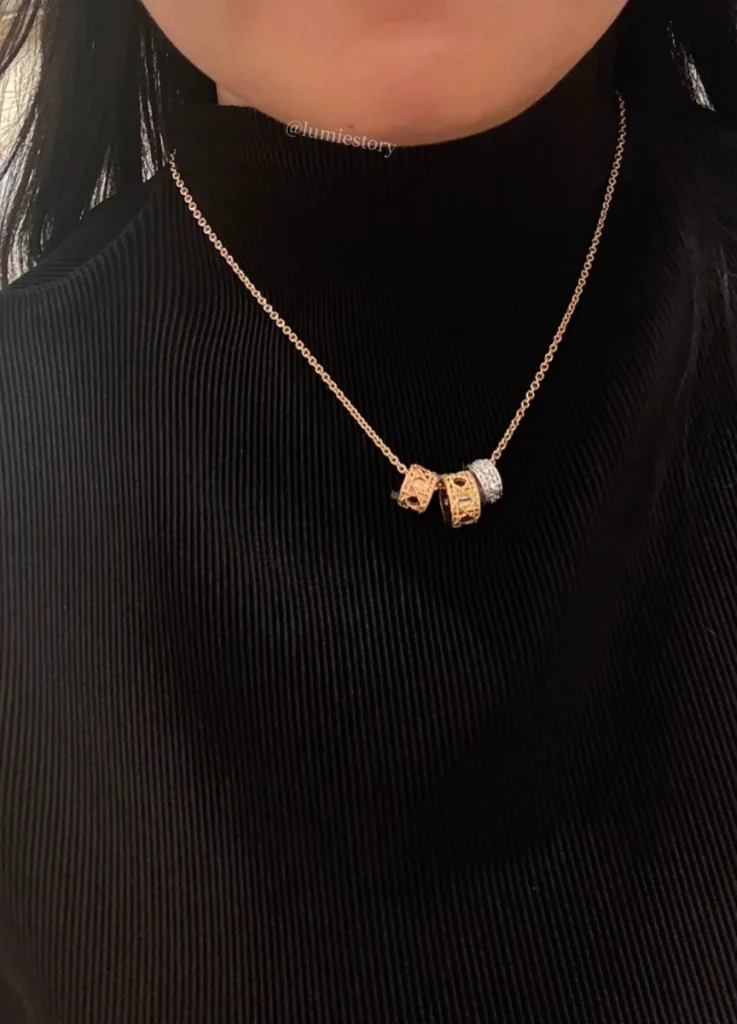
Yellow, Pink and White Gold with Diamonds
How it actually wears — this isn’t a necklace that changes your face
This is where I learned the most from trying the pieces on.
With jewelry, the product shot and the way a piece actually sits on a person are often two different things — and the gap is widest with necklaces. A pendant that photographs beautifully doesn’t necessarily do good work on the face.
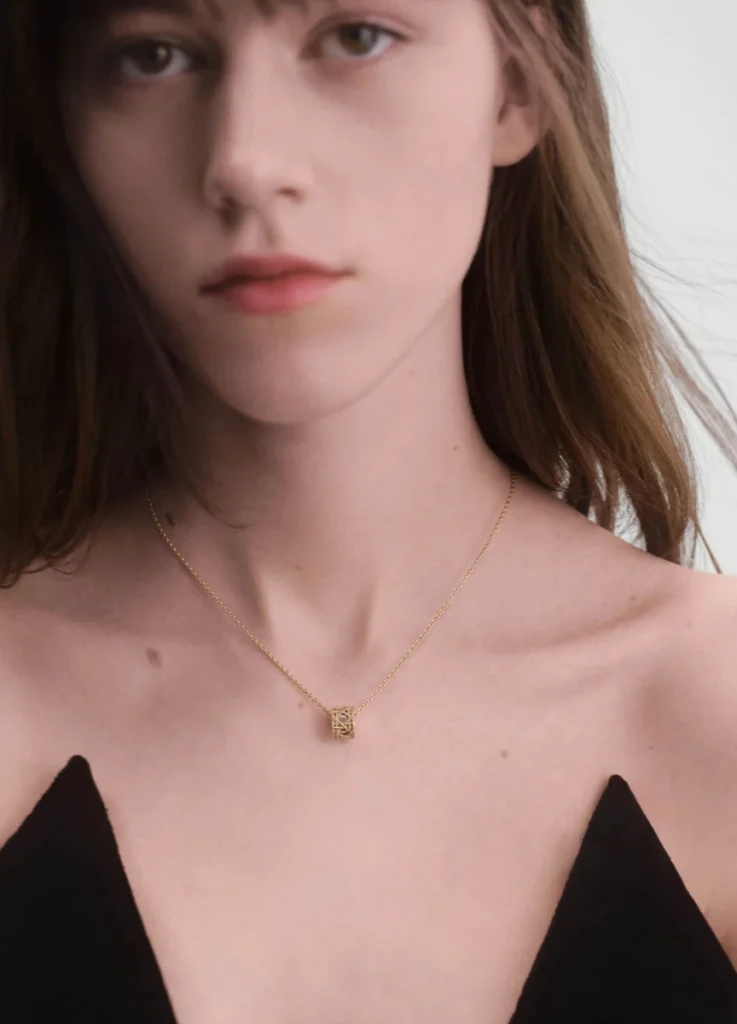
Yellow and White Gold
source: dior.com
My Dior doesn’t correct face shape the way some necklaces do. The fastest way to explain what I mean is to set it next to the Boucheron Serpent Bohème. The Serpent’s pendant has a clear vertical logic: the drop pulls the eye downward and the twisted chain carries that line through, so the face lengthens. On a rounder face, that effect does real work.
My Dior behaves differently. The solitaire is a small central object, not a strong downward drop. The trio carries more horizontal information than vertical. So it’s less a necklace that rebuilds the proportions of a face and more one that adds texture on top of a look you’ve already resolved — it lifts the mood you arrived with rather than constructing a new one.

White Gold
I’ll be honest about my own case, because it was clear-cut. My Dior is genuinely well made, and I do intend to buy into the line. But on my own face, the Boucheron Serpent is the more immediately convincing necklace, and there’s no point pretending otherwise. The reason is structure more than taste. A round face tends to benefit from a pendant that creates a vertical line, and the Serpent does that precisely. My Dior works the other register — refining the whole rather than re-proportioning the face.
That said, if I had to name the face it flatters most, it’s a slim, elongated one — a narrow jaw and a long line, the kind Yuko Araki has. A face that already carries its own length doesn’t need a pendant to stretch it, so the horizontal, textural emphasis of My Dior lands as refinement rather than working against the proportions.

Yellow, Pink and White Gold with Diamonds
@yuuuuukko_ / Instagram
Which means the useful question here is less about face shape than about wardrobe architecture.
It works well for:
- anyone whose clothing is already structured — shirts, architectural knits, minimal tailoring
- anyone who prefers a texture point over face-correcting jewelry
- anyone whose wrist language is already built around a watch and a bracelet
- anyone whose face holds its own center and doesn’t need a necklace to generate presence
It works less well for:
- anyone hoping a single necklace will change the impression of their face
- anyone who prefers a feminine drop silhouette
- anyone after a large motif or a statement-first piece
This is refinement jewelry, not transformation jewelry.
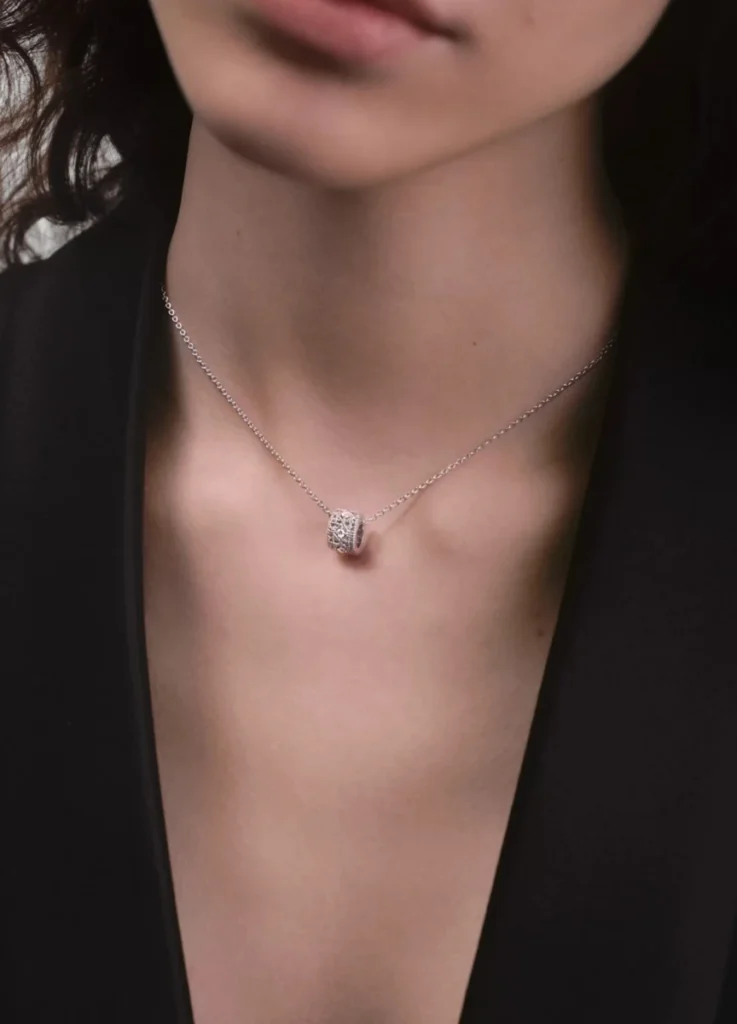
White Gold
A second way to wear it: the bracelet
Because the pendant and chain aren’t fixed to each other, you can take the pendant off and wear it on a correctly sized chain as a bracelet. The pendant is scaled well for that — large enough to read, small enough to sit comfortably on the wrist — which gives the piece more range than a single necklace usually has.
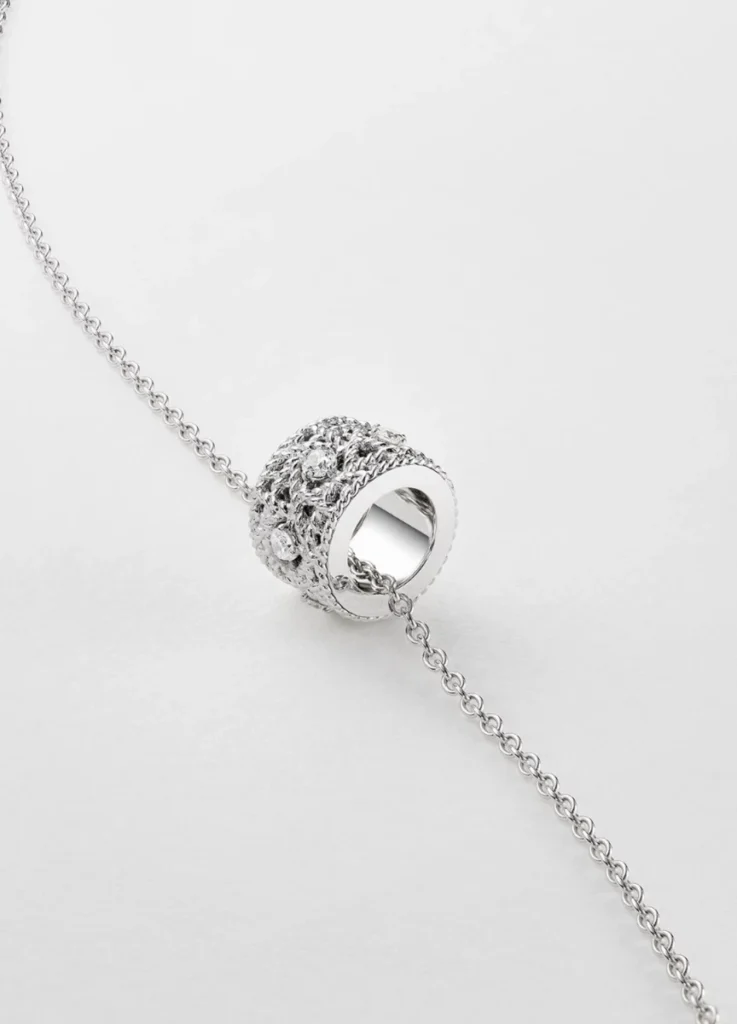
White Gold
A Dior piece that lives easily with other houses
This part interested me more than I expected. My Dior is a Dior object, yet it sits more naturally alongside a Cartier- or Boucheron-led wardrobe than you might guess. The house codes aren’t especially similar. What lines up is the way they’re read.
A good Cartier watch doesn’t announce its logo across a room. Tank, Baignoire, Tortue — the pieces that are actually good reveal themselves up close, in the proportion, the surface finish, the curve of the case. My Dior is much the same. From a distance it looks like a small piece of worked gold. You have to come closer for the cannage and the surface work to show. It doesn’t hide its house code, but the code arrives a beat late — and that delay is why it harmonizes with structured watches instead of competing with them. It’s the same reason it settles so easily into a Cartier or Boucheron wardrobe.
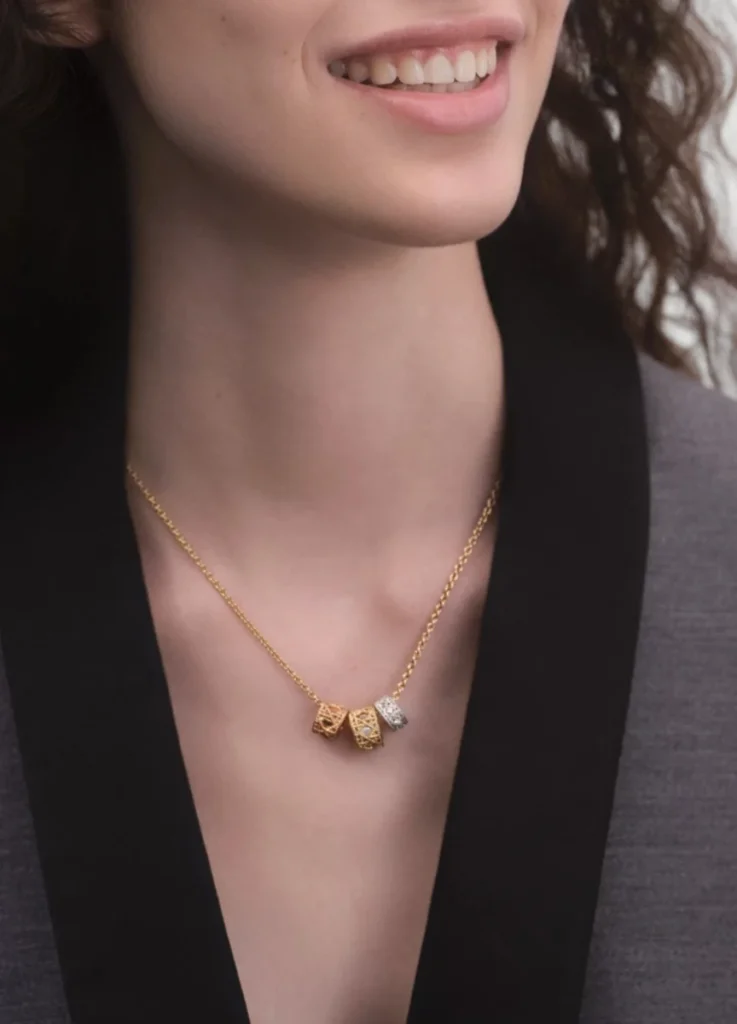
Yellow, Pink and White Gold with Diamonds
Who it’s for
Worth recommending if you:
- already have a wrist architecture in place
- build your style around a watch
- want refinement from a necklace rather than a statement
- want something that connects naturally to a Dior wardrobe
- enjoy reading a house code up close

Pink Gold
Less so if you:
- are looking for a first, main diamond necklace
- are buying primarily on investment logic
- want an unmistakably iconic piece
- expect a face-correcting effect

Yellow, Pink and White Gold with Diamonds
Source: Elle
And the trio-versus-solitaire decision compresses to a single line: the solitaire is for daily integration, the trio for a one-piece statement.
A note on price: full pricing across the necklace line wasn’t published at the time of writing, so figures are best confirmed at boutique level.
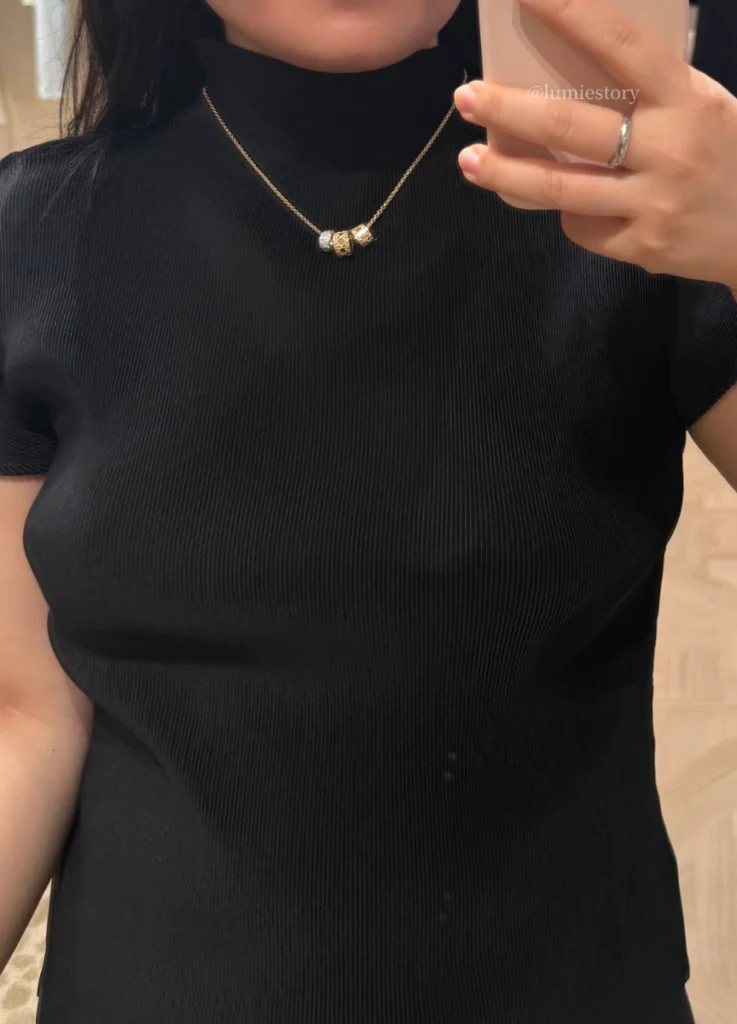
Yellow, Pink and White Gold with Diamonds
Closing — Dior makes you remember the surface
The cannage was a chair pattern to begin with. In 1947, the woven surface of the furniture holding up guests in the 30 Avenue Montaigne salon became, over time, the structure of the Lady Dior — and now, reduced again, a small piece of gold worn at the neck.
The direction Dior takes the language is what stays with me. Plenty of houses explain themselves over time with bigger stones, stronger icons, more immediate presence. Dior moves the other way. It repeats the same code but keeps shrinking the unit. It condenses the surface rather than enlarging the structure.

source: Elle
So the My Dior necklace may not be the piece that lands hardest on first sight. It doesn’t command a room at a glance, and it isn’t easy to justify on investment logic alone. For the same budget there are clearer icons, larger stones, more obvious choices. And yet pieces like this are the ones that last in a wardrobe.
It comes down to the role they play. This isn’t jewelry that manufactures presence; it’s jewelry that fills a small, exact gap in a wardrobe that’s already in order. A neckline above a shirt. A thin knit on a summer evening. A day when the watch and the bracelet have settled into place, everything resolved, and something still comes up a beat short. My Dior goes into that gap.
Good jewelry doesn’t have to be the first thing anyone notices. Some pieces change the whole look; others only raise the density of the surface a little. Now and then it’s the second kind you remember longer. My Dior is probably that sort of necklace — and, as it tends to, Dior makes you remember the surface a piece sits on first.
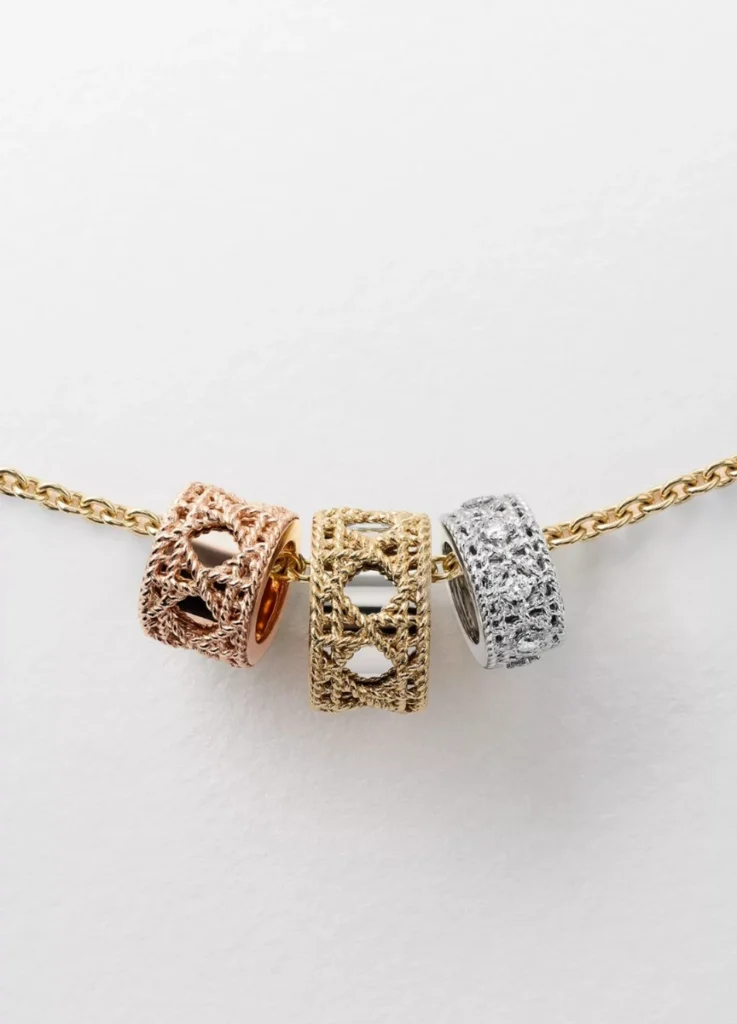
Yellow, Pink and White Gold with Diamonds
All images unless otherwise credited: © Lumie Story
[ Related Editorials ]