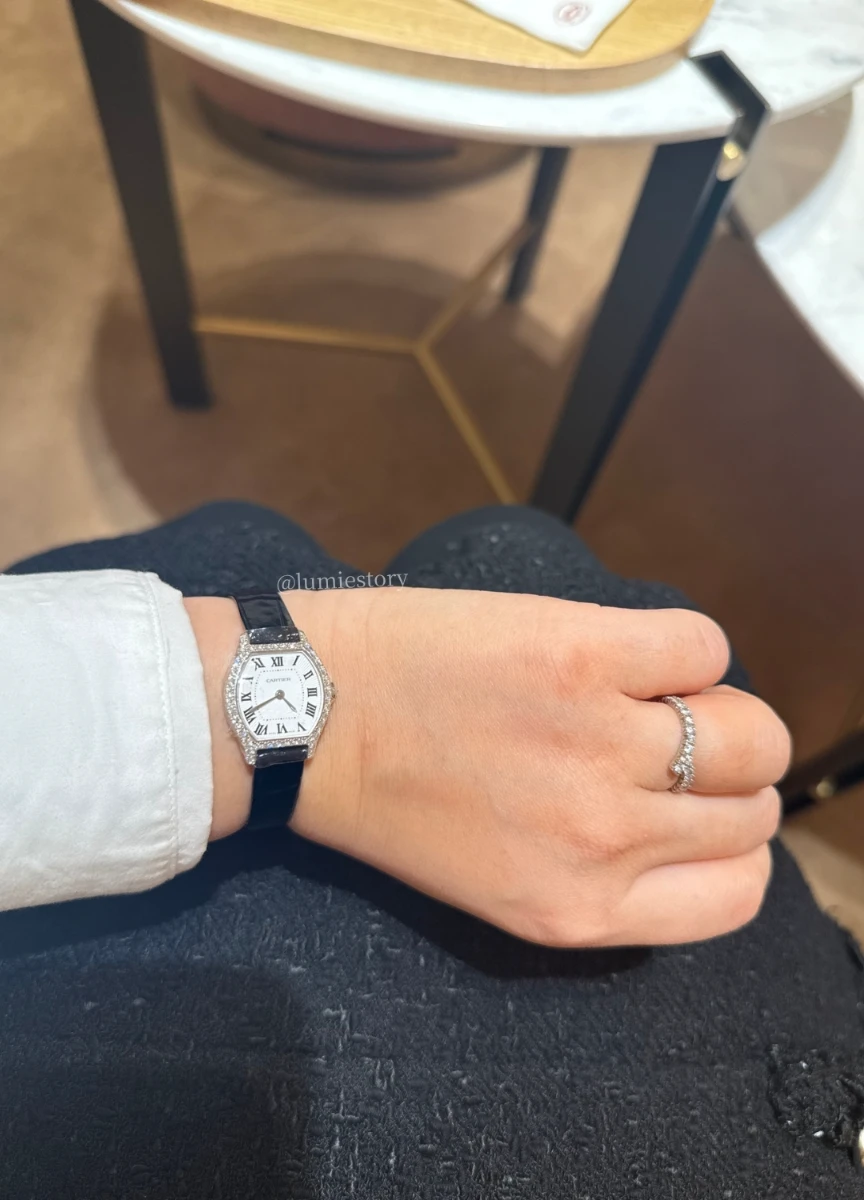
Why Tortue Watch, and Why Now
In recent years, Cartier has moved beyond simply maintaining its position as a classical maison. The brand is actively redefining its pricing and market positioning — a shift that is gradual but visible across its entire product strategy.
At the center of that shift in 2026 sits the Tortue.
This relaunch goes beyond reissue or cosmetic refinement. Cartier has preserved the original form while redesigning proportions and wearability for a contemporary standard. The Tortue moves beyond historical reference into a convincing object in its own right.
The pricing is worth noting. Current Tortue prices appear to sit in a window where Cartier’s characteristic price escalation has not yet fully landed. Compared with the Baignoire, where market premiums are already well established, the Tortue still occupies a range with room to climb.
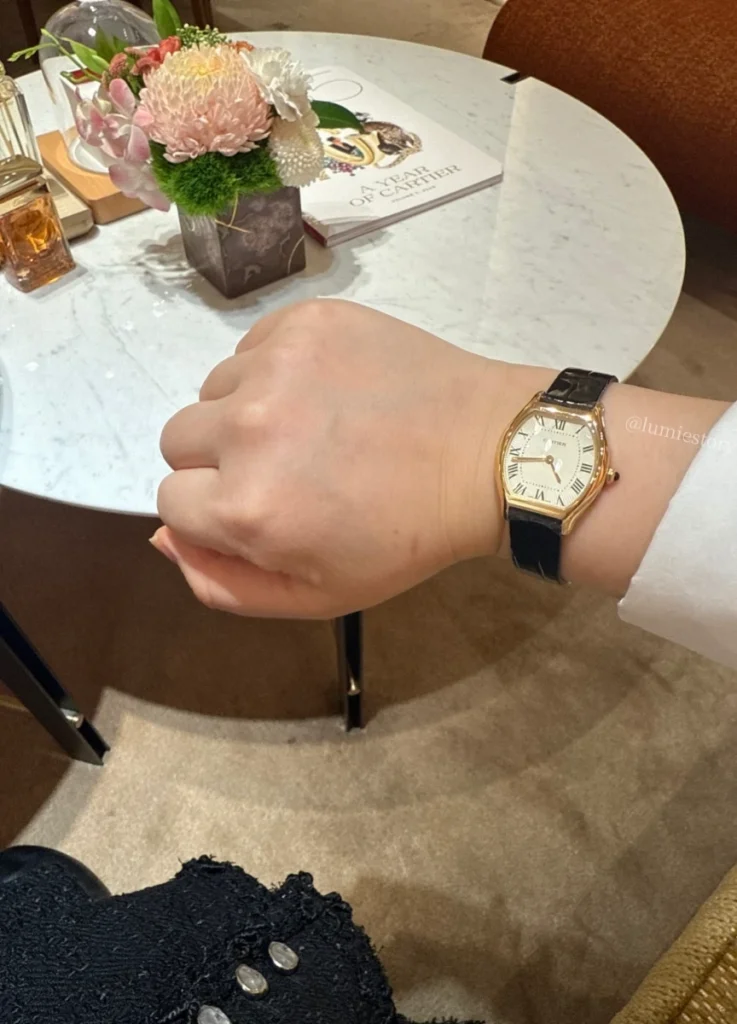
18K yellow gold (750/1000) case
($13,900)
The Tortue Watch — Origin and Symbolism
Tortue is French for “tortoise.” The collection was first introduced in 1912 by Louis Cartier — a highly unconventional form for its time. While most watches remained round or rectangular, the Tortue used a curved, almost oval structure to extend the watch into something closer to sculpture.
The name goes beyond formal resemblance. The tortoise has long symbolized longevity, stability, and endurance — values that align directly with the Tortue’s design philosophy. No dependence on trends or momentary shifts. Instead, a commitment to balance and structure that holds across time.
In that context, choosing the Tortue is less about selecting a design and closer to choosing a standard built to last.
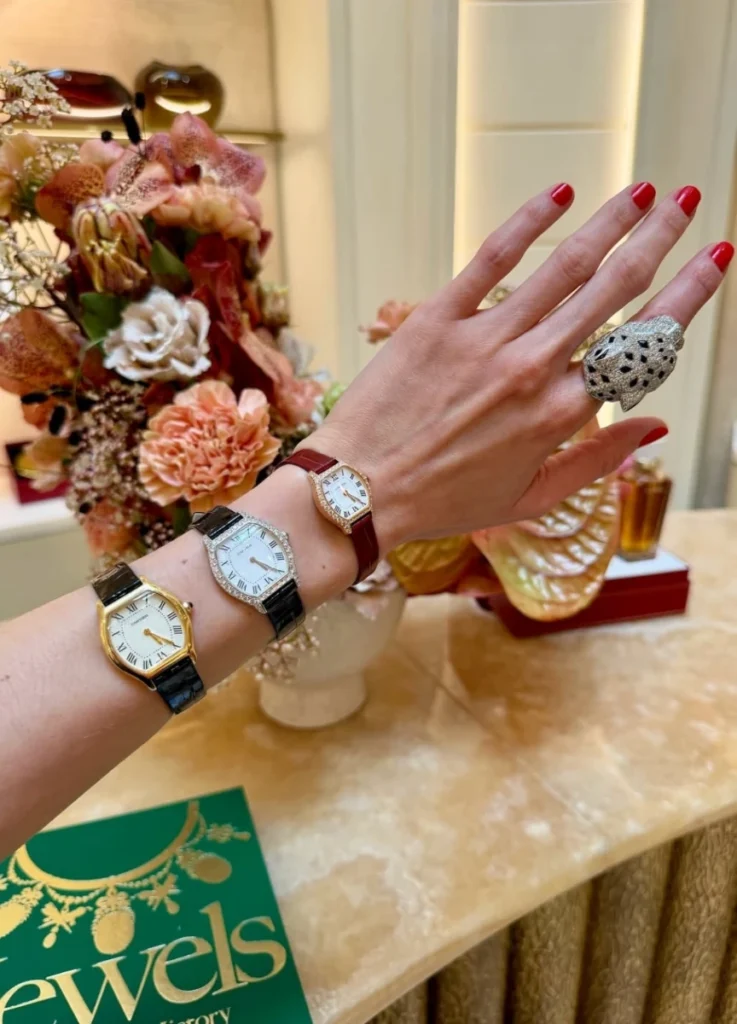
@pastila.club / Instagram
The Essence of the Tortue — Watch as Sculptural Object
The Tortue sits beyond the category of “watch.”
The core of this model is form, not function. The curved case operates as a sculptural object on the wrist — not a flat decoration but a three-dimensional structure that follows the natural curvature of the arm.
The Tortue stands apart from conventional jewelry watches. A Van Cleef & Arpels Alhambra watch, for example, takes a motif-driven, decorative approach. The Baignoire concentrates its identity into a pure oval — a jewelry-first silhouette. The Tortue works differently. The form itself is the design, and diamond setting integrates structurally rather than sitting on top. Less “a watch with jewels added” and closer to “a watch where jewels and structure are inseparable.”
That distinction extends beyond taste. It becomes a question of design integrity.
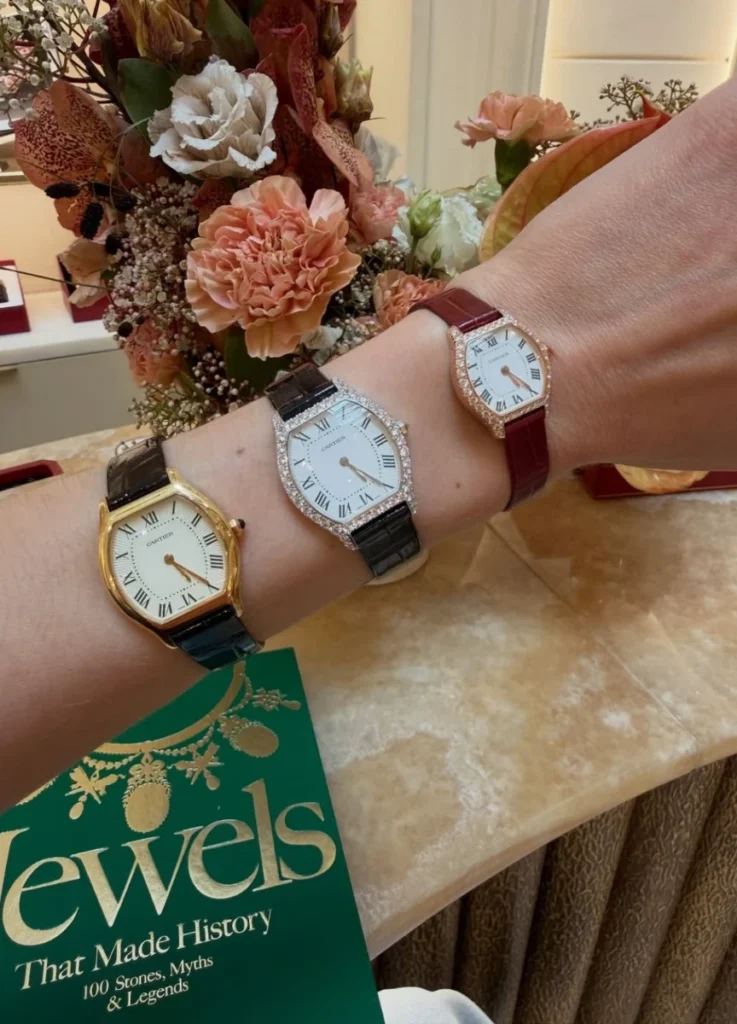
@pastila.club / Instagram
What Changed in the Redesign — Proportion, Fit, and Setting
The most important changes are not immediately visible.
First, proportion. The case is thinner than its predecessor, and the curves have been further refined. The visual weight on the wrist is reduced, and the overall impression reads lighter and more contemporary.
Second, wearability. The structure now sits closer to the skin. The sensation shifts from a watch “placed on” the wrist to one that “settles into” it.
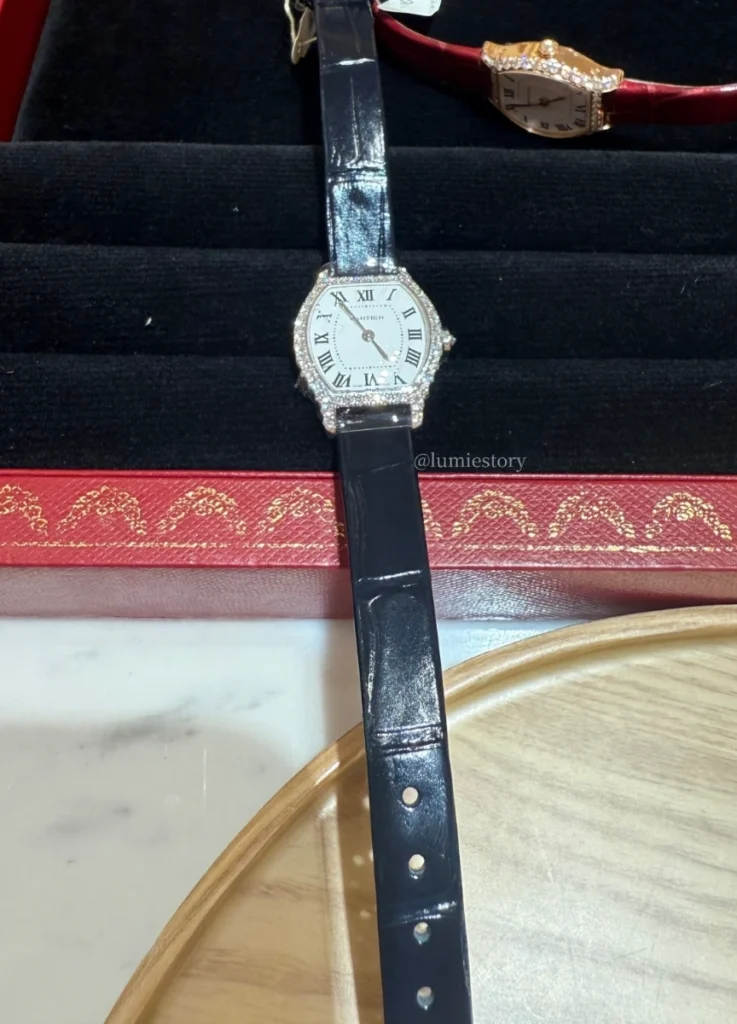
Third, the diamond setting. On pavé models, the diamonds follow the curvature of the case rather than decorating a flat surface. They reinforce the form rather than competing with it. The watch completes itself as a single organic object.
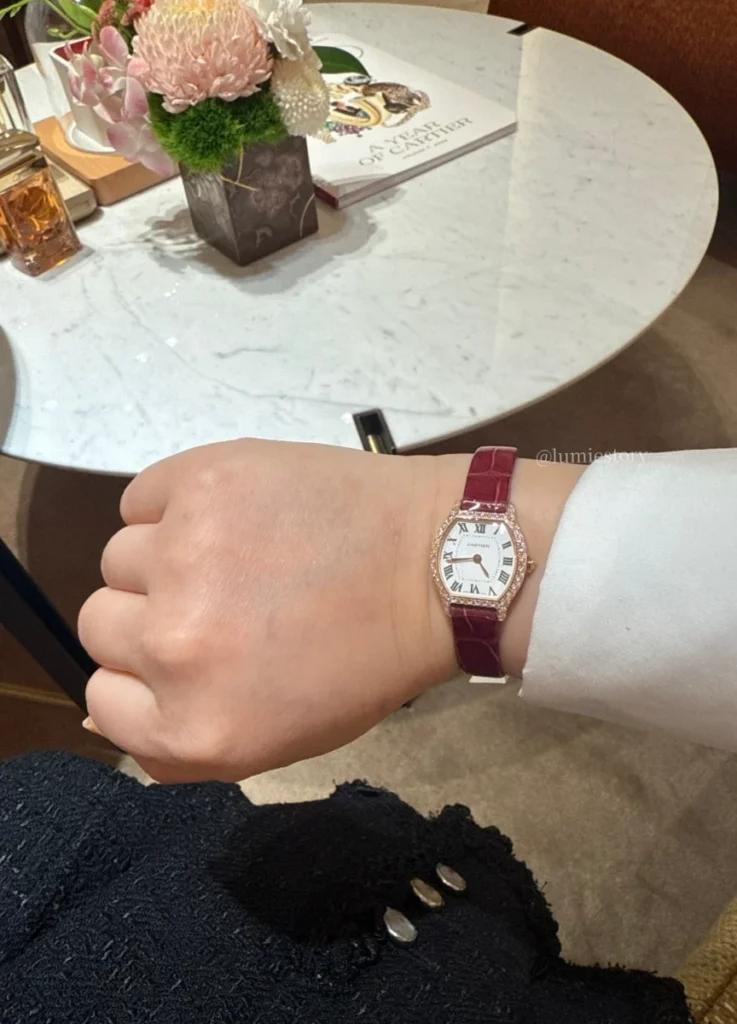
($19,900)
Size-by-Size Breakdown: Mini, Small, and Medium
The Tortue changes character entirely across its three sizes. The difference extends beyond scale — into role, image, and how it wears.
⸻
Mini
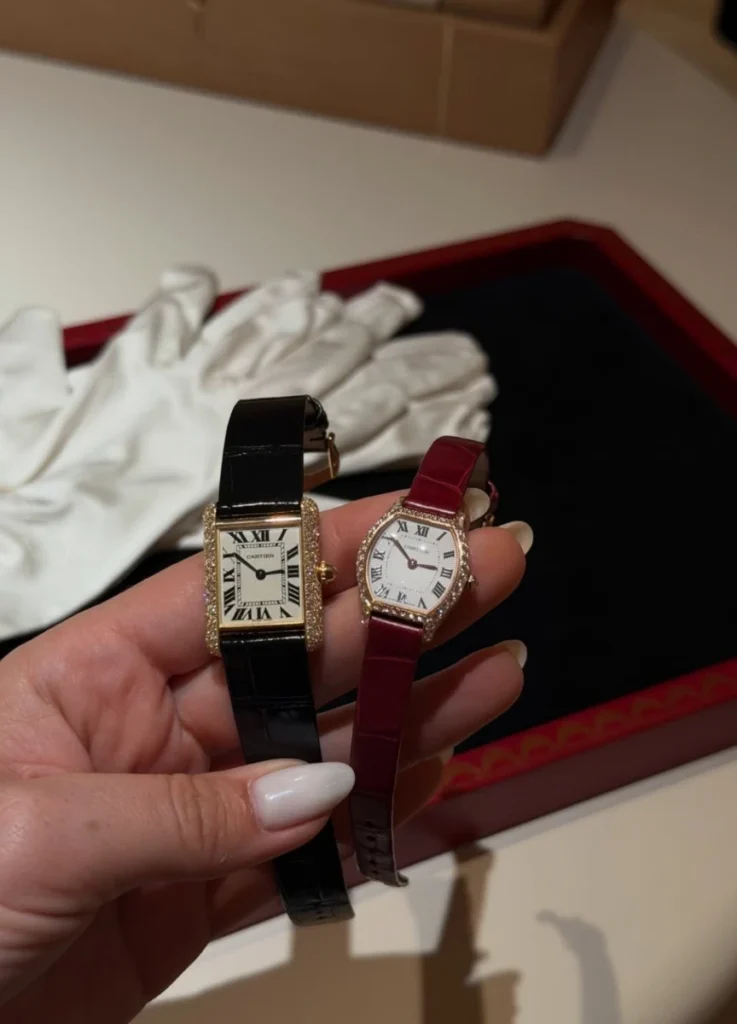
The mini sits closer to jewelry than to watchmaking. The fact that it is offered only in pavé confirms its positioning — Cartier made a deliberate choice to treat this size as a jeweled object rather than a functional timepiece. Yet the wider-set case shape gives it more legibility and more “watch presence” than a Baignoire mini pavé at a similar price point.
This size works best on slim wrists with fine bone structure. It integrates naturally into bracelet layering — stacking with a Love or JUC without visual conflict.
The image is clear: delicacy, femininity, and considered ornament. For those who prioritize a refined, feminine impression, the mini delivers precisely that. In my case, this was the size that suited me best. The pavé felt restrained enough for a business setting — decorative without being excessive.
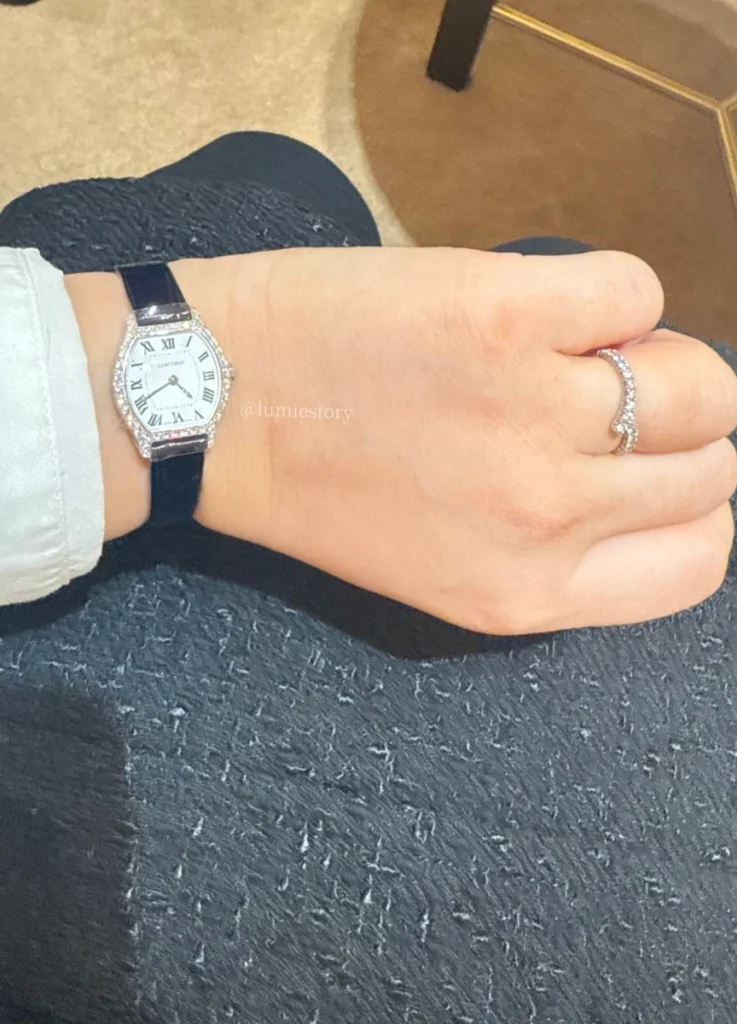
($21,400)
Why the Mini Exists Only in Pavé
This is one of the most interesting strategic decisions in the relaunch.
The mini Tortue is not simply a smaller version of the collection. It was designed from the start as a different product category.
Currently, the mini is available with no plain gold option — pavé only, in white gold and rose gold. The setting uses a cut-down bezel technique that reduces visible metal on the sides and pushes diamond brilliance forward.
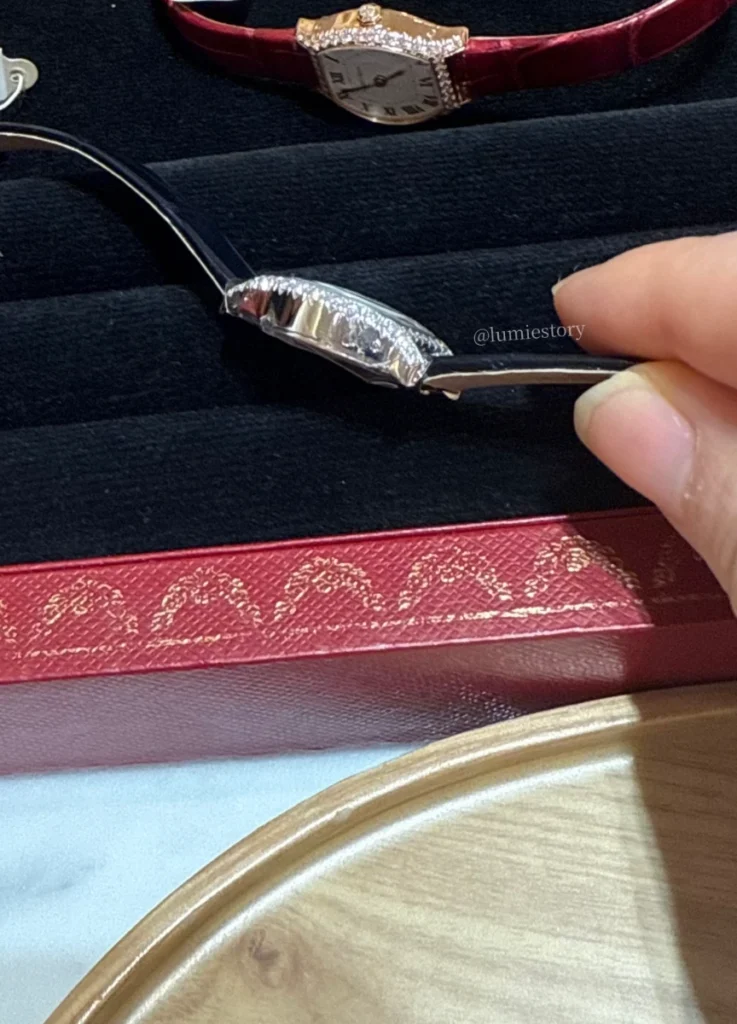
($21,400)
As any watch shrinks, its functional presence weakens — dial legibility, case authority, the sense of “wearing a watch” all diminish. Cartier chose not to fight that reality. Instead, the maison leaned into jewelry positioning — an approach that aligns with the recent direction of the Baignoire as well.
Who the Mini Serves: The conditions are specific. A slim wrist circumference. Fine, non-prominent bone structure. A slender overall arm line. When these conditions are not met, the mini can read as a “small object” rather than a watch — or worse, it can make the wrist appear thicker by contrast. When the conditions align, the mini dissolves naturally into a dress watch that barely announces itself.
Small
The small is the most balanced size. Watch function and jewelry identity coexist without either dominating.
It works naturally on most wrists, sits comfortably for daily wear, and carries enough presence to hold a look without overpowering it.
The standout model here is the yellow gold without diamonds. No pavé, no bezel setting — just metal and form. This is the most refined option in the entire lineup, and the one that most directly demonstrates Cartier’s confidence in form alone. Sapphire cabochon crown, champagne dial, black alligator strap. The watch proves its case without a single stone.
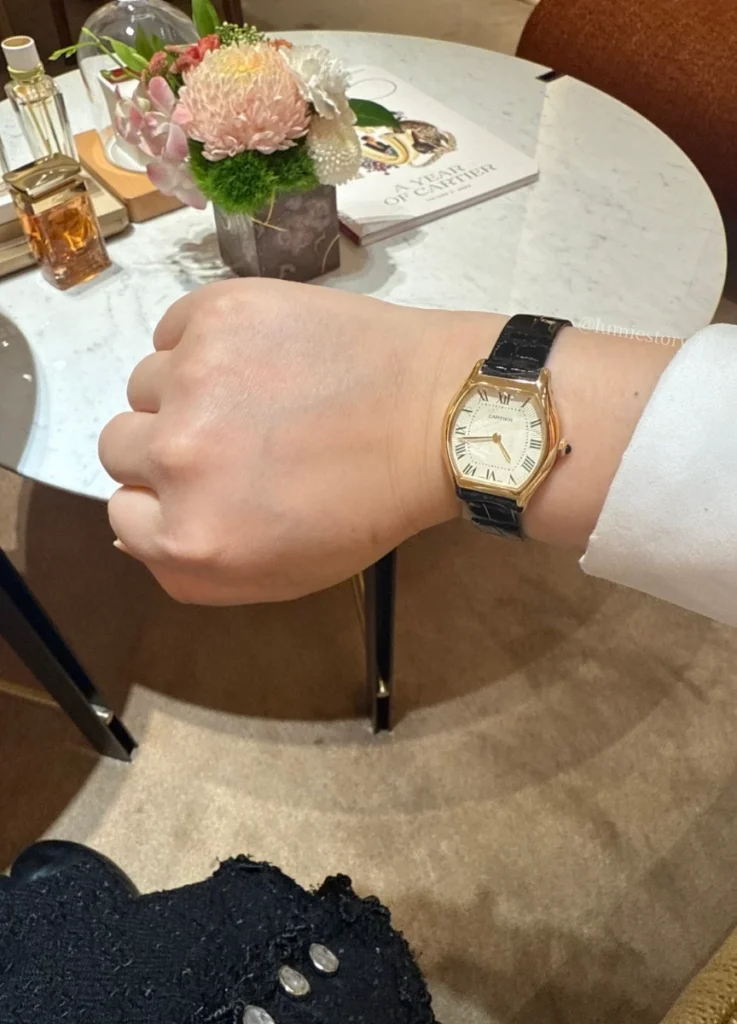
18K yellow gold (750/1000) case
($13,900)
The pavé small adds six diamonds over the mini (42 to 48). As the case grows, diamond density actually decreases — but the balance between form and setting improves. At this size, diamonds coexist with the watch rather than dominating it.
The thin gold bezel also carries an understated, old-money quality. For those who prefer minimalism with substance, the small is the most practical and consistent choice.
Who the Small Serves: Medium wrist thickness. Moderate bone structure. A balanced overall arm proportion. This size has the lowest failure rate of the three — it works across the widest range of bodies and contexts. Daily wear, casual-to-formal transitions, layering or solo — the small handles all of it.
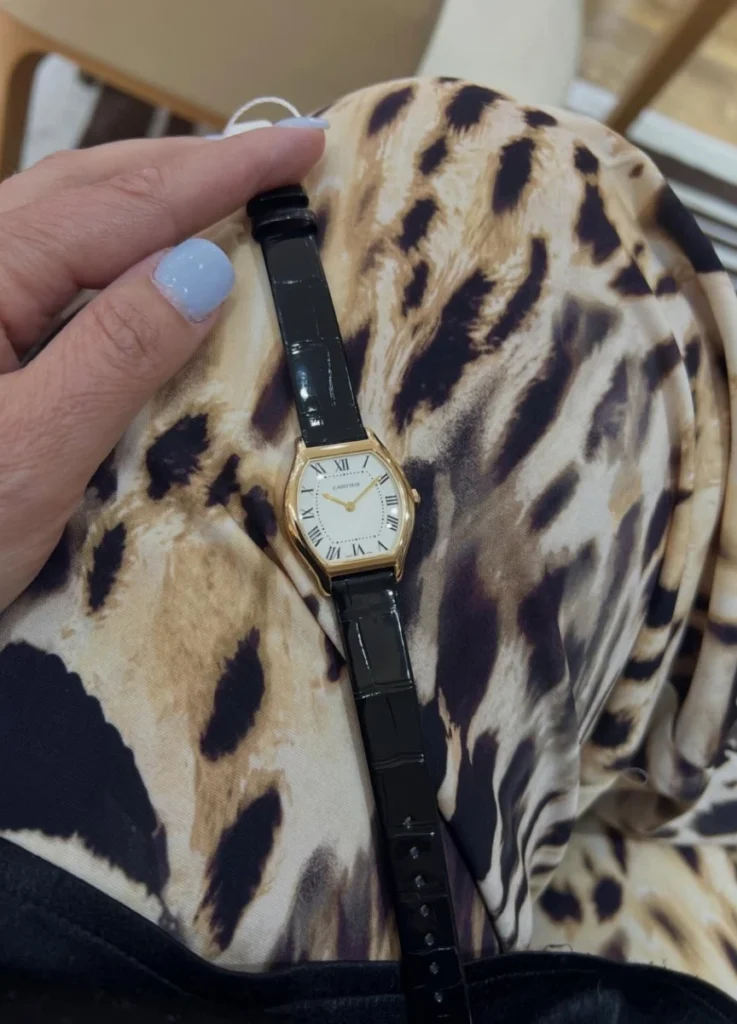
18K yellow gold (750/1000) case
($13,900)
@kelly_yoch / Instagram
Medium (Platinum LM)
The medium commands presence. This is where the watch identity is strongest.
It suits wrists with some volume, or frames where a smaller size would look diminished rather than delicate.
The medium is a completely different watch from the mini and small. It is the only size with a mechanical movement — the in-house hand-wound calibre 430 MC. The bezel carries 46 baguette-cut diamonds (2.7ct), a cut Cartier has used since 1910. The dial is separately designed: rosette guilloché with rhodium apple-shaped hands. This is not a daily watch. It is an evening piece.
The image is maturity and classicism. The watch does not accessorize — it anchors.
Who the Medium Serves: Visible wrist bone structure. Taller frame or larger skeletal build. Clothing with volume and presence. Under these conditions, the medium reaches its full authority.
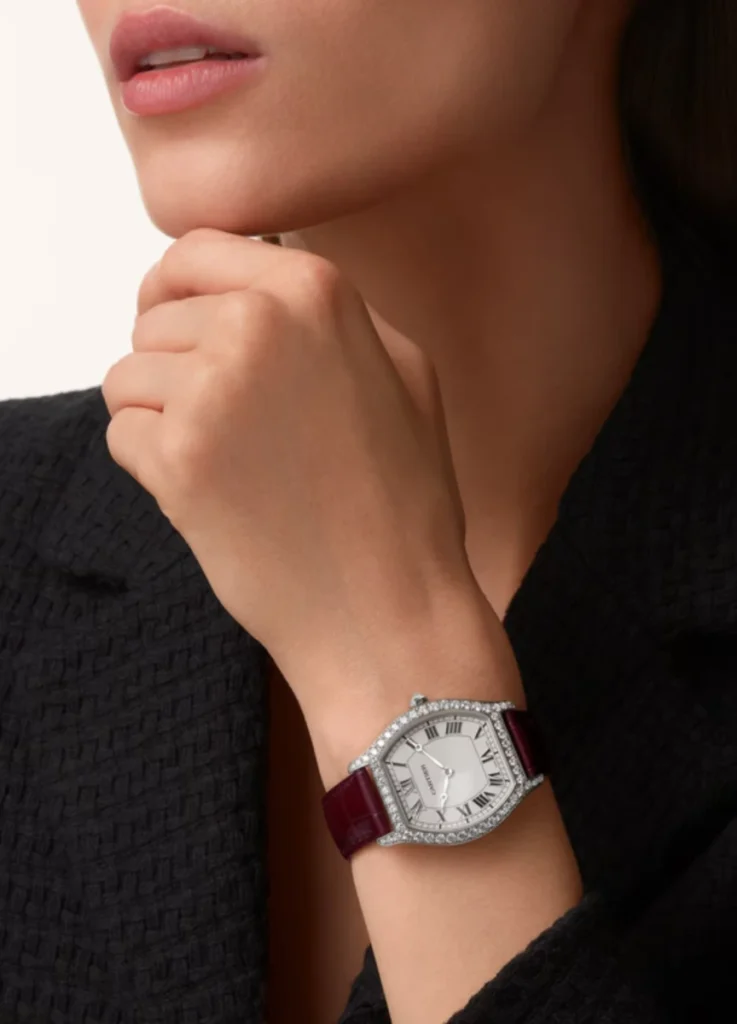
Hardware: Plain vs. Pavé
The hardware choice is a separate decision from size.
Plain gold is the classic route. It ages without fatigue, adapts across contexts, and makes the most rational first Tortue. Pavé occupies a different territory entirely — not an upgrade, but a category shift. It elevates the watch into a jewelry object. Presence becomes definitive. The watch becomes a centerpiece.
Plain is the foundation. Pavé is the completion.
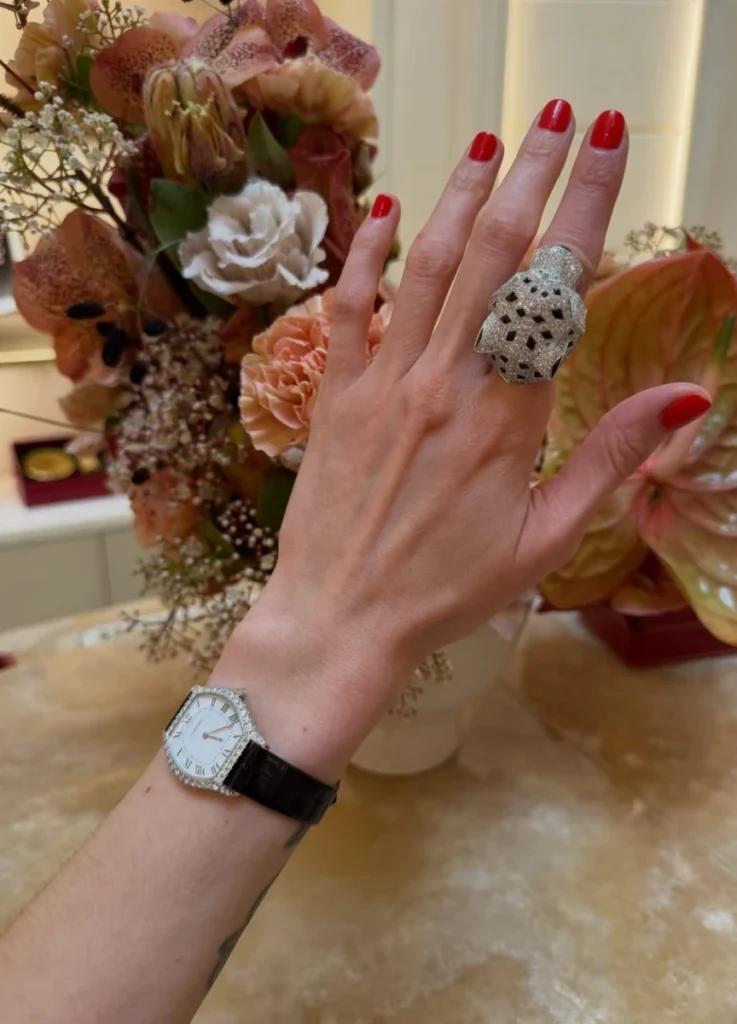
@pastila.club / Instagram
Why Pavé Comes in White and Rose Gold
Yellow gold is stable and classical, but it cannot fully extract a diamond’s brilliance. White gold merges with the stones — the boundary dissolves. Rose gold connects to skin tone — the setting feels organic rather than applied. These two metals maximize what pavé can do; yellow gold would hold it back.
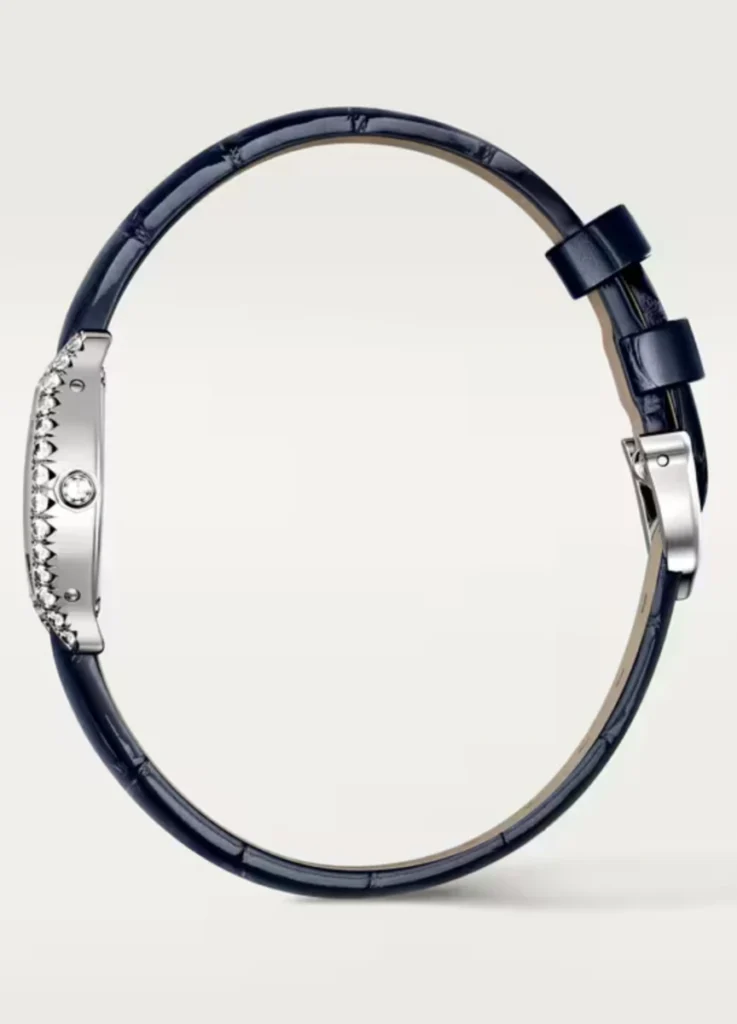
source: Cartier.com
Why the Side Profile Matters
On the Tortue pavé, the side view is where the real craftsmanship registers.
Most pavé watches concentrate their setting on the bezel — decoration visible only from the front. The Tortue is different. Diamonds follow the case curvature and continue across the sides, creating a three-dimensional setting that maintains density while keeping the case thin.
The result is a dual reading: brilliance from the front, structure from the side. When the wrist moves, light rises from the side profile in fine, controlled increments. Most pavé watches deliver everything in one angle. This one shifts with movement.
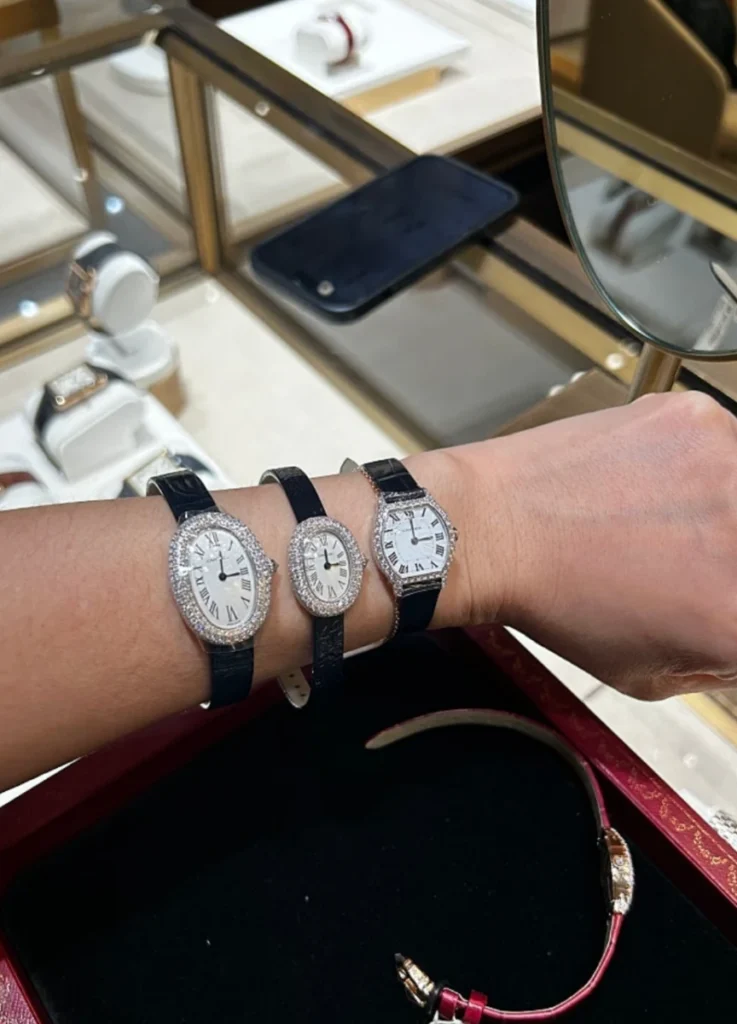
Mini Tortue vs. Baignoire Mini Pavé on Strap — The Real Comparison
This is where the most revealing comparison emerges.
The mini Tortue and the Cartier Baignoire mini pavé (Ref. WJBA0070, white gold on strap) sit at similar price points, making them natural alternatives. But their behavior on the wrist is fundamentally different.
Most comparisons begin with specs. Within the same maison, at the same size class and similar budget:
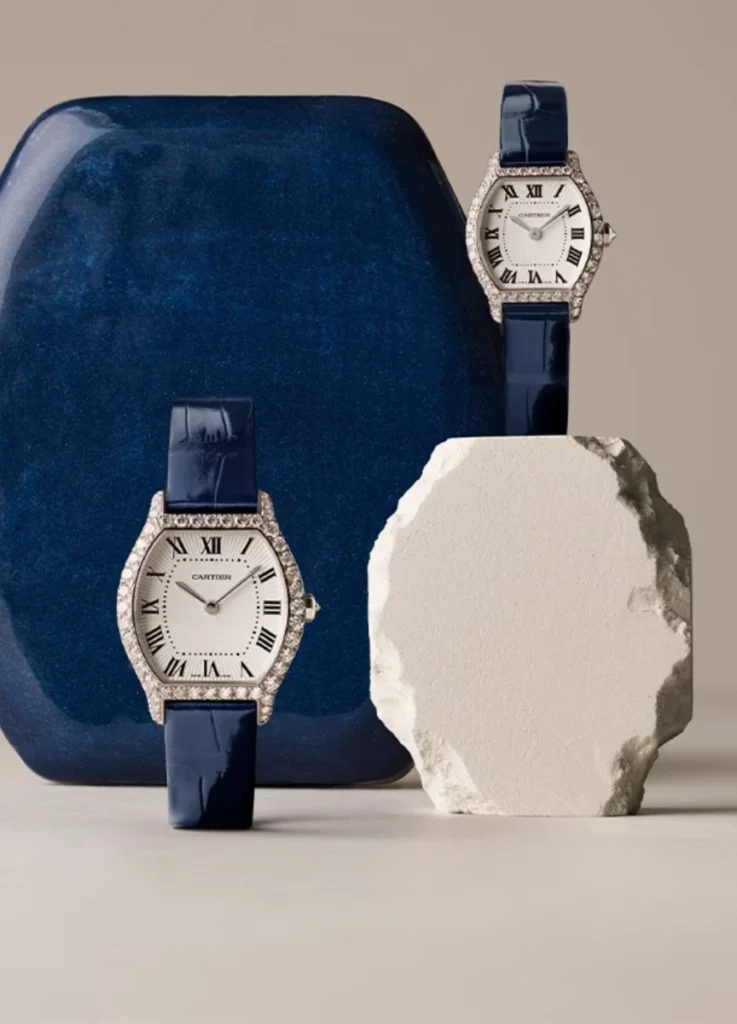
Baignoire mini pavé: 24.6 × 18.7mm, 7.2mm thick. 159 diamonds (1.86ct) plus crown (0.07ct). Total 1.93ct. Tortue mini pavé: 26.1 × 20.9mm, 6.9mm thick. 42 diamonds plus crown. Total approximately 0.81ct.
On paper, the Baignoire wins by a wide margin. Nearly four times the diamond count. More than double the carat weight.
On the wrist, the story reverses.
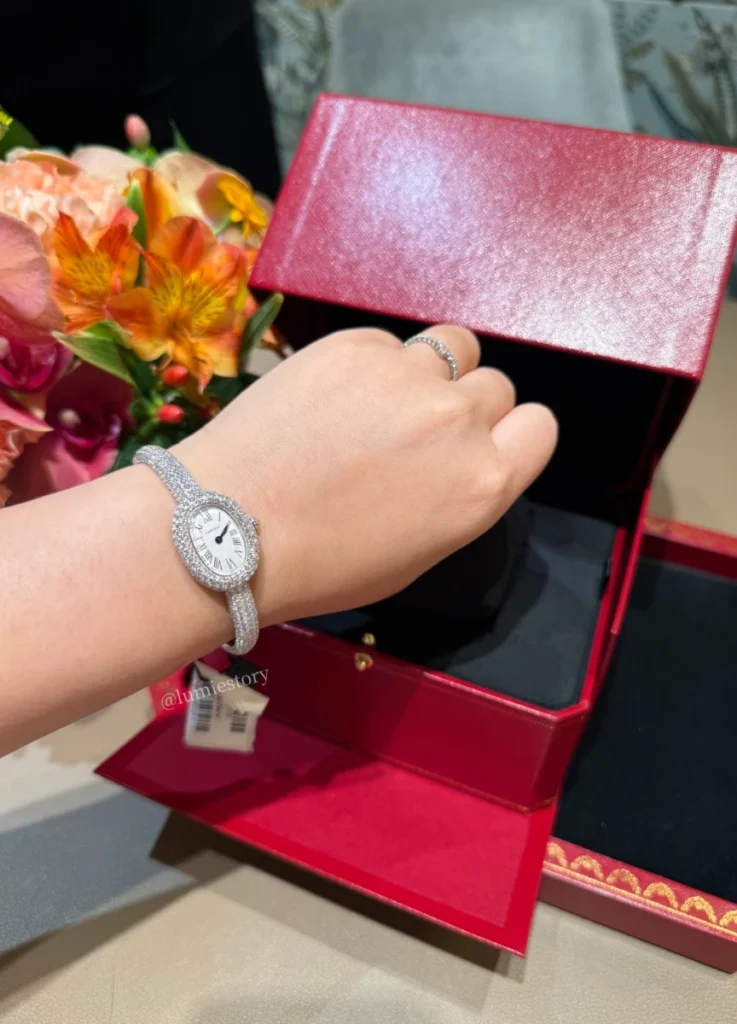
Why the Baignoire Mini Works on a Bangle but Becomes Candy on a Strap
The Baignoire mini performs powerfully as a bangle. The bracelet extends the small case into a full-wrist structure — the 24.6mm head no longer sits alone but connects into a continuous object. The case is small, but the total wearing surface is large. Presence holds.
Switch the same Baignoire mini to a strap, and the dynamic changes. The bangle’s extension disappears. Only the 24.6 × 18.7mm case remains. 159 diamonds packed into that small oval begin reading less as a watch and more as a compact, sparkling ornament.
The impression: candy. Charming, but without gravity.
An oval is inherently a low-direction shape. No clear start or end point. At larger scales, that softness reads as elegance. At mini scale, the form loses its ability to stand on its own. Even 159 diamonds cannot rescue it — the brilliance reinforces “small and shiny” rather than compensating for the loss of structure.
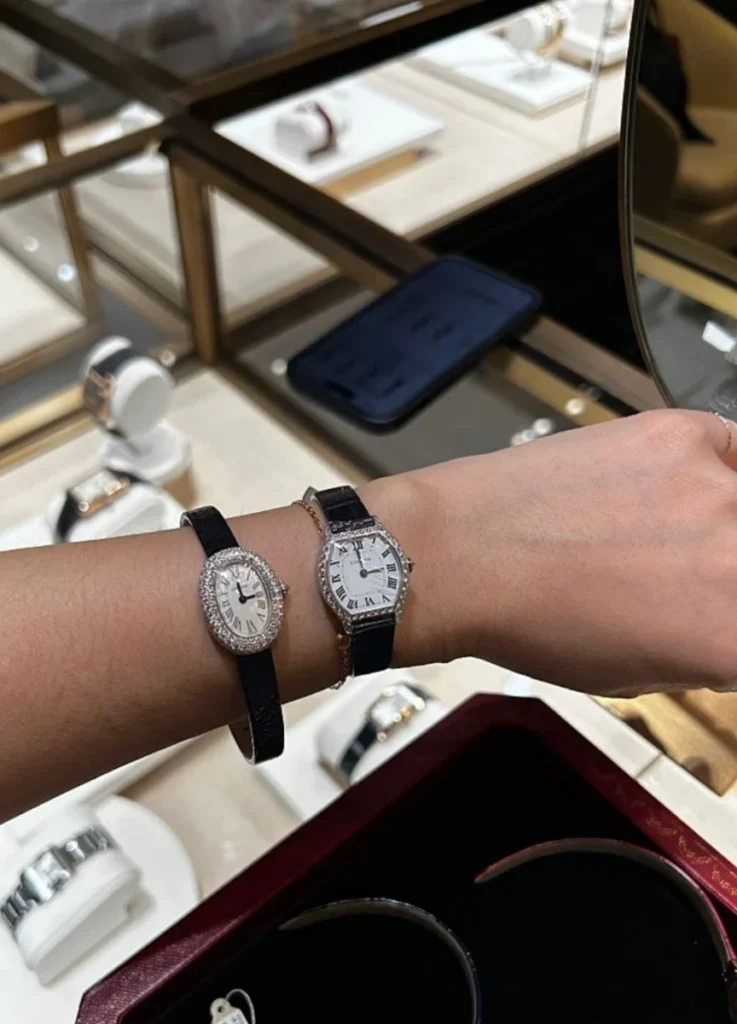
Why the Tortue Mini Holds as an Object with a Quarter of the Diamonds
The Tortue mini carries a fraction of the Baignoire’s diamond count. Yet on the wrist, it reads more like a watch.
Structural self-sufficiency.
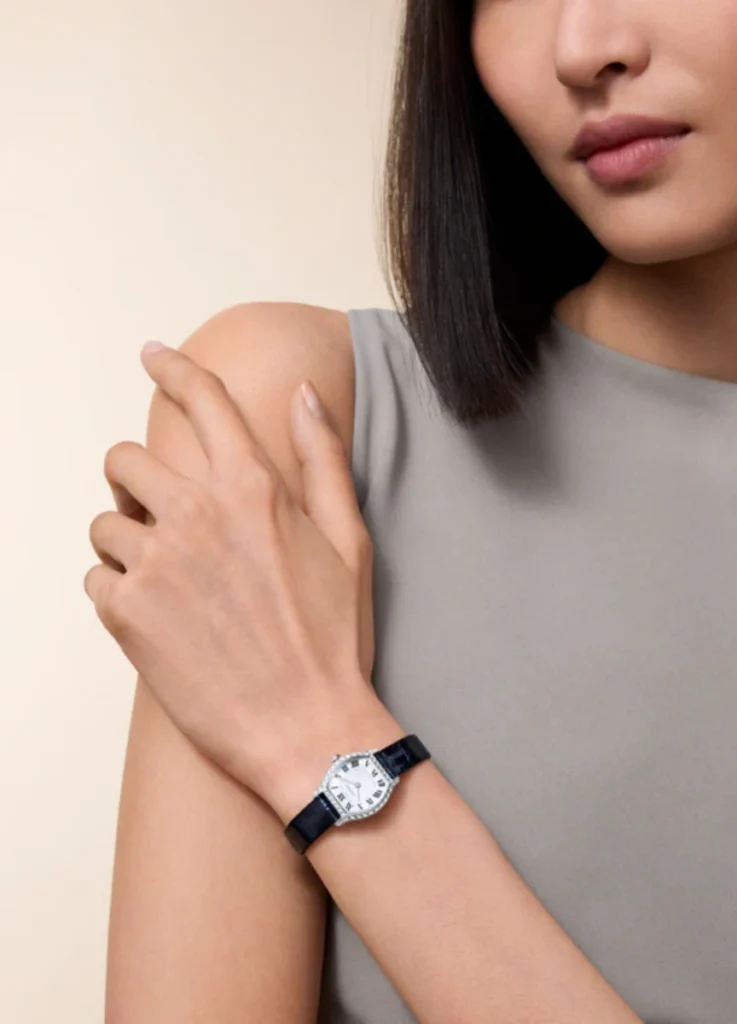
The Tortue’s case holds internal tension — upper and lower curves meeting lateral straight-line lugs. That tension gives the case architectural presence regardless of size. At 26.1 × 20.9mm — only 1.5mm longer and 2.2mm wider than the Baignoire mini — the perceived presence exceeds what those numbers suggest, because the form itself carries conviction.
The 42 diamonds trace the outline of that form. They do not replace it. They emphasize it. Because the setting concentrates on the bezel line only, the polished gold sides remain visible. Metal and diamond coexist. The watch retains its material identity.
On a strap, the Tortue mini holds its own balance. No bangle required. The case reads as a structure, not a decoration.
($21,400)
source: Cartier.com
The Lesson at Mini Scale — Structure, Not Carats
One thing is clear. At mini scale, no amount of diamonds can compensate for a case shape that cannot stand alone. And fewer diamonds on a self-supporting form will outperform a higher count on a form that needs external help.
The Baignoire mini pavé is not a lesser watch. On a bangle, it is excellent. But on a strap, many wrists will encounter the limits of the oval at this scale — curves remain, but structure disappears.
The Tortue mini resolves that limit through form. The internal tension of the case holds at any size. The mini retains the gravity of a watch even without a surrounding bracelet structure.
Same price range. Same maison. Same mini scale. The difference is whether the case shape can stand on its own.
($19,900)
@marina.halkina / Instagram
Final Reflection — Between Dress Watch and Daily Wear
Categorically, the Tortue leans toward a dress watch. In practice, the wearing experience is more flexible and more comfortable than that label suggests.
The pavé models, in particular, resist the expectation of excessive decoration. Diamonds cover the surface, but the setting follows form — light is amplified without disrupting structure. The watch lands in an uncommon position: neither fully formal nor strictly casual. A balance between the two that very few watches achieve by design.
That balance shifts subtly depending on the wearer’s body.
On a wrist with soft curvature and slim proportions, the Tortue’s oval case settles close to the skin and reads as a refined dress piece. On a wrist with more prominent bone structure or a flatter profile, the same watch gains visual weight and reads closer to a daily-wear object.
The character of this watch is not fixed. It completes itself when it meets the wearer’s body.
In that sense, the Tortue is less a product to be consumed and more an object whose meaning expands through the relationship with its wearer.
Choosing this watch is not a question of category. It is about deciding where your own standard of balance sits — and finding the form that holds it.
($21,400)
All images unless otherwise credited: © Lumie Story
[ Related Editorials ]