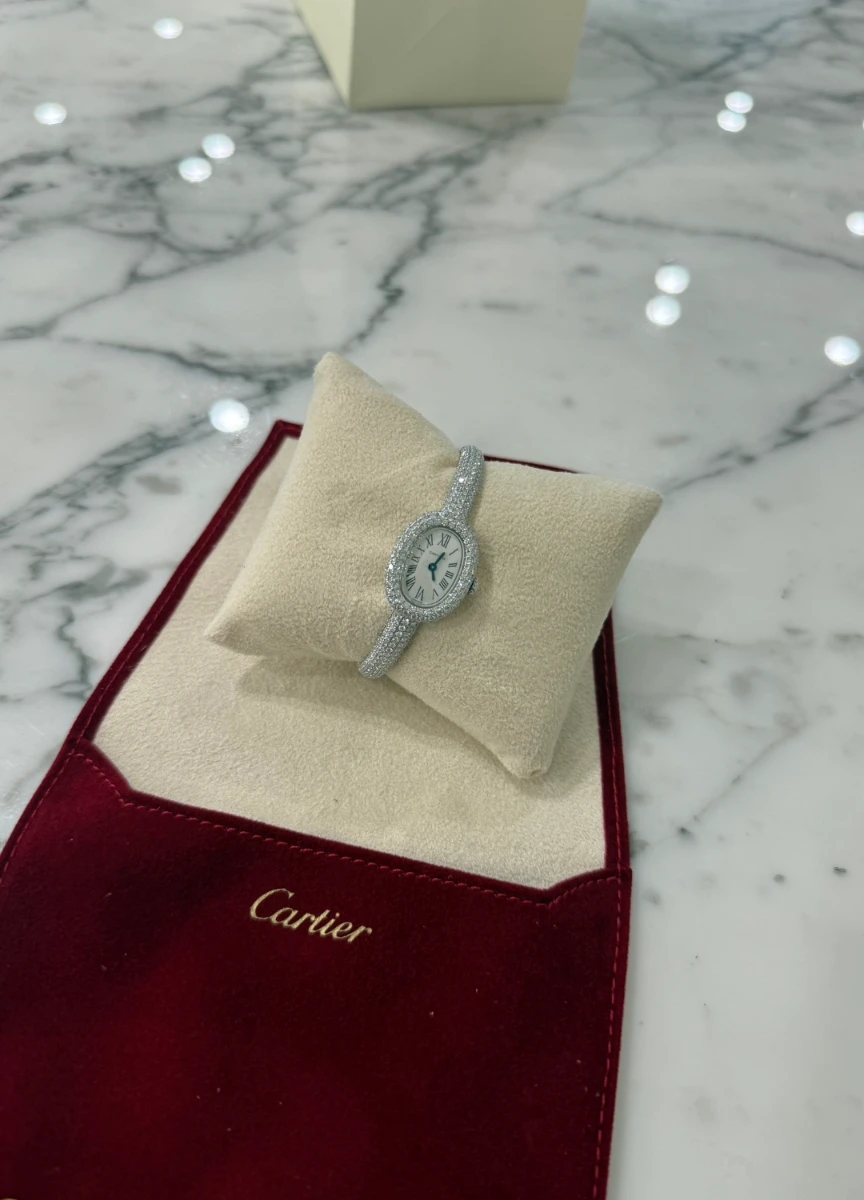
On the Form of the Baignoire Bangle
The Cartier Baignoire is often described as an oval watch. That description is technically correct—but it misses the point.
On the wrist, the Baignoire does not read as a shape. It reads as a curve—one that rests rather than sits, and moves with the body instead of marking it.
What defines the Baignoire can be reduced to three structural ideas.
First, the oval resists geometric purity. Rather than forming a perfect ellipse, the case carries a slight compression—an imbalance that introduces tension and keeps the shape from settling into decoration.
Second, the case and bracelet are not separate elements. The dial does not function as a visual center. Instead, it is absorbed into the structure, becoming a moment within a continuous line.
Third, unlike most watches, the Baignoire doesn’t feel “fastened” to the wrist. It simply rests on it—more like a piece of jewelry than a timekeeping instrument.
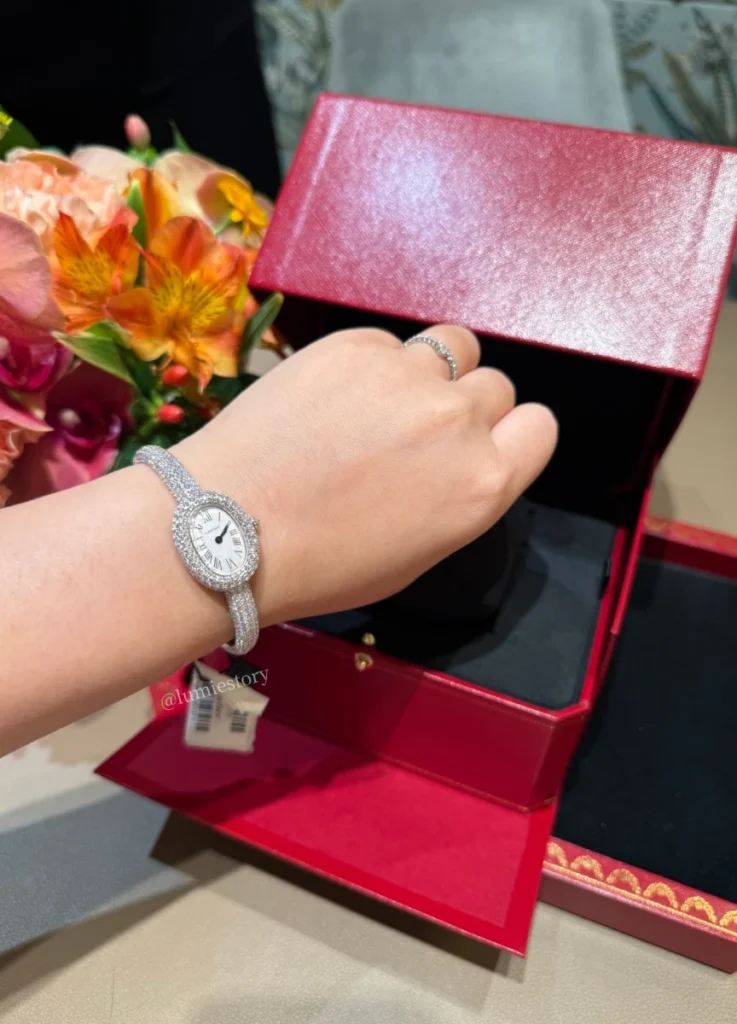
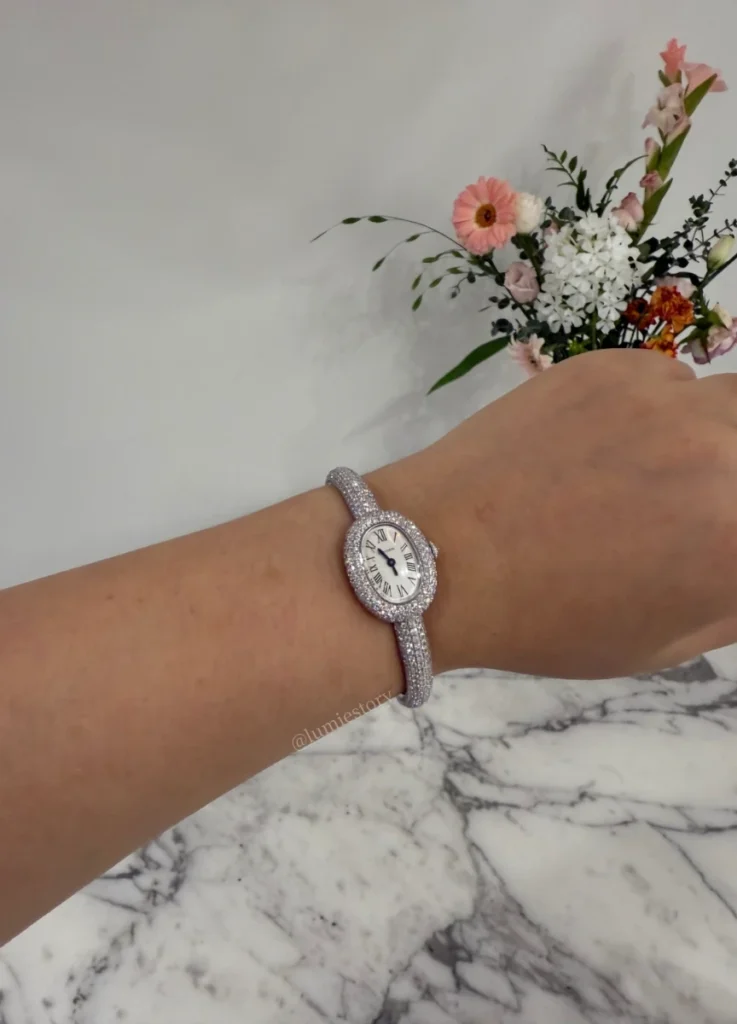
Rhodiumized 18K white gold
$63,500
photograph by Lumie
Because of this construction, the Baignoire does not transform through complications or mechanical variation, but through proportion, material, and surface.
Even within the same model, its behavior changes fundamentally:
The Mini operates as a line. The Small operates as a surface.
That distinction quietly determines every meaningful decision that follows.
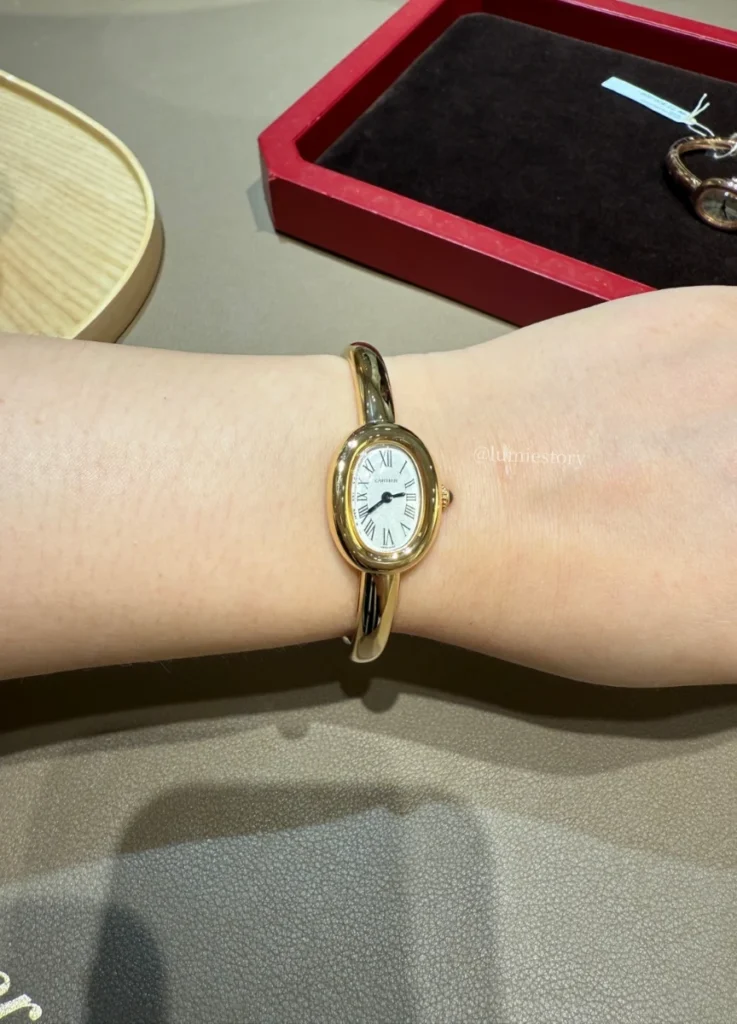
$16,200
photograph by Lumie
The Origin of a Shape
Before discussing how the Baignoire behaves today, a brief return to where it began.
In 1912, Louis Cartier designed an oval-cased wristwatch—an ovale cintré, in the original French—and presented it to the Grand Duchess Maria Pavlovna of Russia. This was not yet the Baignoire. The name would not be applied for another forty-five years. But the structural premise was already present: a circle, deliberately stretched.
At the time, this was not a subtle move. Round cases dominated early twentieth-century watchmaking. To elongate the form, even modestly, was to propose a different relationship between watch and wrist. The round case sits on the arm. The oval case follows it.
The watch was released commercially in 1957 under the name “Baignoire”—the French word for bathtub, though design historians remain divided on whether the reference was to the domestic object or to the VIP box seats of the same name at the Paris opera. Both associations are plausible. Both are ultimately beside the point. What matters is that by the late 1950s, Cartier had committed to a shape that no other maison has been able to appropriate since.
The 1960s brought the Baignoire Allongée, conceived in Cartier’s London workshops—an even more elongated version that later served, by way of creative accident, as the structural basis for the Crash. Through the following decades, the Baignoire remained quieter than the Tank or the Santos. It was a watch for clients who understood what they were buying without needing it explained.
The current Baignoire line exists in that same tradition, but with an added structural tension: two distinct versions—an older thick model and a recently refined slim version—now coexist within the same collection. This is not a matter of preference between them. It is a decision about what one wants a curve to do on the wrist.
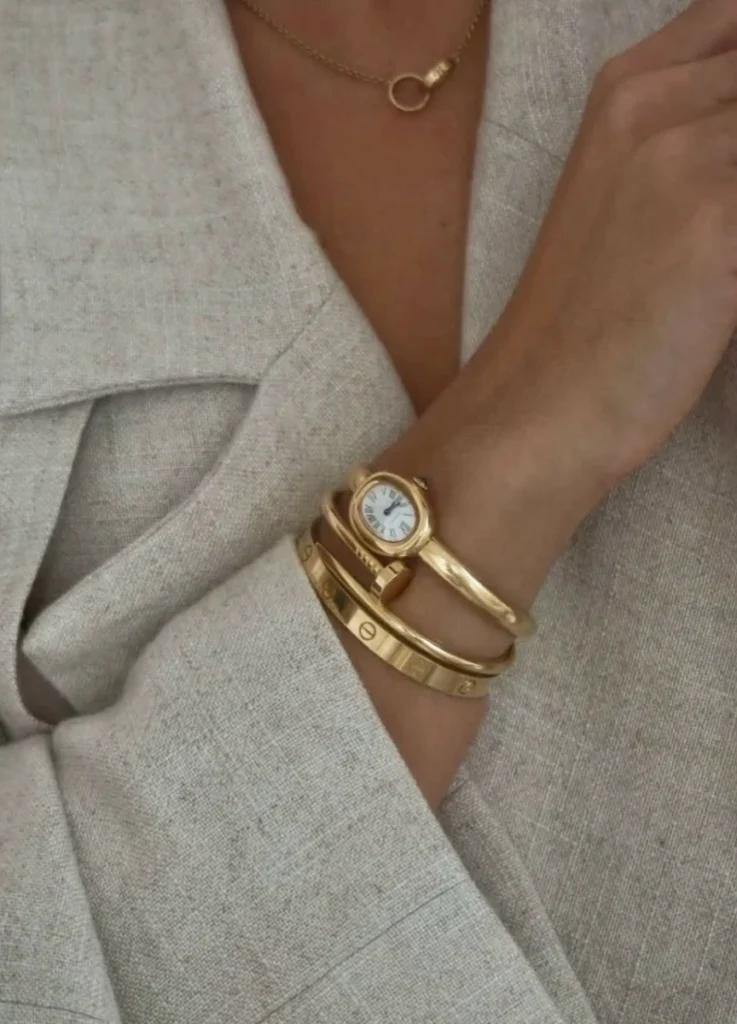
$16,200
@samdasuae / Instagram
A French Reading: Between Watch and Jewelry
From a French design perspective, the question of whether the Baignoire belongs to horology or jewelry is not particularly useful.
Objects are not defined strictly by function, but by how they are carried, perceived, and integrated into daily life.
A watch may indicate time, yet it also shapes the gesture of the wrist. Jewelry may decorate, yet it more deeply reflects a way of presenting oneself.
The Baignoire does not attempt to merge these categories into a hybrid. It simply exists between them.
As a result, it is neither a purely functional timepiece nor a conventional ornament.
In French terms, it aligns more closely with the idea of allure—something that resists direct explanation but becomes immediately perceptible through movement.
The oval resting on the wrist does not insist on attention. Instead, it reveals itself gradually, through motion and light.
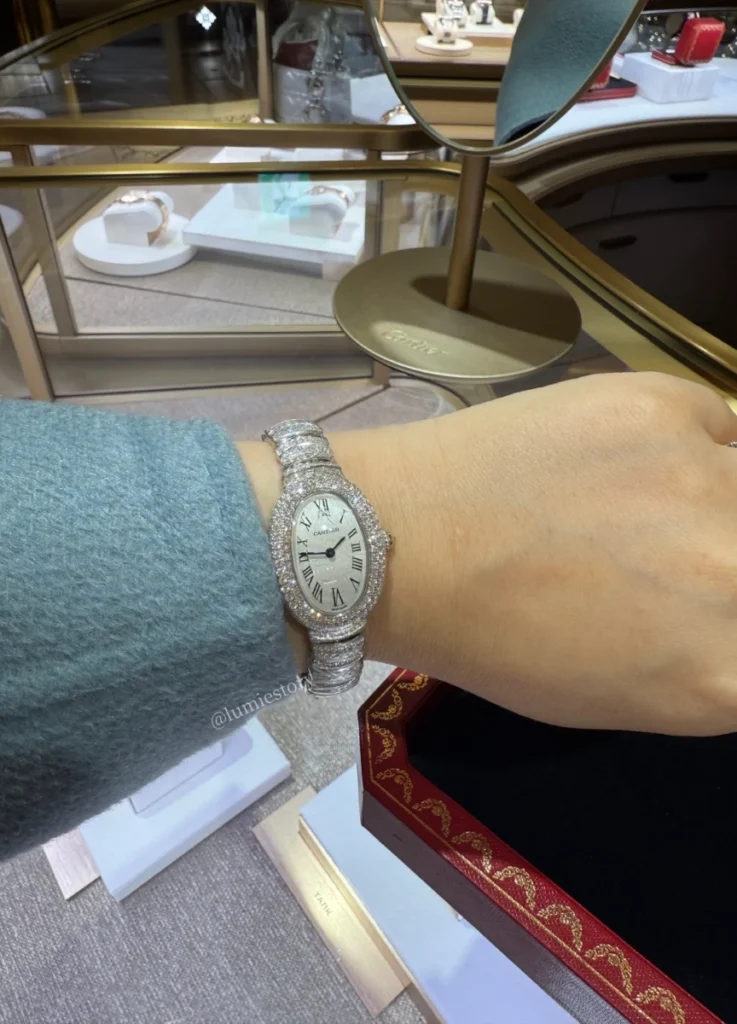
Rhodiumized 18K white gold
photograph by Lumie
Thick vs Thin: A Structural Shift Before Size
Before approaching size, a more fundamental distinction needs to be addressed: thickness.
Two different structural approaches currently coexist within the Baignoire bangle line.
Older models emphasize density and mass. Newer models refine the bracelet into a thinner, more fluid line.
This is not a minor update. It changes how the piece behaves.
The difference can be reduced to a simple contrast:
- Old → density of metal
- New → rhythm of line
Most people start with size. In reality, this is the decision that should come first.
The Old Thick Model — Density as Presence
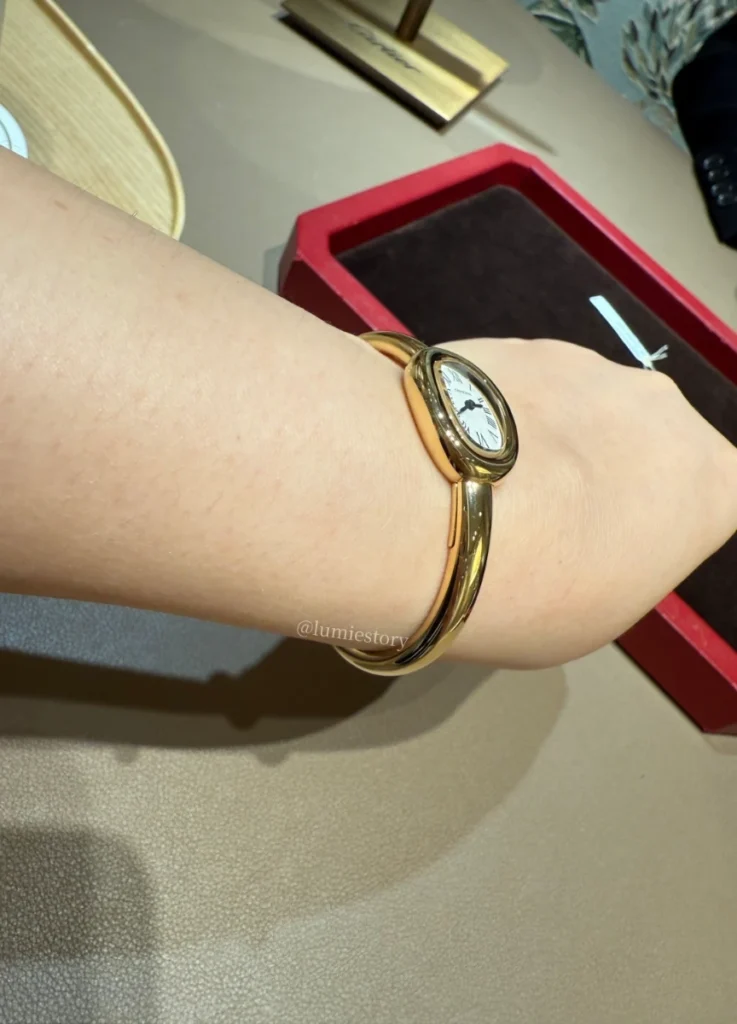
In the earlier Small configurations, the bracelet carries noticeable weight and volume.
The gold does not simply support the design—it defines it.
On the wrist, the piece feels contained and substantial. Rather than wrapping around the arm, it rests on it with a sense of deliberate weight.
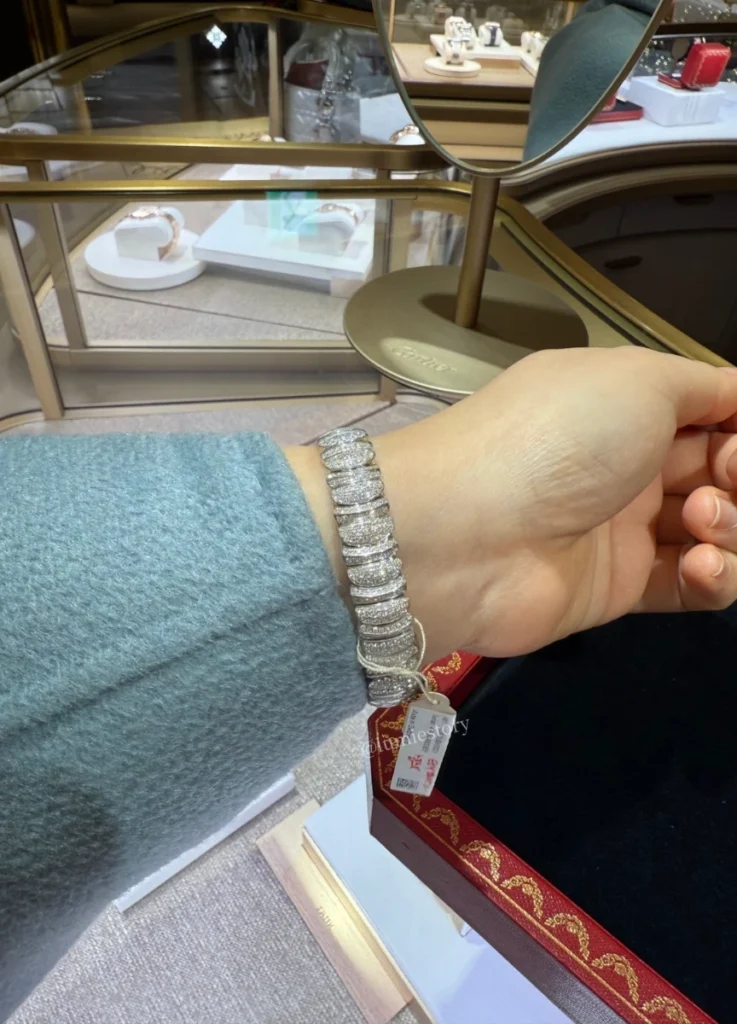
photograph by Lumie
In this configuration, the oval case recedes slightly, while the bracelet’s mass shapes the overall impression. The Baignoire moves away from the idea of a flowing curve and settles into something more complete, almost architectural.
This version works best for wrists that can support visual weight, styling approaches where one piece anchors the entire composition, and those who are drawn to the density of traditional gold jewelry. For collectors who came to fine jewelry through an old-money sensibility—where substance precedes display—this is the version that speaks most directly.
Here, the Baignoire expresses itself through presence rather than movement.
The New Thin Model — The Return to Line
The newer models move in the opposite direction.
The bracelet becomes thinner, lighter, and more continuous. As the material recedes, the curve itself becomes the focus.
In the Mini—case dimensions approximately 18.7 × 25.3 mm, paired with the slimmer bangle introduced in the most recent revision—this shift is most pronounced. The piece approaches the condition of a single uninterrupted line resting on the wrist.
Its identity changes accordingly.
Instead of sitting statically, the Baignoire begins to move with the wearer, aligning with gesture rather than resisting it.
This produces a more contemporary reading—less about objecthood, more about flow.
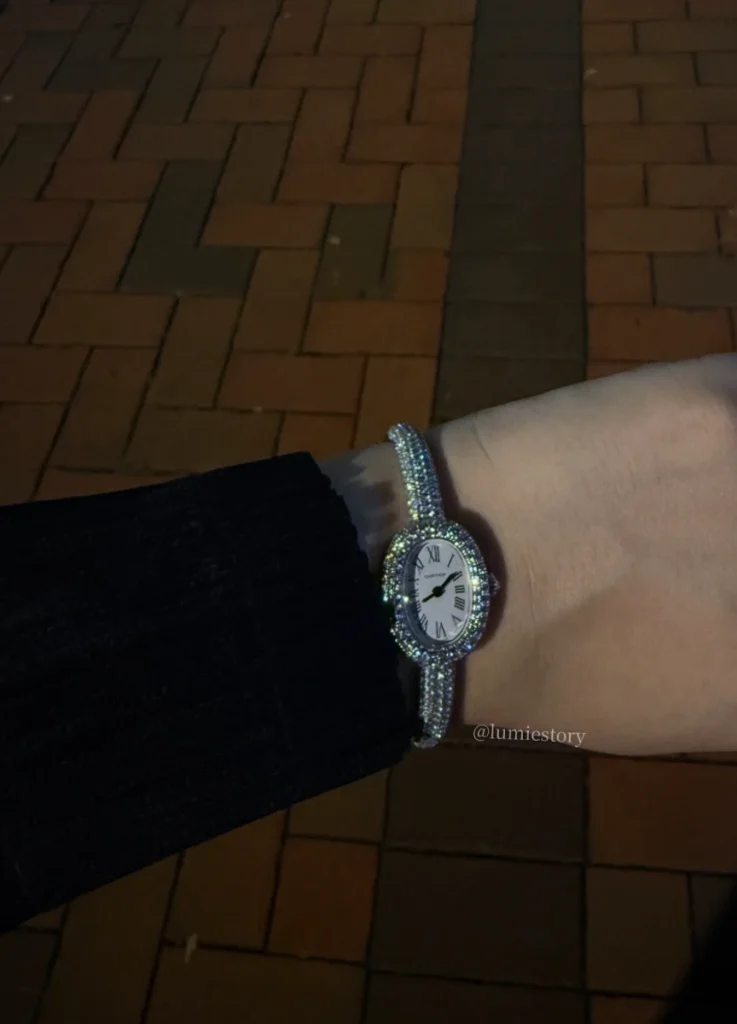
Rhodiumized 18K white gold
$63,500
photograph by Lumie
Mini vs Small: Line and Surface
Mini — A Line That Moves with the Wrist
The Mini reduces the Baignoire to its most essential expression. The case almost disappears, leaving the curve of the bracelet to define the entire piece.
On the wrist, it behaves less like an object and more like a line—subtle, continuous, and easy to forget—until it catches the light again.
For smaller frames, or when worn alone, the Mini integrates effortlessly. It does not compete for attention, but it quietly shapes the overall impression.
For wrists under 14 cm in circumference, or forearms on the shorter side, the Mini is the only version that reads correctly. In my case, the Mini is the answer—the version that resolves the question without compromise.
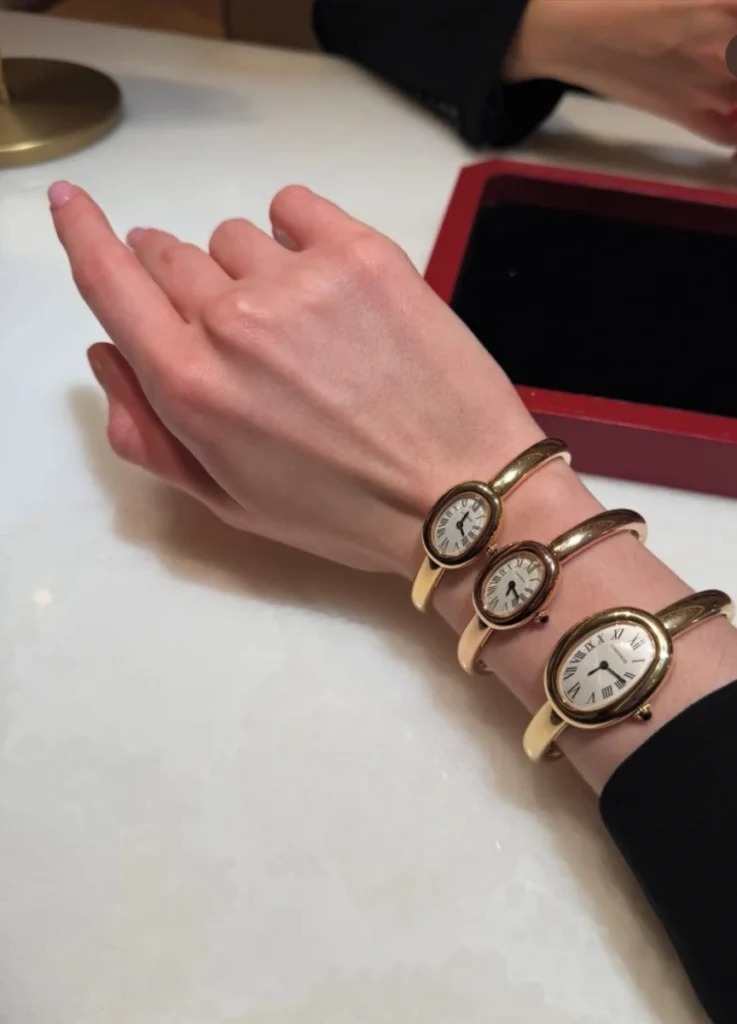
mini: $16,200 small: $21,400
@buybuy_shopping / Instagram
Small — A Surface That Holds Structure
The Small introduces a different kind of presence. The oval becomes clearly legible, and the watch begins to hold its own space on the wrist.
At this point, the Baignoire no longer blends in—it anchors. This makes it particularly effective in layered styling, but also more demanding in terms of proportion.
When proportions align, the curve retains its tension and fluidity. When they do not, the form can feel heavier than intended.
The Small does not simply enlarge the Mini. It changes the relationship between the object and the body.
For wrists above 15 cm in circumference, or for those who want the watch to function as a central styling element rather than a quiet trace, the Small is the more honest choice. Below that threshold, it begins to dominate rather than integrate.
Yellow Gold, Rose Gold, White Gold Pavé
Material as Structural Language
Yellow Gold — Clarifying the Form
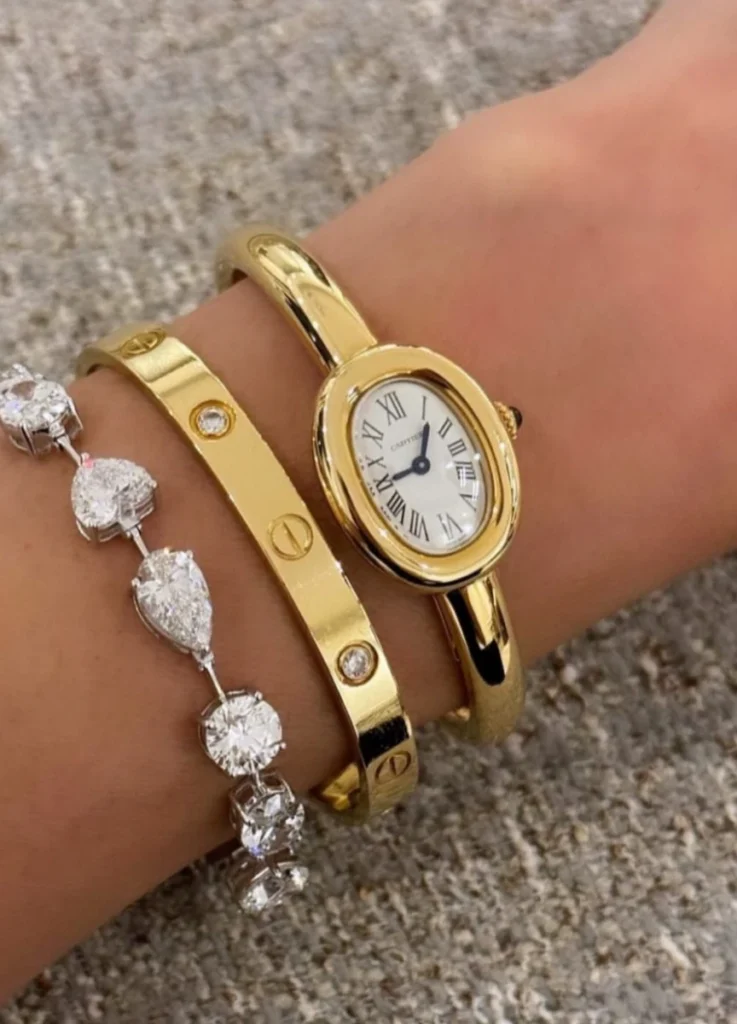
Yellow gold presents the Baignoire with the greatest clarity.
Its surface allows the curve to remain legible and stable, making the structure easy to read.
In both Mini and Small, this is the most direct interpretation of the design.
$16,200
@danaalalami / Instagram
Rose Gold — Softening the Boundary
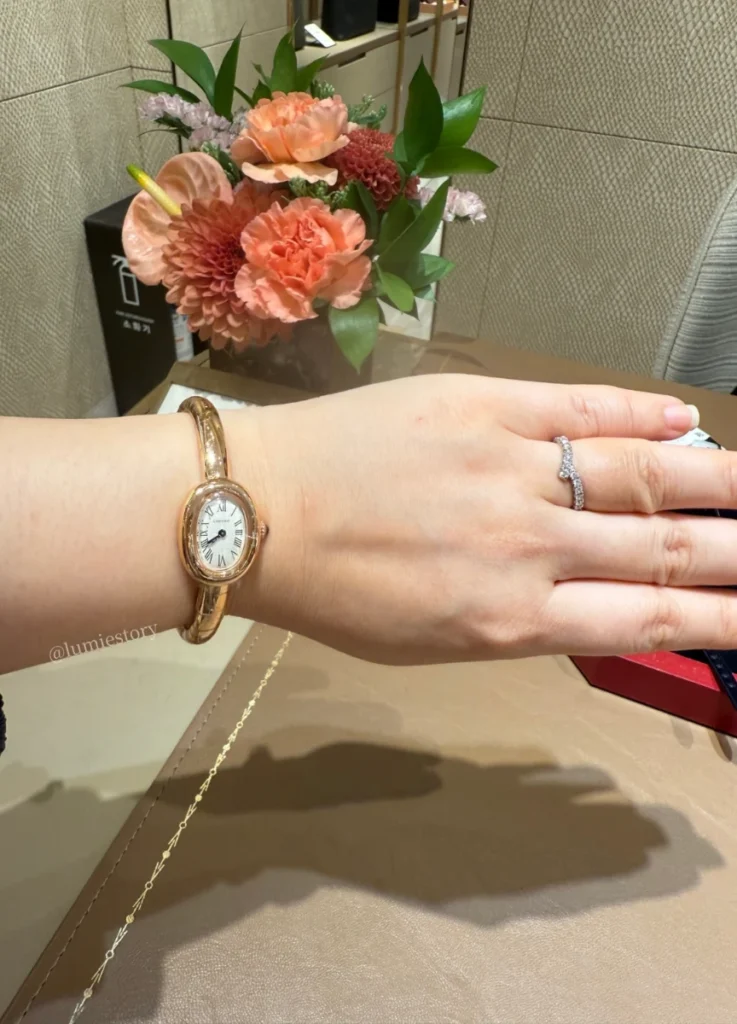
Rose gold reduces contrast between object and skin.
The form diffuses slightly, and the piece feels less defined as a separate object.
In the Mini, it can almost disappear into the wrist. In the Small, it softens the perception of volume.
$16,200
photograph by Lumie
White Gold Pavé — Transforming Structure into Light
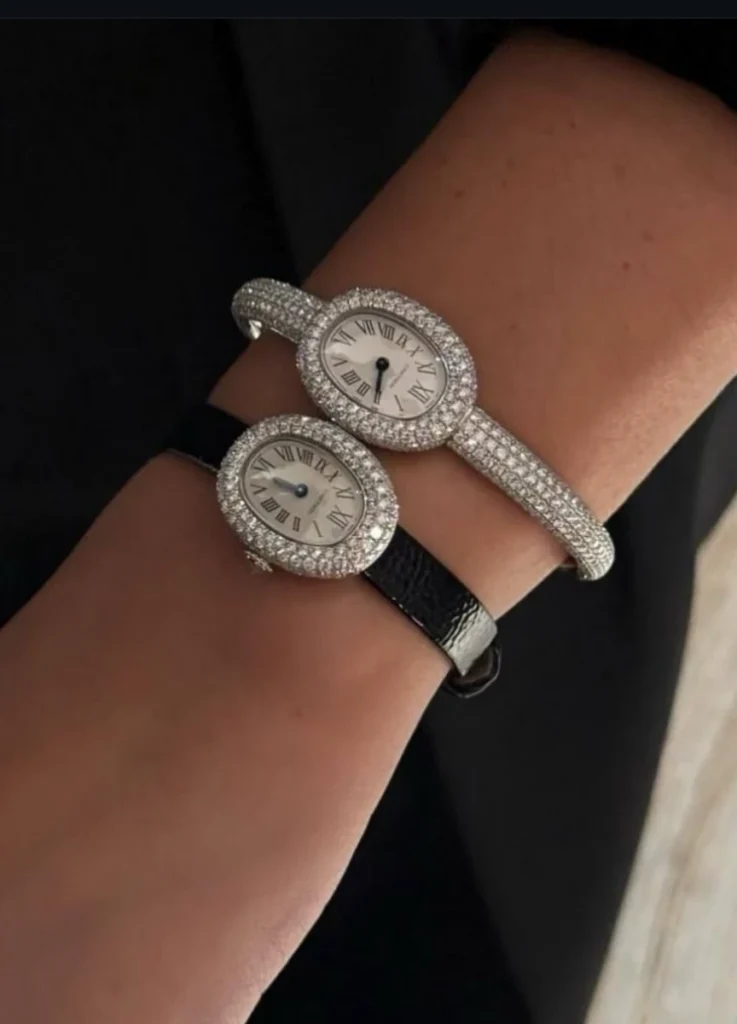
With pavé, the material language shifts entirely.
Metal recedes, and diamonds take over the surface. The curve is no longer read as structure, but as movement of light.
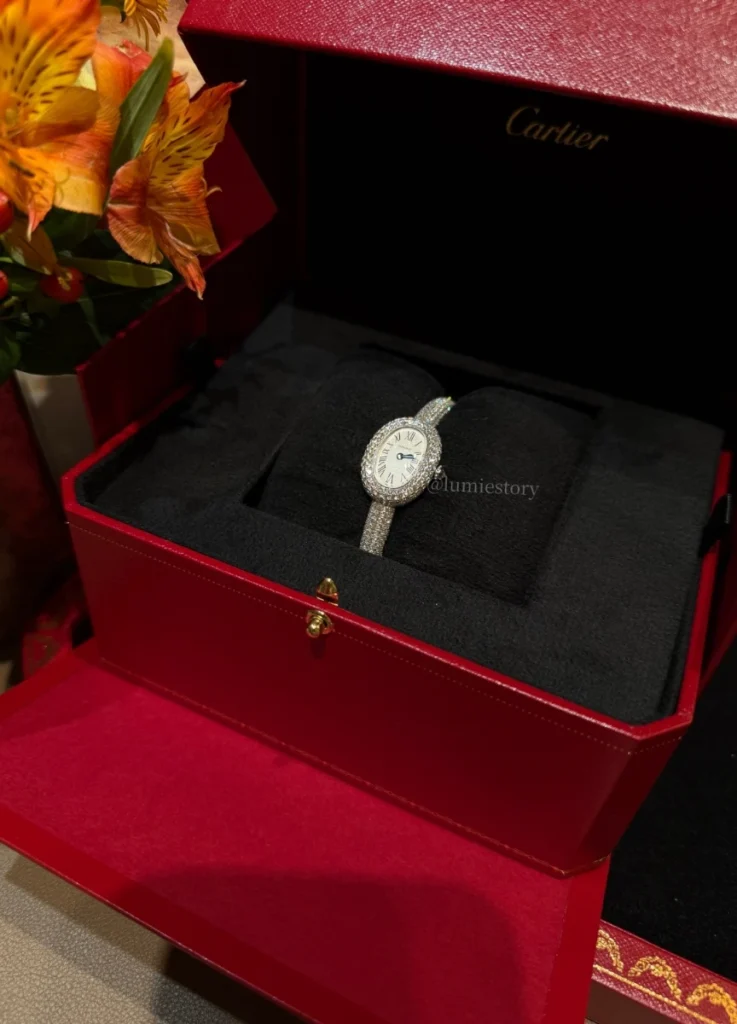
In the Mini, this appears as a fine luminous line. In the Small, it becomes a fully articulated high-jewelry object.
One practical consideration, often overlooked, is weight. While the pavé versions are not particularly heavy at first, the difference becomes noticeable over a full day of wear. The added presence of diamonds introduces a subtle but cumulative weight on the wrist.
For those who are sensitive to weight or prefer a lighter feel on the wrist, the strap versions tend to be a more comfortable alternative.
In the Mini, the pavé does not extend fully to the back. The stones taper gradually along the sides in what Cartier refers to as a semi-pavé construction, preserving the fluidity of the curve rather than fixing it into rigidity.
At this stage, the Baignoire is no longer read as a conventional watch. It becomes an oval constructed through light.
Rhodiumized 18K white gold
Bangle – $63,500 / Strap-$22,600
@cartieraddict / Instagram
Model Analysis
Plain Mini / Small — Yellow Gold & Rose Gold
These models rely entirely on the behavior of metal.
The Mini in yellow gold presents the Baignoire in its most distilled form. In rose gold, that same line softens and merges into the skin.
The Small in yellow gold offers the most balanced and resolved expression. In rose gold, the volume becomes more adaptable, integrating easily with other pieces.
$16,200
photograph by Lumie
Small Rose Gold with Diamond Row
This model occupies a nuanced middle ground.
A single row of diamonds follows the curve, introducing rhythm without overwhelming the structure.
It is not purely about form, nor fully about light. Instead, it creates a controlled trajectory—a line of light tracing the curve.
This balance works best in the Small size, where both elements remain visible. In the Mini, the detail becomes too fine to register.
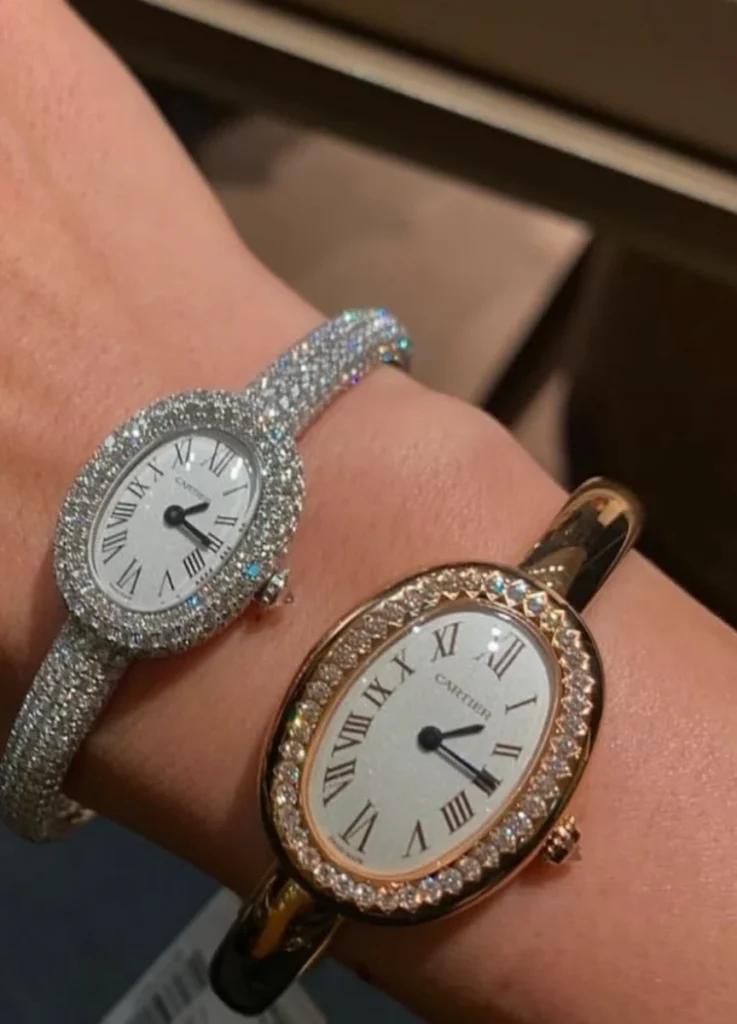
Baignoire de Cartier watch, Small model, 18K rose gold($29,900)
@cartieraddict / Instagram
White Gold Pavé — Mini & Small
These represent the Baignoire at its most elevated expression.
The Mini becomes a refined thread of light, most effective when worn alone.
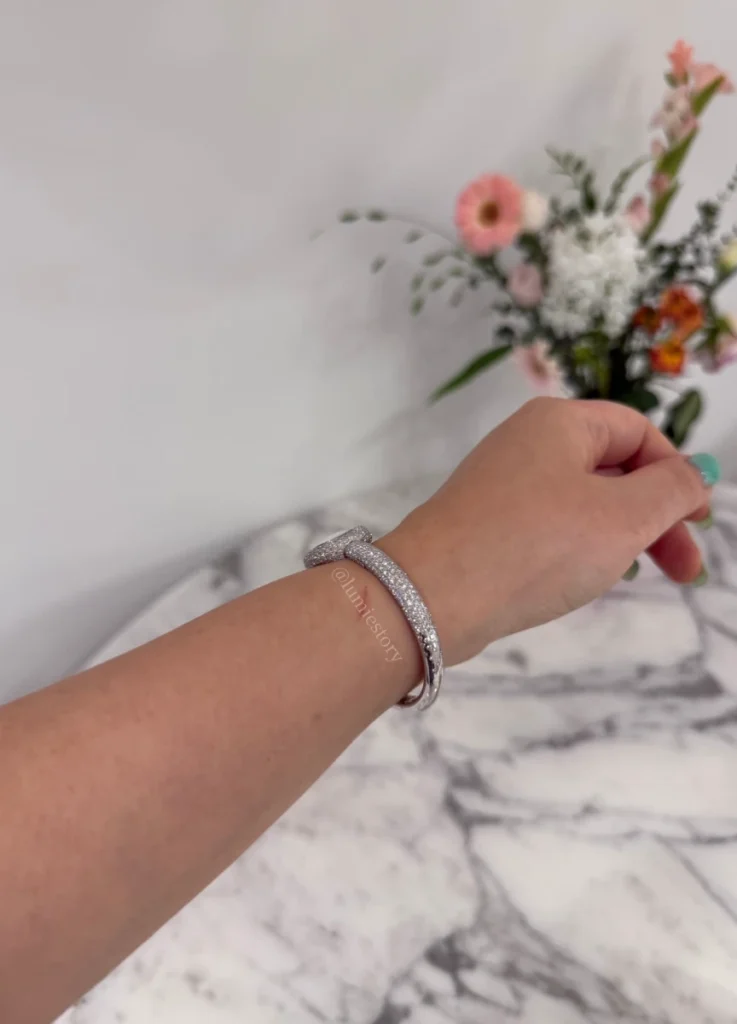
$63,500
photograph by Lumie
The Small develops into a dominant object—one that often defines the entire wrist.
At this level, layering becomes less necessary. The piece carries enough presence on its own.
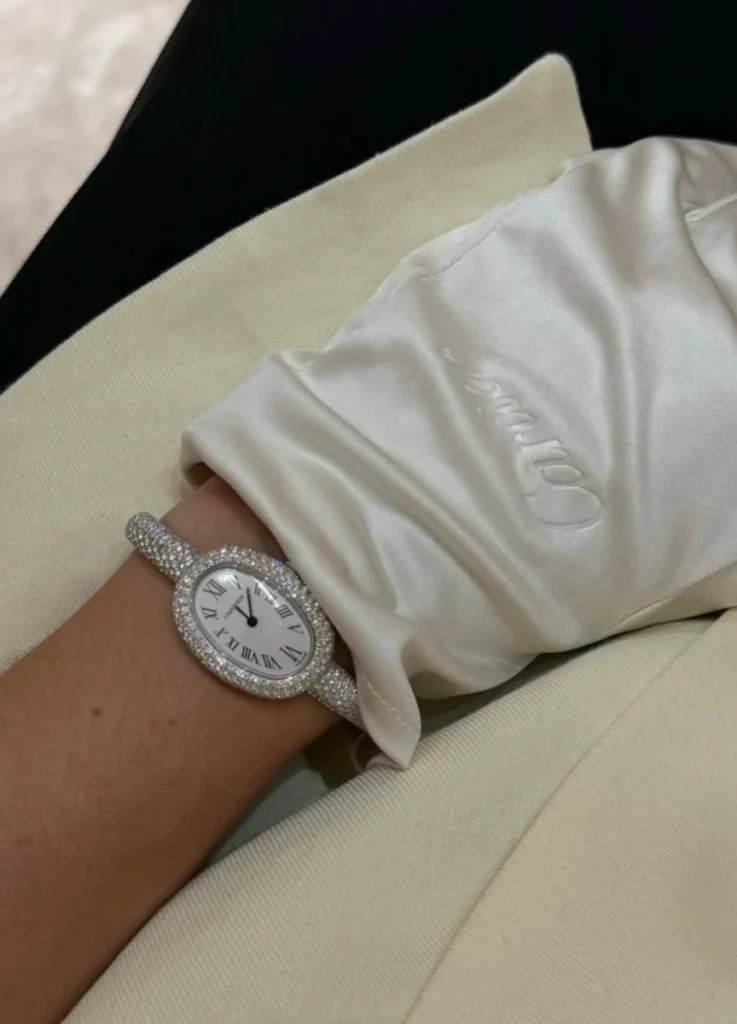
@cartieraddict / Instagram
What Actually Works
Fit Beyond Preference
What works here depends less on personal preference, and more on proportion and context.
- For smaller wrists or minimal styling: → The new thin Mini
- For layering and balanced composition: → The new thin Small
- For strong standalone presence: → The old thick Small or pavé models
The most common Baignoire purchasing mistake is choosing size before resolving thickness. This is particularly visible with the old thick Small on a narrow wrist, where the weight reads as imbalance rather than presence. The piece stops behaving as a curve and begins behaving as a constraint.
The configuration that consistently underperforms is the wrong thickness on the wrong wrist. Almost everything else can be adjusted.
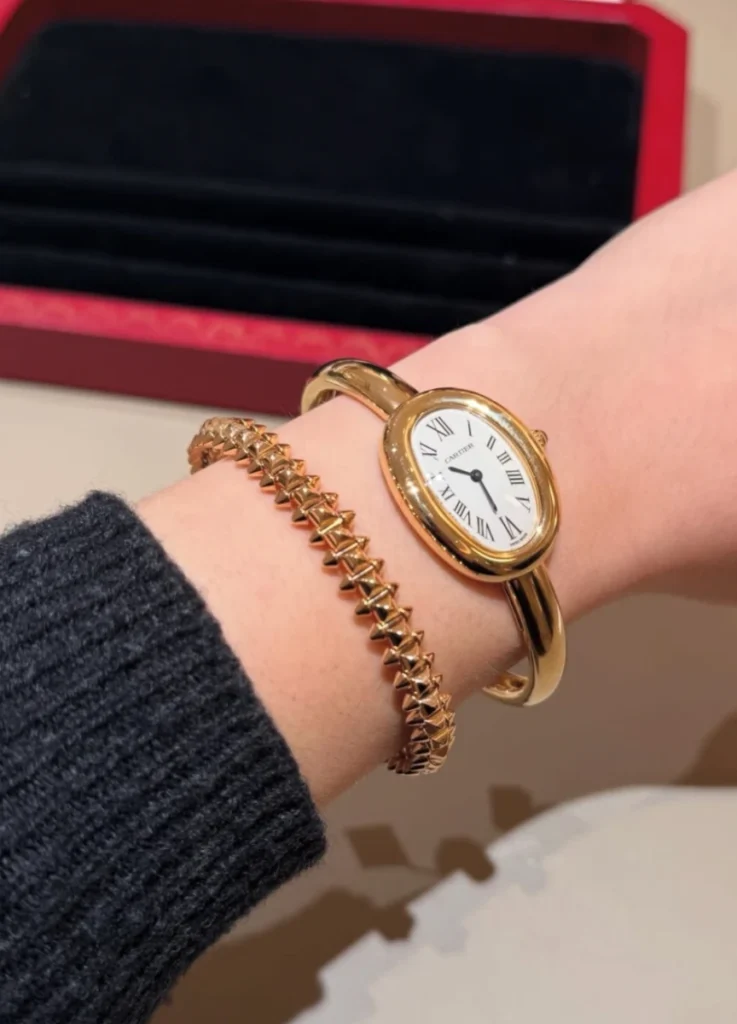
$21,400
@buybuy_shopping / Instagram
Model Overview
Structure, Material, and How Each Version Reads on the Wrist
| Model | Structure | Visual Behavior | Best Use Case | Styling Impression |
|---|---|---|---|---|
| Mini – Yellow Gold (Plain) | Line-based, minimal mass | Clean, defined curve | Small wrist / solo wear | Pure, structural, quietly precise |
| Mini – Rose Gold (Plain) | Line-based, softened edge | Blends into skin | Natural daily wear | Subtle, atmospheric, almost invisible |
| Small – Yellow Gold (Plain) | Surface-based, stable form | Clearly defined oval | Standalone piece / anchor in styling | Classic, composed, most “complete” |
| Small – Rose Gold (Plain) | Surface with softened volume | Diffused structure | Layering with other jewelry | Balanced, fluid, less assertive |
| Small – Rose Gold (Diamond Row) | Surface + linear light accent | Curve traced by light | Elevated daily wear | Refined, controlled brilliance |
| Mini – White Gold Pavé | Line transformed into light | Delicate luminous trace | Solo, minimal styling | High refinement, discreet luxury |
| Small – White Gold Pavé | Surface fully dissolved into light | Strong visual focus | Statement piece | High jewelry object, dominant presence |
| Small (Old Thick Model) | High-density object | Mass-driven presence | Bold standalone styling | Classic, weighty, traditional gold |
| Mini / Small (New Thin Model) | Reduced mass, flow-driven | Movement-oriented | Modern styling / layering | Light, fluid, contemporary |
Instead of choosing by size alone, the Baignoire should be read through its structural behavior—whether it functions as a line, a surface, or light, and how that aligns with the wearer’s proportions and styling intent.
Rhodiumized 18K white gold
$63,500
photograph by Lumie
Final Reflection
The Baignoire is not simply a choice between sizes or materials.
It is a decision about how a curve should exist on the wrist—
As a line. As a surface. Or as light.
In the end, the Baignoire is less about telling time and more about how it sits on the wrist—and how that presence changes the way movement is perceived.
photograph by Lumie
All images unless otherwise credited: © Lumie Story
[ Related Editorials ]