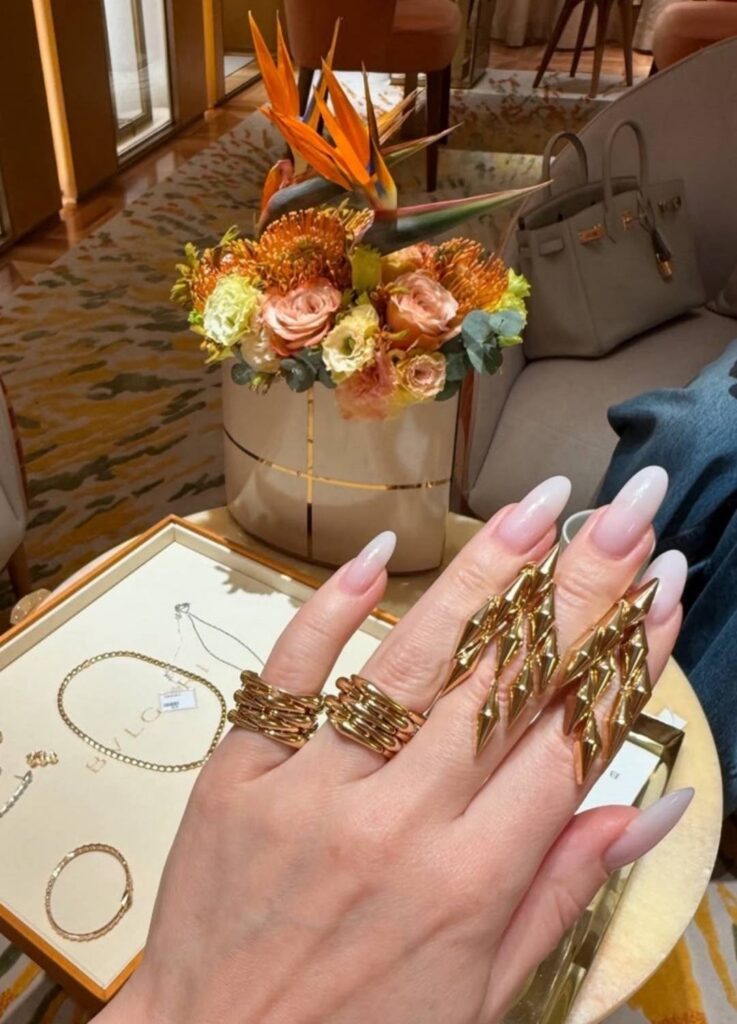
On modular gold, movement, and the architecture of the wrist
Bvlgari’s newly unveiled Eternal Collection resists the usual definition of a “new release.”
Rather than asserting novelty, it reactivates time—translating an archival logic into a contemporary metal language. At the center of this approach is Vimini, a line derived from a 1940s bracelet held in the Bvlgari archive.
This is not heritage reproduced.
It is heritage reconstructed as structure.
What follows is a close reading of the Eternal Collection’s origins, its formal vocabulary, and the precise conditions under which Vimini achieves its strongest visual and physical coherence on the body.
Origins of the Collection
The Return of Vimini from the 1940s Archive
The Eternal Collection begins with a bracelet created in the 1940s—a period defined by material scarcity and wartime constraint.
In that context, ornament was reduced, and structure became expression.
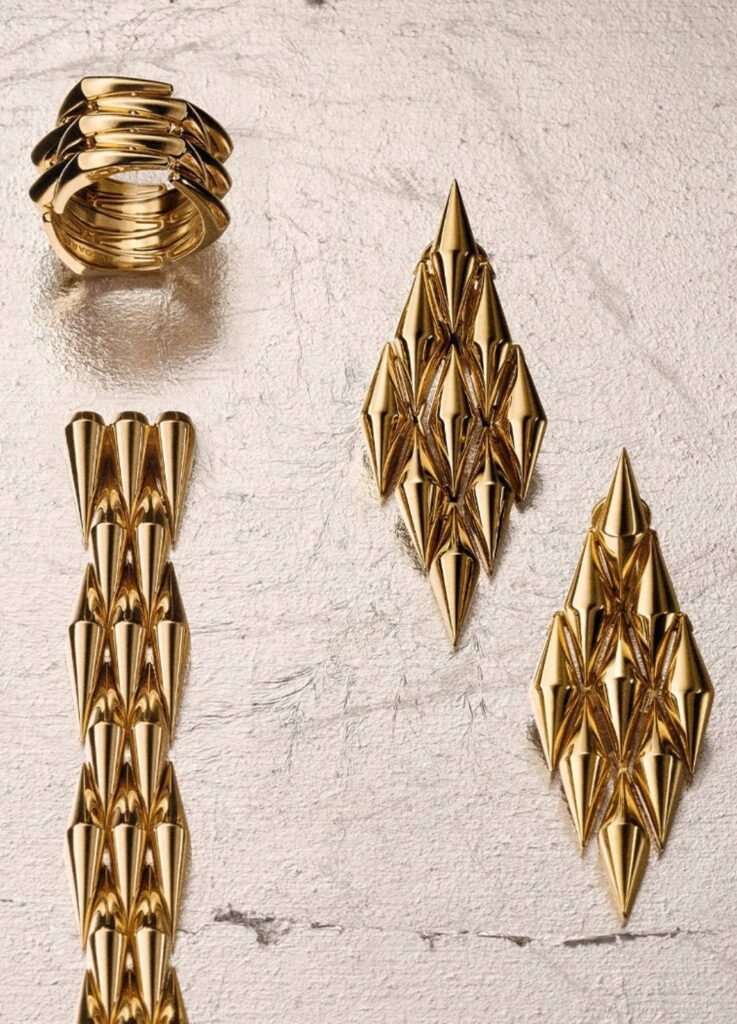
The original piece relied on repetition rather than embellishment: slender gold modules joined in rhythmic sequence, forming volume through accumulation rather than mass. Straight lines intersected with diagonals, producing a surface that felt both restrained and assertive.
Bvlgari’s crucial decision here is what it did not do.
The brand did not replicate historical proportions, nor did it attempt a literal revival. Instead, it isolated the essential principle: the modular system. Everything else—scale, finish, articulation—was recalibrated for the present.
This choice positions the Eternal Collection not as a nostalgic gesture, but as a contemporary structural proposal.
The Formal Language of Vimini
Gold as Repeated Sculpture
Vimini’s defining characteristic is repetition as form.
Triangular, faceted modules are connected at consistent angles, fragmenting light into controlled reflections. The result is neither fluid like a chain nor rigid like a bangle.
Vimini occupies an intermediate state:
flexible, yet architectural.

- Bracelet
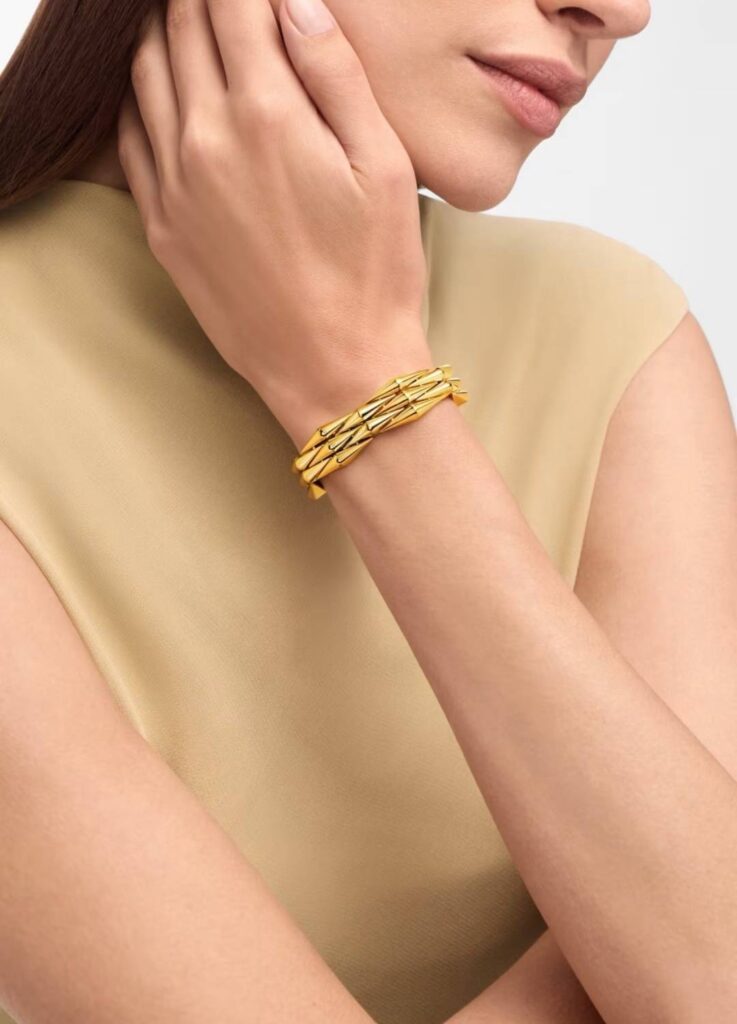
As the piece encircles the wrist, each module subtly adjusts its orientation. From the front, the rhythm appears ordered and continuous; from the side, the volume reads as sculptural. The sensation is not of something wrapping or coiling, but of a structure settling into place. - Ring
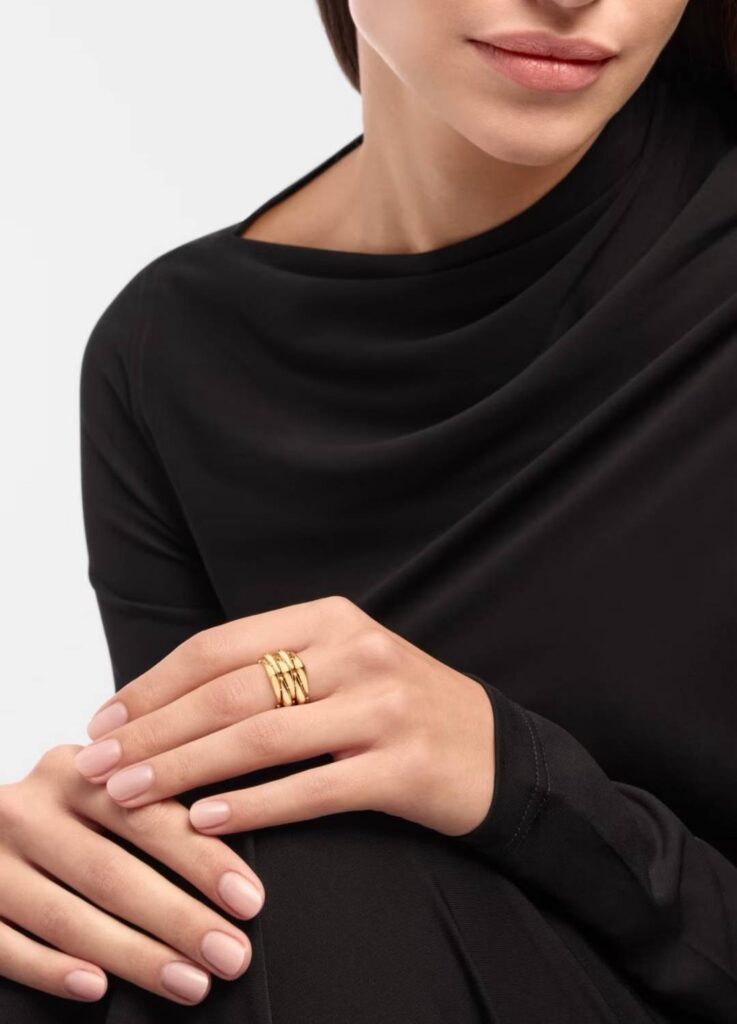
Though visually layered, the ring is a single integrated construction. Weight is evenly distributed along the finger’s curvature, resulting in surprising stability relative to its apparent mass. - Earrings and Necklace
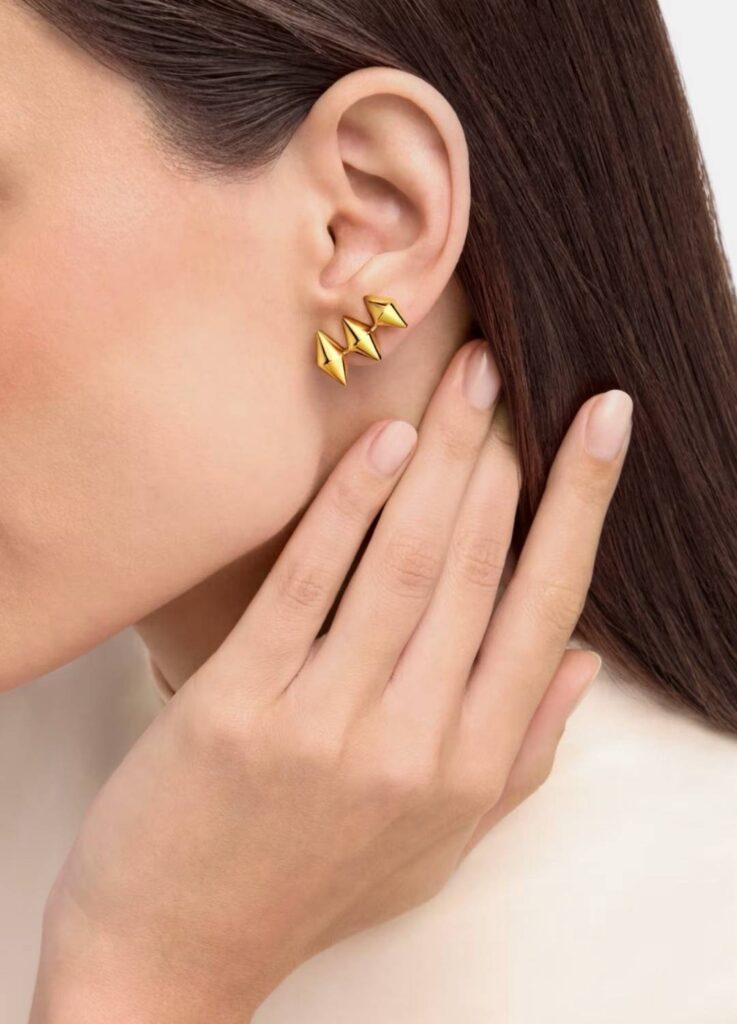
Using the same modular unit, these pieces extend vertically or horizontally, producing architectural silhouettes that rely on repetition rather than ornament.
Throughout the line, gold is not used to decorate.
It is used to demonstrate density, rhythm, and continuity.

Why “Eternal”?
Permanence Through Structure
The name Eternal is deliberate—and specific.
This is not an abstract claim to timelessness. The durability of the collection lies in its method, not its symbolism.
- No reliance on diamonds or colored stones
- Gold weight and assembly as the primary aesthetic
- A form governed by logic rather than trend
In this sense, Eternal occupies a different register from Bvlgari’s Serpenti line. Where Serpenti builds memory through symbol and sensuality, Eternal does so through structure.
Here, remembrance is not emotional—it is architectural.

Who Does Vimini Suit?
Conditions for Visual and Physical Coherence
1. Wrist and Body Type
- Slender wrists benefit from Vimini’s density; the structure adds presence without overwhelming.
- Fuller wrists experience effective weight distribution, with minimal pressure or constriction.
2. Upper Body Proportion
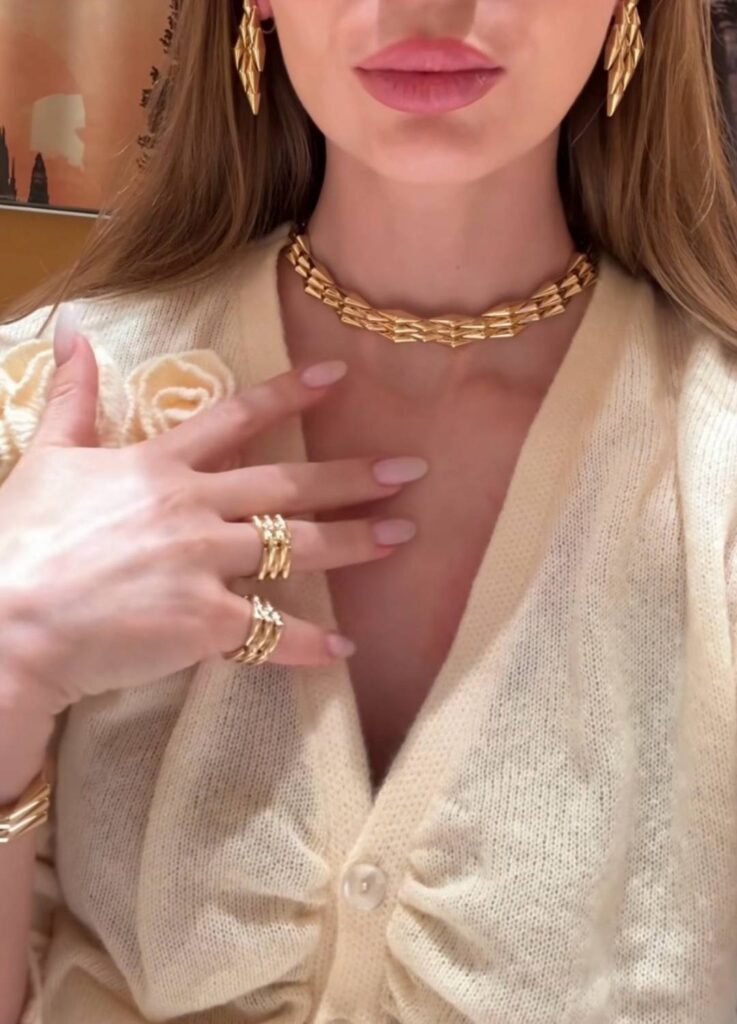
Vimini’s sharp planes and defined facets become more articulate closer to the face.
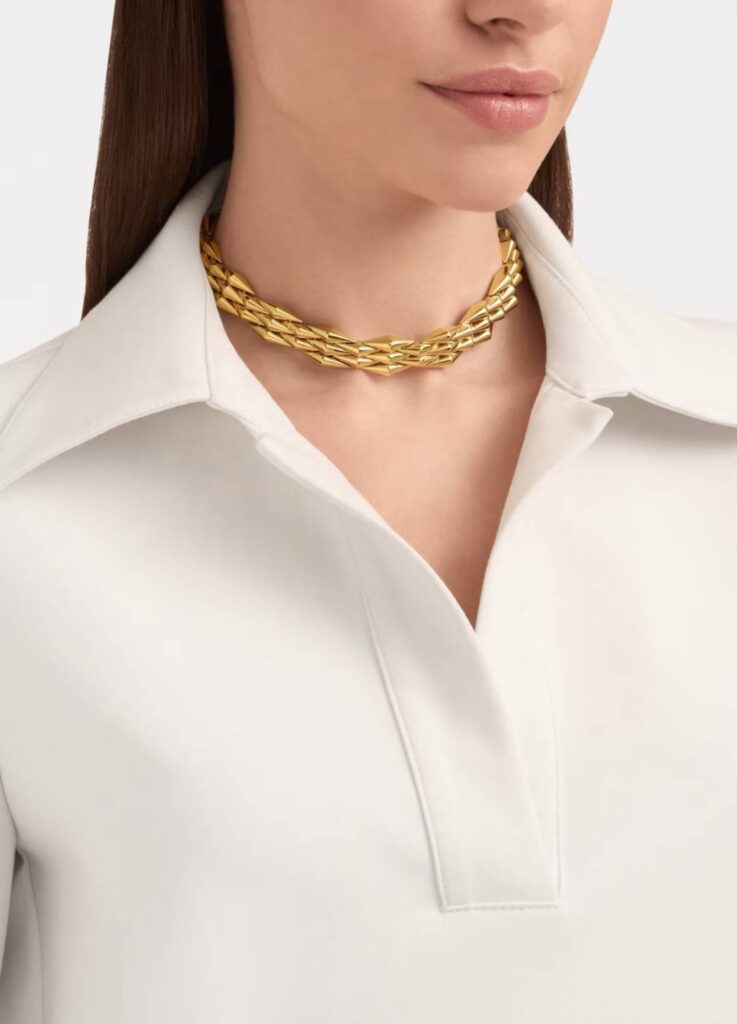
- Necklaces read best at collarbone height, near a choker position.
- Earrings are most effective between cheekbone and jawline, where vertical repetition is visually legible.
- Hair worn back—low buns or clean ponytails—allows the geometry to register clearly.
3. Height and Scale
- Around 160 cm: Bracelet worn alone creates the strongest proportion. Shorter necklaces maintain visual tension.
- 165–170 cm: Bracelet and earrings together form a balanced upper-body frame.
- Above 170 cm: The necklace achieves full sculptural scale, with planes reflecting across the chest.
4. Hands and Details
Long fingers or pronounced joints emphasize the ring’s layered effect.
Matte or low-saturation nails prevent interference with gold’s reflections. Bracelets sit best just above the wrist bone, where the structure appears anchored rather than mobile.
5. Clothing Interaction
- Necklines: shallow V or square shapes frame the metal without dispersing focus.
- Fabrics: knit, wool, silk—textures that remain quiet. Ruffles and heavy drape compete with the geometry.
- Layering: minimal. Vimini performs strongest as a singular frame.
6. Emotional Readiness
Vimini is not a passive accessory. The moment it is worn, visual gravity shifts toward the wrist or hand. It suits those comfortable allowing a single object to carry structural authority.
The Position of Eternal Within Bvlgari
A Strategic Quiet Turn
The Eternal Collection extends Bvlgari’s recent emphasis on form-driven design.
If Serpenti speaks the language of iconography and desire, Eternal speaks in terms of archive, construction, and continuity.
It is quieter—but more durable.
Rather than aiming for immediate recognizability, the collection functions as a statement of direction. Bvlgari is, at this moment, choosing structure over spectacle.
Closing
What Remains When Trends Fall Away
The Eternal Collection poses a simple question:
Why do we keep certain pieces for decades?
Bvlgari answers not with brilliance or rarity, but with repeated gold—assembled through logic rather than fashion.
On the wrist, these modules hold their shape without insistence.
They age without losing coherence.
Not because they shine,
but because they are built to stand.
In that sense, Eternal earns its name—
not through radiance, but through structural integrity.
[ Related Editorials ]