Demna’s fourth act at Gucci puts restoration above invention — and uses Tom Ford’s commercial language as the blueprint.
Inside Gucci Cruise 2027
The cruise collection is normally a predictable format.
Houses take a step away from the tension of main-season shows and translate movement, holiday, and ease into something lighter and more easily consumed. The cruise wardrobe has long been the wardrobe of someone going somewhere.
Gucci’s cruise this season uses the format to do something else.
Demna’s first Gucci cruise doesn’t look like clothes for a holiday destination. It looks like a statement about what the brand intends to put back at its center. The signal starts in the collection’s name.
GucciCore.
It is a structural declaration more than a seasonal one. Rather than asking what is new this season, the name announces what Gucci intends to repeat. After the past few years at Gucci, repetition is the point.
Where Gucci has been makes that thesis sharper. Alessandro Michele built a world that was rich and emotionally specific — to wear Gucci was to enter a taste, not to assemble a wardrobe. That world was powerful, but it asked the customer to commit to a feeling, not to fill a closet. Sabato De Sarno turned the other way: quieter, more pared-back, more “realistic” luxury that came across as polished but never quite restored the brand’s old appetite. Clothes were organized. Desire was not.
Demna’s first cruise breaks from both. He has not designed a new fantasy. He has rebuilt the commercial backbone — the categories Gucci can sell, repeatedly, into customers’ actual wardrobes. The collection lands less as an aesthetic declaration and more as a commercial one.
The Fourth Act
Demna calls this collection “the fourth act,” and the framing is precise. What he has shown at Gucci over nine months reads less as four discrete seasons and more as four stages of one long project.
The first, La Famiglia, defined the people before the clothes. The lookbook introduced character types more than outfits — figures with implied social positions, attitudes, ways of wearing Gucci. The traditional debut shows clothes first. Demna showed casting first. He decided who Gucci is going to dress before he decided what they would wear.
The second, Generation Gucci, brought in time. From that point on, Gucci’s past entered the work directly. The late-1990s Tom Ford era surfaced — sharp cuts, restrained sensuality, the after-dark sophistication of that period. The choice to deliver it as a lookbook rather than a runway show was telling. Demna wasn’t producing spectacle. He was reorganizing brand memory.
The third, Primavera, finally moved to the body. The clothes stopped citing images and started behaving on a contemporary figure — surfaces close to the skin, tensioned silhouettes, sensuality engineered rather than performed. The Tom Ford echo got louder, but it now arrived inside Demna’s colder, more calculated precision.
GucciCore is the fourth, and the structure is now visible. Define the customer. Settle the era of memory to draw from. Move it onto the body. Then consolidate everything into a closet that can actually be sold.
This is less a season than a long-form redesign of the brand’s product architecture.
@gucci / Instagram
The Tom Ford Ghost
It is difficult to watch this collection without thinking of Tom Ford.
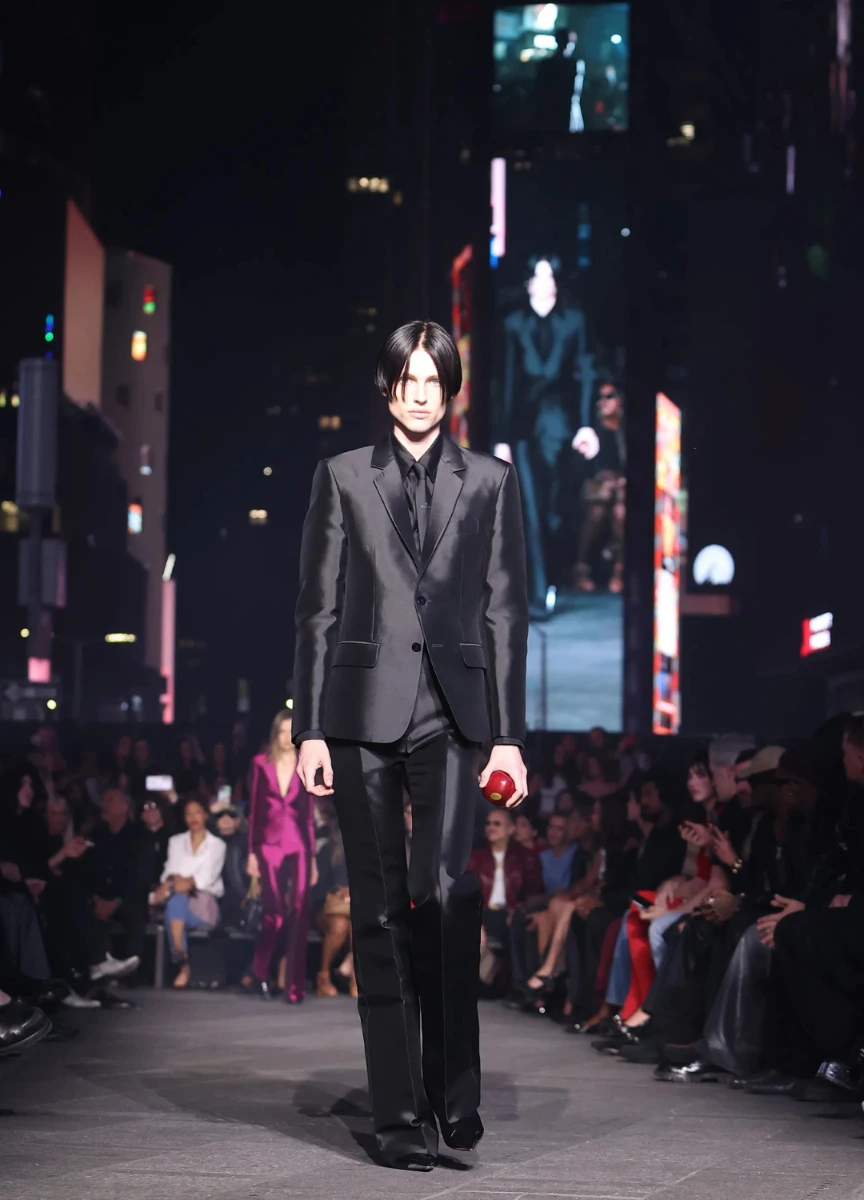
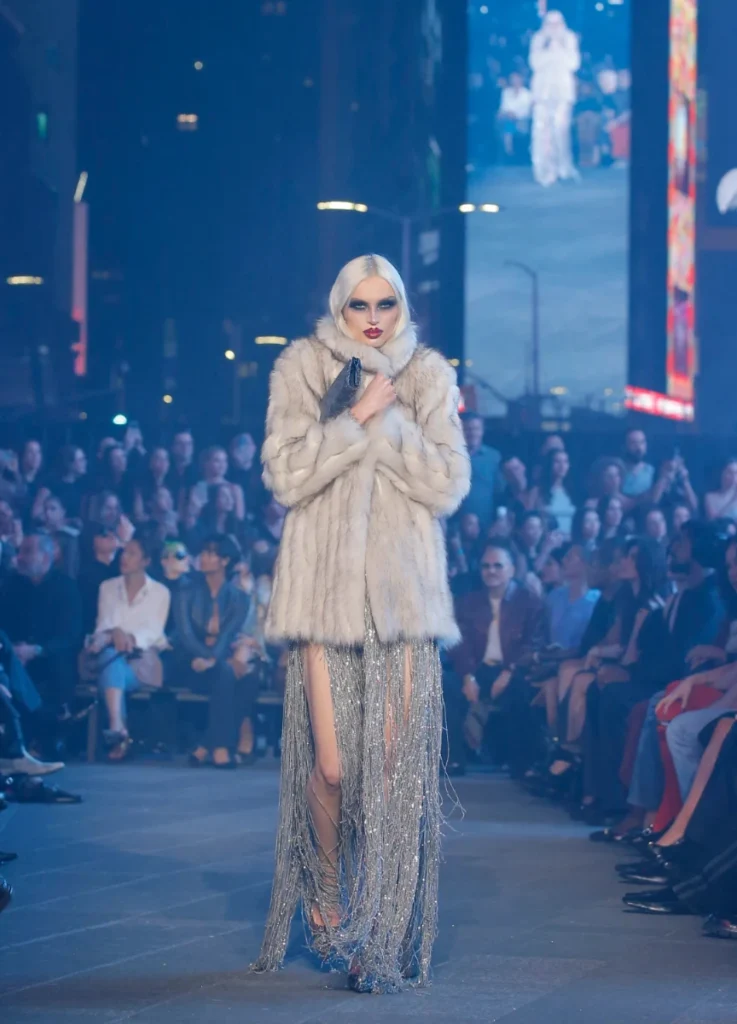
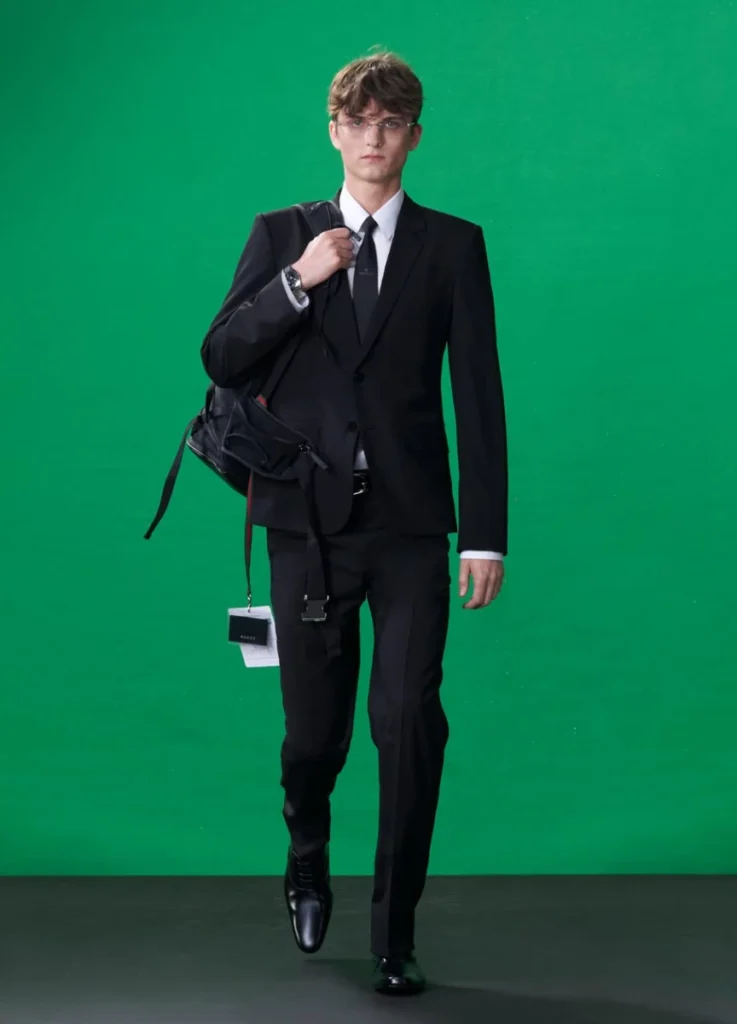
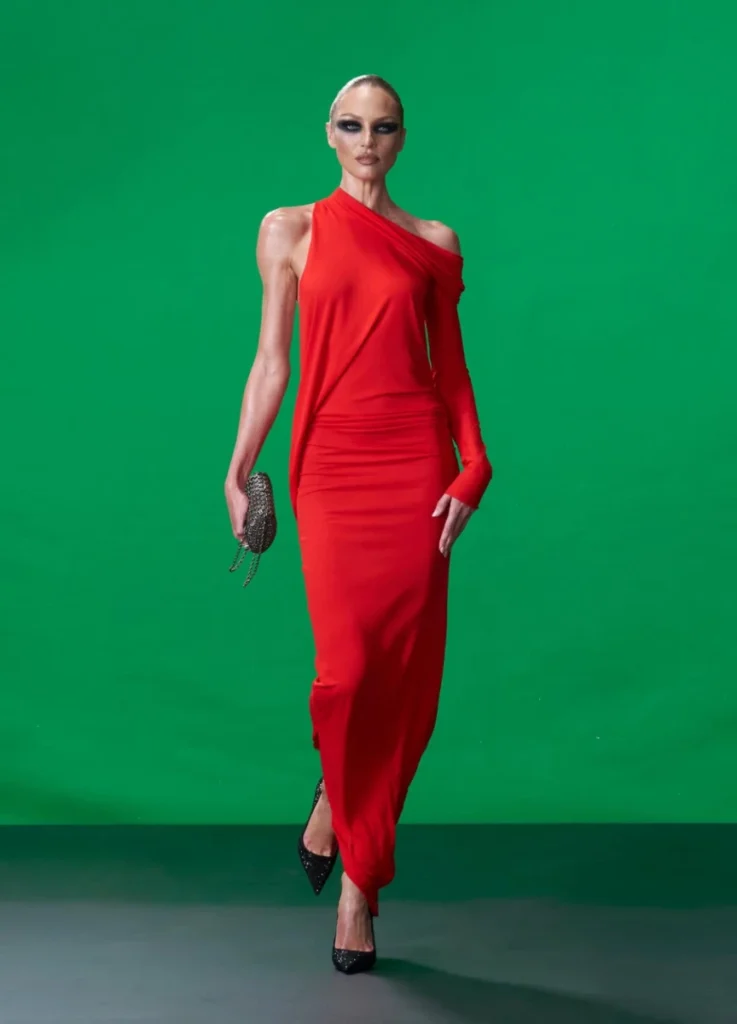
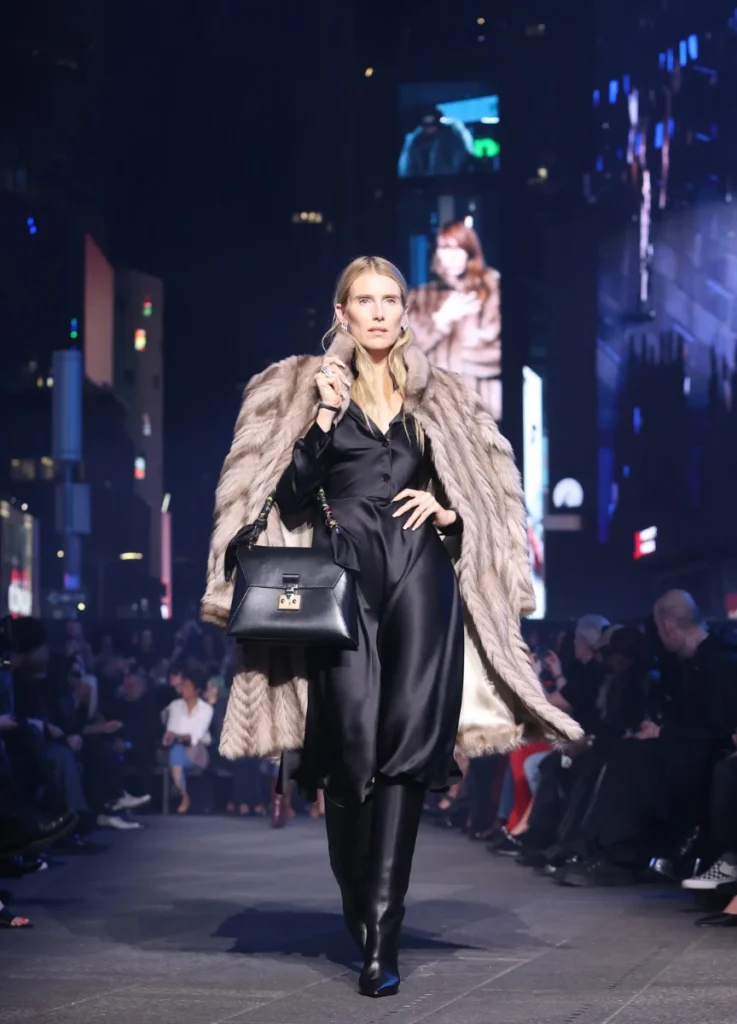
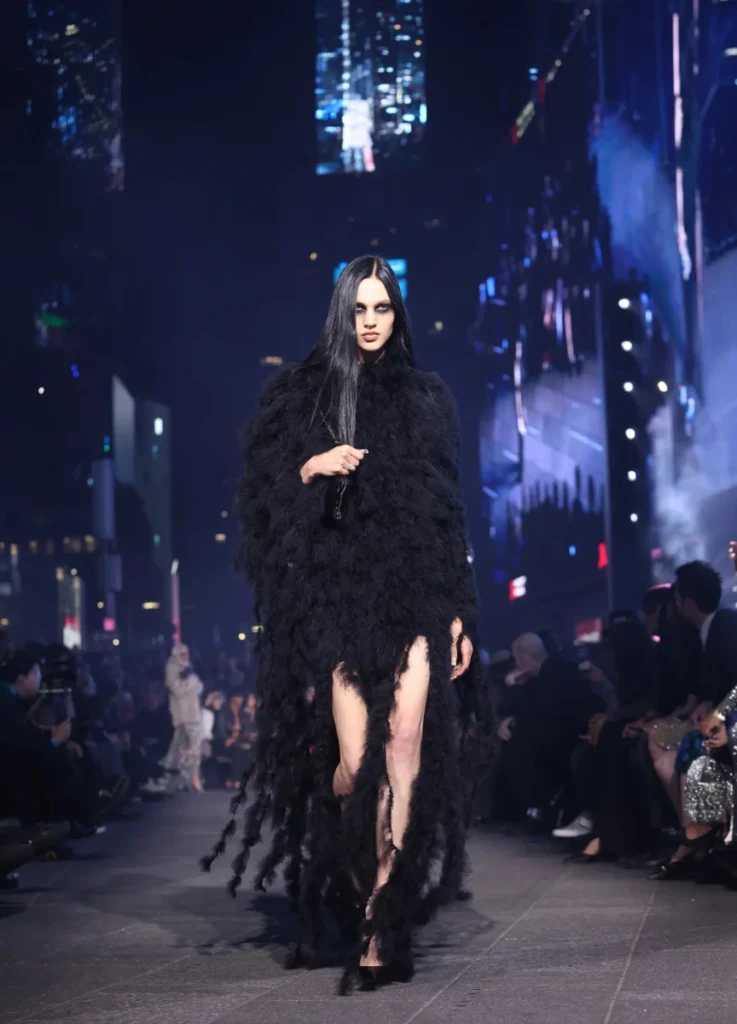
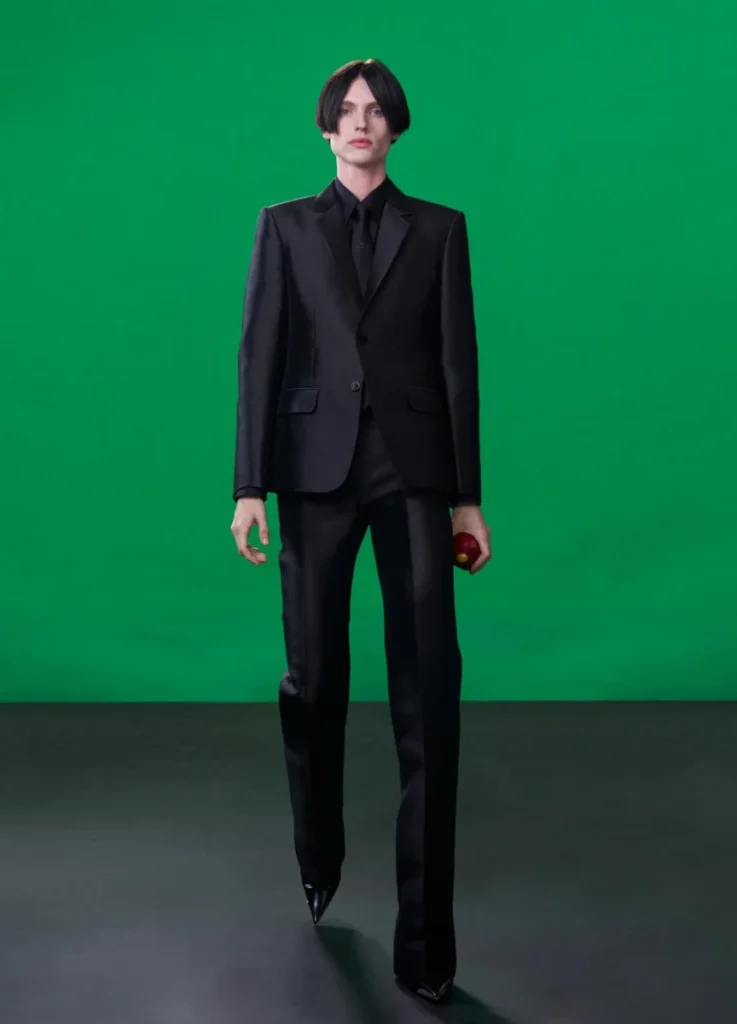
The opening sets it immediately — a black satin tuxedo, minimally ornamented, all the tension in the cut and the slight gleam of the surface. The pieces that follow continue the line: the women’s tailoring, the red column gown, the fur opera coat, the low-slung waists, the sensual separates that don’t try to explain themselves. The language is recognizable.
This is the Gucci that pulled the brand to the center of the luxury market in the late 1990s and early 2000s. Skin shown but never rushed. Cuts sharp but never overstated. Sensuality without the explanation. A specific kind of nighttime glamour that the brand sold extremely well, and that no one has quite replicated since.
@gucci / Instagram
The interesting thing is that Demna pulls the visual language forward almost directly, while keeping a spoken distance from the name. That distance feels deliberate.
Naming Tom Ford openly would turn the project into a tribute, and the show into nostalgia-driven RTW. The effect Demna seems to want is structurally different — less tribute than reactivation, bringing forward the most commercially effective vocabulary the brand has ever produced.
The difference matters. Reproducing the past and re-engaging the engine that made the past work commercially are two different exercises.
Why Times Square
The American cruise calendar this season made the venue choice unusually legible.
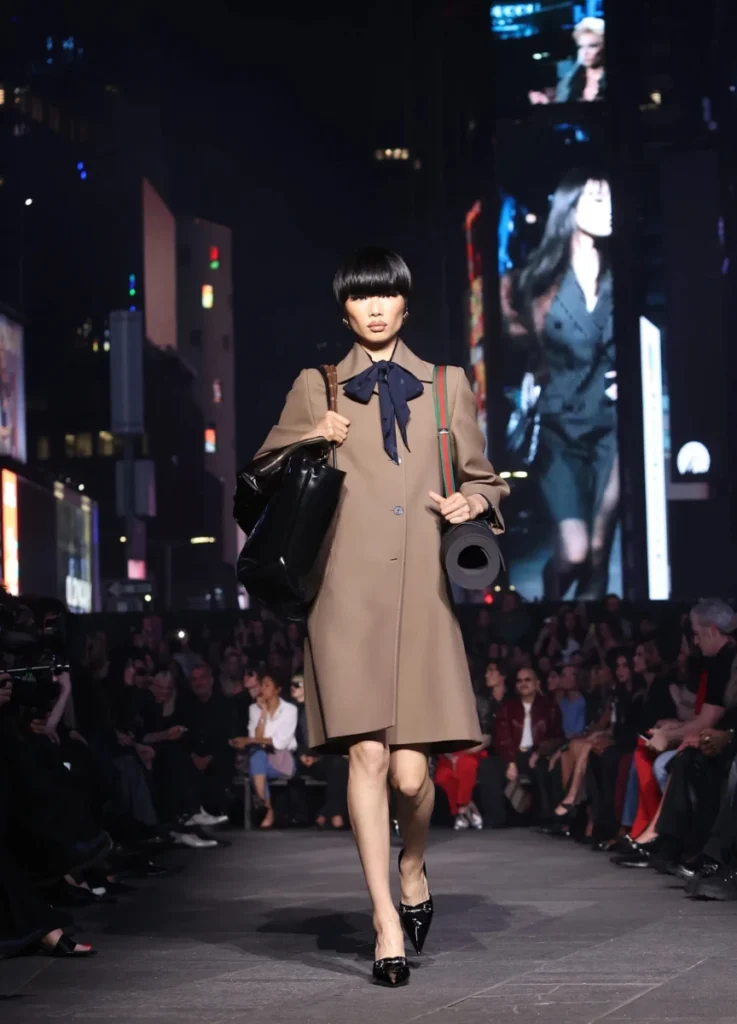
Dior chose LACMA — a cultural institution with architectural authority. Louis Vuitton chose the Frick Collection — a space that carries history and old-money cultural weight. Gucci chose Times Square.
The choice is openly commercial.
Times Square isn’t a space of quiet cultural authority. It is the dense center of advertising, foot traffic, immediate image consumption, and visual overstimulation — arguably the most direct stage of consumer capitalism still operating in physical form. The space carries no museum logic. It is the marketplace, made literal.
That Demna chose this venue isn’t a stylistic gesture. It tracks closely with what the brand needs right now. Where Dior reinforces its historical theatre and Louis Vuitton extends its cultural authority, Gucci steps directly into commerce.
The priority appears clear: not the expansion of authority, but the restoration of revenue.
GucciCore │ What’s Being Restored
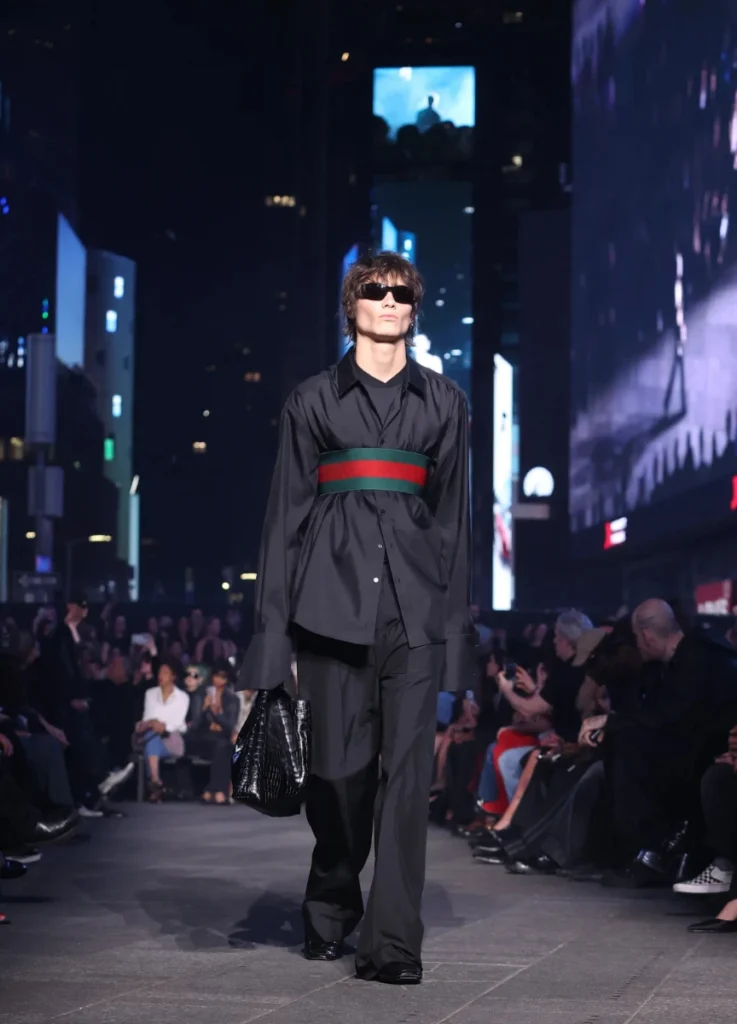
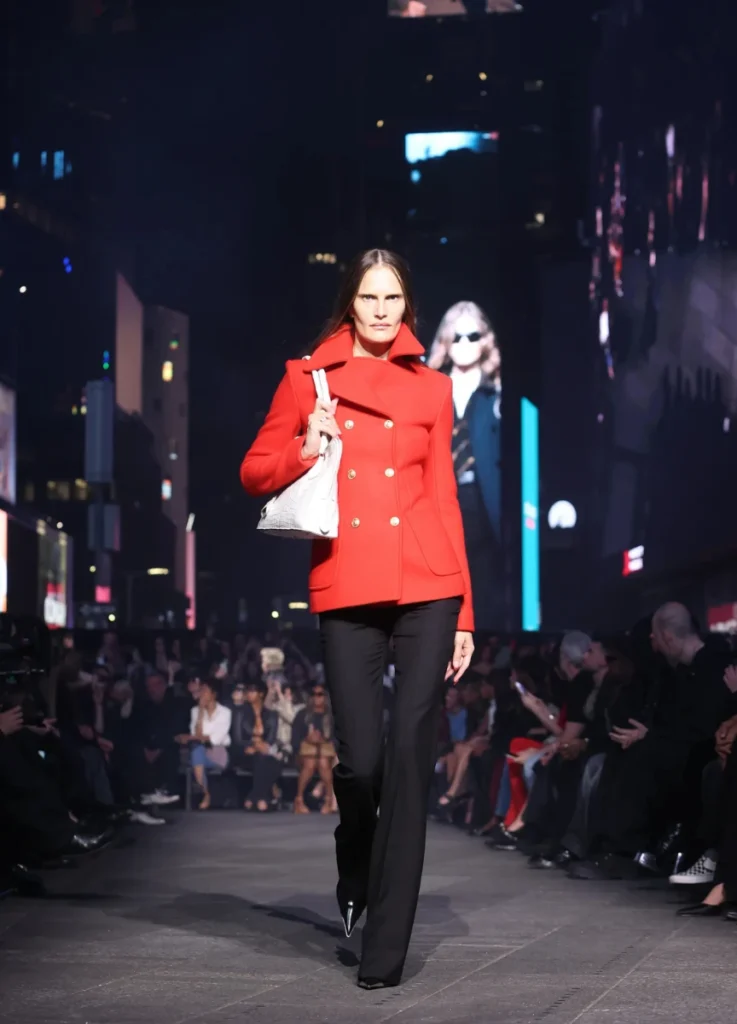
The most interesting part of the collection isn’t the dressed-up evening looks. It is the unusually direct list of basics Demna pushes to the front: peacoats, trench coats, business suits, shirts, pencil skirts.
The list is dry by fashion-show standards. No emotional storytelling. No description of a dream. The items read closer to the categories a brand’s internal commercial team would name when redrawing the core merchandising matrix — the products that customers buy, then return to, then replace.
That lines up with where Gucci appears to be.
The problem at the brand over the past few years hasn’t been visibility. People knew the brand. The collections produced enough image content. The gap appeared to be between the desire the brand generated and the products customers actually returned to buy. Image held. Repeat purchasing did not keep pace.
GucciCore lands as a response to exactly that gap.
A runway show is normally engineered to generate desire. This one tries to generate desire and rebuild the commercial backbone in the same gesture. The outerwear, the tailoring, the shirting — these are the categories that, if working correctly, customers return to over time.
The conservatism of the choice is itself notable. Demna is not a designer associated with restraint. But the strategic moment Gucci is in argues less for radical newness than for a stable center. A brand that needs to be restored to wearability has different priorities than a brand that needs to be re-imagined.
Not a Replay
Surface reading might suggest a straightforward Tom Ford-era reprise. Close reading does not.
Tom Ford’s Gucci was a fully resolved world. Everything was finished, sensuality was glossy, the customer bought a completed glamorous persona. Reality didn’t interrupt the picture.
Demna keeps reality in the frame.
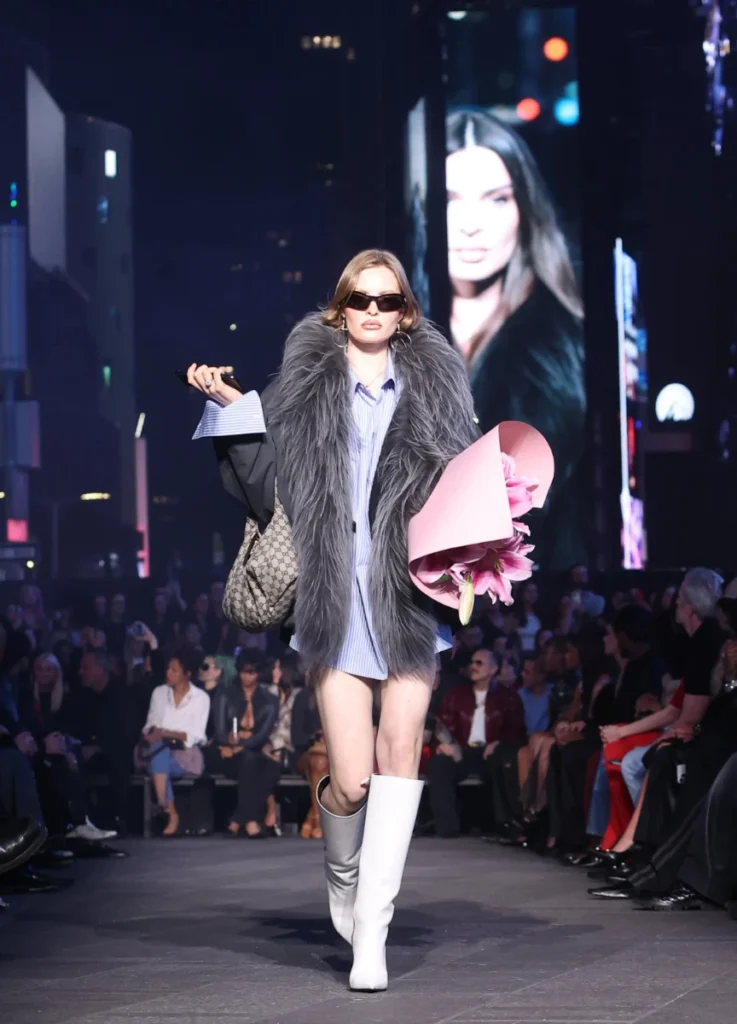
The models walked through Times Square carrying iPhones, keys, yoga mats, bouquets — small everyday objects that wouldn’t have entered a Tom Ford lookbook. That era of Gucci sat closer to fantasy than to life. Demna won’t quite let luxury operate outside reality. He leaves the small imperfections in.
The silhouettes register the same shift. Ford’s tailoring tracked the body with high precision — sensuality engineered, proportion calculated, every line resolved. Some of the Cruise 2027 looks are looser. Some still cut sharp; others puff slightly; certain proportions stop just before they go fully clean.
That last point matters. It is the difference between a collection that preserves the past and a collection that re-builds the past’s most effective commercial machinery on a contemporary body.
This isn’t a museum show. It is a reconstruction.
Key Looks
@gucci / Instagram
The opening black satin tuxedo
A first look does its work fast. Demna opening with a black satin tuxedo names the kind of closet GucciCore wants to anchor.
The surface stays restrained. Ornament is stripped down. The look lives in the tension of the cut and the soft sheen of the satin. The reference is clear without being underlined — the Gucci of the late 90s, the city after dark, restrained sensuality that doesn’t need a soundtrack to register as desire.
The adjustment is the body’s relationship to it. The tailoring is not as aggressively narrow as Ford’s. It leaves room for someone to actually wear it without performing it. That accommodation is the collection’s logic in one piece: the brand’s most commercially proven evening language, dialed to be wearable for a 2026 customer.
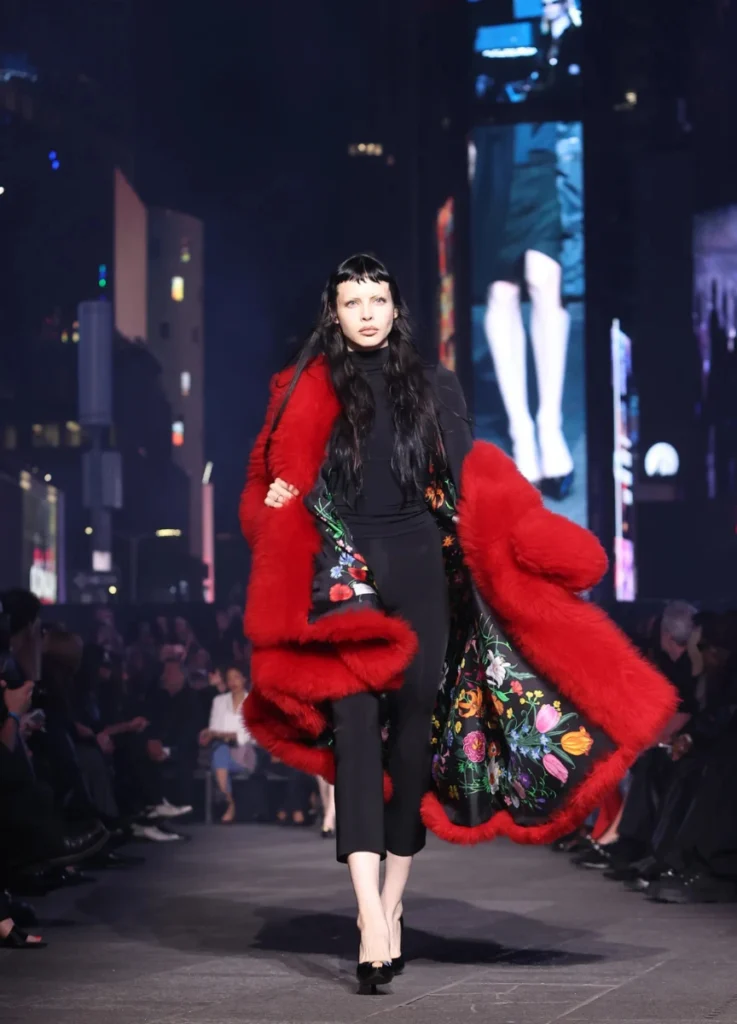
The red fur opera coat
The most ostentatious moment in the collection — and the most Gucci.
Strong red has always been Gucci’s color of desire. Ford used it. So does Demna, here, though his red is more theatrical and openly performative than the late-90s smoothness was. A fur opera coat sits at zero practical wardrobe utility. That is the point.
It makes clear that GucciCore is not going to be a quiet brand of basics. Even in restoration mode, Gucci needs excess. The coat exists to remind the audience that the commercial spine being rebuilt still has, at its end, the high-volume drama that the brand was built on.
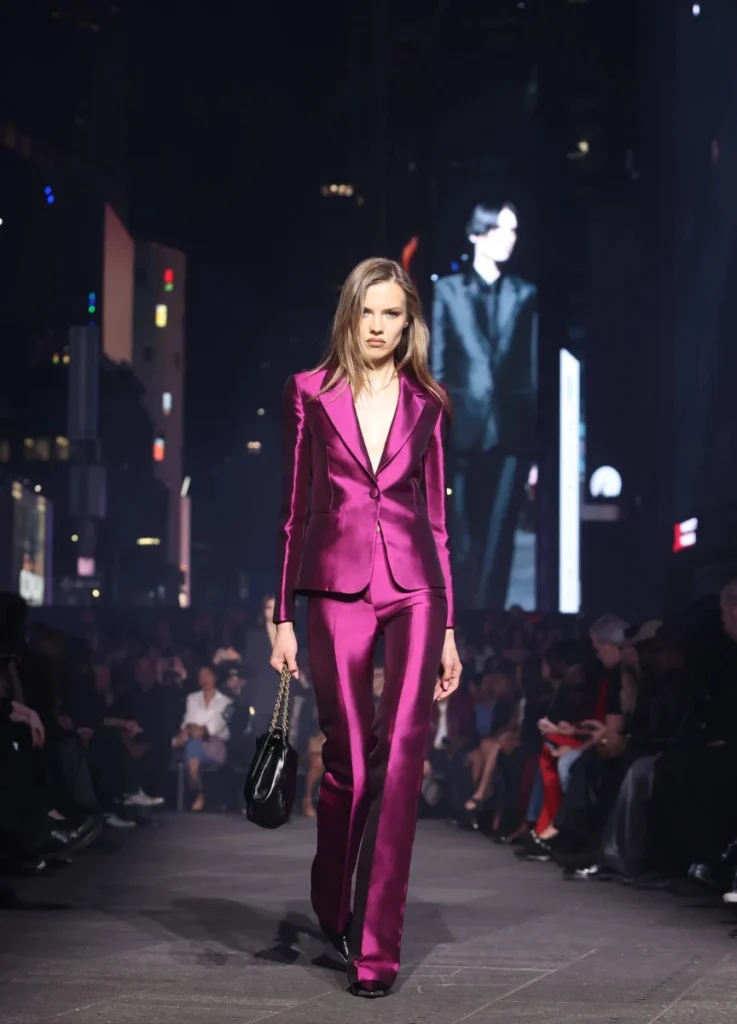
The women’s suiting
These are the looks that matter most to the business, even if they don’t make the front page.
Restrained women’s tailoring has been ceded across the past few years to other houses. Gucci’s presence in that category had thinned. Putting women’s suiting back at the front of the show is a category-level decision, not a styling one.
The fit is interesting. Less aggressive than Ford’s. Still sharp, but tuned closer to what a customer might actually keep wearing. The desire stays in the line. The barrier to entry comes down. That is the adjustment the brand probably needs at this moment.
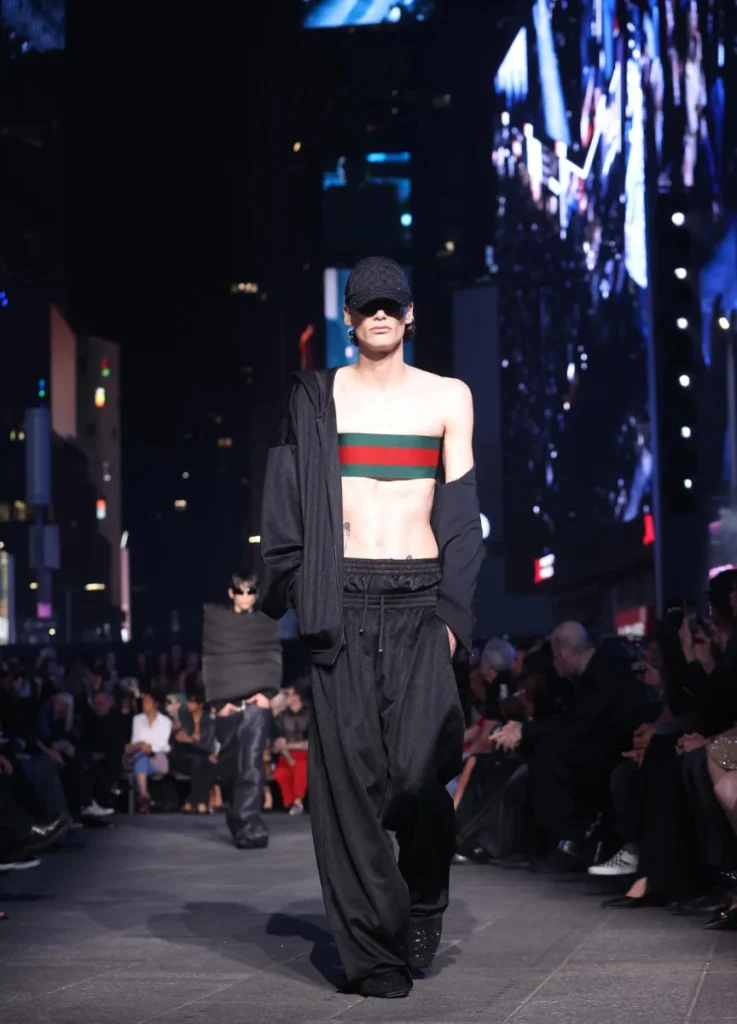
Web stripe bandeau and low-rise trousers
Multiple eras of Gucci compress into one look here. The Web stripe is one of the house’s oldest signals. The low waist invokes the early-2000s Ford codes directly. But the styling itself is current. It’s not perfectly cleaned up. It carries small traces of present-day dressing rather than recreating a runway image.
The look avoids the trap of straightforward heritage replication. It is past Gucci, processed by a contemporary eye, with the small inconsistencies left visible.
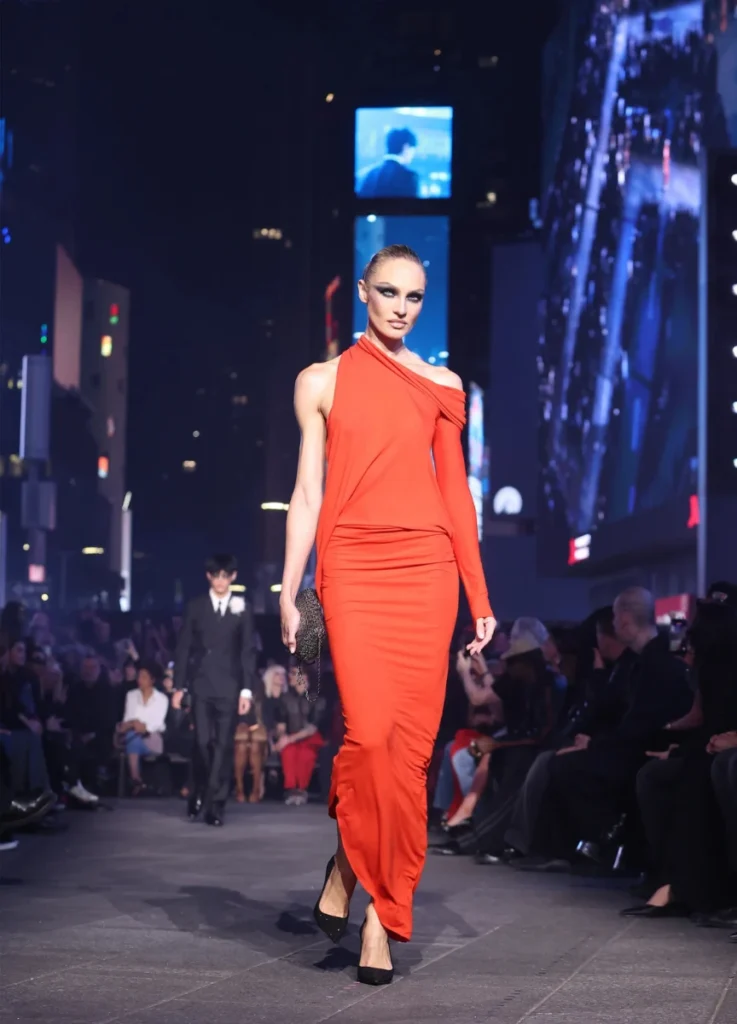
The red one-shoulder column gown
The closest the collection comes to direct evocation of older Gucci eveningwear. Long silhouette, surface tension, restraint about the sensuality.
What is unusual is how little irony Demna applies. His earlier work has typically included some torque — a broken proportion, an uncomfortable styling note, a deliberate friction with the luxury fantasy. This dress arrives without that twist. The seriousness is what comes through.
If the collection has a single piece that signals how much weight Demna is putting on this project, this is probably it.
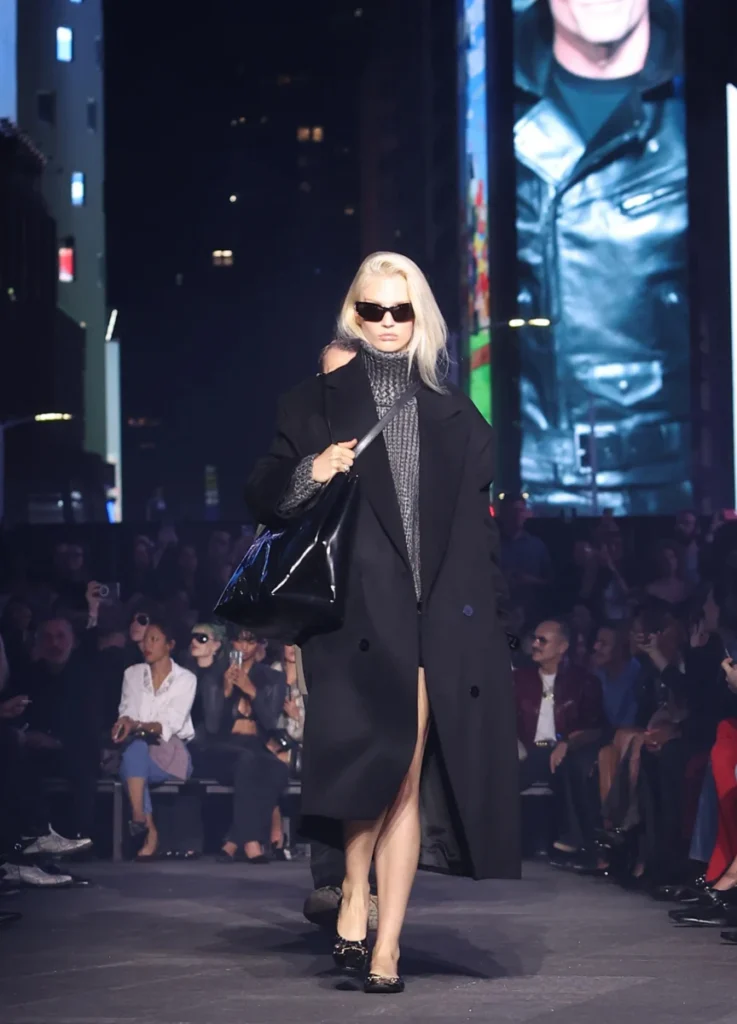
The Casting
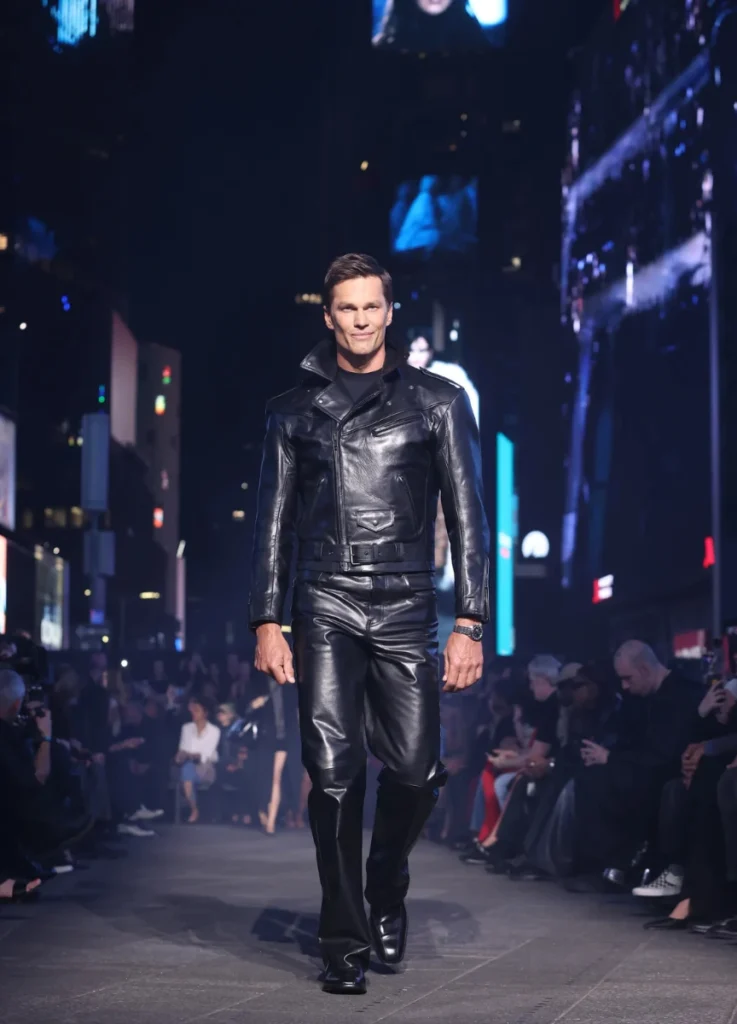
Tom Brady, Cindy Crawford, Paris Hilton.
The cast is not just a celebrity stunt. Each functions as a period marker. Cindy Crawford is the 1990s supermodel-glamour memory in compressed form. Paris Hilton is the 2000s celebrity-excess image. Tom Brady stands for a particular American masculine success fantasy. None of them is here primarily as themselves. They are here as cultural shorthand.
Demna has used casting this way before. He treats people as social types more than as individuals — figures who carry whole eras in their public images. In a collection that openly cites 90s and early-2000s Gucci, the casting extends the logic. The clothes call back to that period; the bodies carrying them do the same.
That continuity is part of why the show holds together. Stunt casting on its own would have come across as marketing. This casting feels structurally aligned with the collection’s logic.
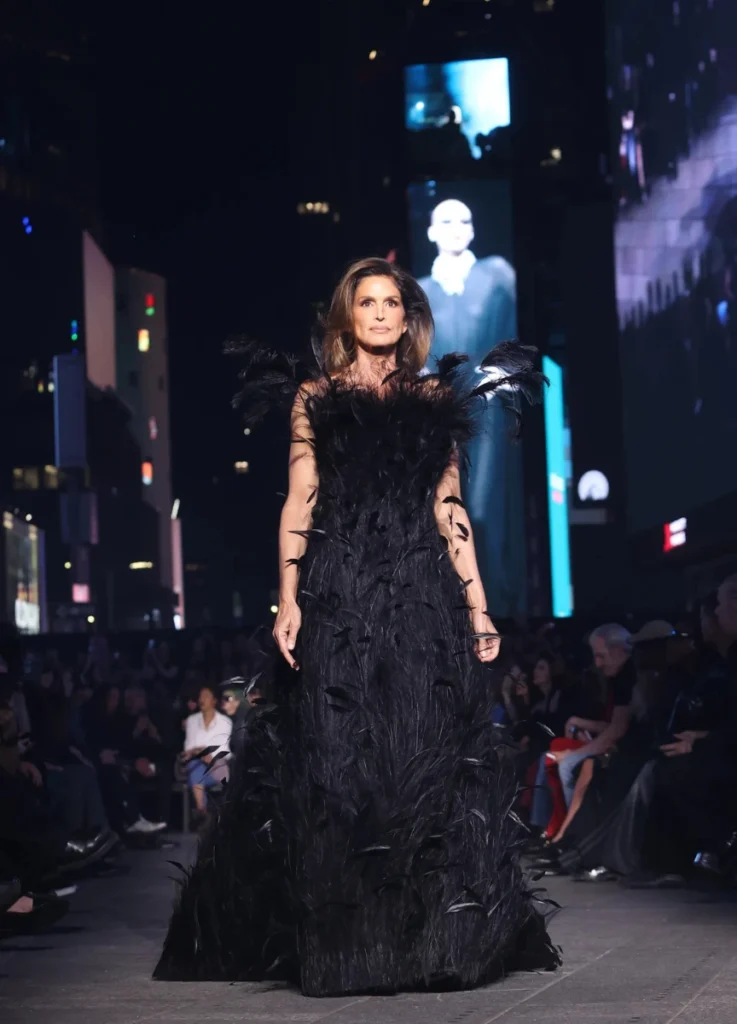
Gucci Cruise 2027 Look 63
Closing │ The Bet
Cruise 2027 isn’t a radical collection. It is a strategic one.
Demna isn’t using the platform to perform his most disruptive instincts. He is reassembling the commercial language that worked best in Gucci’s history. That looks, on the surface, like a designer pulling back from his own voice. Given Kering’s current pressure on the brand, it may also be the most useful move available.
Not every brand needs to invent a new world every season. Some moments call instead for re-establishing what worked — recovering the categories, the silhouettes, the evening codes, the women’s tailoring that the customer already trusts. That is what this collection does.
If the bet works, Demna will be remembered as the designer who restored Gucci to a brand that customers actually wear, not just admire. If it doesn’t, the season will be filed as the period in which he muted his own language for a strategic restoration that failed to hold.
One thing is clear in either direction. Cruise 2027 announced what Gucci appears to be trying to lock back into its center. The next year will show whether customers commit alongside it.
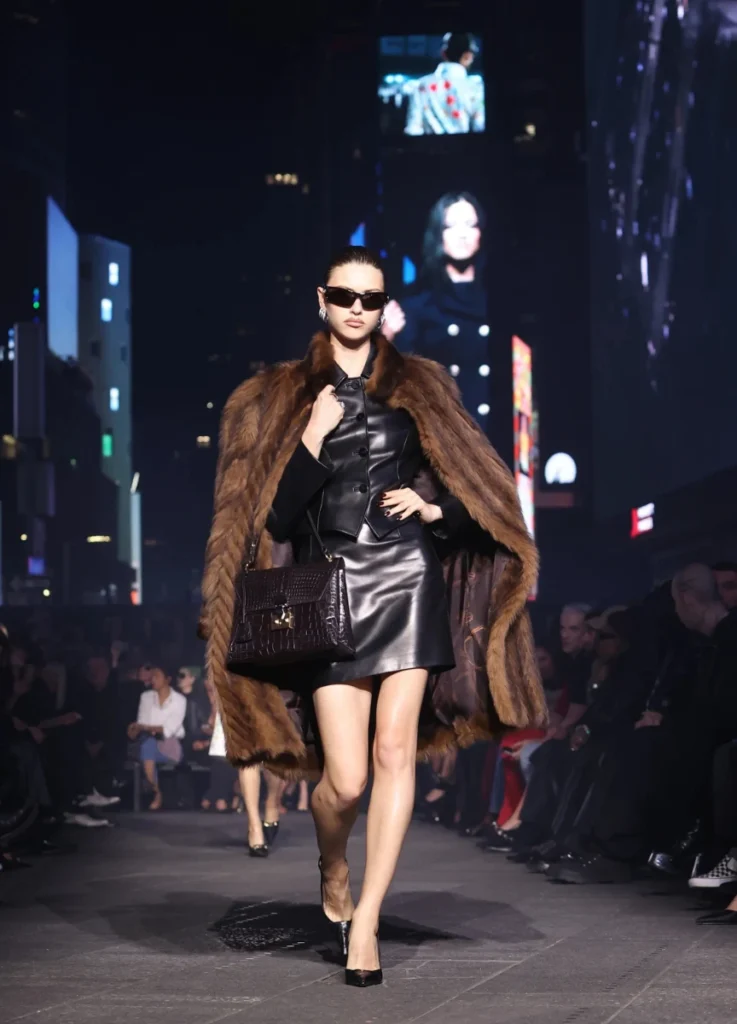
All images unless otherwise credited: Vogue Runway
[ Related Editorials ]