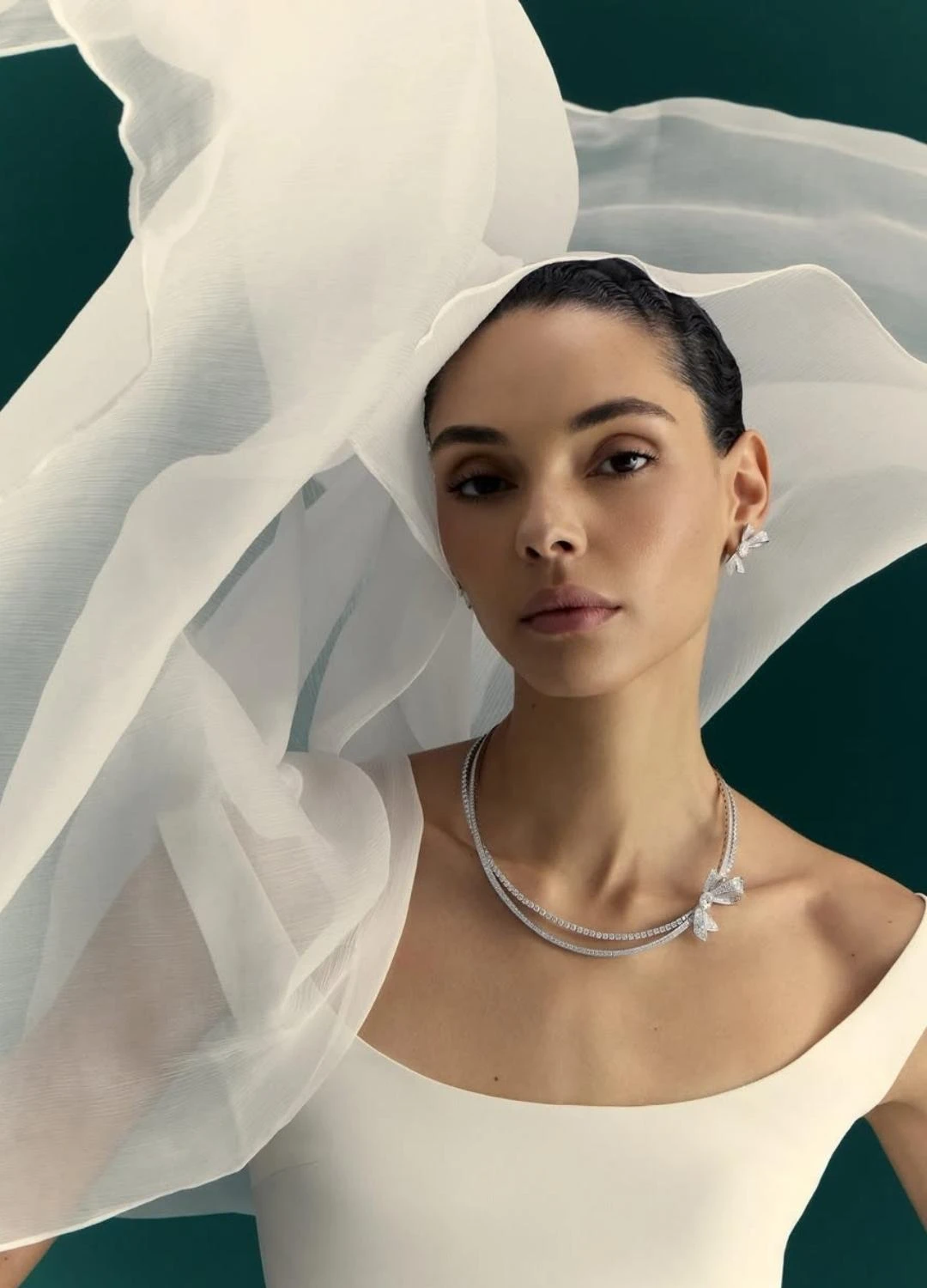
Inside Graff Tilda’s Bow
Graff has significantly expanded its Tilda’s Bow collection in recent months, introducing new designs that stretch across both fine jewelry and high jewelry simultaneously.
It may read as a straightforward extension. It is not.

& Earrings(3.33 carats) / $31,400 (Excl. taxes)
@graff / Instagram
Graff is running two tracks at once. One delivers wearable, commercially viable fine jewelry — small bow earrings, rings, delicate pendants. The other reinforces the sculptural identity of the bow through high jewelry pieces where the motif becomes a fully three-dimensional object.
This dual expansion moves Tilda’s Bow beyond a decorative theme. The bow operates as a structural system — one that scales from a graphic silhouette on the ear to a diamond architecture across the neckline.
Two Structures — Plane Bow and Sculptural Bow
A defining characteristic of the Tilda’s Bow collection lies in how the bow motif is interpreted aThe key distinction is not size or price, but construction.
The plane bow appears primarily in the fine jewelry line. Small earrings, bow-shaped rings, pendant necklaces. In these pieces, the bow is not built as a volumetric object. It is reduced to a controlled silhouette — a ribbon shape resolved on a relatively flat plane.
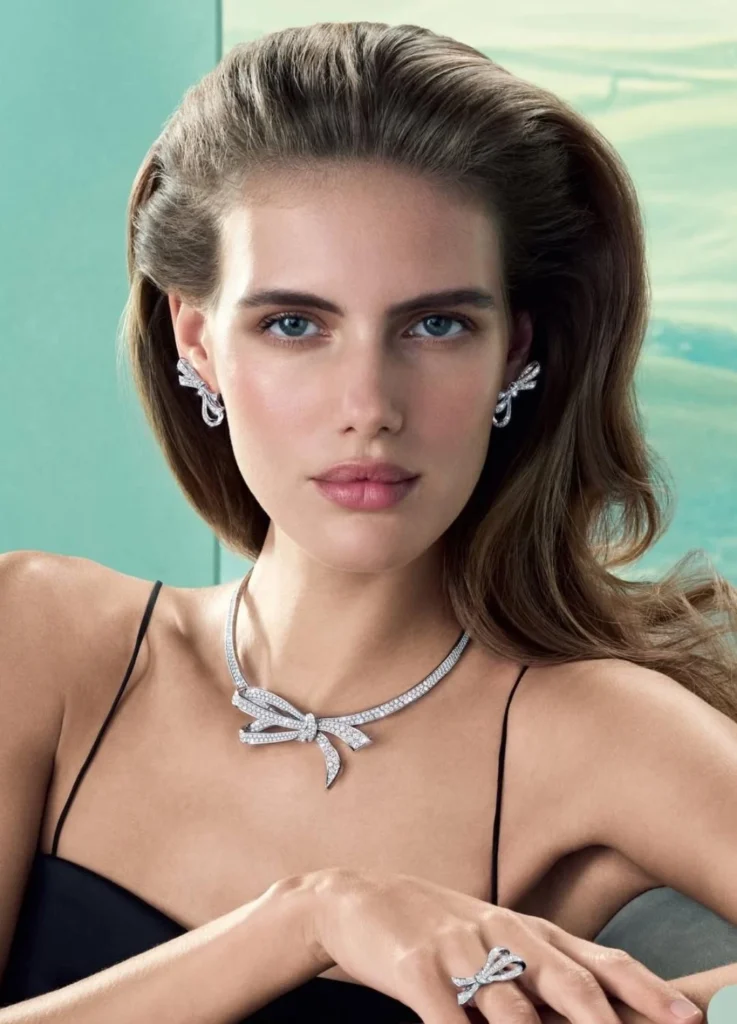
Marquise-cut diamonds define the outline of the loops. Round brilliant pavé fills the surface with light. The overall thickness stays minimal. The bow reads as a graphic form — a line drawing rendered in diamonds. It sits lightly on the ear or hand, registering as a refined motif rather than a sculptural presence.
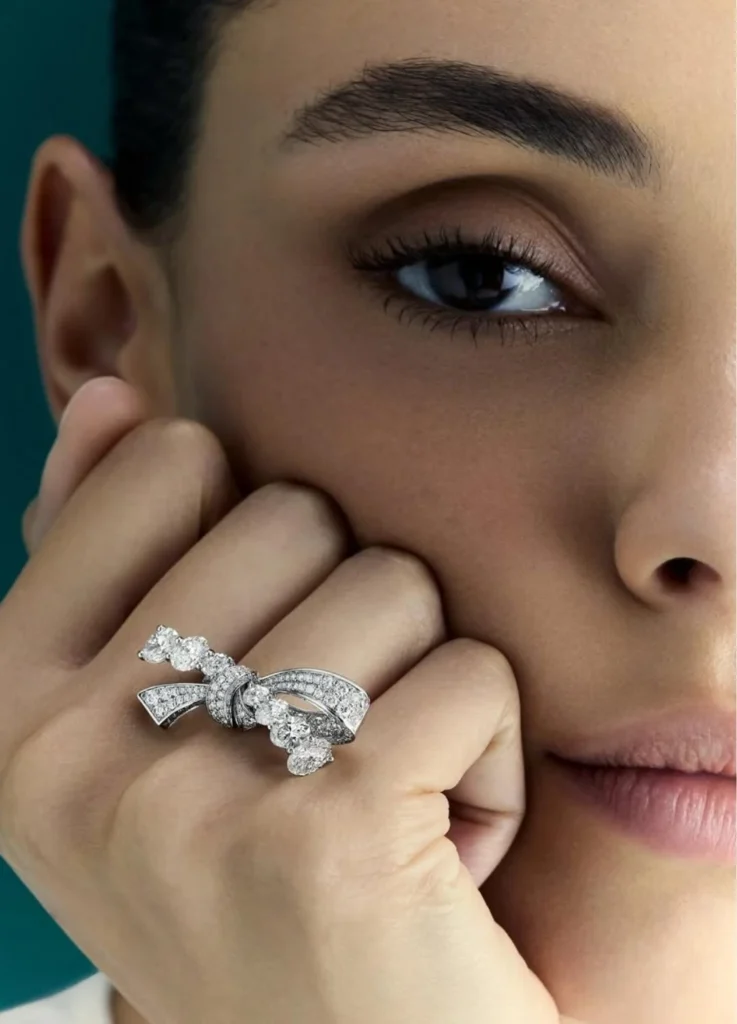
@graff / Instagram
The sculptural bow defines the high jewelry pieces. Here, the bow is constructed as a fully three-dimensional form with distinct components: a central knot with volume, symmetrical loops extending outward, and tails that fall downward in a draped movement.
In this configuration, the bow is no longer a motif applied to a surface. It becomes a self-contained structure in space.
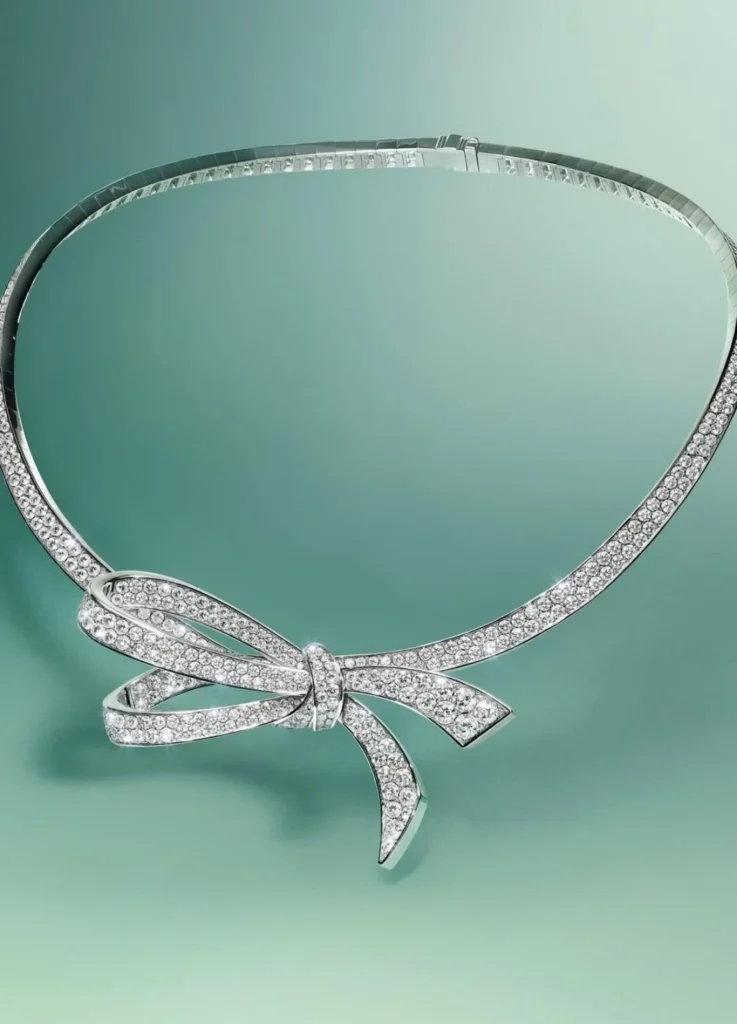
– A total weight of approximately 14.60 carats.
$170,000 (Excl. taxes)
@graff / Instagram
Marquise-cut diamonds form continuous curves, creating the tension and direction of the loops. Round pavé builds density and luminosity across the surface. Pear-shaped diamonds extend the form downward, introducing a sense of weight and gravity — simulating the natural pull of fabric on a ribbon’s tail.
The plane bow is a silhouette-driven design. The sculptural bow is a space-driven design. Same motif, entirely different impressions.
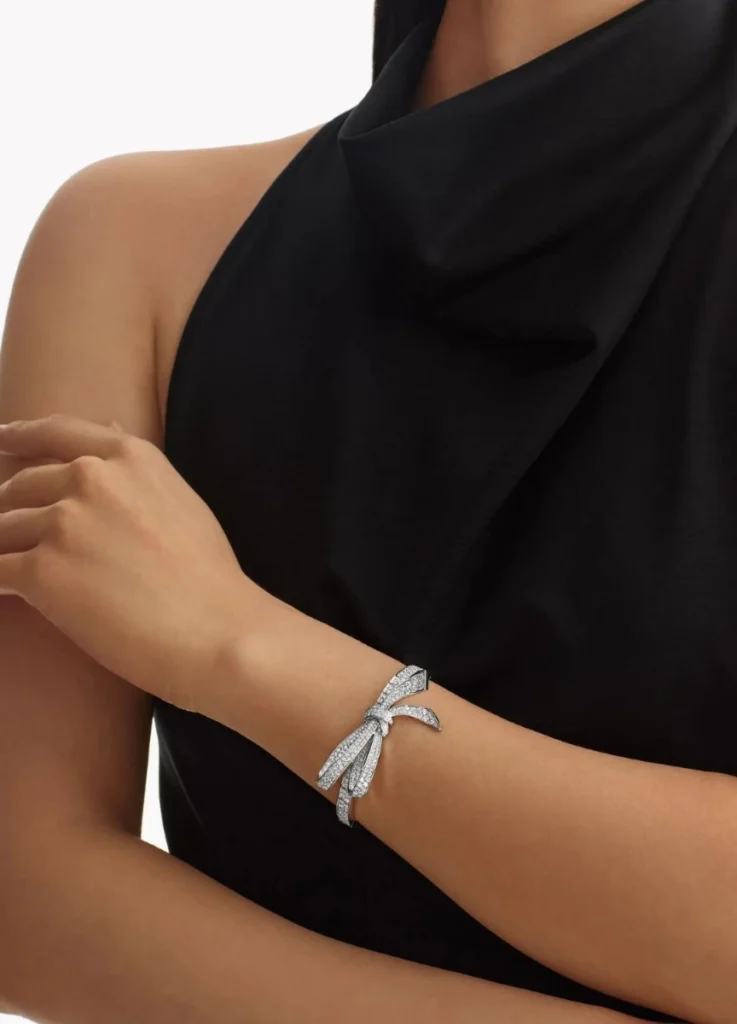
source: graff.com
Fine Jewelry — Wearable Structure, Controlled Light
The fine jewelry pieces are defined by restraint. They rely on a limited palette of diamond cuts — marquise and round brilliant pavé — and that limitation is precisely what makes them work.
The marquise cut, with its elongated pointed form, is particularly suited for constructing curves. Placed sequentially, multiple marquise stones create a fluid line that suggests movement without requiring volume. And for the same carat weight, marquise diamonds cover a larger visual area than rounds — the bow maintains presence without increasing material weight.
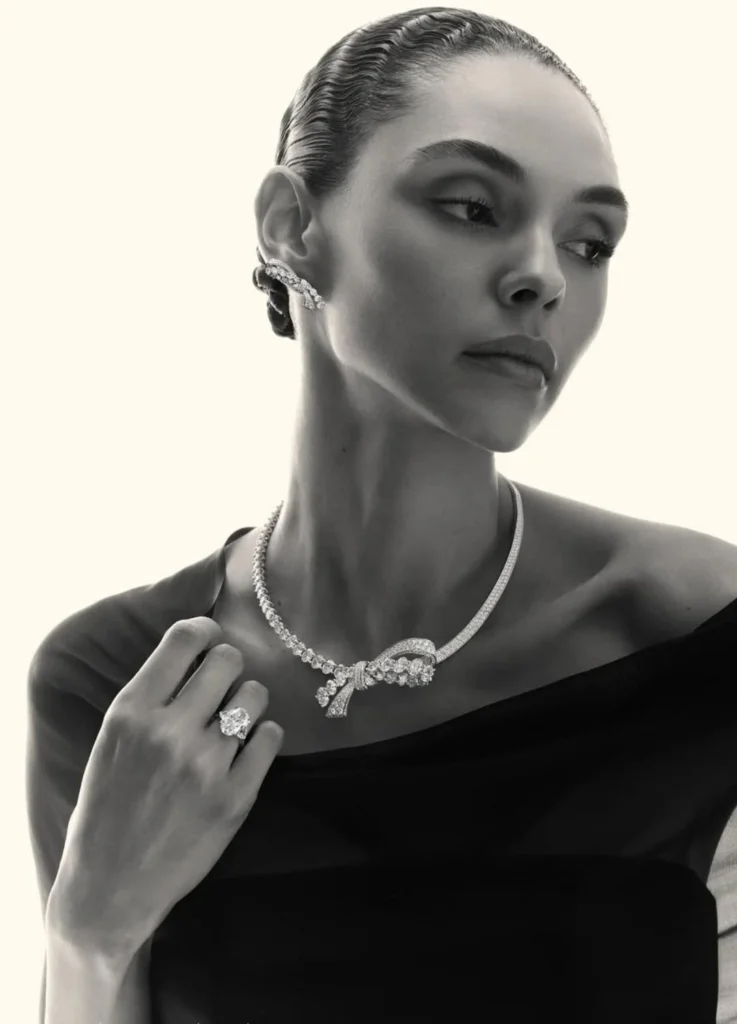
The pavé setting fills the surface with uniform brilliance, ensuring visual continuity between stones. The thin prong settings minimize visible metal, allowing diamond coverage to dominate while keeping the ribbon’s curves soft.
Two technical advantages follow. Visual elongation — the bow appears larger than its carat weight suggests. And light continuity — the pavé creates a consistent reflective field with minimal interruption.
The result is a bow that feels light, controlled, and genuinely wearable. Among Graff’s broader portfolio, these pieces are notably adaptable. They transition into daily wear not by reducing identity but by refining structure.
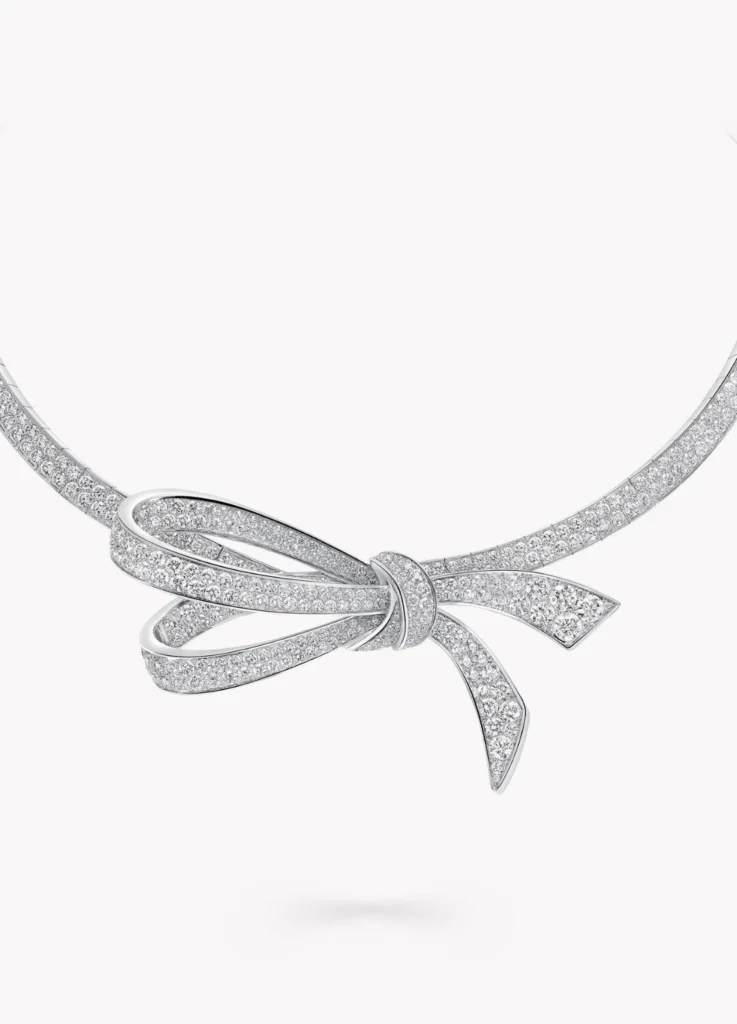
$170,000 (Excl. taxes)
source: graff.com
High Jewelry — Volume, Movement, and Diamond Architecture
In the high jewelry pieces, the same motif expands into a far more complex system. The bow becomes a compositional framework rather than a decorative reference.
Multiple diamond cuts are deployed simultaneously, each performing a specific function. Marquise cuts define the trajectory of the curve. Round brilliant pavé builds surface density. Pear-shaped drops introduce downward motion. Occasional oval stones handle transitional volumes between structural elements.
@graff / Instagram
The marquise stones set direction. The pavé fills. The pear drops pull — simulating the way gravity stretches a real ribbon’s tail. The composition of cuts varies across models, with some incorporating baguette-cut diamonds for additional linear definition.
The high jewelry pieces dissolve the visible boundary between metal and stone. The diamonds do not appear set onto a framework. They constitute the framework. The bow seems formed entirely from light — an illusion that requires extraordinary technical precision to maintain across a three-dimensional surface.
These pieces do not sit passively on the body. They interact with the neckline, unfolding as sculptural objects that shift with movement.
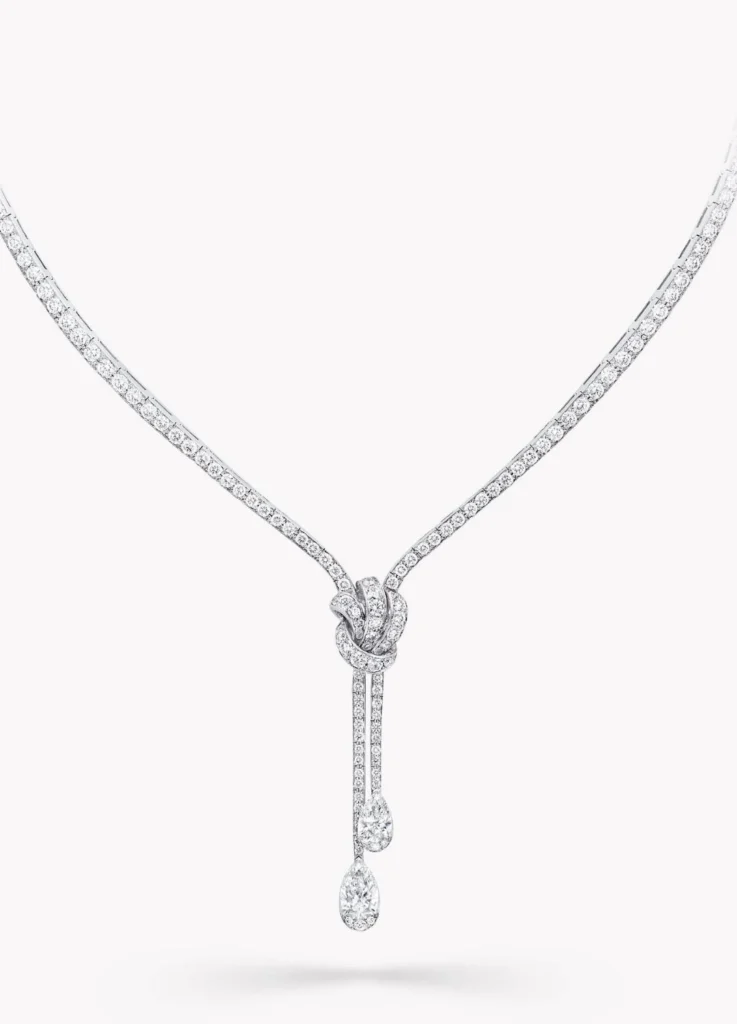
7.40 carats, showcasing two 0.80 carat pear shape diamond drops.
$97,000 (Excl. taxes)
source: graff.com
Why Marquise Dominates Bow Motifs
The repeated use of marquise cut in bow jewelry across the industry — not just at Graff — follows a clear structural logic.
Curvature. Round brilliant diamonds excel in radial symmetry but extend in all directions equally. Marquise stones extend linearly, allowing them to be arranged into continuous curves. In bow designs, where loops must appear fluid, this directional property is essential.
Surface expansion. For the same carat weight, marquise diamonds cover a larger visual area. This creates a sense of scale without proportional increase in material cost or weight — particularly valuable in fine jewelry where the bow must hold presence at smaller dimensions.
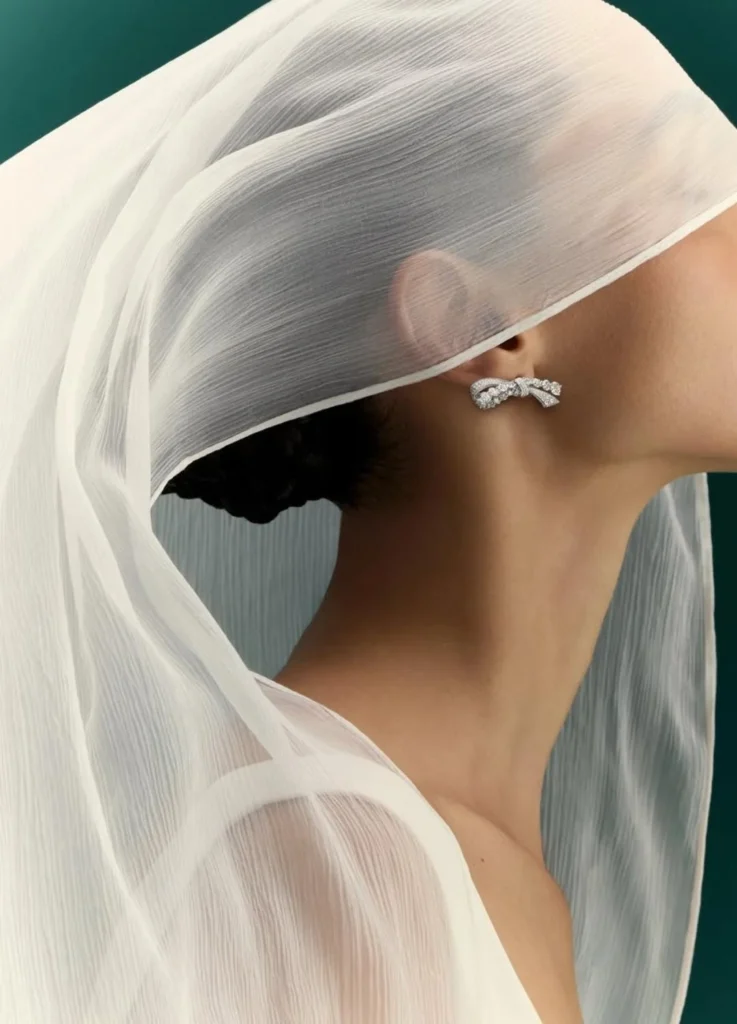
@graff / Instagram
Directional light. The elongated geometry distributes light along its axis rather than scattering it uniformly. When multiple marquise stones are aligned in sequence, light appears to travel along the curve. Combined with pavé and pear drops, this produces a layered optical system: structure from the marquise, surface brilliance from the pavé, movement from the pear.
Graff’s Tilda’s Bow follows this classical framework but refines it into a more precise architectural system — one where each cut performs a designated role within a unified composition.
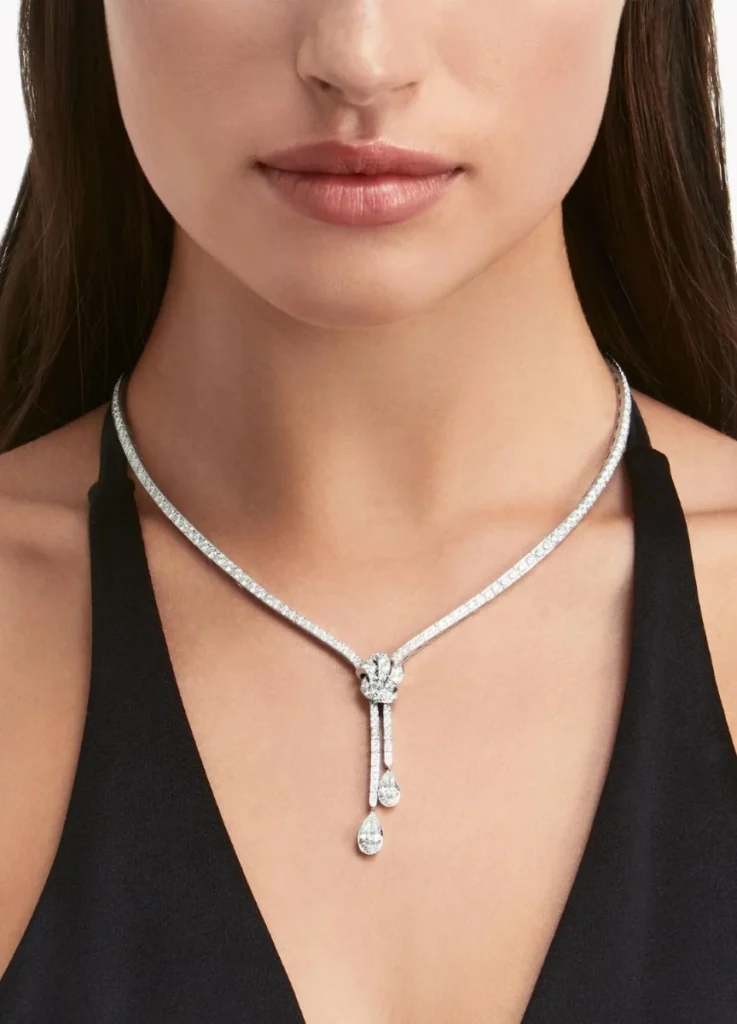
$97,000 (Excl. taxes)
source: graff.com
Body Proportion — Plane Bow vs Sculptural Bow
The structural difference between the two bow types changes how they interact with the body.
Fine Jewelry (Plane Bow)
Because the form stays relatively flat, these pieces adapt across a wide range of proportions.
The earrings work particularly well with oval or softly contoured face shapes — the bow’s curves echo the face’s natural lines. On very angular or strongly linear jawlines, the ribbon’s curves can read as slightly more decorative, though the small scale keeps this manageable.
The rings distribute horizontally across the finger, making them suitable for various finger lengths and hand structures. They sit well on hands where knuckles are not overly prominent and fingers carry moderate length. On very slender, elongated fingers, the bow can read as slightly ornamental rather than structural.
Overall, the fine jewelry line is structurally forgiving — body proportion plays a limited role in how these pieces perform.
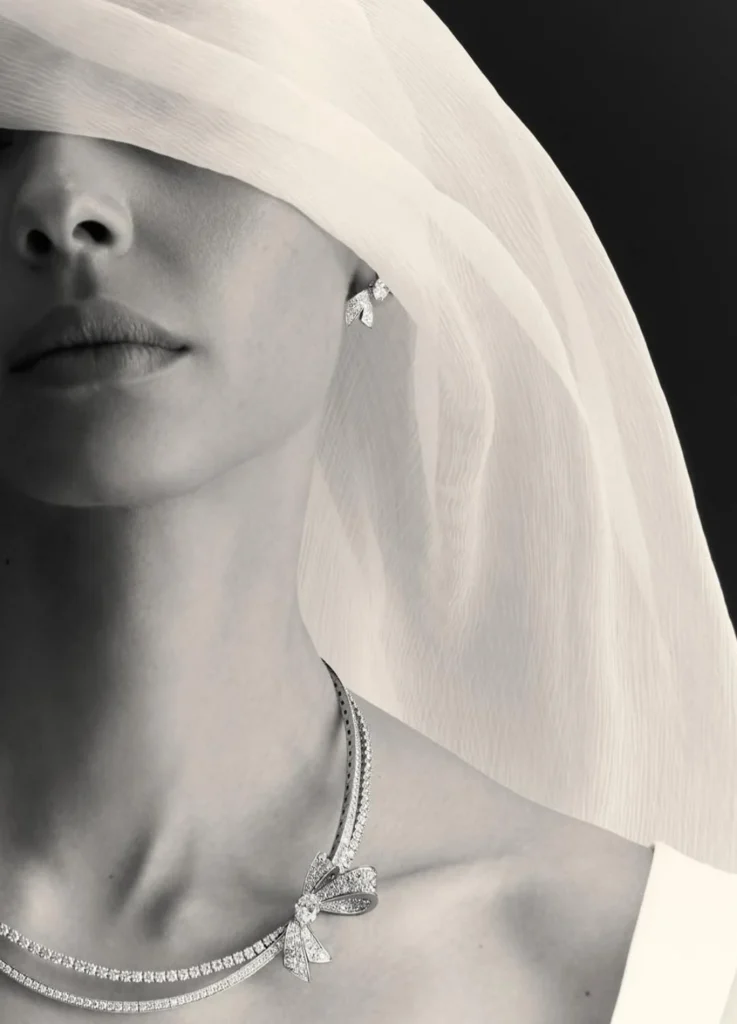
@graff / Instagram
High Jewelry (Sculptural Bow)
The high jewelry pieces, especially necklaces, are far more dependent on body structure.
The central knot acts as a focal point positioned at the base of the neck. From there, loops and tails extend outward and downward. Three conditions determine whether the composition unfolds fully.
A longer, slender neck gives the ribbon structure space to display. On a shorter neck, the three-dimensional knot cannot fully reveal itself — the composition compresses before it resolves.
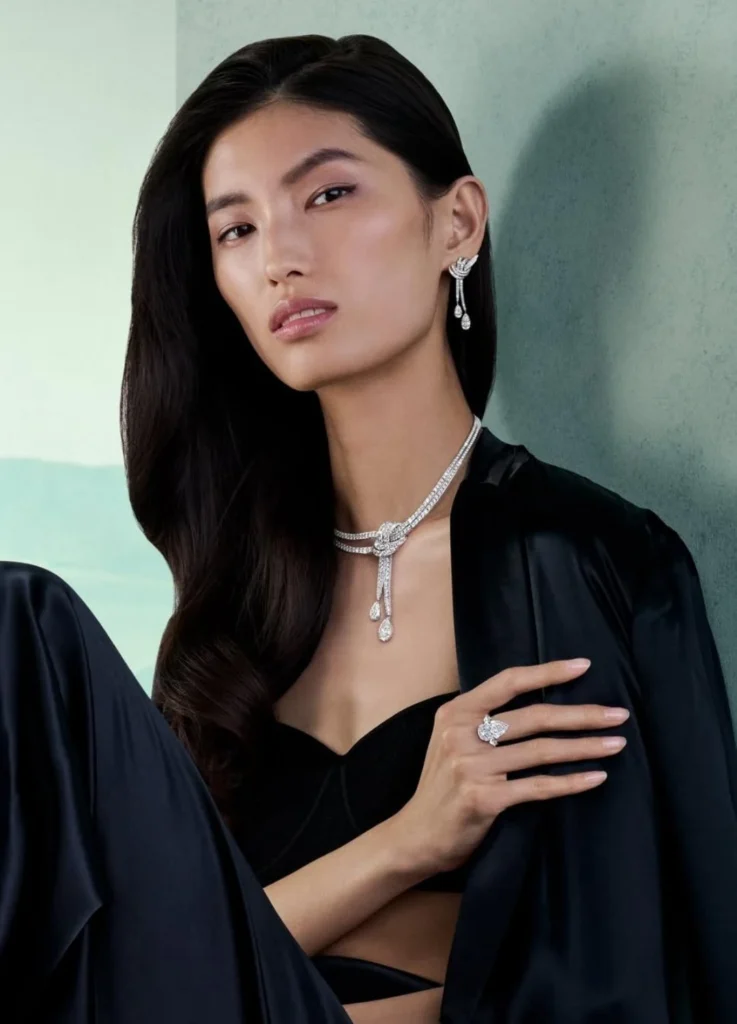
@graff / Instagram
Visible clavicle structure matters. The necklace drapes across the collarbone, and when that line is defined, the bow’s architecture gains a natural frame. Without clavicle definition, the piece sits on the body rather than being framed by it.
Shoulder width should be moderate. The bow is fundamentally a curvilinear motif. On very broad shoulders, the ribbon’s femininity can become overly emphasized. The bow reads most elegantly on a neck-centered frame where the proportions allow the structure to unfold without compression or exaggeration.
These high jewelry pieces are not simply worn. They are framed by the body.
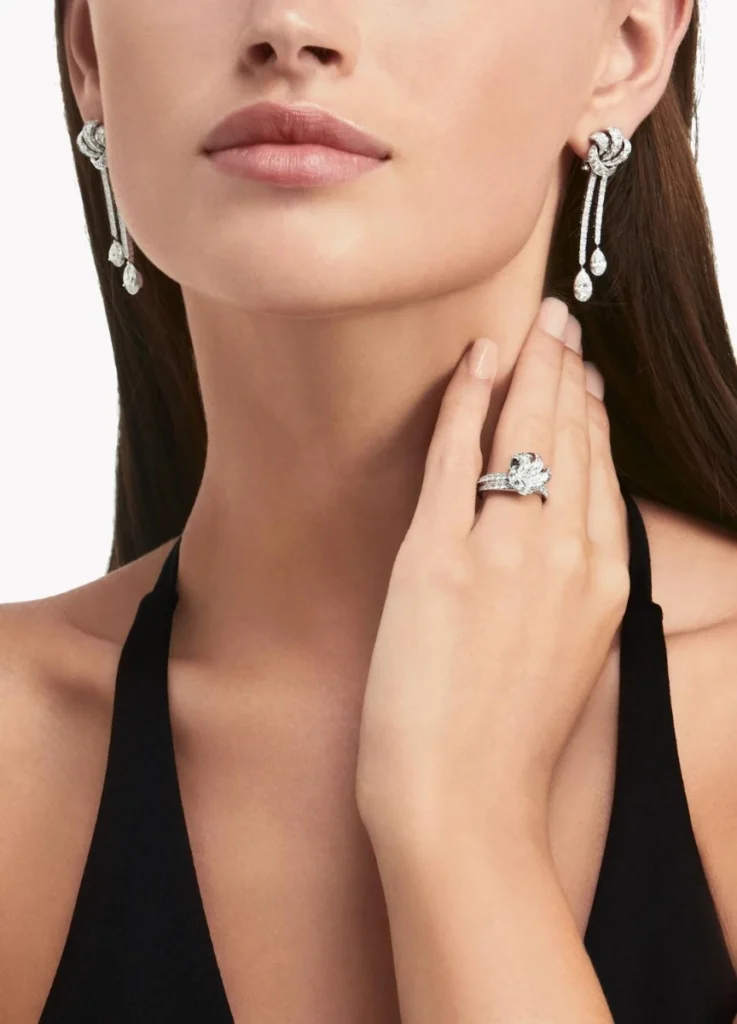
source: graff.com
The Contemporary Bow — Dior and Graff
The bow’s return in fashion runs parallel to Graff’s expansion — not because the materials overlap, but because the structural principle does.
In Dior’s recent collections under Jonathan Anderson, the bow appears not as an applied decoration but as a byproduct of drape. A continuous length of fabric is gathered, tensioned, and released. The bow emerges from this process. There is no clear separation between knot, loop, and tail. They exist as a single movement — a point of tension where fabric meets itself.
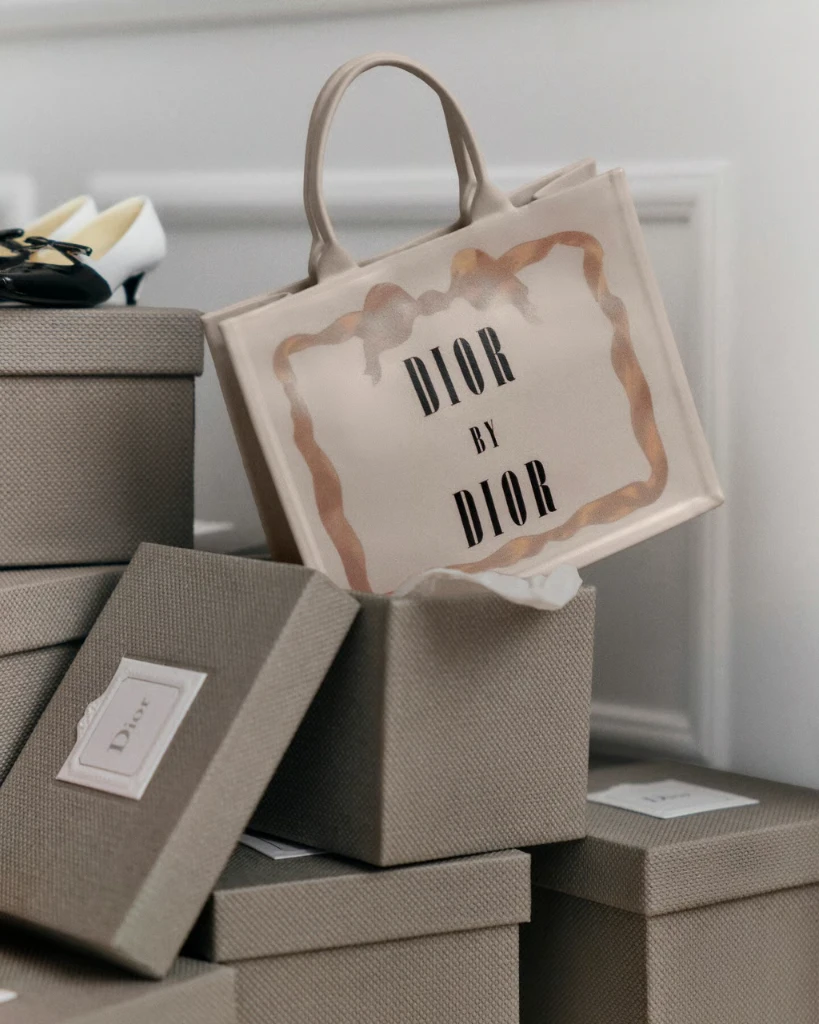
source: Dior.com
The bow in fashion has shifted from ornament to structure. It is no longer pinned on. It forms where forces converge.
Graff’s Tilda’s Bow maintains a more defined structure. Knot, loops, and tails remain legible as distinct components. Yet in certain high jewelry necklaces, a subtle convergence appears. Diamond lines follow the neckline before gathering into a knot-like formation. The bow is not placed — it forms at the point where directional lines meet.
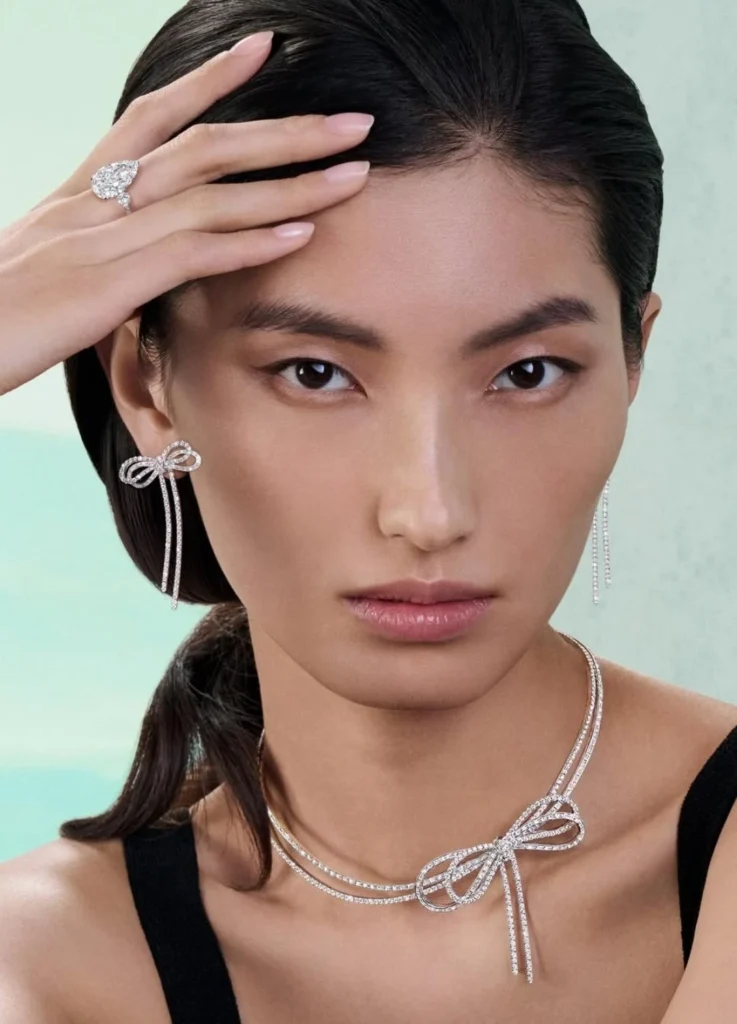
@graff / Instagram
This is where Graff intersects with contemporary fashion. Not in material, but in principle. Whether the medium is fabric or diamonds, the bow emerges from the same structural logic: two lines meeting under tension and resolving into form.
One is shaped by gravity. The other by precision.
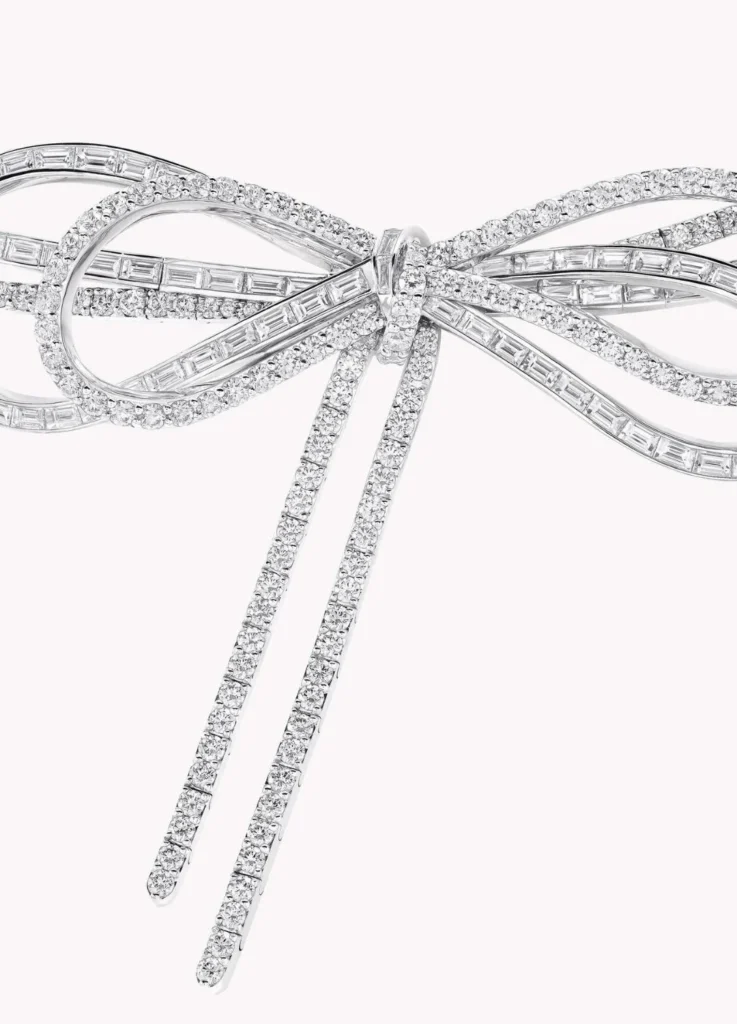
-a total weight of approximately 13.39 carats.
source: graff.com
Why Bow, and Why Now
The emergence of the bow within Graff’s portfolio connects to a broader shift in the brand’s positioning.
In the high jewelry market, each major house holds a defining motif — a visual language that functions as both signature and system. Cartier has the Panthère. Van Cleef & Arpels has the Alhambra. Boucheron has its own iconic forms.
Graff has historically built its identity around the singularity of the stone itself — size, rarity, brilliance. The diamond was the message. A clear motif icon was relatively absent from the brand’s vocabulary.
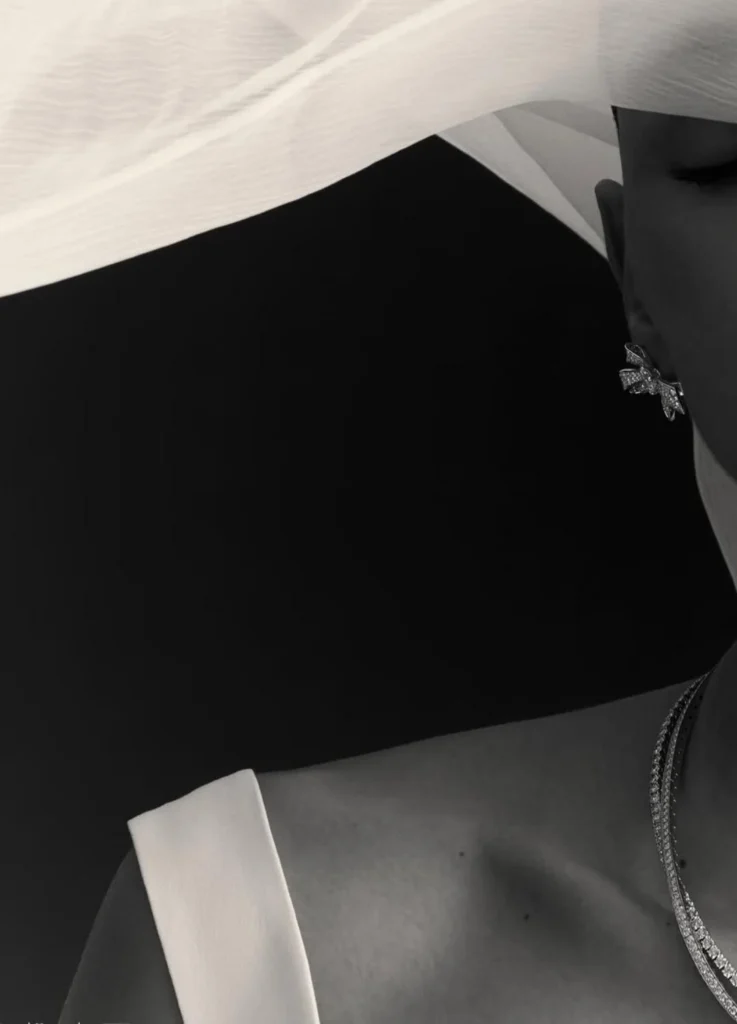
Tilda’s Bow enters precisely at this gap.
The bow is an ideal motif for demonstrating technical control because it cannot be faked. It requires curvature, tension, and resolution simultaneously. Unlike floral or abstract motifs, a bow cannot be convincingly rendered without coherence between its parts. Every component — knot, loop, tail — must relate structurally to the others.
Building a complete ribbon form entirely from diamond cuts is technically demanding. The curves, the knot’s volume, the drape of the tails — each element requires a different cut performing a different function within a unified composition.
Tilda’s Bow therefore functions not just as a design theme but as a platform for expressing diamond architecture — and, increasingly, as the kind of recognizable motif icon that Graff has lacked.
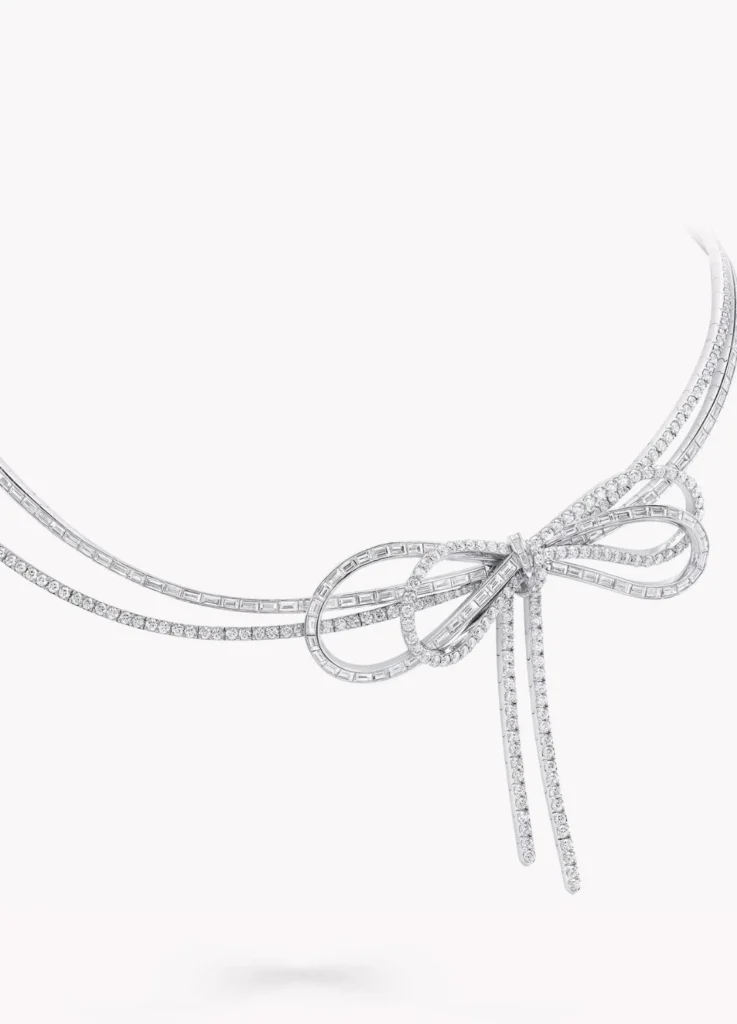
– a total weight of approximately 13.39 carats.
$110,000 (Excl. taxes)
source: graff.com
Final Reflection
The bow is not new. It has existed across centuries as ornament, symbol, and decoration. But not all forms persist in the same way.
In contemporary fashion, the bow is no longer defined by its surface appearance. It is defined by how it is formed. In Dior, it emerges from tension within fabric. In Graff, it is constructed through the alignment of diamonds.
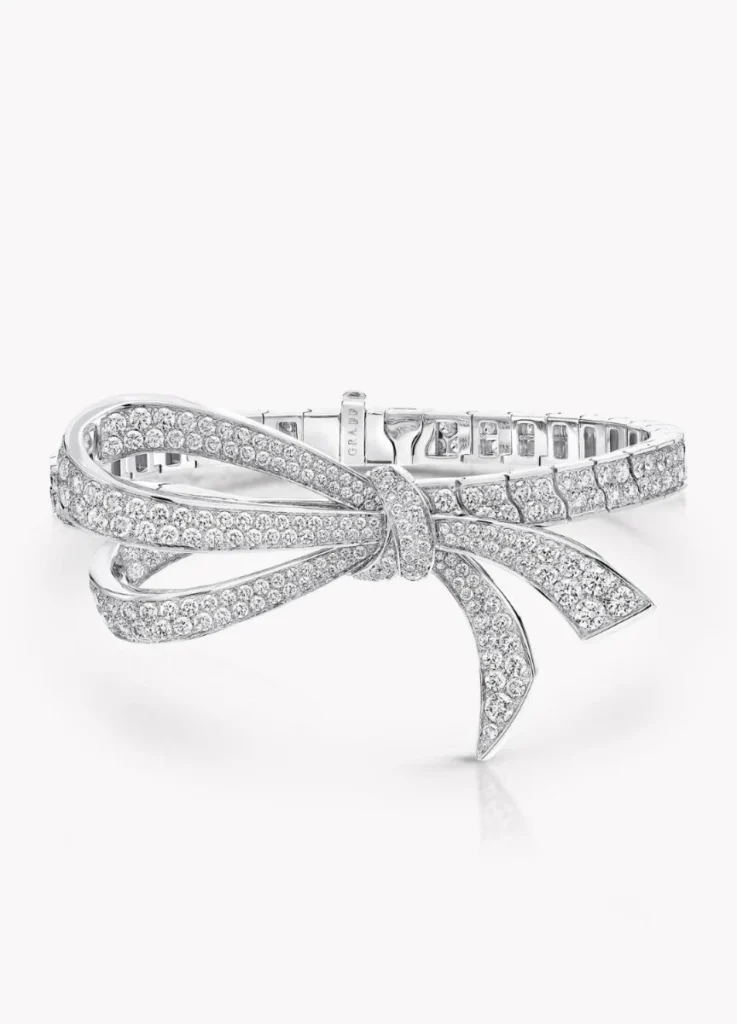
Approximate Diamond Weight: 7.00 cts
$69,500
source: graff.com
One is shaped by gravity. The other by precision.
In Tilda’s Bow, lines of diamonds follow the body before converging into a point of closure — a knot. That moment is not decorative. It is structural. A point where direction resolves into form.
Whether in fabric or in diamonds, a bow is still two lines meeting and holding. And in that small knot — where tension resolves, where direction finds its center — the entire composition is decided.
Tilda’s Bow reads the ribbon not as decoration but as a structural event. And that reframing may be what gives this collection its quiet authority.
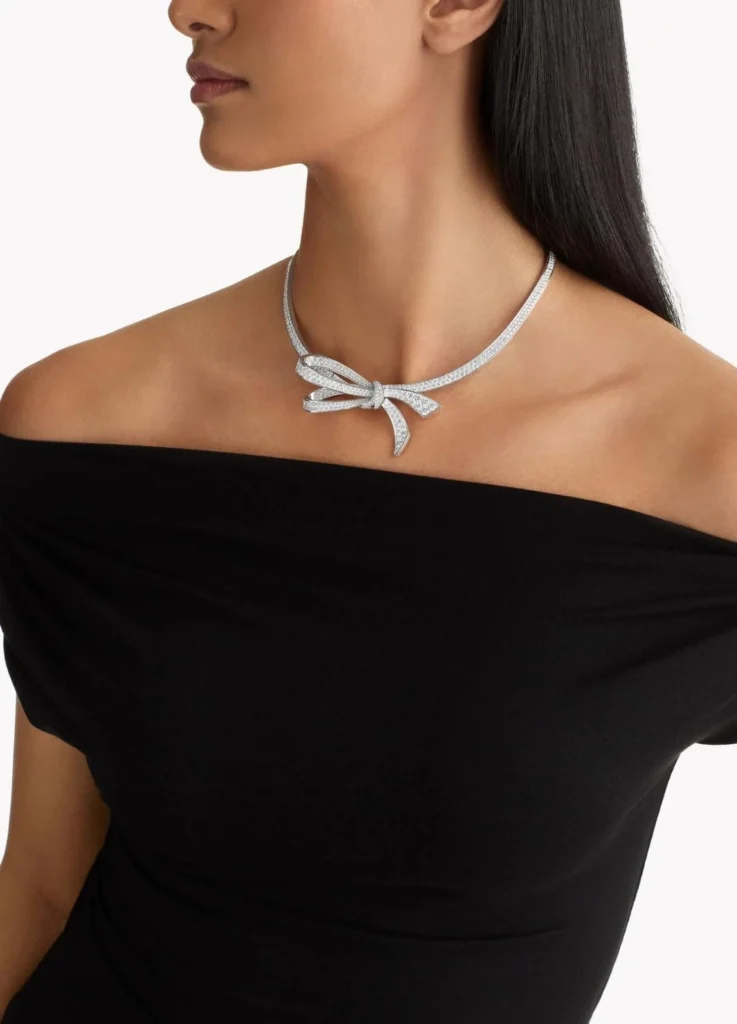
source: graff.com
Featured Image via @graff / Instagram
[ Related Editorials ]