Inside Khaite Spring/Summer 2026
During New York Fashion Week last September, Khaite Spring 2026 once again asserted its presence — not through spectacle, but through precision.
The collection unfolded under a deceptively simple question: How do you twist this?
What followed was not a playful deconstruction. It was a disciplined exploration of instability — garments bent, shifted, and slightly undone to reframe what confidence looks like when it’s no longer symmetrical, polished, or fixed. Asymmetric draped dresses.
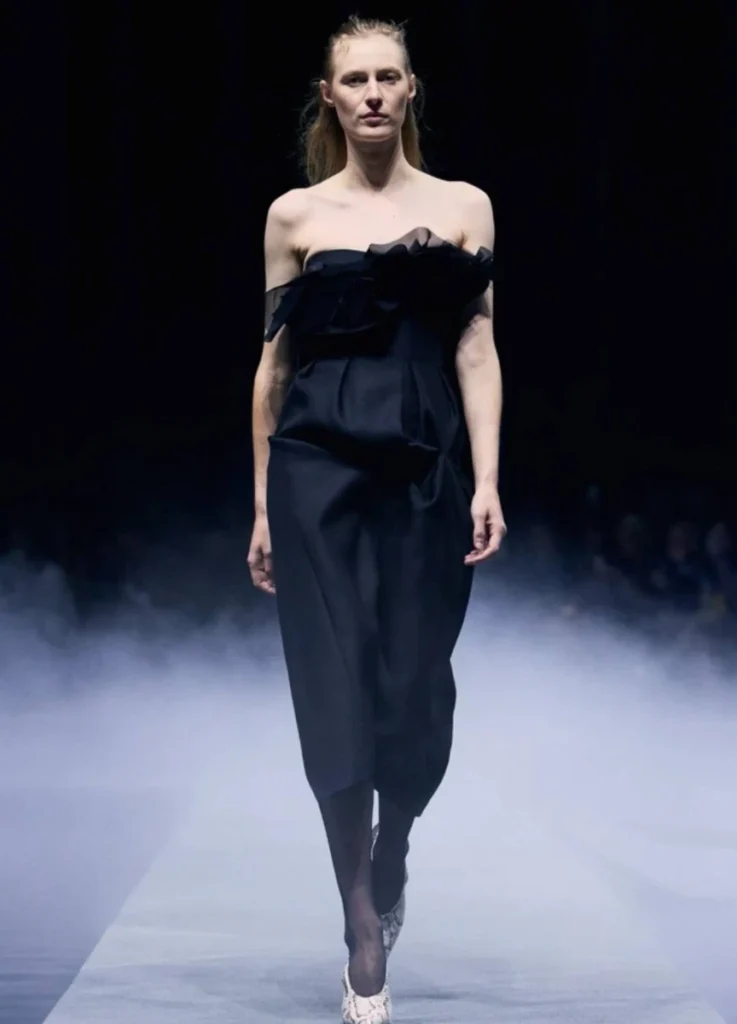
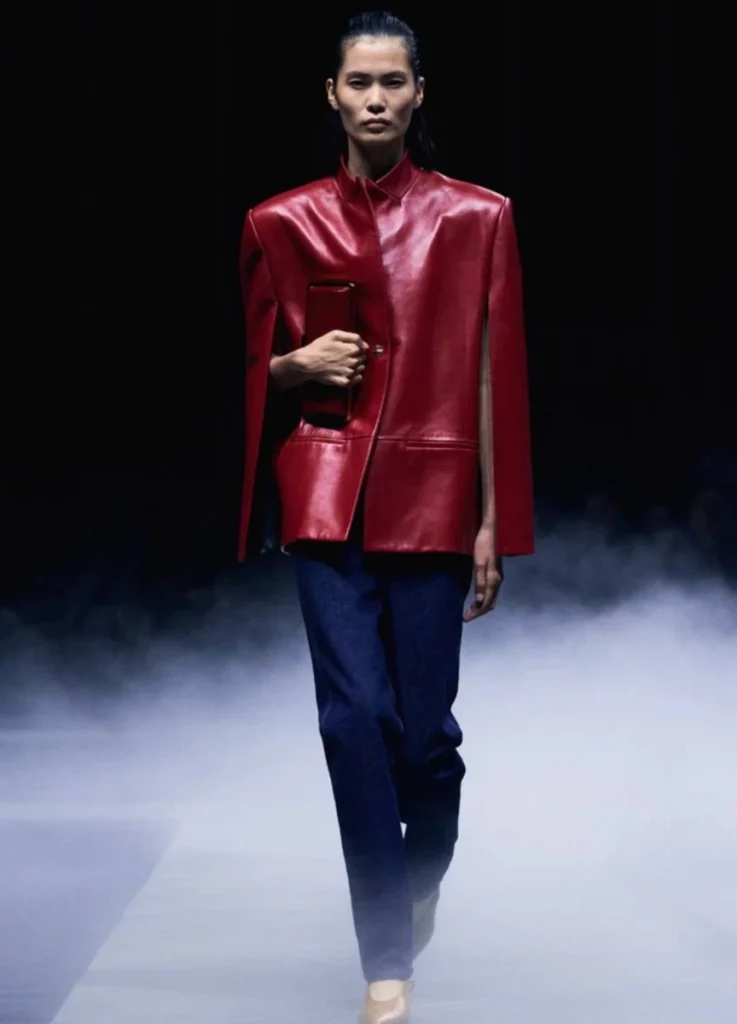
A red leather cape hybrid. Restrained off-shoulder silhouettes that translated the lived reality of the New York woman: practical, alert, quietly resilient in moments of imbalance.
The Khaite woman is really comfortable in being uncomfortable, Catherine Holstein said backstage. This whole idea of confidence that people always talk about, I really find that in insecurity and being self-conscious. I think it’s OK to be self-conscious and insecure. I really hold confidence from that.
That premise — confidence as something held under pressure, not performed in its absence — is what shapes Spring 2026 from opening look to final exit.
Structure and Negative Space — The Tension Between Control and Release
Catherine Holstein has positioned herself as one of the most articulate interpreters of modern New York femininity since founding Khaite in 2016.
The brand’s rise has never been about surface beauty alone. Khaite consistently examines how clothing supports a woman’s posture, rhythm, and psychological stance in daily life.
Holstein has often described herself as an outsider, yet it’s precisely that distance that lets her capture New York’s contradictions accurately — conservatism and experimentation, stability and anxiety, minimalism and emotional friction.
Spring 2026 sharpens that tension rather than resolving it.
“How Do You Twist This?” — A Season Built on Intentional Imbalance
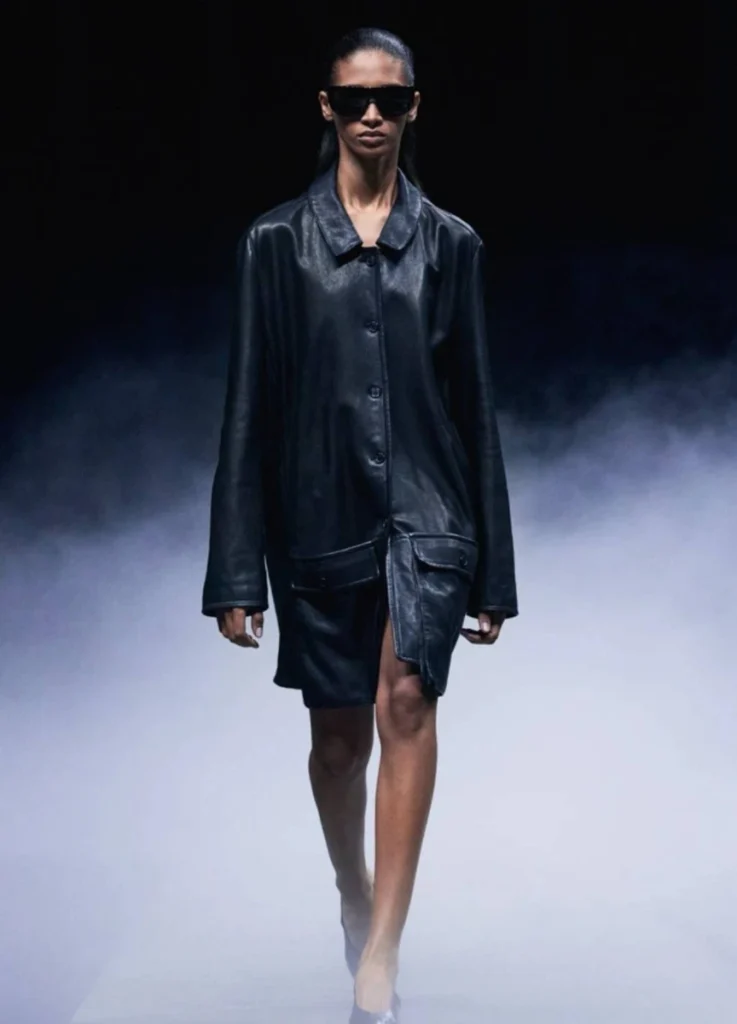
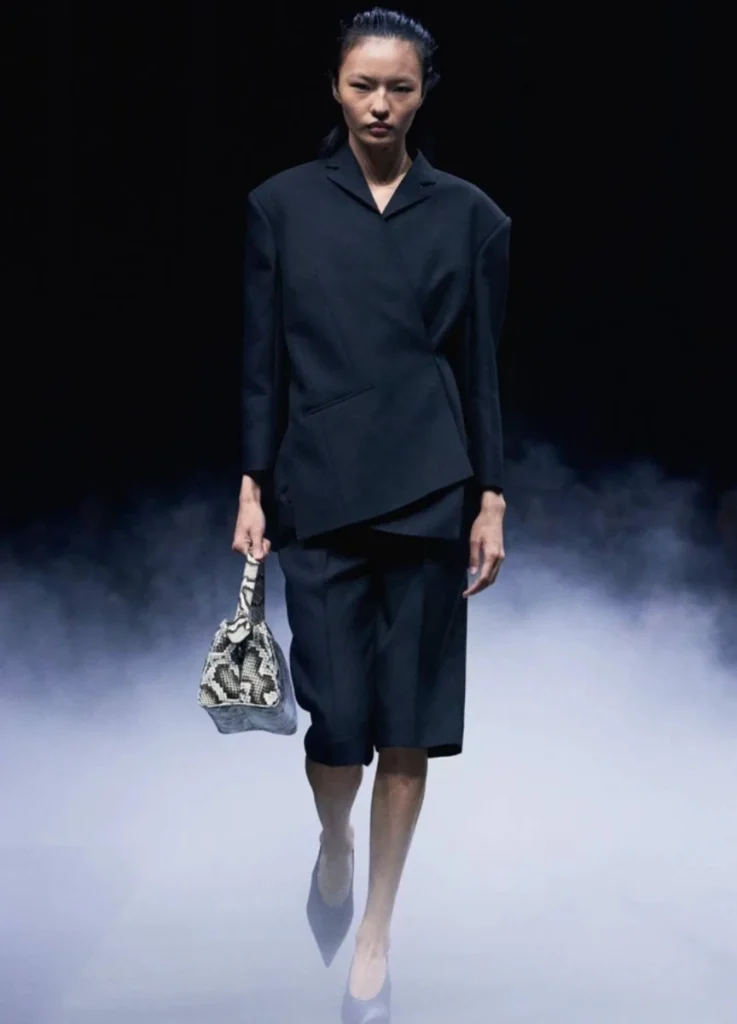
Khaite Spring/Summer 2026 opened with a leather blazer — structured, sharp, unmistakably tailored — yet subtly distorted through twisted seams and misaligned closures. It wrapped the body while simultaneously resisting it.
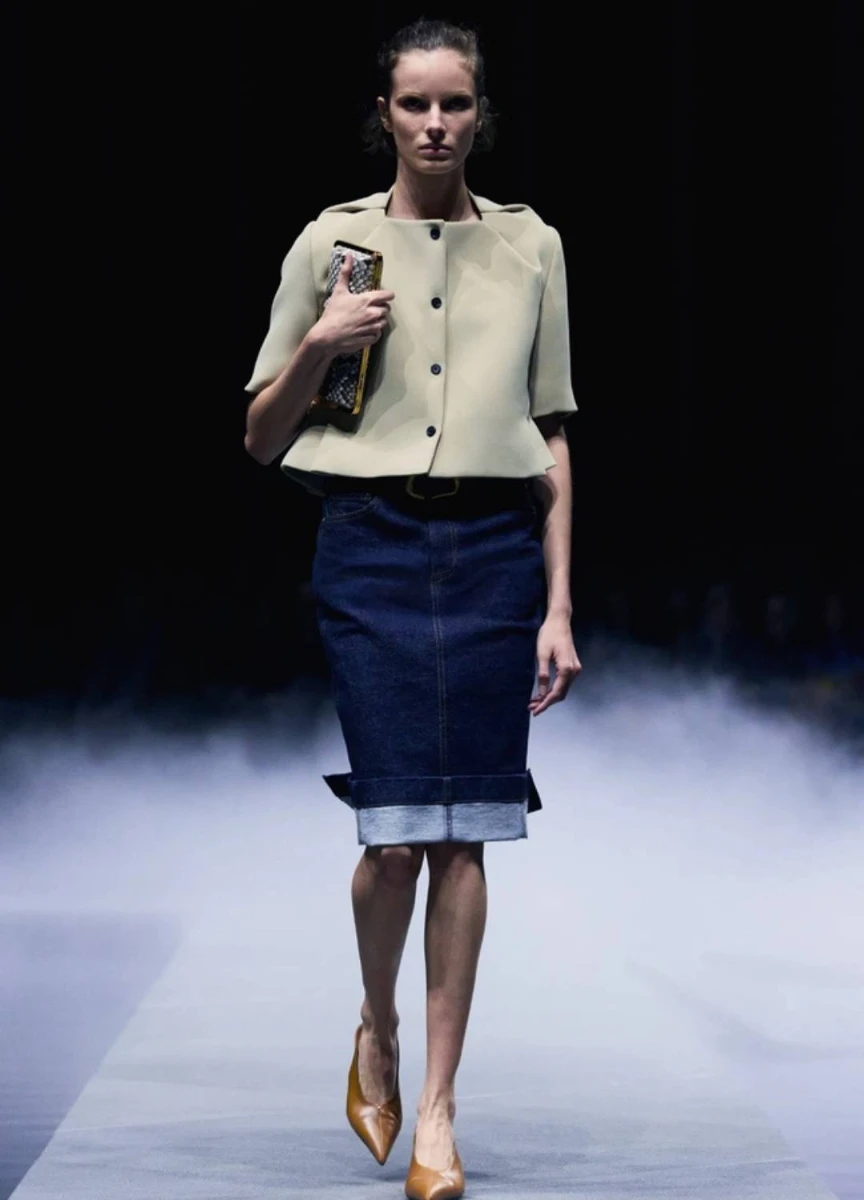
Holstein opened the show with what she called a signature palette cleanser: leather blazer, dark blue jeans, black heels. The blazer, like other jackets in the collection, was cut up the side and twisted across the front — a slightly off-kilter, signature look that announced where the rest of the collection would live.
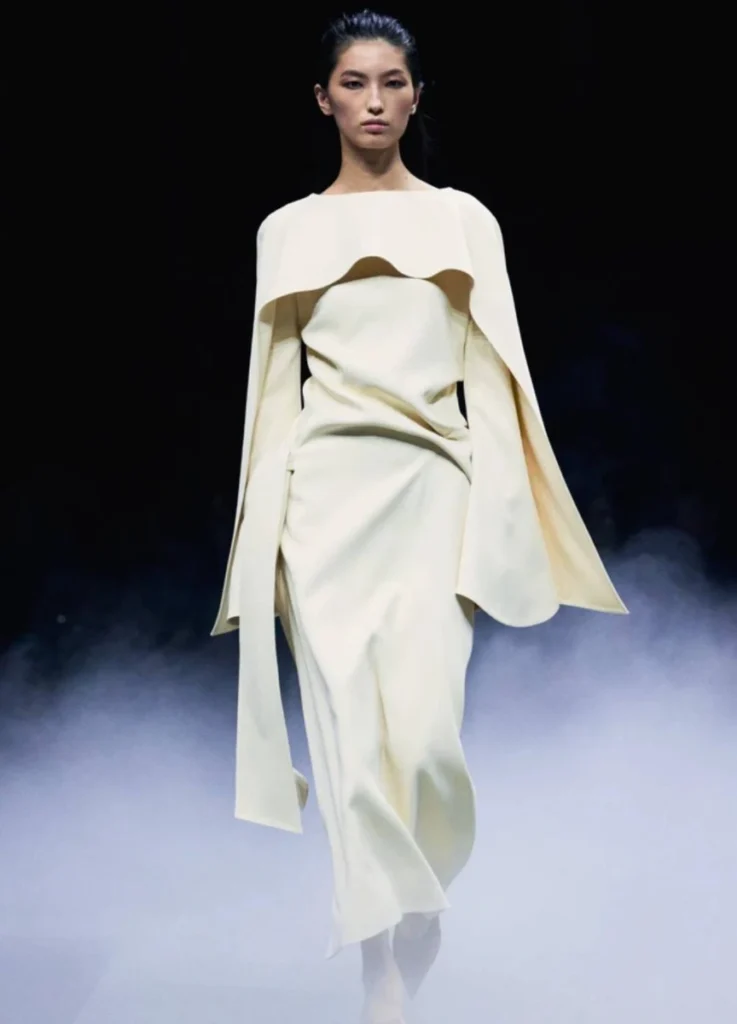
Dresses and coats repeatedly disrupted their own symmetry. Cuts slipped off-center. Drapes pulled weight to one side. Silhouettes hovered between control and release.
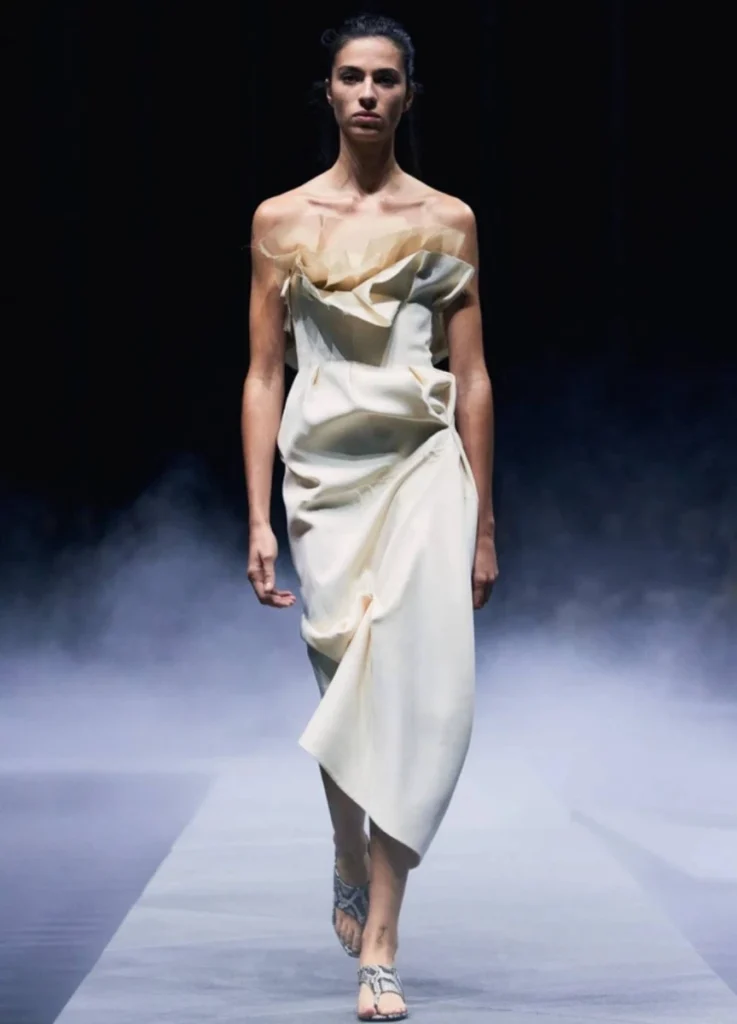
A standout white draped dress drew particular attention — fabric cascading asymmetrically from shoulder to waist, tracing the body’s contours without attempting to perfect them. Vogue described the look as the beauty of delicate collapse. W Magazine read it as introducing a romantic disorientation into New York minimalism.
The personal context made the disorientation register as intentional rather than aesthetic. Holstein had spent the summer in the city as a new mom to her second child, and she wanted to inject the naivety and emotions she experienced in her youth, now reliving through her eldest child’s eyes.
I used to cut things up all the time when I was a teenager and wear them a certain way, and I wanted to go back to that, she said. The ultra-cropped toppers, fold-over tiny bandeaus, cuffed crop jeans, and askew-hemmed trousers all carried that teenage gesture of cutting clothes up and putting them back together a different way.
Construction and Deconstruction — Letting the Process Show
Holstein continued her practice of revealing process rather than masking it.
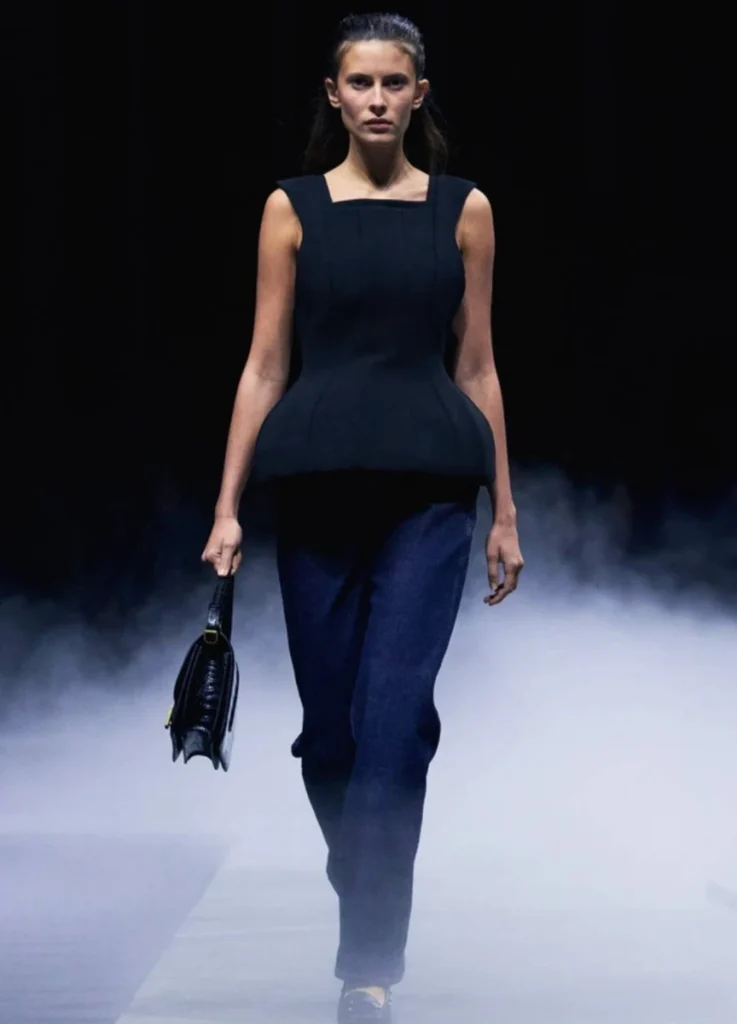
Corset structures appeared partially dismantled. Seams were exposed. Tulle inserts emerged where rigidity might normally be expected. Some corset looks were exploded into bulbous, hourglass sculptures. Others were ripped down and stuffed with tulle at the bust — just to make it a little stupid, as Holstein joked, but the underlying point was about not being afraid to take risks.
These gestures didn’t weaken the garments. They reframed strength as something that survives disruption.
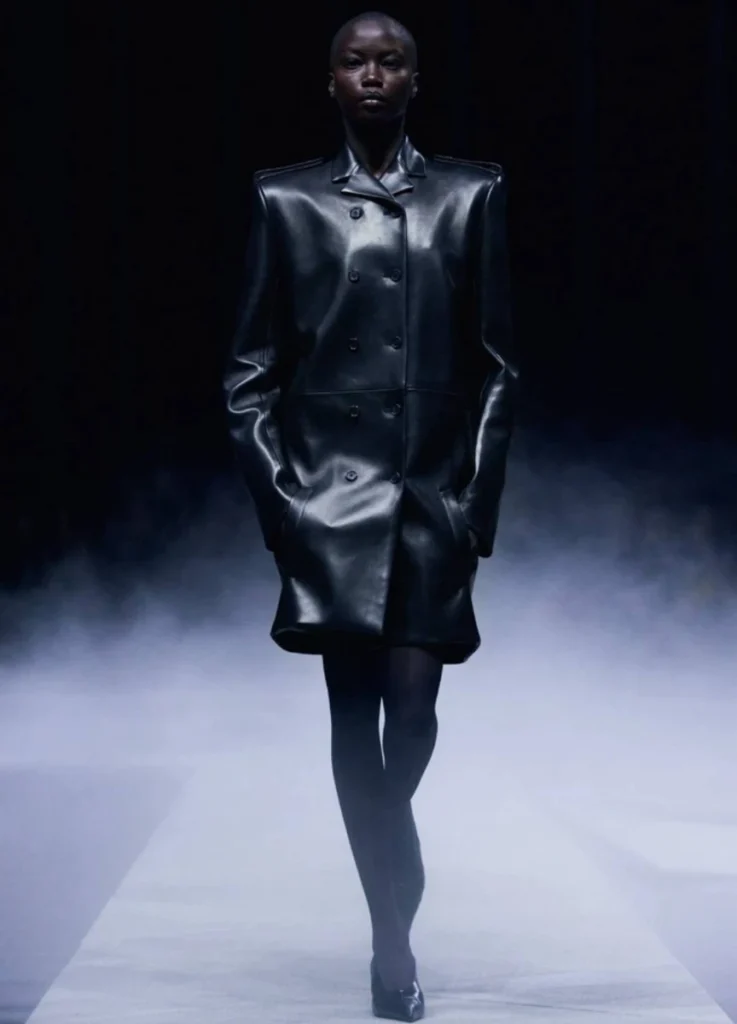
Black leather sets and denim looks followed the same logic. Raw materials were compressed into disciplined silhouettes, forcing practicality and experimentation to coexist without compromise. The dark indigo wash jeans in straight-leg silhouettes (relaxing from the thigh to the ankle) and the dark-wash denim pencil skirts with cuff hems revealing the raw underside of the denim — these were the practical anchors of the collection.
Who What Wear flagged the denim pencil skirts specifically as no-longer-dated, the kind of piece that converts runway to wardrobe immediately.
Confidence isn’t a finished surface. It’s a state maintained under pressure.
Accessories and Detail — The Power of Restraint
Accessories played a strategic role, never overwhelming the garments but amplifying their tension.
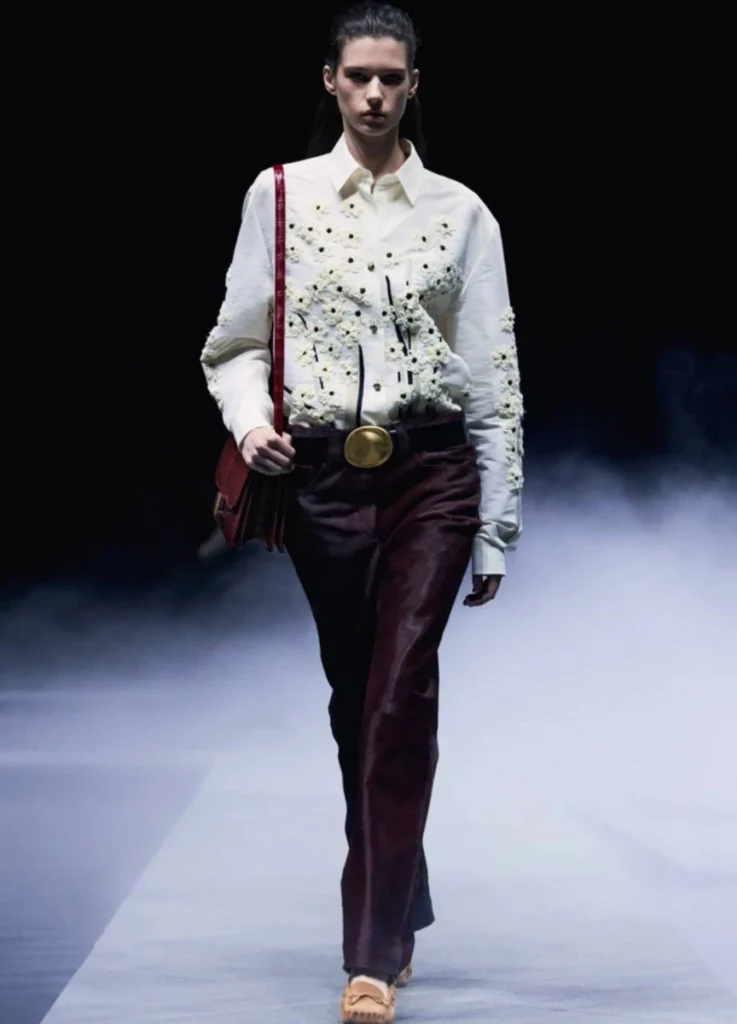
Deep cuff raw denim evoked retro references while clashing deliberately with sharply tailored leather outerwear. The red leather cape hybrid punctured the largely neutral palette, appearing almost as an interruption rather than an accent. Slingbacks and kitten heels grounded the collection in everyday wearability, reinforcing Khaite’s reputation as the New York woman’s uniform.
The new Blake and Lori bags appeared on multiple front-row guests outside the venue — Shailene Woodley, Chloe Fineman, Rosie Huntington-Whiteley, and Olivia Munn all arrived in head-to-toe Khaite. The Khaite show started long before guests took their seats.
Kendall Jenner walked the runway. Inside, Arielle Charnas, Sarah Harris, and Olivia Palermo filled the front row. The brand has reached the point where its audience IS its clientele — a feedback loop that few independent labels achieve at this scale.
These details underscored the brand’s belief that absence can be as expressive as embellishment.
Critical Reception — Evolution Rather Than Revolution
Industry response highlighted the collection’s intellectual clarity.
Holstein questioning the very concept of confidence — not a perfect silhouette, but the posture that moves forward through anxiety and trembling — that was Vogue’s read. Harper’s Bazaar observed that within Khaite’s calculated structures, there remains a distinctly feminine margin — space for the wearer to project her own narrative.
The Impression framed the collection as a dance of contrasts, noting that it wasn’t a revolution, but it was an evolution, gently expanding Khaite’s vocabulary without losing the thread of what makes the house distinct. Hypebeast read it as Khaite undone — Holstein’s argument that haphazard can be haute.
Online fashion communities echoed the sentiment. On Reddit and PurseForum, users praised the season as one in which Khaite balanced New York energy with subtle Parisian sensibility. The leather blazer and draped dresses were repeatedly cited as next-generation iconic pieces.
The polarity Holstein invited — you can like it or you can hate it, that’s fine, but you can’t say it’s not Khaite — never really materialized in the press. Critics largely converged on a single reading: this was an evolution piece, gently extending what the brand already does, rather than a rupture. That convergence is itself a measure of how settled Khaite has become as a label whose identity readers and critics already know how to receive.
The Business Position — From New York Outsider to Global Label
Spring 2026 arrived at a particular moment in Khaite’s commercial trajectory. Holstein opened her milestone Los Angeles flagship in 2025, marking the brand’s first major footprint outside New York. The Khaite Japan Corp., a joint venture and long-term strategic partnership with Yagi Tsusho, launched as a vehicle for the brand’s Japanese expansion in fall 2025.
The brand’s commercial pillars are now clearly defined. Denim, leather, and footwear are the three biggest categories, alongside belts (the Benny belt has held its status as the brand’s best-seller since launch), sunglasses through the Oliver Peoples collaboration, and cashmere.
I’m a big believer that your best marketing tool is good product, Holstein said in a recent WWD interview tied to the LA opening. There’s a core instinct, gut feeling when I see the products.
That commercial anchor explains why Spring 2026’s experimentation reads as intentional rather than scattershot. Holstein can twist seams and explode corsets across a runway because the brand’s volume comes from a stable category mix that doesn’t depend on the runway pieces themselves to perform commercially. Runway becomes the laboratory. Denim, leather, and accessories carry the business.
For collectors and buyers, this is the position to watch. Khaite has crossed from aspirational to staple in the modern luxury wardrobe — and Spring 2026 is the season where the brand’s confidence in that position becomes unmistakable.
Reading Across Seasons — The Twist as Through-Line
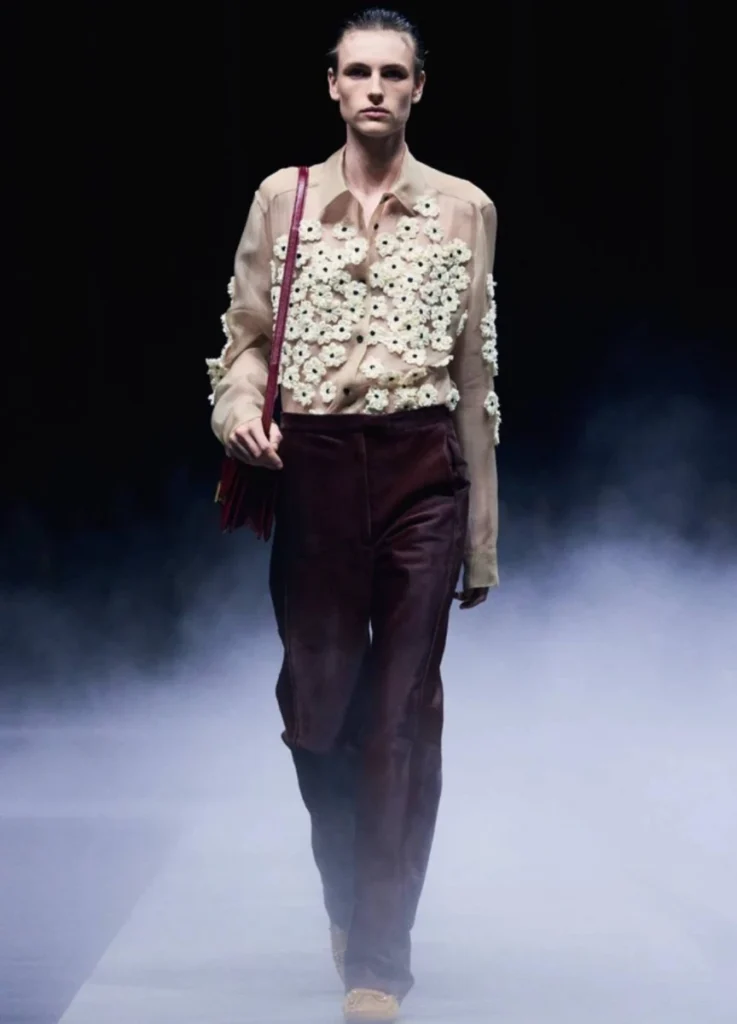
Spring 2026 sits inside a clear evolution arc. Pre-Fall 2026 (presented in December) extended the same vocabulary — Holstein described the season as a study in the right way to wear something or the right way a garment should fit, with seams twisted around the body and buttons placed slightly off-kilter.
Pre-Fall introduced ultra-cropped plonge leather jackets and feminized 90s grunge through the off-the-shoulder hand-draped pink dress with Venetian-inspired drapes. Resort 2026 had earlier expanded the brand’s playfulness through pintucked sheer dresses and 90s boho-grunge layers.
Fall 2026 (presented this February) carried the through-line forward — military-style jackets with sharp shoulders, bustled skirts, belt-loop chains, leather gloves of varying colors and lengths.
Across four collections, the twist has stabilized as Khaite’s structural signature. Each season offers a different inflection — teenage gesture, body-aware fit, 90s grunge, military structure — but the underlying language remains: garments engineered to read as resolved while carrying intentional disruption.
This consistency is rare at the contemporary luxury level. Most independent labels at Khaite’s price point either repeat themselves into stagnation or pivot abruptly to chase virality. Holstein has done neither. The brand has built a framework flexible enough to absorb new references without dissolving its core, and that framework is now the foundation of Khaite’s longer-term equity.
Khaite’s Present — and Its Trajectory
Spring 2026 reaffirmed Khaite’s position as a brand less concerned with trends than with the act of dressing itself.
Holstein’s work continues to resonate not because it dictates a look, but because it constructs a framework — one flexible enough to accommodate uncertainty. Khaite garments rarely feel like completed statements. They resemble poems with intentional gaps, waiting for the wearer’s movement, time, and experience to fill them.
In Spring 2026, confidence wasn’t presented as composure or dominance. It emerged through tension, imbalance, and the courage to remain upright while the structure shifts.
Khaite once again translated the psychology of the New York woman into form — quietly, precisely, with lasting impact. The collection that walked across broken glaciers carries a different kind of certainty than the kind that performs from a stable runway. It’s the certainty of a brand that knows what it is, knows who it’s for, and trusts the structure underneath even as the surface twists.
The garments rarely shout. They reward the wearer who returns to them.
That’s the position Khaite has been building toward for nearly a decade. Spring 2026 is the season where the position becomes fully visible.
All images referenced in this post are drawn from Vogue Runway.
[ Related Editorials ]
[Khaite Pre-Fall 2026] On Imperfection, the Body, and a Shift in Silhouette
[Journal] Is The Row a Trend—or a New Classic?
[The Row Pre-Fall 2026 ] Clothing That Speaks in Stillness
[Phoebe Philo | Collection D] Why She Continues to Refuse the Runway