Inside Valentino Fall Winter 2026
The Fall Winter 2026 collection at Valentino is one of the clearest articulations yet of how Alessandro Michele intends to handle one of fashion’s most historically resolved aesthetic systems.
Two seasons in, the brief he’s working with isn’t a missing identity. Valentino’s identity is fully formed — romanticism, refinement, couture-level craft, a distinctly Roman elegance held together for decades. That coherence is also the problem. When a house’s visual language is already this articulated, the question for any incoming designer isn’t how to rebuild it. It’s how to move inside it without erasing the foundations.
Michele’s answer this season is captured in a single word he used to describe the collection: interference.
He doesn’t dismantle Valentino’s heritage. He introduces small disruptions into a system that was, by design, supposed to be uninterrupted. The result isn’t transformation — it’s recalibration. An elegant structure disturbed by carefully placed irregularities.
This review reads the collection through silhouette, material, color, and industry context, with a parallel comparison to what’s happening at Celine this season — because the two houses are asking strikingly similar questions in different ways.
Season Context | Interference Inside a Perfect System
The show took place at Palazzo Barberini in Rome, and the location was already half the argument. Baroque frescoes, monumental architecture, the weight of Italian cultural heritage pressing in on the runway — Valentino’s relationship to Roman classicism rendered as physical space.
Few houses possess such a defined visual tradition. Since Valentino Garavani’s era, the brand has been associated with one specific idea of elegance: romantic, graceful, immaculately composed. That heritage is exactly the challenge.
This isn’t the situation Michele faced when he transformed Gucci in the mid-2010s. Gucci was a brand in search of identity. Valentino has one of the most fully realized aesthetic codes in luxury fashion.
So instead of breaking the structure, Michele introduces tension inside it.
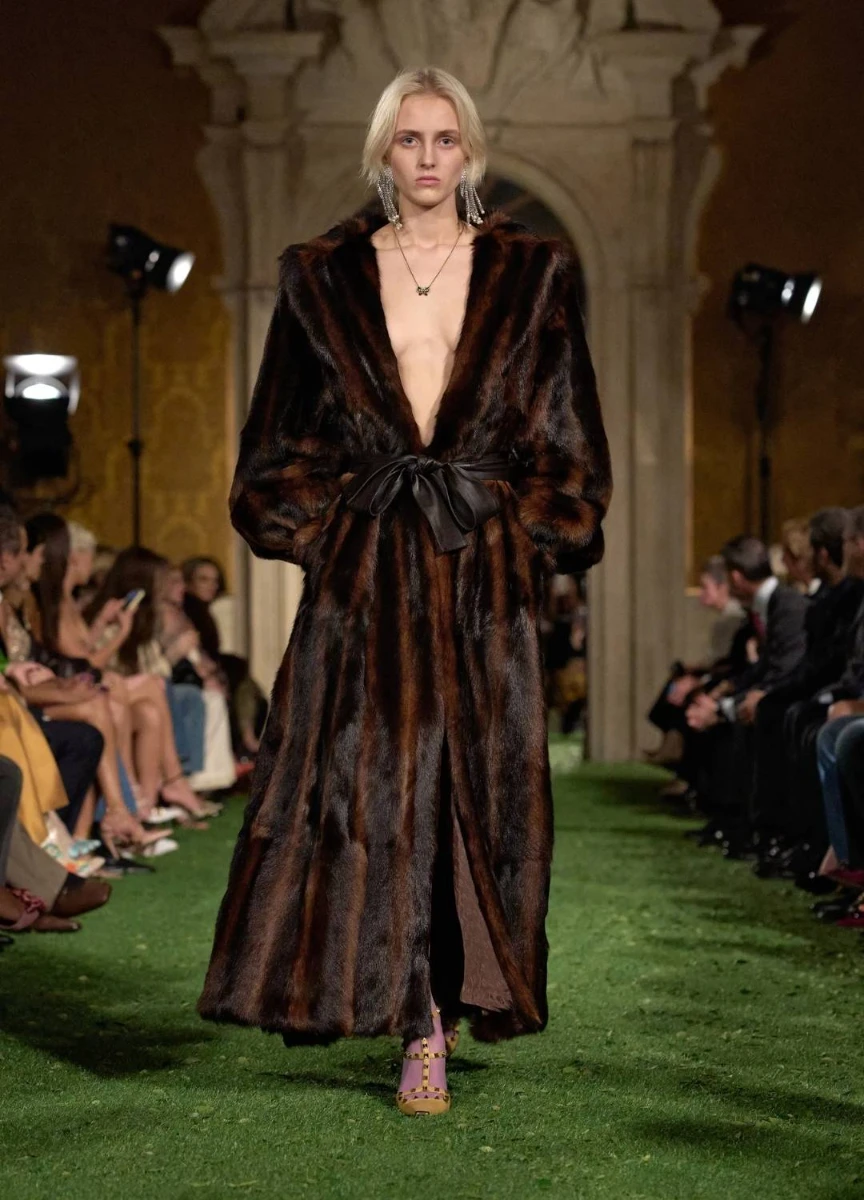
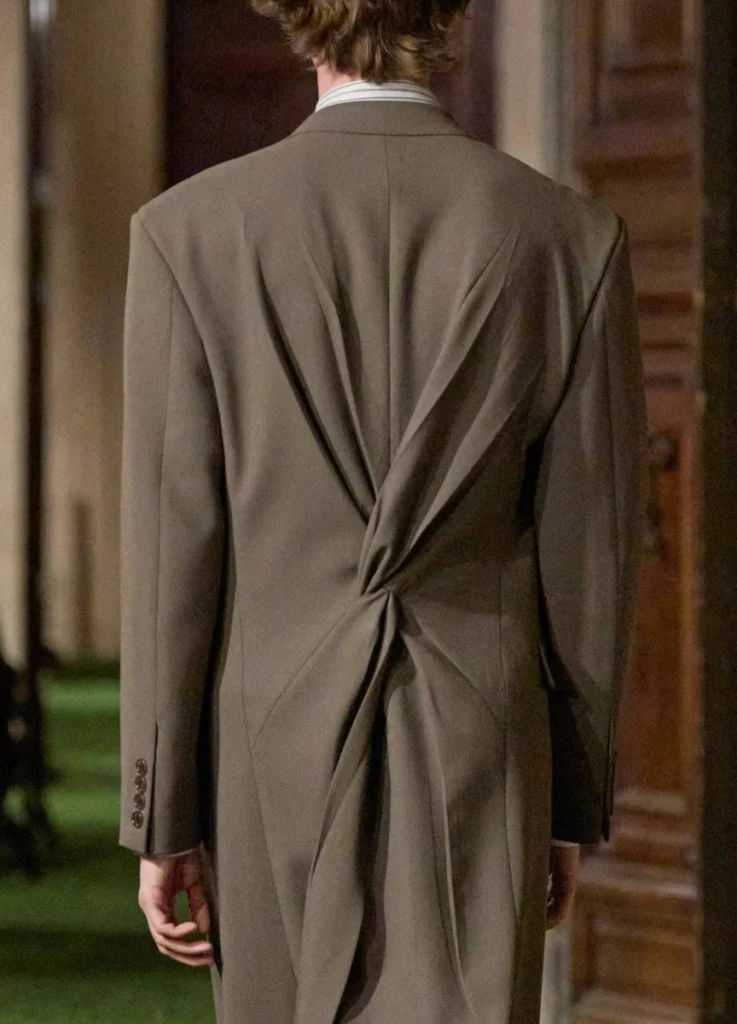
Classic draped evening dresses appear alongside exaggerated 1980s tailoring. Romantic lace layers under dramatic fur coats. Fluid silhouettes share the runway with masculine suiting. None of these elements destroys Valentino’s elegance. They destabilize it slightly.
The effect resembles walking into a perfectly arranged room where one object has been intentionally set at a subtle angle. The room stays harmonious, but the deviation shifts the emotional balance of the entire space.
That’s the essence of interference.
Structural Center | A Controlled Fracture Within Valentino’s Order
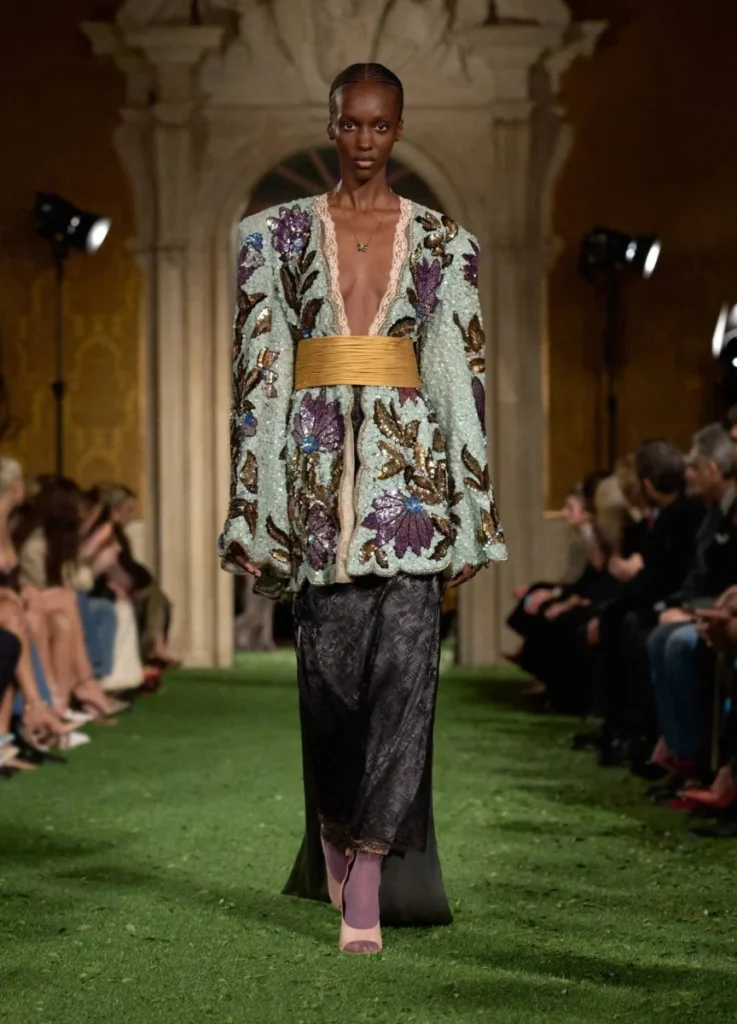
The collection works through a specific structural idea: small fractures introduced into an otherwise perfect aesthetic system.
Valentino’s historical identity is built on harmony — romantic silhouettes, refined couture techniques, an aristocratic femininity that has held the house’s center for decades. Michele’s intervention doesn’t erase that harmony. It injects moments of dissonance.
The dissonances are specific:
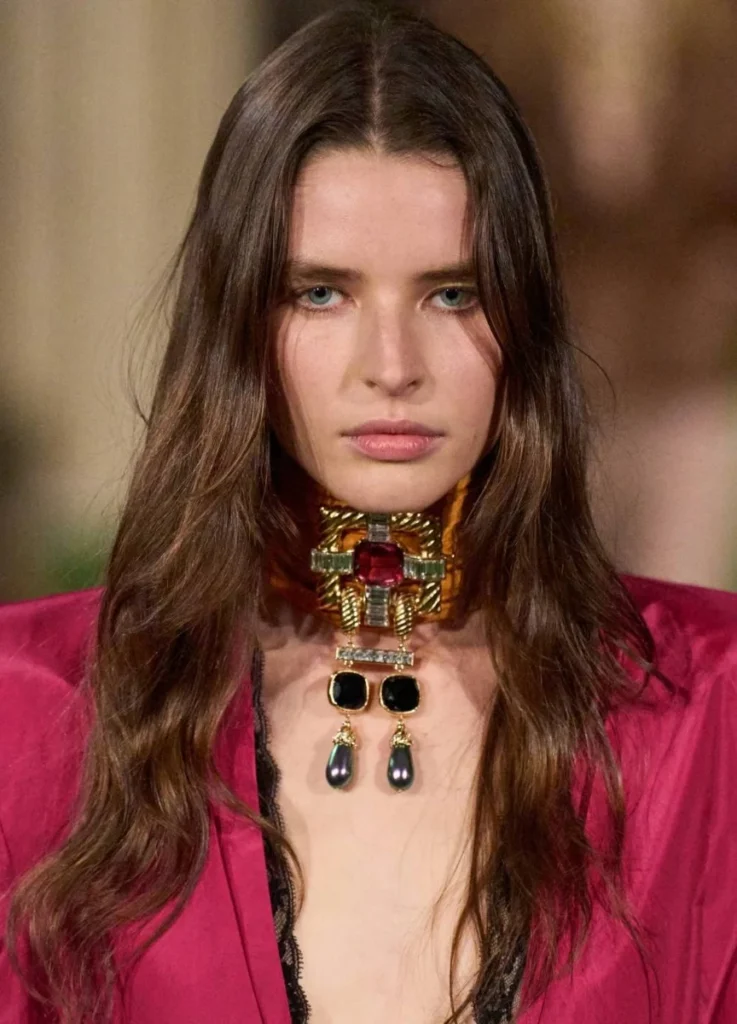
- Power-shoulder tailoring interrupting delicate lace gowns
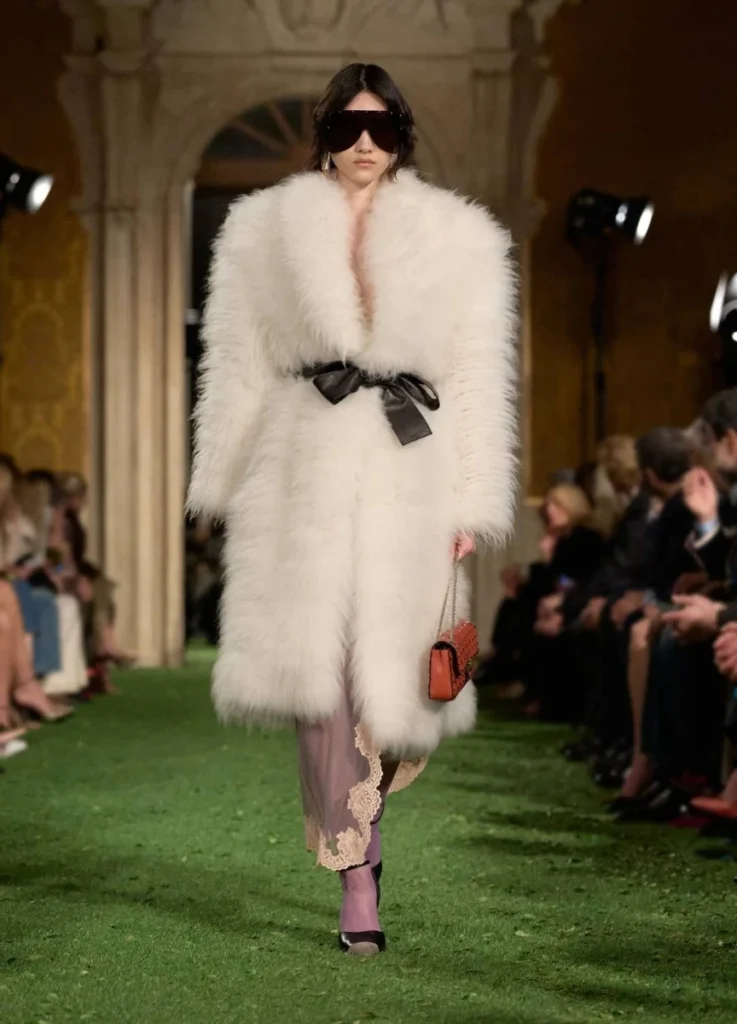
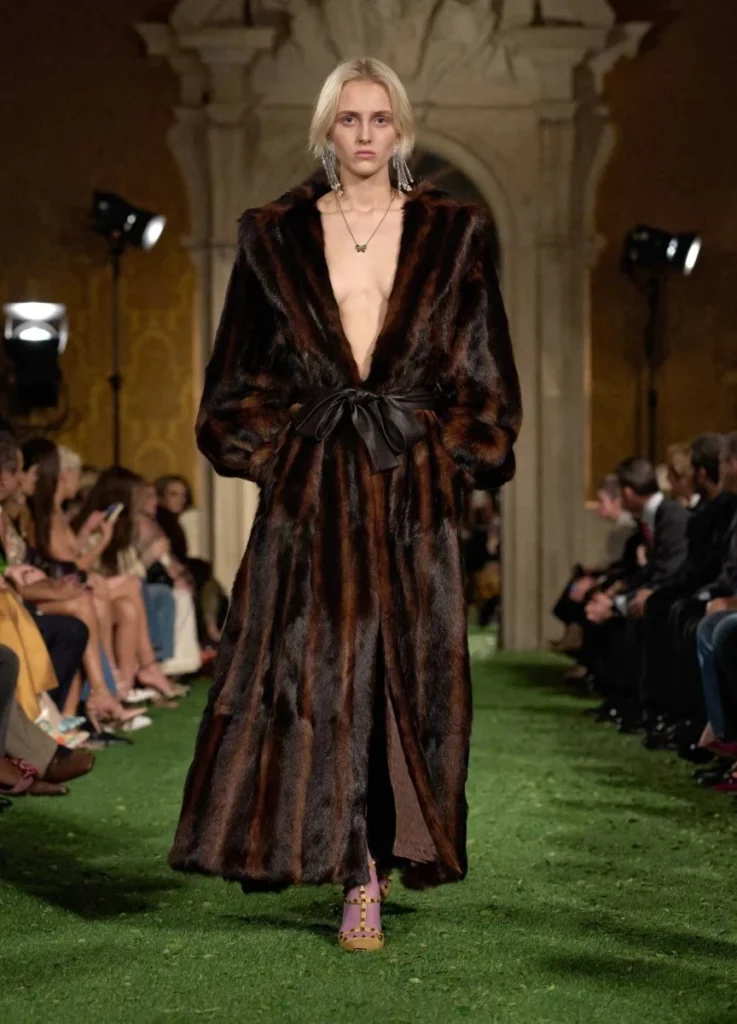
- Luxurious fur coats layered over romantic dresses
- Structured suiting placed beside fluid draped silhouettes
These gestures create tension without collapsing coherence. Michele avoids the disruptive reinvention that often accompanies designer transitions. He treats Valentino’s aesthetic as a completed structure — one that can be slightly disturbed to generate new visual energy.
The result isn’t chaos. It’s a quiet imbalance that activates the entire collection.
Silhouette | Power Tailoring Meets Romantic Fluidity
The silhouettes organize around two distinct axes.
1. Power Silhouettes
One direction references the exaggerated proportions of 1980s tailoring:
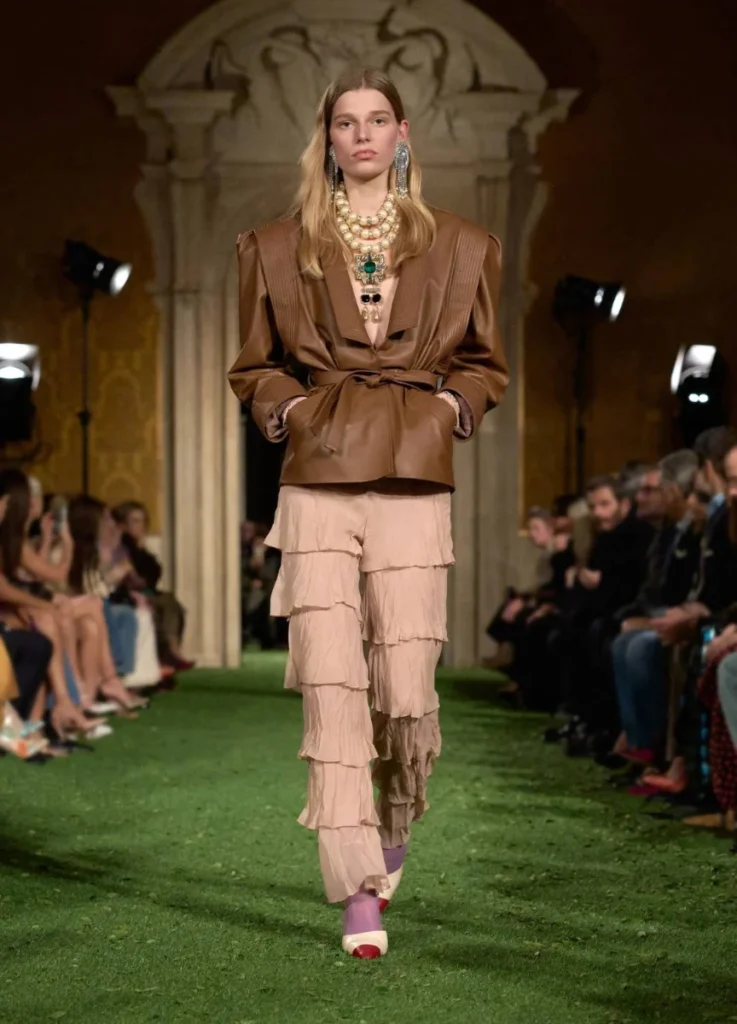
- Rounded, emphasized shoulders
- Generous tailoring
- Long coats, wide trousers
- Structured jackets with strong vertical lines
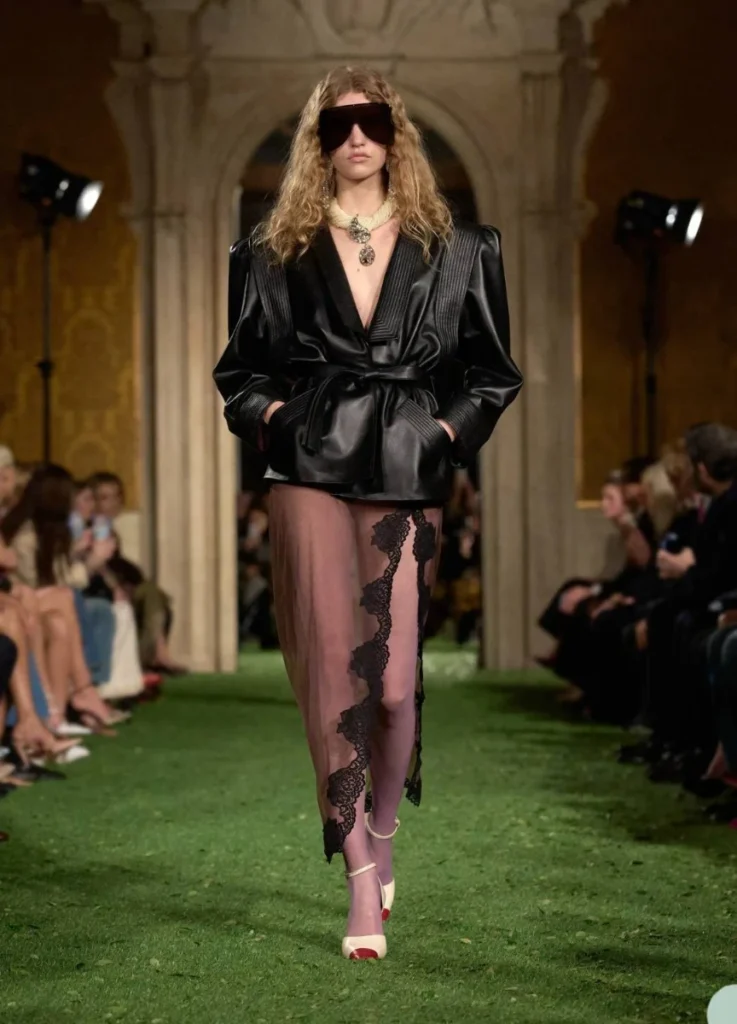
These shapes carry the language of power dressing while reaching into Michele’s long-standing fascination with historical fashion references. The oversized shoulders, in particular, introduce a dramatic counterpoint to Valentino’s traditionally soft femininity.
2. Draped Romantic Silhouettes
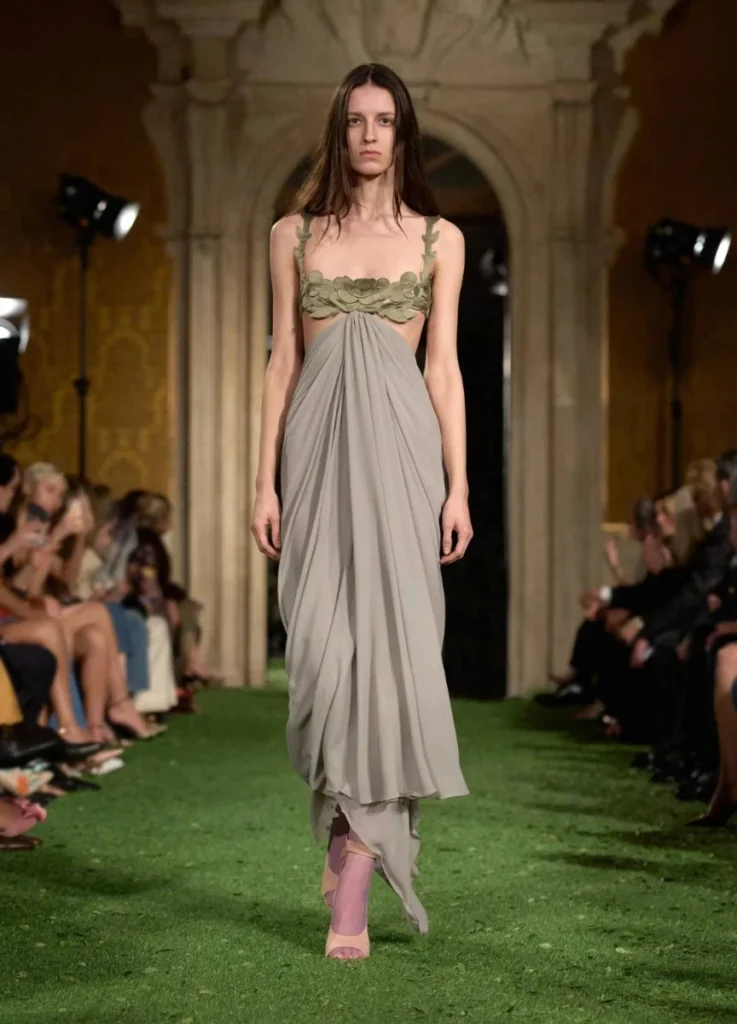
Running parallel are softer forms:
- Draped chiffon dresses
- Tunic silhouettes
- Pleated skirts
- Flowing evening gowns
These pieces remain firmly inside Valentino’s historical vocabulary.
What the Dual Silhouette Means
The coexistence of these two silhouette families signals a broader conceptual move.
Rather than presenting a single unified image of the Valentino woman, Michele introduces several identities simultaneously. Some looks read as traditional romantic femininity. Others lean toward masculine tailoring. Others suggest a bohemian or eclectic sensibility.
This multiplicity echoes a strategy Michele used repeatedly at Gucci: instead of constructing one narrative identity, he assembles several parallel ones.
The Valentino woman, in this collection, isn’t singular. She’s plural.
Materials | Romance Meets Structure
Material choices reinforce the dual structure.
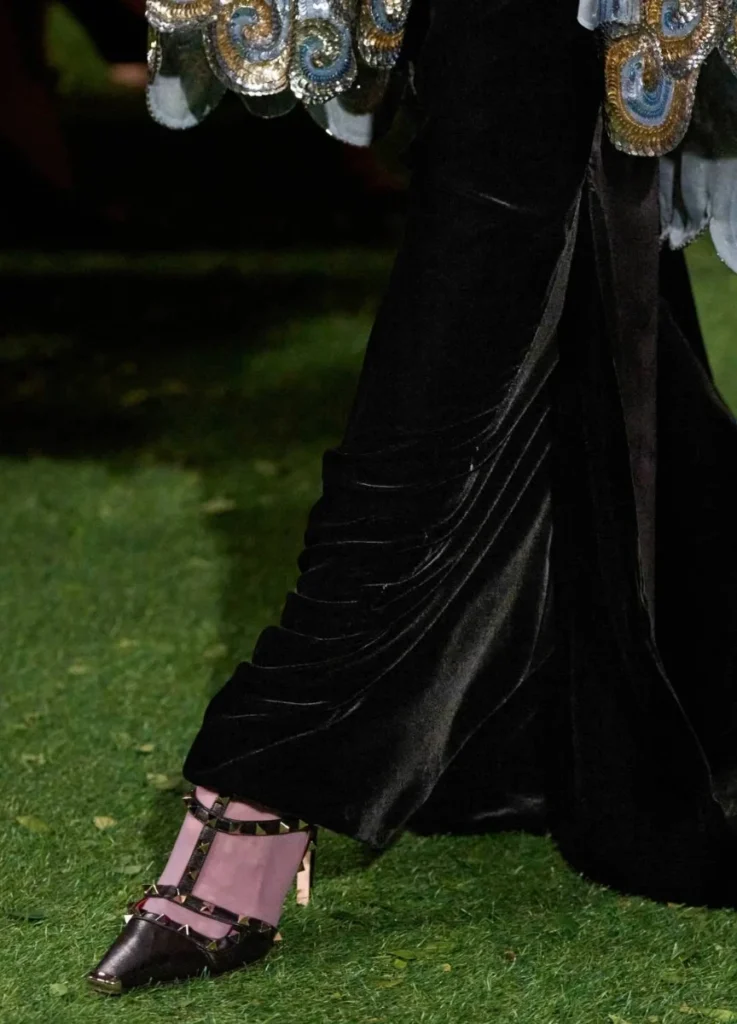
The primary fabrics: velvet, chiffon, lace, fur, wool tailoring, taffeta. Each carries a different aesthetic register.
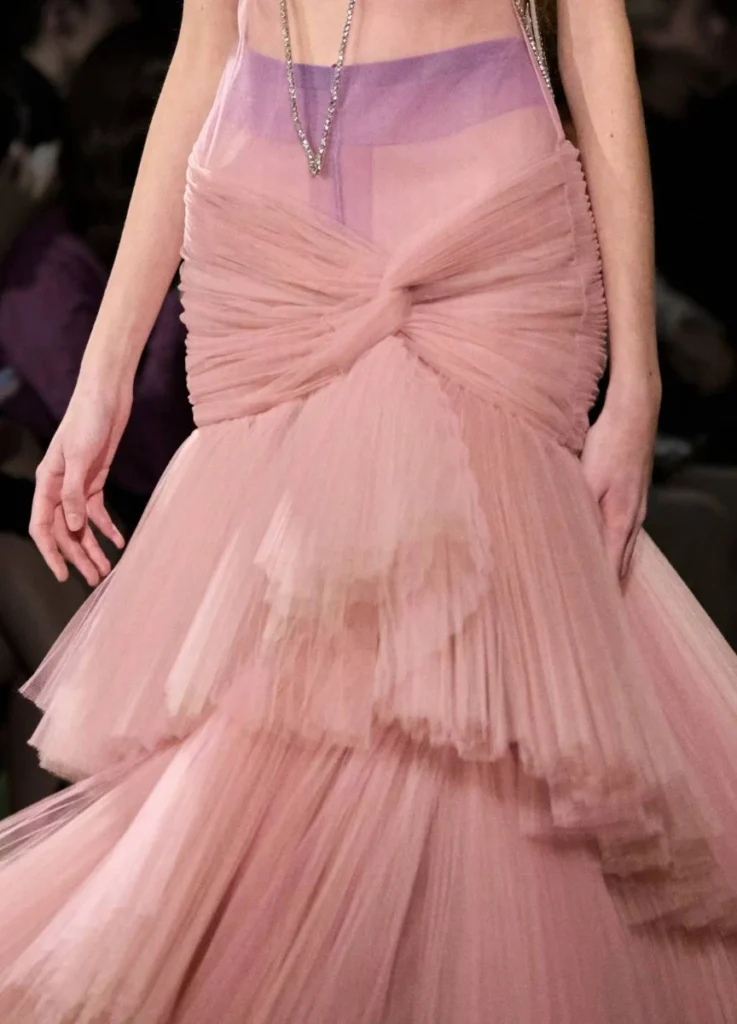
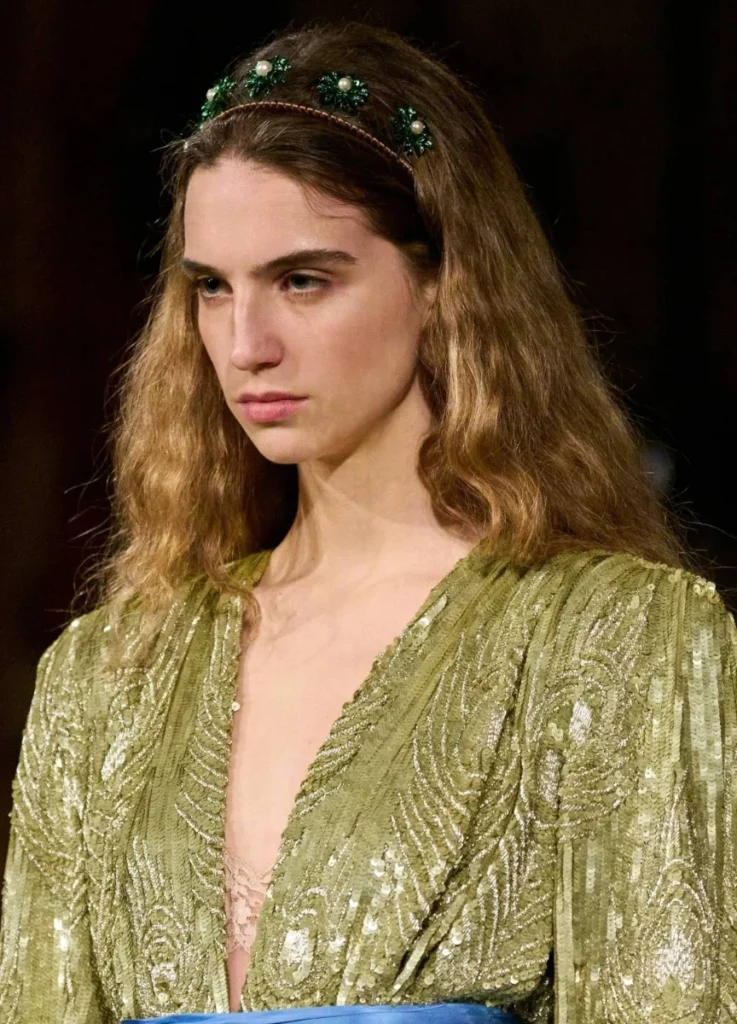
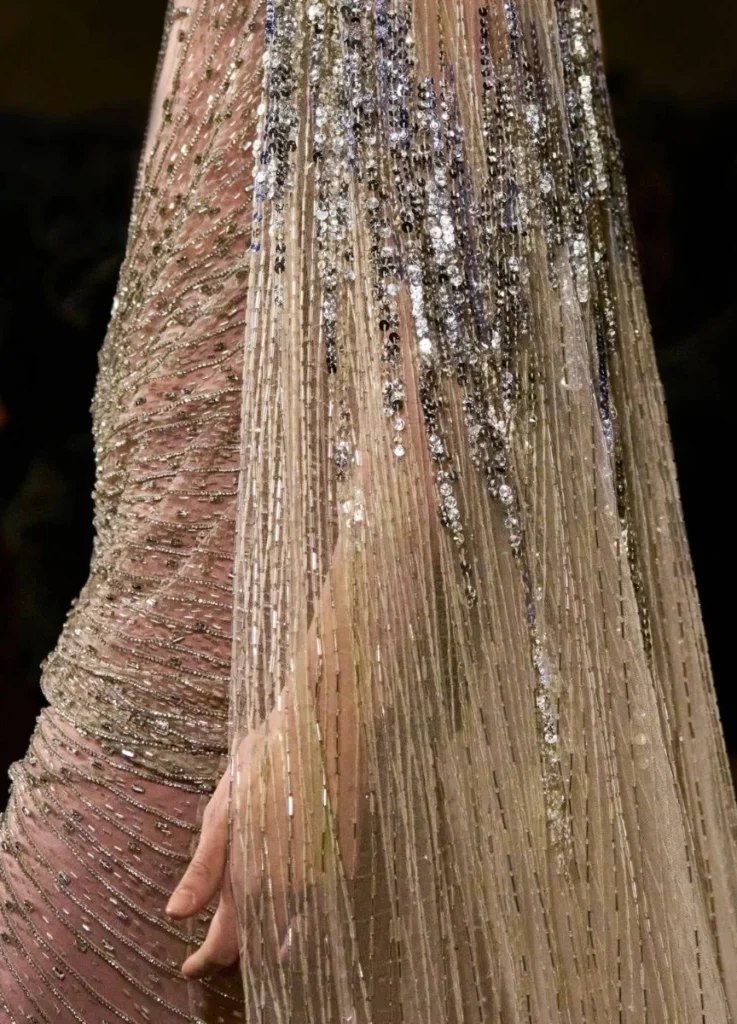
Romantic materials. Chiffon, lace, and silk dominate the draped evening looks, emphasizing softness and movement. These fabrics carry Valentino’s long-standing association with couture romance.
Structured materials. Wool tailoring and structured fabrics appear in coats and jackets, creating sharper architectural shapes. Taffeta introduces dramatic volume in the evening dresses, adding sculptural presence to the runway.
Styling | Michele’s Eclectic Layering
If Valentino’s traditional elegance is the foundation, styling is where Michele’s personality becomes most visible.
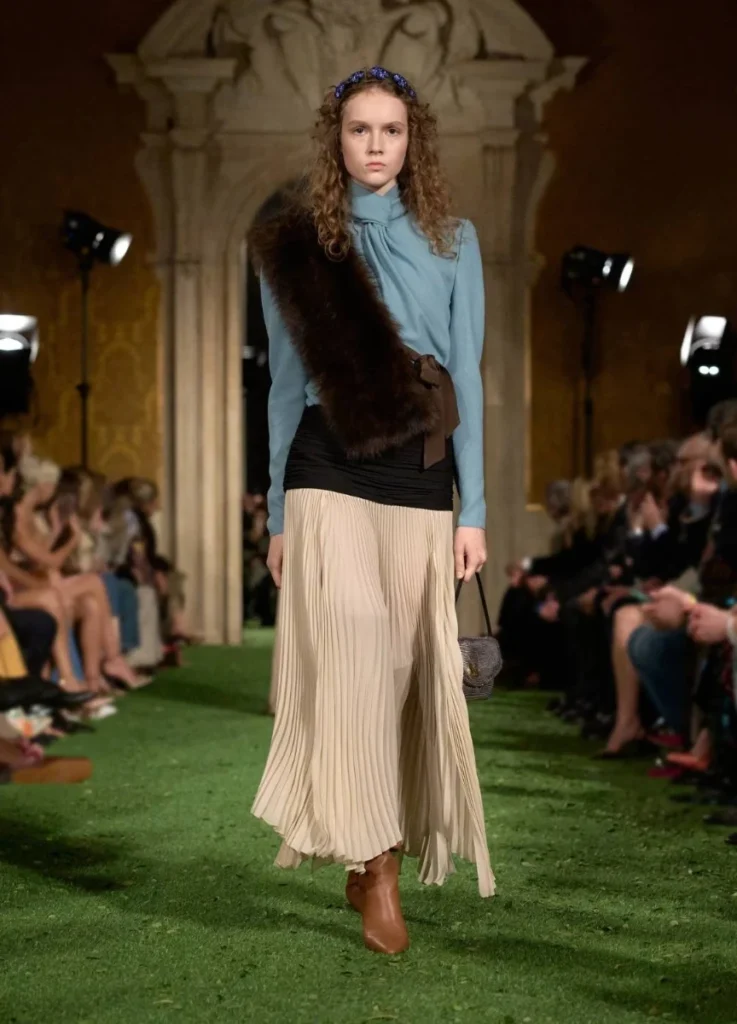
Several elements stand out:
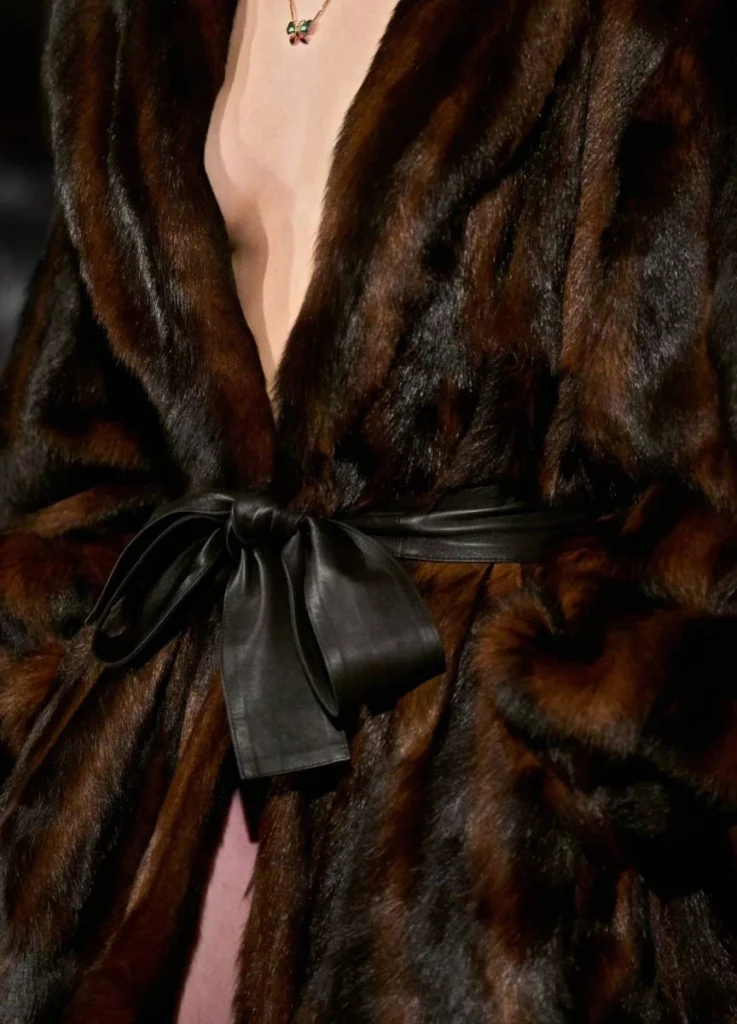
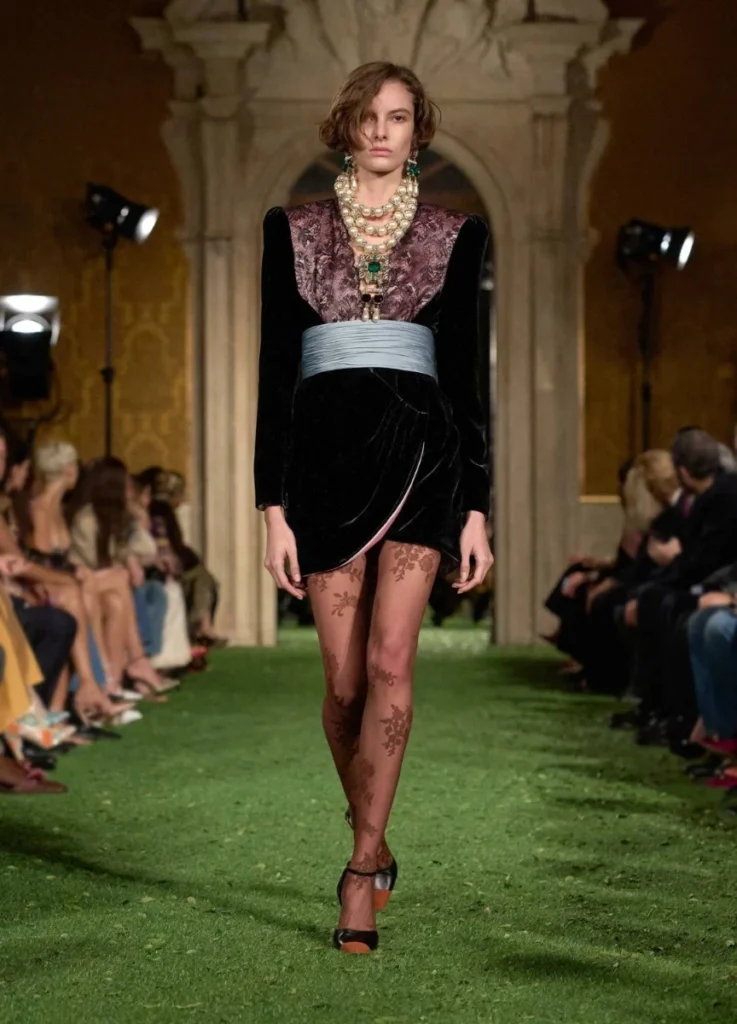
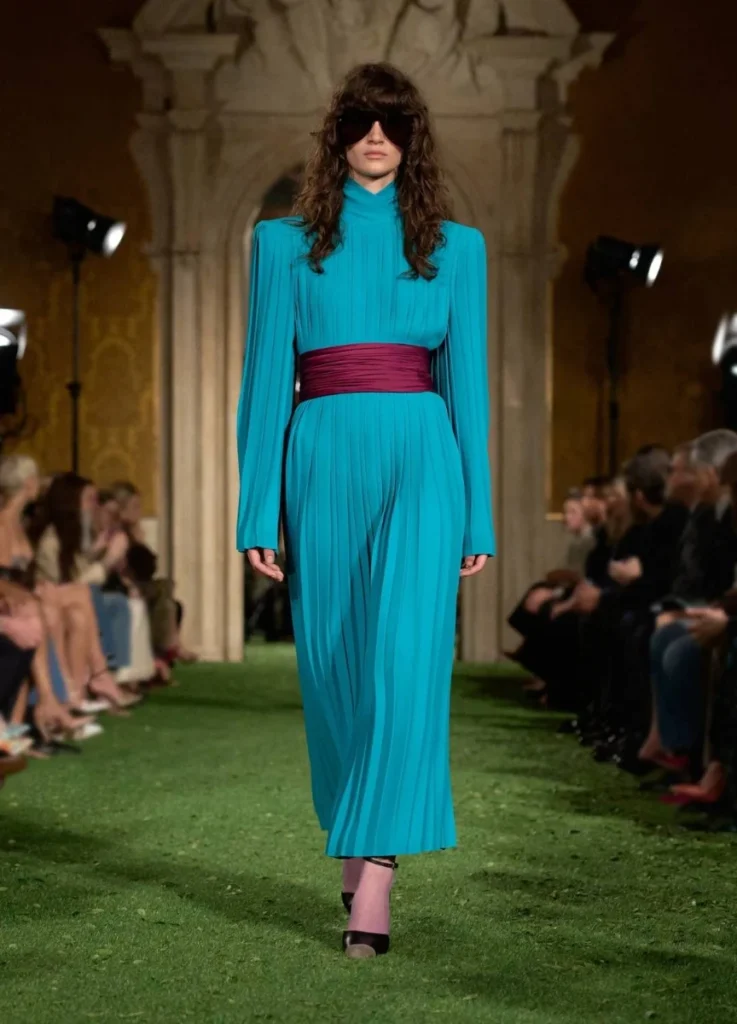
- Wide sash belts
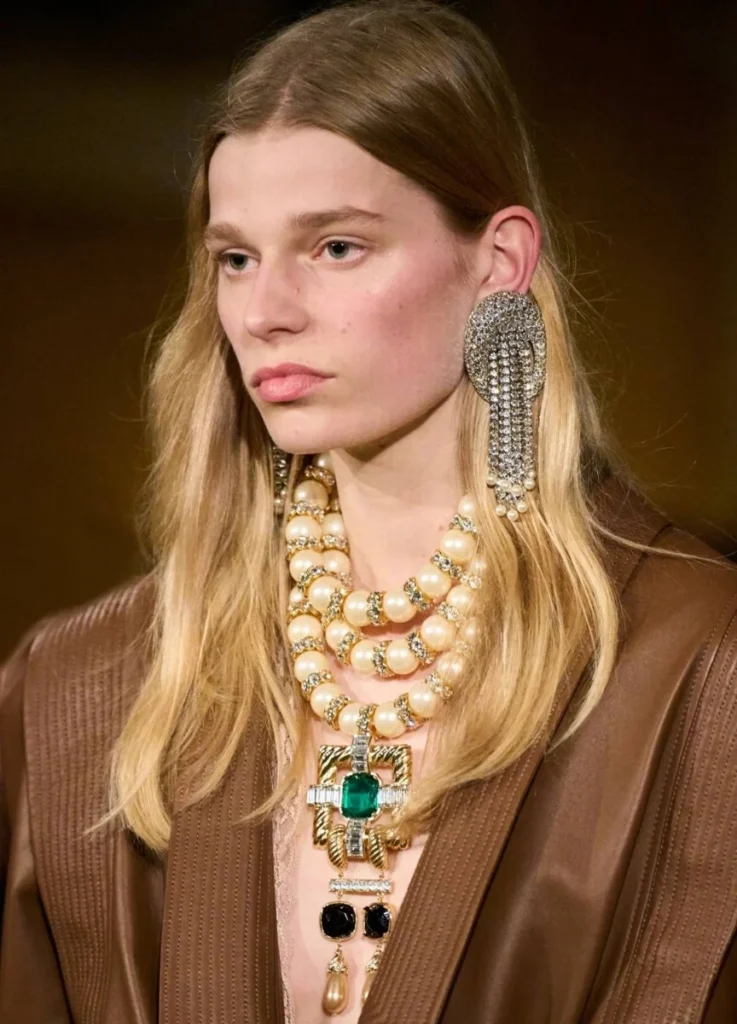
- Oversized necklaces
- Lace stockings
- Fur stoles
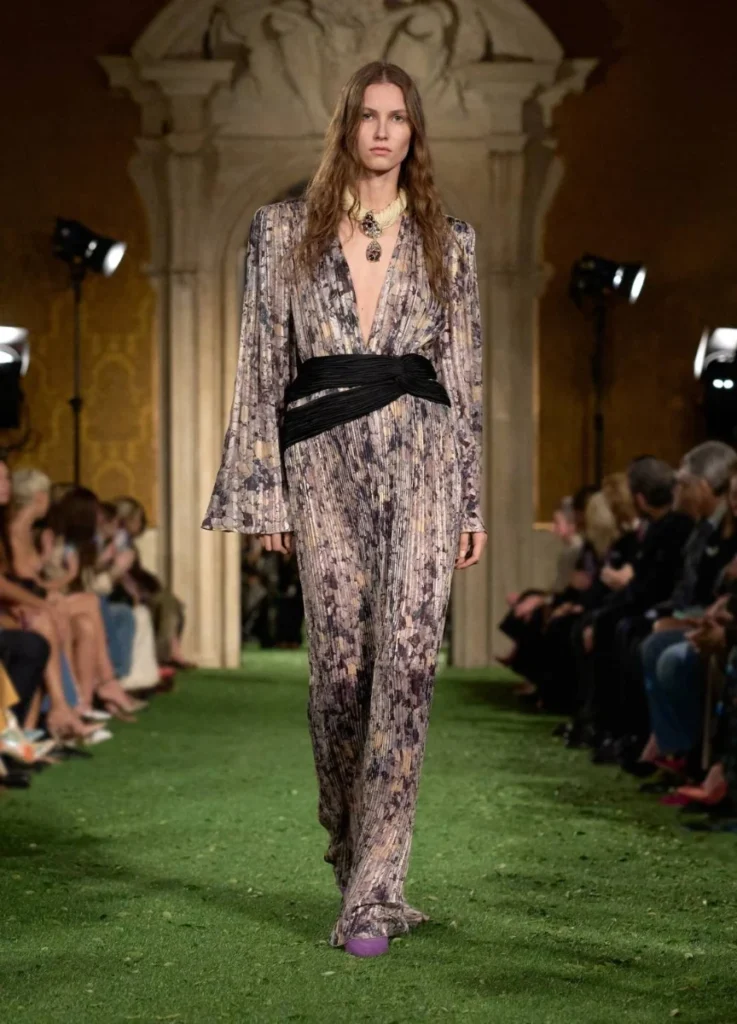
Layering does the heaviest work. Lace dresses appear beneath heavy fur coats. Tunic silhouettes pair with unexpected elements — denim, in one striking instance.
These combinations introduce moments of excess that disrupt Valentino’s otherwise refined aesthetic. The excess is carefully controlled, though. The styling never overwhelms the garments. It introduces slight asymmetries that animate the runway.
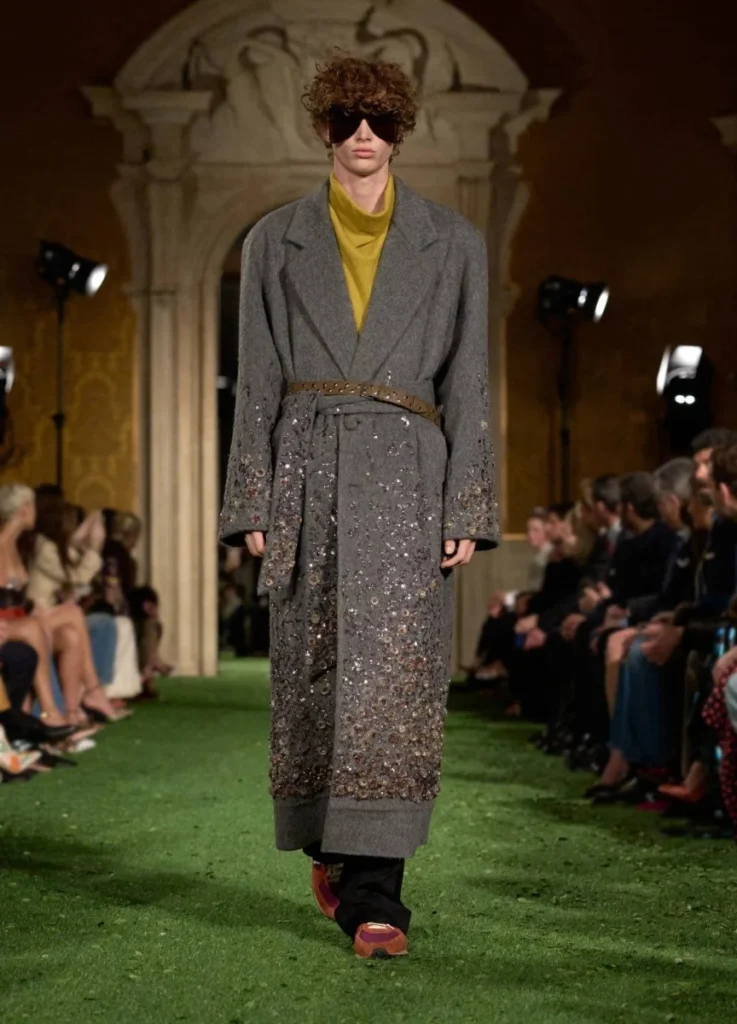
Color | Classic Palette, Disruptive Accents
The base palette stays close to Valentino’s traditional comfort zone — brown, camel, beige, black. The interference happens through the accents that arrive on top: emerald green, purple, turquoise blue, and the unmistakable Valentino red.
The red dress that closes the show is the collection’s emotional climax. Valentino red has always functioned as the house’s signature, and Michele has spoken about red as a color that holds presence. Here, it serves a dual function — anchor to the heritage, and resolution to the season’s controlled tension.
Key Looks
Several looks capture the collection’s central argument.
1. Fur Coat
2. Red Tailored Suit
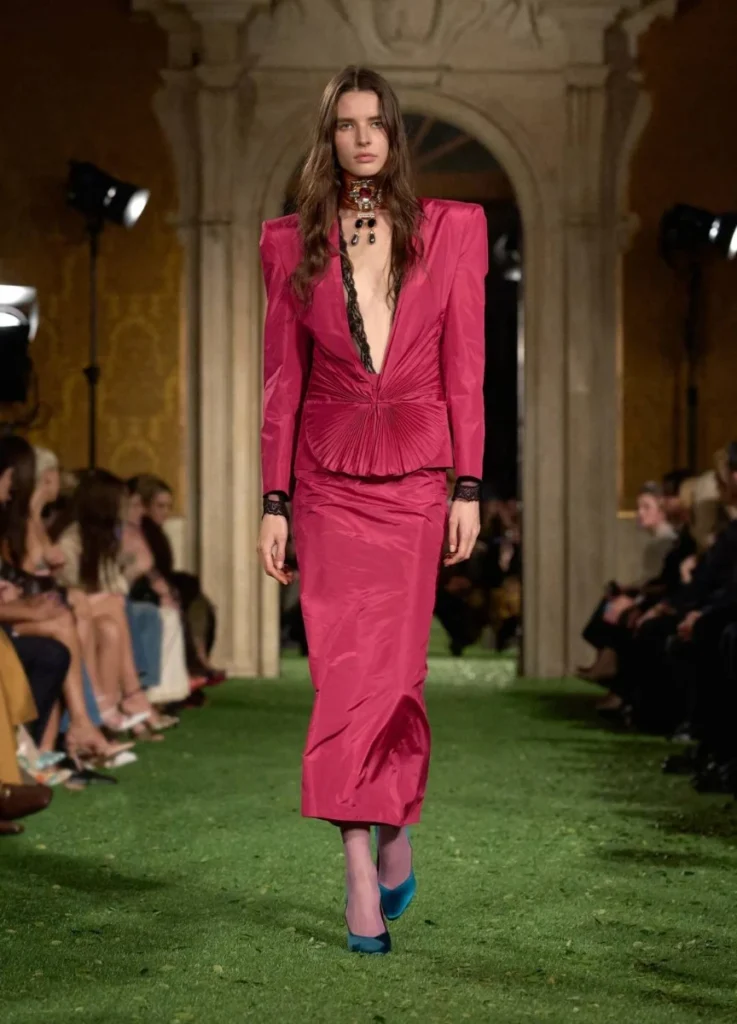
Strong shoulders, slim skirt, channeling 1980s power dressing while keeping Valentino’s red signature intact. The most efficient summary of the collection’s thesis in a single look.
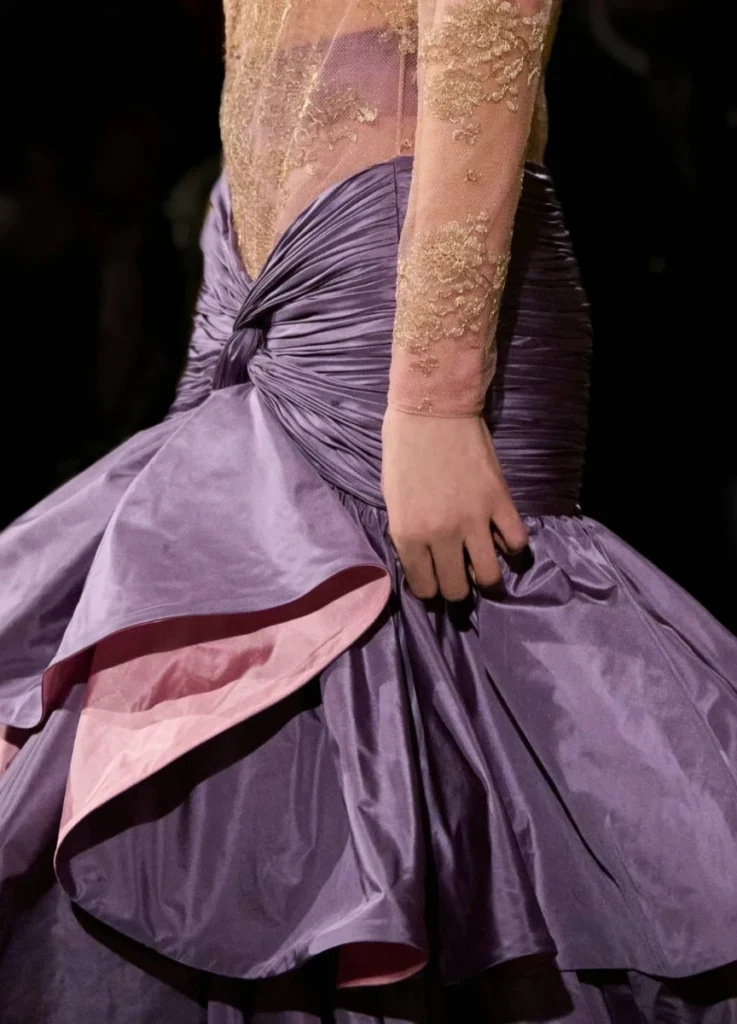
3. The Sculptural Lace and Taffeta Evening Look
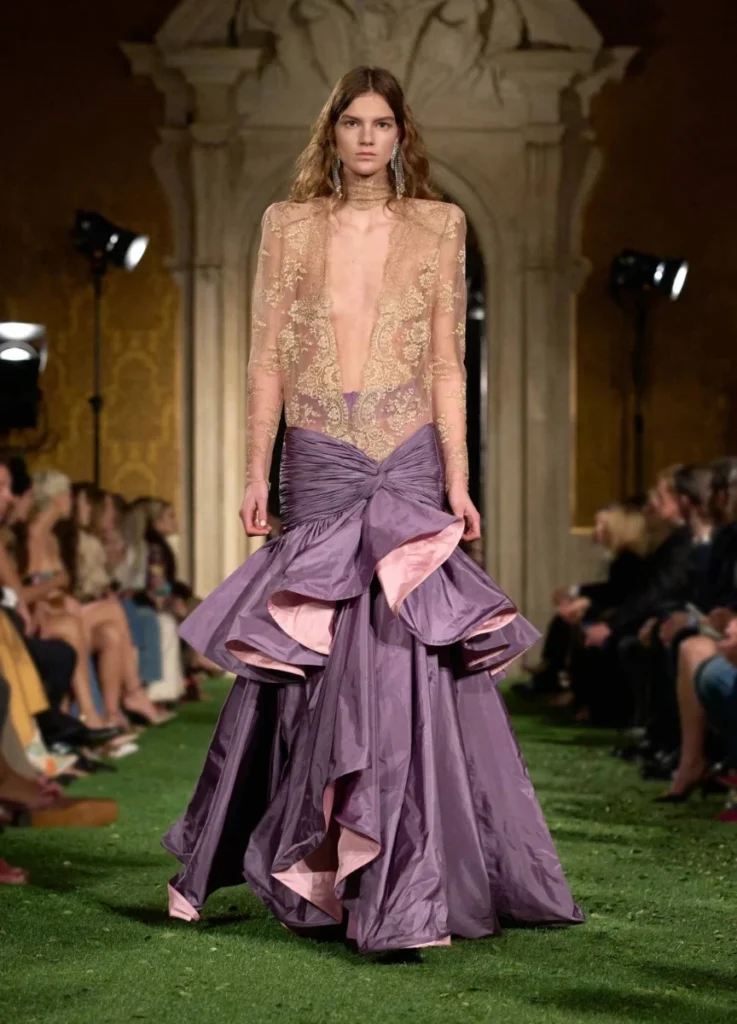
A sheer lace bodice paired with a sculptural purple taffeta skirt, producing one of the collection’s most theatrical evening moments. The contrast between transparent delicacy and architectural volume captures Michele’s method at Valentino in a single image — preserve the romanticism, introduce deliberate interference.
4. The Closing Red Dress
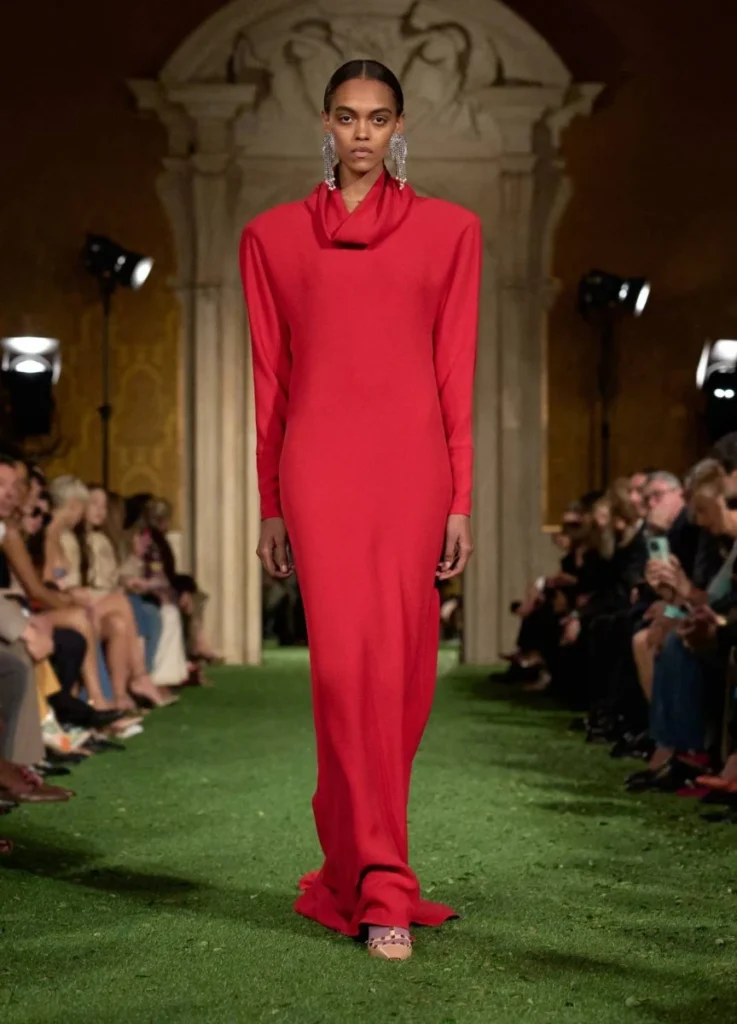
The emotional resolution of the show. A reminder that Valentino’s iconic red still carries the weight of the entire house, regardless of who is designing.
Industry Context | Celine and Valentino, Same Question, Different Answers
The most interesting frame for this collection isn’t Valentino in isolation. It’s Valentino against Celine.
Both houses showed in the same fashion week. Both are working through designer transitions. And both are asking nearly identical questions: how do you move forward inside a brand that has already been precisely defined?
The answers are opposite.
Celine’s Fall Winter 2026 rearranged its existing codes through more precise alignment. The collection felt like a careful re-tuning of Parisian tailoring already established at the house — sharper coat silhouettes, restrained palette, structural tailoring as the spine. The disruptions arrived through styling: an oversized muffler rising almost to cover the face, slight exaggeration in hair styling. Order made tighter, then lightly disturbed at the surface.
Valentino’s Fall Winter 2026 does the inverse. Where Celine sharpens order, Valentino interrupts it. Lace dresses, fur coats, 1980s shoulders, drapery, and taffeta all coexist on the same runway, creating deliberate collisions between codes that weren’t built to share space.
The two strategies define a real bifurcation in current luxury house thinking. Both designers have rejected the complete reinvention model that defined the 2010s. Both inherited brands too well-formed to dismantle. Both are working with restraint. But Celine sharpens what’s already there; Valentino loosens it.
This is the more interesting industry pattern of the season. After a decade of dramatic creative transitions, luxury fashion has entered a phase of careful reorganization — and the difference between sharpening and loosening will likely define which houses feel coherent and which feel adrift over the next several seasons.
Final Reflection | A Gentle Disturbance
Valentino Fall Winter 2026 doesn’t present itself as a dramatic reinvention. It works through subtle shifts:
- Fur against lace
- Tailoring against drapery
- Power shoulders against romantic silhouettes
These contrasts create quiet tensions that sit under the surface of the collection. The runway itself, in pure visual terms, is one of the season’s richer experiences — material density, color discipline, and a cohesive emotional register held throughout.
Michele doesn’t try to rebuild Valentino from the ground up. He tilts it slightly. That tilt may ultimately prove more interesting than any radical transformation, because Valentino has always been a house built on the assumption of perfection. The most intriguing gesture a designer can make at this kind of house isn’t to break that perfection. It’s to disturb it just enough that we begin to see it differently.
After two seasons, that’s exactly what Michele is doing.
Michele does not attempt to rebuild Valentino from the ground up.
He simply tilts it slightly.
And that slight tilt may ultimately prove more interesting than any radical transformation.
Because Valentino, after all, has always been a house built on perfection.
And sometimes the most intriguing gesture a designer can make is not to break perfection—but to disturb it just enough that we begin to see it differently.
All images referenced in this post are drawn from Vogue Runway.
[ Related Editorials ]